A picture-story retelling, after H. G. Wells (1898)
A science-fiction invasion story with many deaths, a city's panicked flight and one killing, shown through distance, flame, smoke and aftermath, never in gruesome detail.
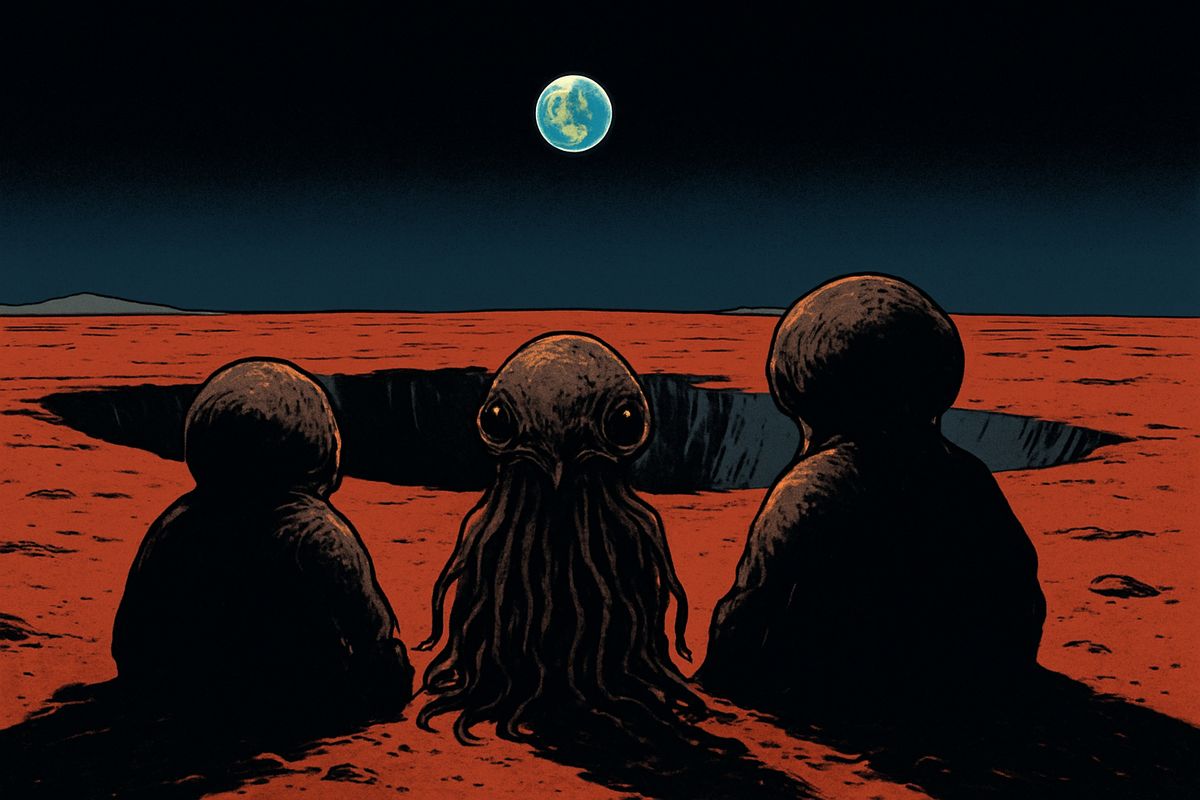
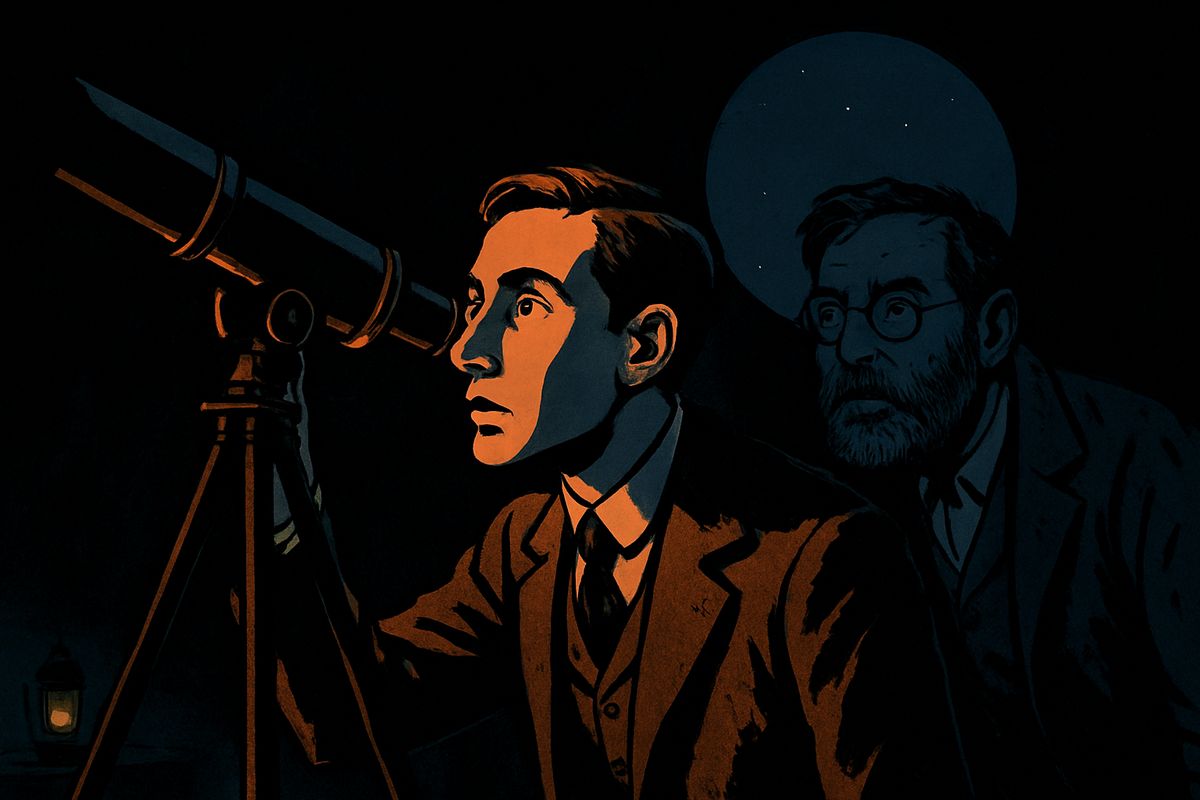
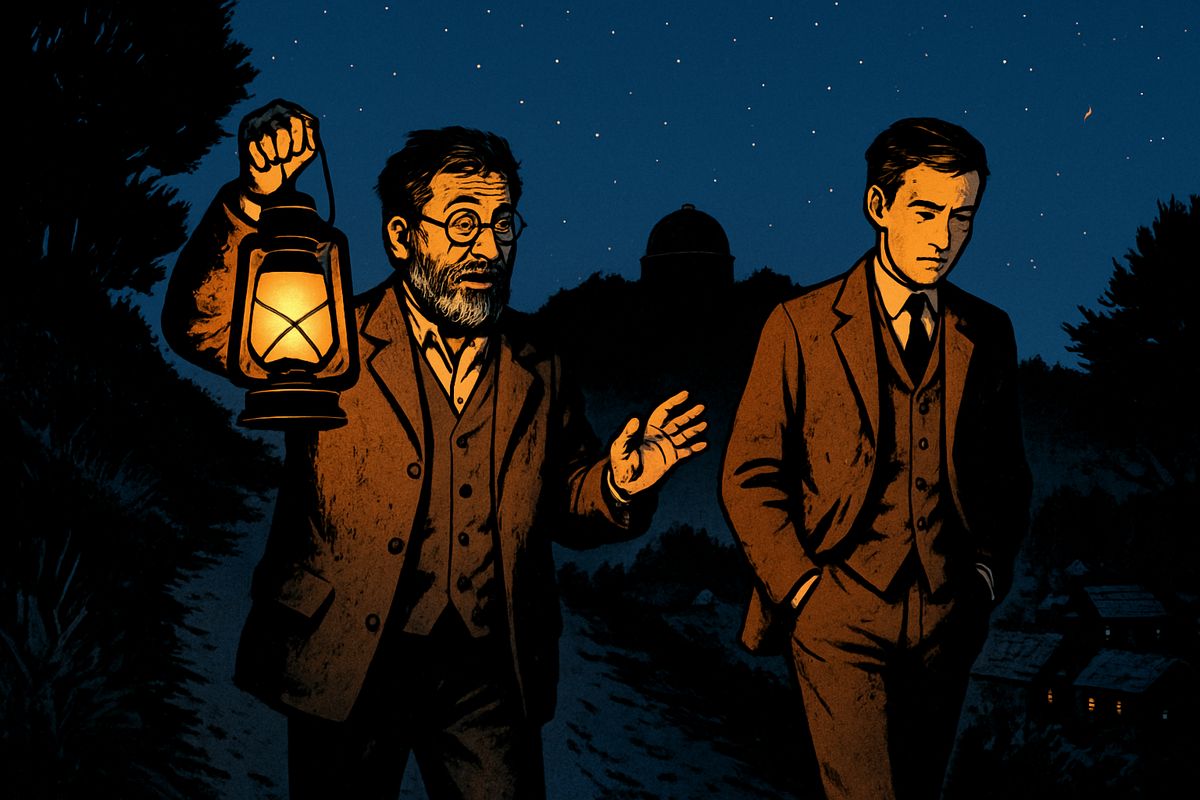
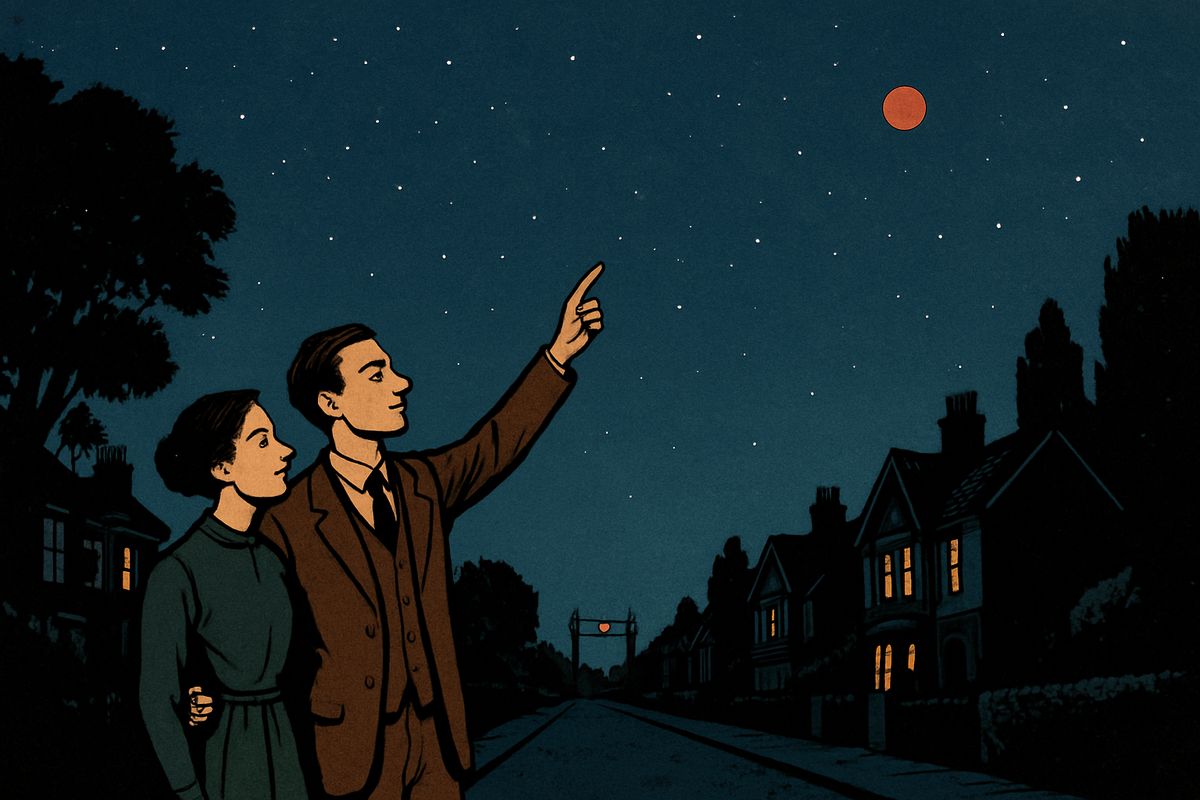
1No one in the last years of the nineteenth century believed this world was being watched. Yet across the gulf of space, on a cold and dying Mars, intellects vast and cool and unsympathetic regarded our green planet with envious eyes, and slowly drew their plans against us—no crueller, perhaps, than men who wiped out the dodo, the bison and the Tasmanians.2Six years ago, after news of a great outbreak of flaming gas on Mars, the astronomer Ogilvy invited me to his black, silent observatory at Ottershaw. At the stroke of midnight I saw it myself: a reddish flash at the planet's edge, the slightest projection—another missile leaving Mars, though neither of us dreamed it.3Walking back to his house by lantern-light, Ogilvy scoffed at the vulgar idea of Martians signalling to us; it was a shower of meteorites, he said, or a huge volcanic explosion. "The chances against anything manlike on Mars are a million to one." Below us, Ottershaw and Chertsey slept in peace.4For ten nights a flame leapt from Mars, and the papers joked about Martian volcanoes while I learned to ride a bicycle. One warm starlit evening I walked with my wife and pointed out Mars creeping zenithward. Signal lamps glowed by the distant railway, and all seemed safe and tranquil, yet the first missile was barely ten million miles away.5Then came the night of the first falling star. Early that morning it rushed eastward high over Surrey, a line of flame trailing a greenish streak. I sat writing in my study with the blind up and never looked up, though it must have fallen while I sat there. Hundreds saw it and took it for an ordinary meteor.6Ogilvy, sure a meteorite lay on Horsell Common, found it soon after dawn: a vast cylinder caked in grey ash in a smoking pit. As he watched, flakes fell from its end, and he saw the round top slowly turning. Something inside was unscrewing it. "Good heavens! There's a man in it—men in it! Half roasted to death!"7Too hot to touch, the metal drove him back, and Ogilvy ran wildly into Woking, hatless and covered in sand. People took him for a madman until he called over the palings to Henderson, the London journalist. Henderson dropped his spade and hurried back with him, then ran to the station to telegraph the news to London.8By nine the tale of "dead men from Mars" had spread, and I hurried to the sand-pits. About twenty people stood round the hole. Boys sat on the edge throwing stones at the huge mass until I stopped them. The rest stared in silence, plainly disappointed that this rusty-looking bulk showed no heap of charred corpses.9By afternoon the evening papers had startled London, and a holiday crowd came out in the glaring heat, with carriages, bicycles and a barrow of ginger beer. In the pit, Stent the Astronomer Royal stood on the cooling cylinder directing workmen with spades. They could not unscrew the top, yet a faint stirring still sounded within.10When I came back to the common at sunset, two or three hundred people were jostling about the pit, black against a lemon-yellow sky. The crowd had pushed a young shop assistant down onto the cylinder, and a strange humming rose from below. "Help keep these idiots back," Ogilvy cried. "We don't know what's in the confounded thing!"11The lid fell upon the gravel with a ringing concussion. Everyone expected a man; instead, grey snake-like tentacles coiled out of the darkness, and then a greyish rounded bulk the size of a bear heaved itself up, glistening like wet leather. Its huge eyes fixed on me; its lipless V-shaped mouth quivered and panted. I stood petrified with disgust and dread.12The crowd broke and ran, and I ran too, stumbling, unable to turn my face away, until I reached a clump of young pines a hundred yards off. From there I saw the shopman's head bobbing on the pit's edge against the hot western sun. He struggled up, slipped back, and suddenly vanished, and my fear overruled my wish to help him.13At dusk a Deputation crept towards the pit under a white flag, Ogilvy, Stent and Henderson among them, to show the creatures that we too were intelligent. Then three puffs of luminous green smoke shot up, a hissing swelled into a drone, and a humped shape rose from the pit. A silent flash leapt from man to man, and each was turned to flame.14The invisible sword of heat swept round the common: pine trees burst into fire, furze bushes flared with a dull thud, and far towards Knaphill hedges and sheds blazed. It passed and spared me, and the night fell suddenly dark and empty. Then panic struck, and I turned and ran stumbling through the heather, weeping silently like a child, never daring to look back.15The Martians seemed to throw an intense heat in a parallel beam from a polished mirror, kindling whatever it touched. In the Chobham Road a crowd of townsfolk out for an evening stroll escaped only because a hummock of sand shielded them; the beam whistled just over their heads, firing the beeches and splitting a gable. "They're coming!" a woman shrieked, and the crowd bolted blindly for Woking.16I fled blindly through the heather and fell by the canal bridge near the gasworks. When I sat up, my terror had dropped away like a garment. A workman and his little boy passed and wished me good night; a lit train clattered south. Everything was so ordinary that the common behind me seemed only a dream.17At home, over a cold dinner left untouched while I told my story, I tried to reassure my white-faced wife. I explained that Earth's gravity made the Martians three times heavier than on Mars, so they could hardly crawl. "A shell in the pit," said I, "will kill them all." I did not know it, but that was my last civilised dinner for many terrible days.18All Friday night Woking dined, gossiped and caught its trains as if Mars did not exist, while the Martians hammered in their pit. About eleven, companies of soldiers marched out to ring the common. A few seconds after midnight, the crowd watched a second greenish star fall silently into the pine woods to the northwest. This was the second cylinder.19On Saturday evening, as we took tea in the summerhouse, a crash shook the ground. The Heat-Ray had struck the crest of Maybury Hill, firing the trees and toppling our chimney. I hired the Spotted Dog's dog-cart, threw in our valuables, and drove my wife away downhill. Looking back, I saw black smoke shot with red fire pouring up over everything we had left.20At Leatherhead my wife was strangely silent, her face very white, as if she sensed some coming evil. I had promised to return the landlord's dog-cart, and near eleven I set out alone into a hot, black night. She watched from the lighted doorway until I jumped up, then turned abruptly and went in.21Past Pyrford, Maybury Hill rose black against a blood-red glare. Then a thread of green fire pierced the clouds and fell into a field: the third falling star! Lightning burst, the horse bolted, and in a flash like daylight I saw a monstrous tripod, higher than many houses, striding over the pine trees.22A second tripod burst through the woods ahead. In panic I wrenched the horse round; the cart heeled over and flung me into a pool. Crouching under the furze beside the dead horse and the slowly spinning wheel, I watched the colossal machine go striding past, howling in triumph above the thunder: 'Aloo! Aloo!'23Crawling home by ditches through the pouring hail, I stumbled on something soft by the fence. A lightning flash showed a man crumpled against the palings. I turned him over: it was the landlord of the Spotted Dog, quite dead. At home I bolted the door and sat shivering at the foot of my stairs.24Later, in dry clothes, I climbed to my study and found the whole valley on fire: houses glowing in ruins, a wrecked train burning by the railway arch, and three huge black shapes busy at the sand-pits. Towards dawn a soldier clambered over my garden fence. 'Hist!' he whispered, and I leaned eagerly out of the window.25Eating bread and mutton in the dark, the artilleryman told me his story by fits: how the tripod had risen from the pit and burned his battery, the infantry and all Woking. 'They wiped us out—simply wiped us out.' At dawn we looked out on a valley of ashes, where three metal giants stood about the pit, their cowls turning.26At dawn I slipped away with the artilleryman through the scorched woods, past guns waiting at Byfleet. Weybridge was in festive confusion: people in their Sunday best loading carts as if on an outing. One old man would not leave his orchids. "Death is coming!" I shouted at him, but he only stared vaguely over the trees.27By midday we reached the ferry near Shepperton, where far more fugitives jostled than the boats could carry, still joking that the soldiers would see to it. Then guns thudded from Chertsey, and a man in a blue jersey shouted, "Yonder!" One after another, five armoured Martians came striding across the meadows towards the river, fast as flying birds.28I ran into the shallows and dived under. When I came up, hidden guns at Shepperton fired, and a shell burst full in one Martian's hood and blew it to pieces. "Hit!" I shouted. The headless giant staggered on blindly, smashed through the church tower and fell into the Thames, and the river flashed into steam as a scalding wave came sweeping round the bend.29The other four Martians came wading down the river, and their Heat-Rays set Weybridge burning. Scalded and half blind, I struggled out of the nearly boiling wave and fell on a bare gravel spit, in full view of them. A huge metal foot drove into the gravel a few yards from my head, then lifted again, and the Martians walked off carrying their dead comrade's wreckage.30I drifted downstream in an abandoned boat with no oars, past the burning, empty houses of Halliford, and collapsed near Walton. I woke to find a curate from Weybridge raving that it was the Day of Judgement. "Be a man!" I told him. Far off the guns muttered, and the crescent moon hung pale above the smoke.31In London my younger brother read the calm Sunday papers, which spoke of Martians 'crawling' helplessly in their pit. At sunset, with the church bells ringing for evensong, he stood on Waterloo Bridge among idle loafers, watching a curious brown scum drift down the Thames beneath a sky of perfect peace.32Then hawkers burst into the Strand with still-wet pink papers: the Martians were giant machines a hundred feet high, swift as express trains. Amid the Sunday crowds my brother saw the first haggard fugitives from West Surrey rattling past in carts. 'Boilers on stilts, I tell you, striding along like men,' one of them insisted.33In the small hours of Monday bells clanged, drums beat and policemen hammered on doors: 'The Martians are coming!' At pink dawn a newsvendor ran past with the fleeing crowd, selling papers as he went. The Commander-in-Chief's dispatch said it plainly: there was no safety from the Black Smoke but in instant flight.34Hours earlier, on Sunday evening, the Martians had come out again. Gunners hidden in the pines on St. George's Hill fired at a thousand yards, and a tripod staggered and fell. Its companions' Heat-Rays blew up the battery; soon seven Martians, each carrying a thick black tube, stood silent in a twelve-mile crescent.35From a ditch near Halliford the narrator and the curate watched a Martian raise his tube and fire with a heavy, flameless thud. Inky black hills rose where the canisters fell, then sank and poured into the valleys, smothering every hidden gun. Later the Martians waded through it, clearing it with jets of steam.36As Monday dawned, terror swept through London. Crowds fought savagely for standing-room on trains, and the police, exhausted, lost all control. Failing to board a train at Chalk Farm, the brother was first into a looted cycle shop, cut his wrist dragging a bicycle out through the window, and pedalled away, punctured tyre and all, ahead of the panic.37Near High Barnet he heard screams. Three roughs were dragging two ladies from their pony-chaise. He knocked one down, but was outnumbered until the slender lady, Miss Elphinstone, turned back, pulled a revolver from under the seat and fired. The robbers fled. She handed him the gun. "Take this!"38With Mrs. Elphinstone crying for her husband George, they made for the Great North Road and found it a roaring river of fugitives under white dust. A man's bag burst, scattering gold; he flung himself on the coins and went down beneath the hooves. The brother tried to drag him clear, but the torrent swept him back. "We cannot cross this—hell."39Then Miss Elphinstone drove the pony straight into the stream while he held back a cab horse, and they fought across. For two days they pushed east, losing the pony at Chelmsford, until near Tillingham the sea appeared, crowded with ships of every nation. A paddle steamer took them aboard, bound for Ostend, as a Martian came striding along the shore.40Three tripods waded far out to cut off the fleeing ships. Then the Thunder Child tore past the steamer, rushing at them full speed without firing a shot, which may be why they let her come so close. The Heat-Ray struck her, and flames poured from her decks, but she brought one Martian down and rammed straight into a second.41"Two!" yelled the captain, and every ship took up the cheer. Steam hid the rest; the Thunder Child and the third Martian were gone from sight. At twilight, as the steamer beat out to sea, a huge, flat, broad thing rushed up into the western sky, swept round in a vast curve and sank away, raining darkness on the land.42After two weary days hiding from the Black Smoke at Halliford, the curate and I set out at last towards Sunbury. The whole country lay under thick black dust, like a black snowstorm. Carts lay overturned, and still shapes of men and horses lay along the road. It made me think of Pompeii.43We passed through green Bushey Park and Twickenham, and about half past eight we hurried over Richmond Bridge. Floating down the river were strange red masses, some many feet across. There was no time to look closely, and I imagined something far more horrible than they really were.44Near Kew a fighting-machine loomed over the meadows, chasing a handful of running people. It used no Heat-Ray. In three strides it was among them, picking them up one by one and tossing them into the great basket on its back. For the first time I understood the Martians might want something from us besides our destruction.45At Sheen we broke into a white house and found a pantry full of bread, ham, beer and tins. We sat eating in the dark kitchen. "It can't be midnight yet," I said, and then came a blinding green glare and a tremendous crash. The ceiling came down on us, and the fifth cylinder buried us under the ruins.46Through a slit in the wreckage I looked into a vast pit. A glittering, crab-like handling-machine was unpacking the cylinder, moving so smoothly it seemed alive. Beyond it crawled the Martians themselves: round head-bodies with huge dark eyes, a fleshy beak, and sixteen whip-like tentacles. Within days crimson red weed was creeping up the edge of the pit around our hiding place.47Trapped in the ruined house at Sheen, the curate and I came to hate each other, and fought with whispers and kicks over whose turn it was at the peephole. He wept for hours, hardly slept and gorged on our small store of food, though I warned him again and again that our lives depended on making it last.48At twilight the pit flickered green as the handling-machine drew dazzling aluminium bars from the clay. Then a tentacle lifted a struggling, well-dressed man from the cage on a fighting-machine's back. He vanished behind the mound, and only shrieks and cheerful hooting followed. After that, a failed tunnel dug with the hatchet and a night of far-off guns brought no hope.49When I caught the curate drinking in secret, I rationed the food, and for days we wrestled in the dark. On the ninth day he rose with his arms spread and shouted loud enough to reach the pit: 'I must bear my witness!' Fierce with fear, I grabbed the meat chopper, turned the blade back and struck him down with the butt.50A handling-machine came to the hole, and its tentacle dragged the curate's still body away. I buried myself among the coals in the cellar, but the tentacle found the door, opened it and groped blindly through the dark. Once it touched the heel of my boot. I bit my hand to keep from screaming, and at last it went away.51When I crept out, the food was gone, and I lived on tainted water from the pump while red weed grew over the hole and turned the light crimson. On the fifteenth day a dog sniffed at the gap, then ran off. When I finally looked out, the pit lay silent and empty. The machines were gone, and only crows squabbled over the bones.52After fifteen days I crawled out and stood tottering on the mound. Where I expected ruined Sheen I found the landscape of another planet, crimson with red weed. I felt dethroned, no longer a master but an animal among the animals. Hunger soon drove me over a wall into a garden, where I grabbed young onions and carrots.53The weed had choked the rivers. From a garden near Putney I looked down at dusk on the flooded Thames valley: blackened ruins, sheets of red-tinged water, and silence everywhere. That night in an empty inn I lay thinking of the curate's death, and for the first time in days I prayed for my wife, and meant it.54At dawn on Wimbledon Common a filthy figure with a cutlass rose out of the bushes. It was the artilleryman. "We're beat," he said. He had it all planned: they would live in the drains under London, keep wild, save men's science, and one day seize a fighting-machine for themselves.55His tunnel, a week's work, was barely ten yards long, and by afternoon the digging had given way to champagne, cigars and cards. That night on the roof, with Mars glowing red above London, I threw the cigar away, ashamed. I felt I had betrayed my wife and my kind, and I resolved to go on into London alone.56Leaving the artilleryman, I crossed Putney Bridge, its roadway nearly choked by red weed already whitening with disease. Beyond lay Fulham and a strangely silent London: black dust in the streets, houses shut and blinds drawn, shops broken open by looters, gold chains spilled across a pavement where nobody had bothered to pick them up.57Near South Kensington I first heard it: a sobbing howl of two notes, 'Ulla, ulla, ulla, ulla,' that never stopped. I slept in a public-house and woke at dusk. At the top of Baker Street I saw it at last, far over the trees of Regent's Park: the hood of a Martian giant, standing still and howling.58I passed a wrecked handling-machine and crossed the weed-choked Regent's Canal, and the howling stopped. The silence came like a thunderclap. Windows stared like the empty eyes of skulls, and terror took hold of me. I ran from that stillness and hid until long after midnight in a cabmen's shelter in Harrow Road.59At dawn a third Martian towered on Primrose Hill. I walked towards it meaning to die, then saw black birds circling its hood, and I ran. From the earth rampart I looked down on nearly fifty Martians lying still. They had been killed not by any human weapon but by earthly bacteria, the humblest things on Earth, which their bodies could not fight.60The sun rose over the silent, saved city: St. Paul's, Regent's Park and the far blue Surrey hills. People might live in these streets again, and the healing would begin that very day. I stretched my hands to the sky, close to tears. Then, with overwhelming force, I thought of my wife, and of the old life that had ended for ever.61For the next three days I remembered nothing. While church bells rang all over England and food ships raced towards London, I wandered weeping and raving through St. John's Wood until a kind family took me in. When my mind cleared, they gently told me that a Martian had wiped out Leatherhead, with every soul in it.62Four days later I went home through ragged London, past red weed climbing Waterloo Bridge, and took a free train through the blackened country to Woking. My house stood open and empty. On my desk lay the essay I had left behind, its last line broken off in the middle: "In about two hundred years, we may expect——"63In the dining room the mutton lay rotting where we had left it. Then a voice behind me said the house was deserted and nobody had escaped but me. I turned to the open French window. My cousin and my wife stood there, white and amazed. "I came," she said. "I knew——" She swayed, and I caught her in my arms.64Experts later agreed that earthly germs had killed the Martians, though the Black Smoke and the Heat-Ray stayed mysteries, and I expected Mars to return. Busy crowds now looked like ghosts to me. On Primrose Hill, children played round the dead machine while I held my wife's hand, and under the first stars I still felt uneasy.
Adapted from The War of the Worlds by H. G. Wells, public domain. Pictures are AI illustrations drawn for this edition.
Add Stories to your Home Screen: tap
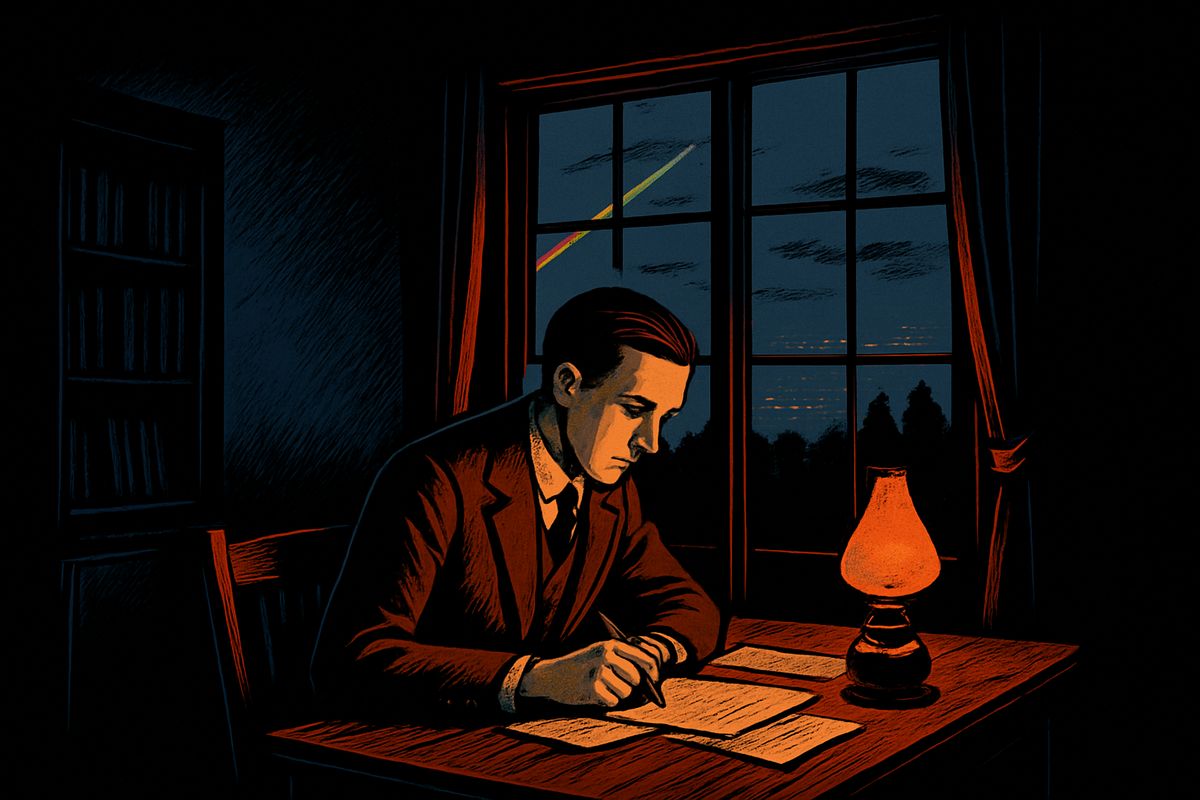
then Add to Home Screen.