A picture-story retelling, after Alexandre Dumas and Auguste Maquet (1844)
Volume 1 of a planned three-volume adaptation is available now; it follows chapters 1–22 through the Queen's diamond-studs intrigue. Later volumes are in production. The full story includes duels, ambushes, assassination, poisoning and execution, shown without gruesome detail.
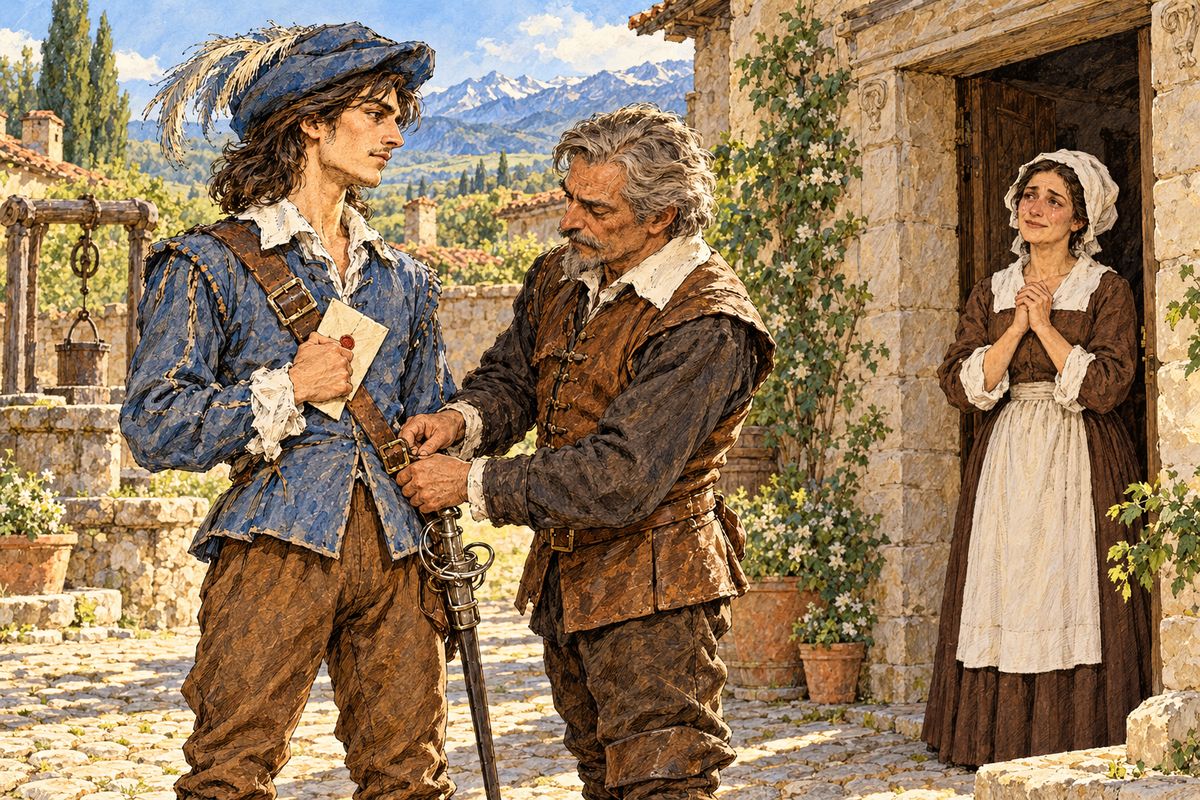
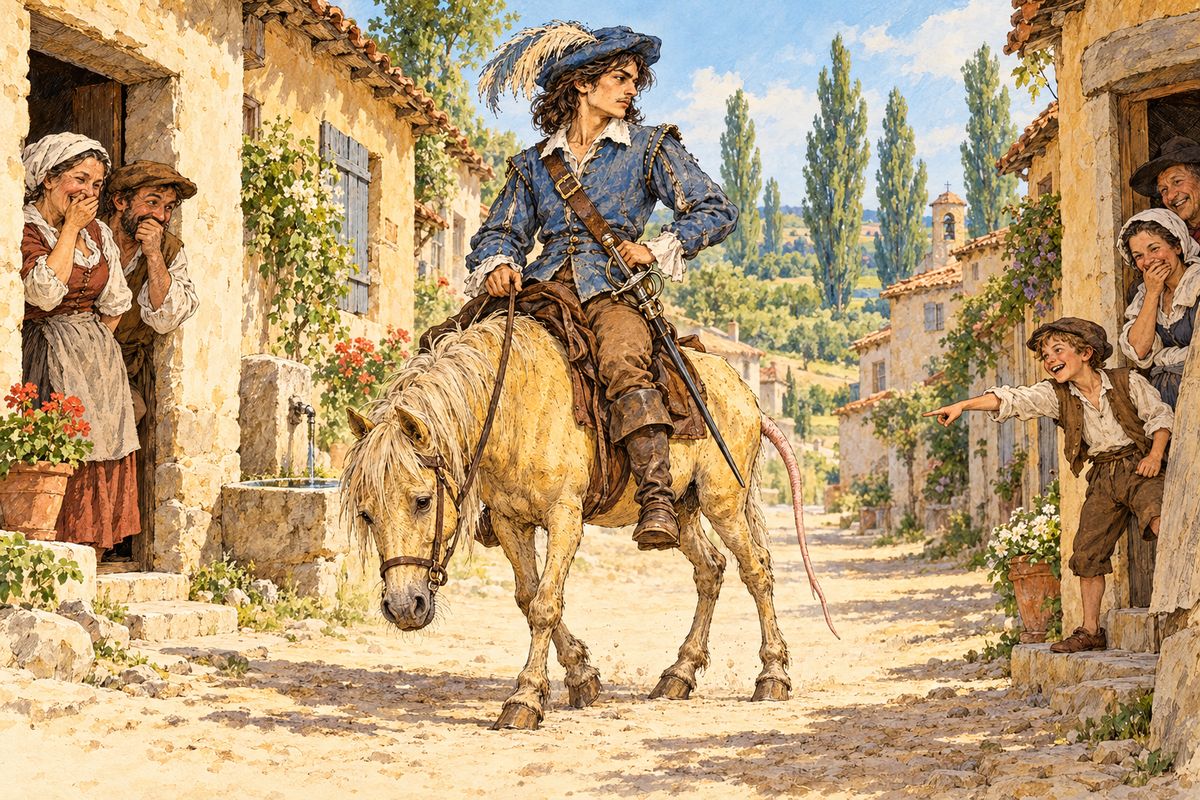
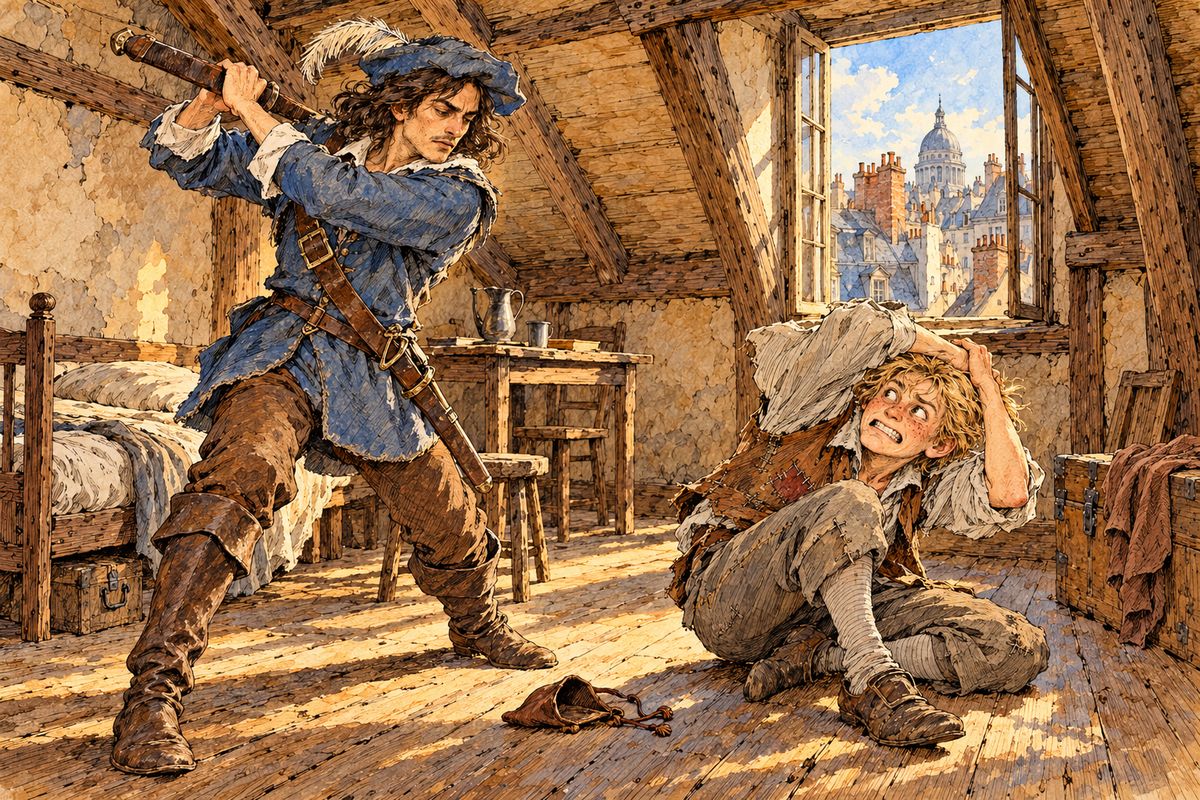
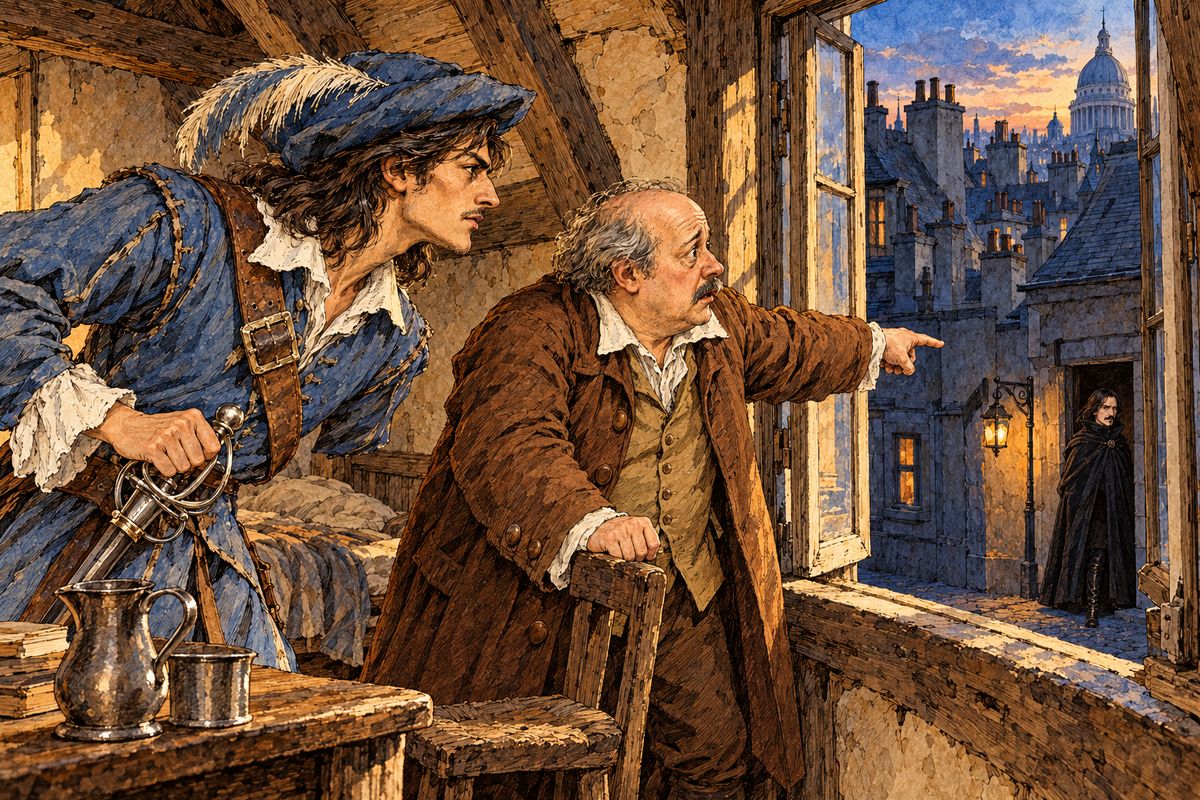
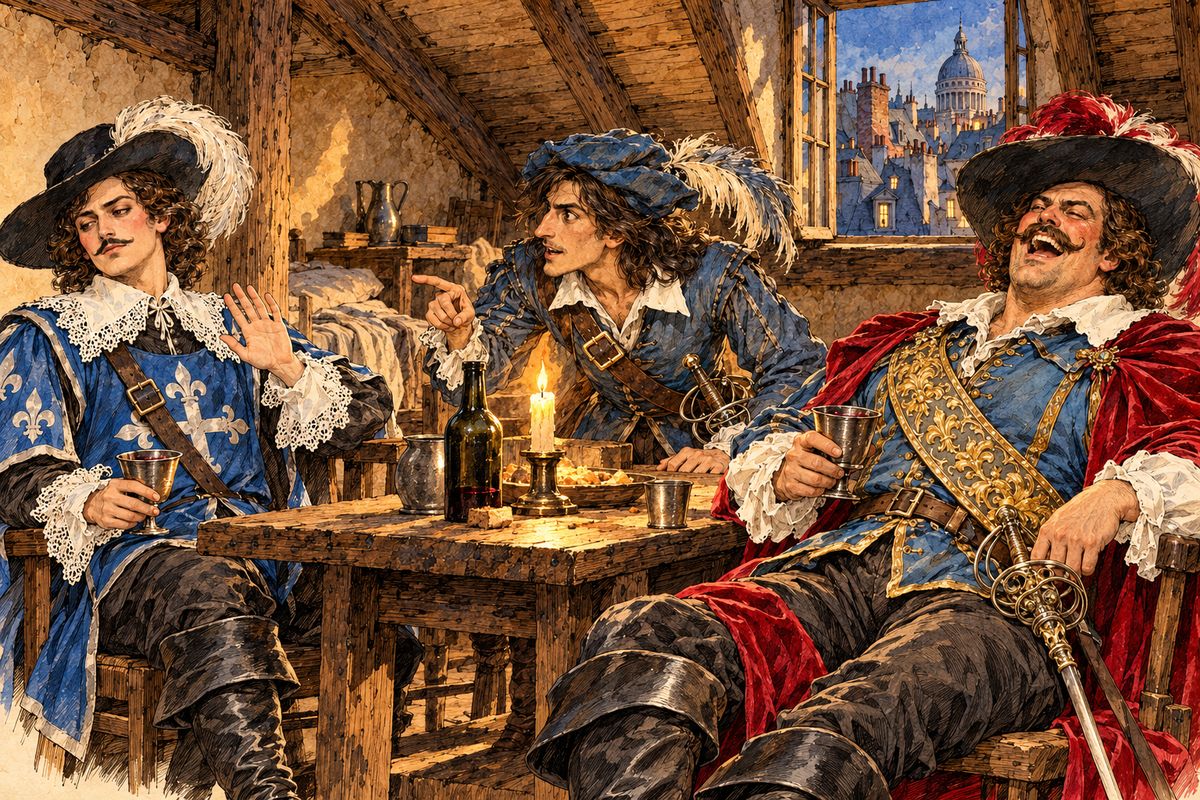
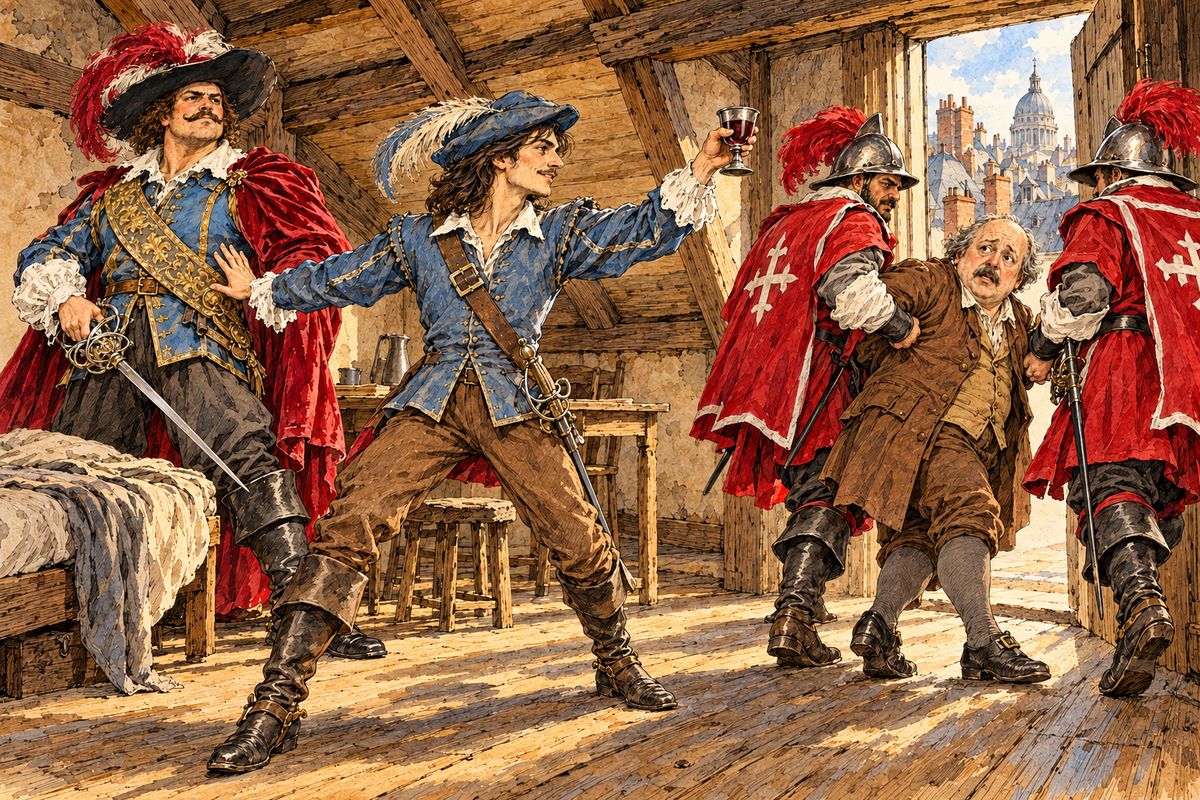
1In April 1625, young d'Artagnan left his Gascon home with his father's three gifts: fifteen crowns, an old yellow pony and a letter to Monsieur de Tréville, captain of the King's Musketeers. "Never fear quarrels, but seek adventures," the old man told him, buckling on his own sword. His weeping mother added a recipe for a balsam that would heal any wound.2From Tarbes to Meung, the hairless-tailed yellow pony drew grins at every village. D'Artagnan took each smile for an insult and kept his hand on his sword, so the passers-by learned to laugh behind their hands, or on only one side of their faces.3At the Jolly Miller in Meung, a pale stranger in violet sat at a window making jokes about the pony, and his two listeners roared. "Tell me what you are laughing at, and we will laugh together!" d'Artagnan demanded. The stranger coolly called the horse a buttercup, "a colour very well known in botany".4D'Artagnan drew and lunged. The stranger stepped back and drew his own sword, but the host and two companions fell on the boy with sticks, shovels and tongs. Still refusing to beg for mercy, d'Artagnan saw a stick snap his blade in two, and a blow to the forehead knocked him down.5Bandaged and dazed, d'Artagnan staggered down to the kitchen and saw the stranger at a carriage window, giving a young lady the Cardinal's orders: go back to England, and report when the duke left London. She was pale, fair and beautiful, with cold blue eyes. "What, without chastising this insolent boy?" she asked. Then both galloped off, and d'Artagnan collapsed in the street.6With his mother's balsam, d'Artagnan was almost healed in a day. When he came to pay, though, the letter to Tréville was gone, and his sword was only a stump in its scabbard. He raged, and the host, spit in hand, put the blame elsewhere: "It has been stolen, by the gentleman who was here yesterday!"7At the gate of Saint-Antoine he sold the yellow pony for three crowns, a fine price for such an odd colour, and entered Paris on foot. He rented a garret in the Rue des Fossoyeurs, close to Tréville's own house, and fell asleep sure that a Gascon's fortune was waiting for him there.8Tréville had come to Paris a penniless Gascon and sword-fought his way to captain of the King's Musketeers, swaggering rivals of the Cardinal's Guards. At his hôtel, d'Artagnan found Musketeers fencing on the staircase with sharpened blades for sport, laughing at every scratch, and for the first time in his life he felt ridiculous.9In the antechamber the Musketeers mocked the Cardinal openly. Vain Porthos showed off his gold baldric until soft-spoken Aramis hinted that Buckingham was in France for the queen's sake. "The queen is sacred," Porthos warned. Aramis's mild eyes flashed, and the two were about to quarrel when d'Artagnan's name was called.10Tréville called for Athos, Porthos and Aramis and scolded the two who came: the Cardinal's Guards had arrested Musketeers after a tavern brawl in the Rue Férou. Red to the eyes, Porthos protested that they had been ambushed six against six, two comrades killed and Athos badly wounded, and they had escaped on the way.11Then the tapestry lifted and Athos walked in, deathly pale but perfectly dressed. "You have sent for me, sir." Moved by such courage, Tréville seized his hand and squeezed it hard. Athos could not bear the pain of his wound and fell to the floor as if dead. A surgeon was found, and Tréville later learned that he had only fainted from loss of blood.12Alone with Tréville, d'Artagnan described the scarred man of Meung who had spoken with a lady he called 'Milady'. Tréville recognised him at once. "Pass by on the other side of the street," he warned. "He would break you like glass." But as Tréville handed over a letter for the Academy, d'Artagnan saw his thief from the window and rushed out.13Bursting from Tréville's antechamber in pursuit of the man of Meung, d'Artagnan ran headlong into a Musketeer and struck him full on the wounded shoulder. It was Athos, pale with pain, who seized him by the belt and named a meeting: noon, by the Carmes-Deschaux. "At quarter past twelve I will cut off your ears as you run."14At the street gate Porthos stood chatting with the sentry. D'Artagnan darted between them just as the wind swelled the giant's crimson cloak, and Porthos, clutching it tight, rolled him up in the velvet until his nose came to rest on the famous baldric.15The secret was out: the baldric glittered with gold in front but was plain buff leather behind. When Porthos raged, d'Artagnan could not resist a jab, "I know full well that you don't turn your back to yours," and ran off laughing, with a second duel fixed for one o'clock behind the Luxembourg.16The stranger had vanished. D'Artagnan searched down to the ferry and back by the Rue de Seine, finding nothing, and as he sweated, his temper cooled. He had insulted two men he admired above all others. If he survived, he vowed, he would be perfectly polite, like the mild and graceful Aramis.17Outside the Hôtel d'Arguillon he found Aramis among three Guardsmen. Seeking a graceful way out of his intrusion, d'Artagnan drew an embroidered, crested handkerchief from under Aramis's foot and offered it to him. Aramis blushed scarlet and denied it was his, and the Guardsmen's teasing ended in a judgment of Solomon: each would take half.18When the Guardsmen had gone, d'Artagnan tried to apologise, but Aramis coldly accused him of compromising a lady, and tempers flared. They fixed a third duel for two o'clock. Hurrying toward the Carmes-Deschaux, d'Artagnan sighed, "Decidedly I can't draw back; but at least, if I am killed, I shall be killed by a Musketeer."19Knowing no one in Paris, d'Artagnan came to the Carmes-Deschaux alone just as noon struck. Athos sat waiting on a post, pale from his wound, and said he would fight left-handed. D'Artagnan shyly offered him his mother's balsam: in three days he would be healed, and they could fight then.20Athos's seconds arrived: the giant Porthos and the elegant Aramis, both of whom had duels with the Gascon that same afternoon. Asked about their quarrels, Porthos reddened over 'dress', and Aramis called his 'theological'. D'Artagnan only smiled and kept their secrets.21With a gallant air d'Artagnan drew, and he and Athos crossed swords. Scarcely had the blades touched when a company of the Cardinal's Guards rounded the convent corner, led by M. de Jussac. 'Fighting here, Musketeers? And the edicts?'22Three Musketeers, one of them wounded, faced five Guards, and Jussac told the boy he was free to leave. D'Artagnan did not hesitate to choose the king over the Cardinal. 'You said you were but three, but it appears to me we are four.'23The nine closed with fury. Fighting like a tiger, d'Artagnan wore down the skilled Jussac and ran him through. Then he caught Athos's silent look as Athos sank to one knee, sprang at Cahusac and sent his sword flying twenty paces.24Athos finished Cahusac himself, and Aramis made his last man beg for mercy. Only Bicarat, a Gascon who would not fall, still held out against Porthos. Ordered by Jussac to yield, he broke his own sword across his knee rather than surrender it, and the Musketeers saluted him.25They left the wounded under the convent porch, rang the bell, and carried off four swords out of five. Arm in arm and filling the whole street, they marched to Tréville's. 'If I am not yet a Musketeer,' said d'Artagnan, 'at least I have entered upon my apprenticeship, haven't I?'26Tréville scolded his Musketeers in public and praised them in private. That evening, at the king's gaming table, he told Louis XIII how three Musketeers and a Gascon boy had beaten five of the Cardinal's Guards. "Why, this is a victory!" cried the king, and bade him bring all four up the back stairs next day.27Next morning, at a tennis court, d'Artagnan ducked one of Porthos's balls, and the Guardsman Bernajoux sneered at the "Musketeer apprentice." They stepped out into the empty street. Bernajoux, wounded in the shoulder, called it nothing, rushed blindly forward and ran himself onto d'Artagnan's sword.28Guardsmen rushed to Bernajoux's aid, La Trémouille's servants poured from the hôtel, and the cry "To the rescue, Musketeers!" brought half the quarter running. The Cardinal's men fled inside and barred the gates. The victors were ready to set the house on fire when eleven o'clock struck. Remembering their audience with the king, the friends hurried away, leaving only a few paving stones thrown.29But the Cardinal had reached the king first, at the stag hunt in St. Germain. That night Louis accused the Musketeers of murder and of trying to burn Paris. Tréville had already been to Bernajoux's bedside, where the dying man admitted the fault was his own side's. He asked the king to question La Trémouille himself, and the duke cleared them.30Next morning the king met the four with mock scolding: "Seven of his Eminence's Guards in two days! That's too many!" He pressed forty pistoles into d'Artagnan's hand and told Tréville to place him in Dessessart's Guards, already enjoying the face the Cardinal would make. For a week the furious Cardinal stayed away from the king's gaming table.31D'Artagnan spent his share of the King's pistoles as his friends advised: a feast at the Pomme-de-Pin, ordered by Athos, and a lackey, supplied by Porthos. Planchet, a Picard whom Porthos had found on the Tournelle bridge spitting rings into the river, watched his new master pay in gold and thanked heaven for such a Croesus.32Athos, grave and noble, hardly ever spoke; he had trained silent Grimaud to obey a mere gesture. In his rooms hung a jewelled sword he would never pawn and an ancestor's portrait, and he always carried the key to a gilded casket. Rumour said a terrible betrayal in love had poisoned his life, but no one knew what it was.33Porthos was the opposite of Athos: loud and boastful, forever pointing up at the grand windows where Mousqueton posed in his master's made-over cast-offs. "That is my abode!" Yet nobody was ever invited up. Aramis, who swore he would soon take holy orders, only smiled; his sleek lackey Bazin dressed in black and read pious books.34A month later the King's pistoles were nearly spent, and Planchet began to grumble. D'Artagnan thrashed him soundly, then forbade him to leave: "Your fortune is made if you stay with me." Planchet complained no more. Then Porthos gambled away their last pistoles, and the four friends and their lackeys went from house to house in search of borrowed dinners.35One hungry afternoon his landlord Bonacieux arrived. His wife Constance, the queen's linen-maid, had been kidnapped by a scarred nobleman, perhaps as part of a plot to lure Buckingham to Paris with a forged letter in the queen's name. D'Artagnan knew the face at once. Then Bonacieux pointed at a cloaked man in a doorway across the street. "It is he!"36Over Bonacieux's good Beaugency wine, d'Artagnan told his friends that the queen's linen-maid had been kidnapped by the man of Meung. Then Aramis let slip that a dark stranger had stopped him the night before, outside a 'doctor of theology's' house, with the doctor's veiled niece on his arm. "He took you for Buckingham," cried d'Artagnan, "and her for the queen!"37Just then the terrified mercer burst in with four of the Cardinal's Guards behind him. D'Artagnan waved his friends' half-drawn swords back into their scabbards, pushed Bonacieux into the Guards' hands, and drank to the health of the king and the Cardinal with their leader. Porthos grumbled that it was a disgrace, but they could only save Bonacieux by staying free themselves.38Athos and Aramis praised the Gascon's quick thinking. "All for one, one for all," said d'Artagnan, "that is our motto, is it not?" Porthos was still grumbling as he held out his hand, and the four friends swore the oath together. From that moment, d'Artagnan warned, they were at war with the Cardinal.39The Cardinal's men turned Bonacieux's rooms into a mousetrap, seizing anyone who knocked. D'Artagnan lifted a plank from his floor and listened. The next night he heard a struggle and a woman's voice: "I am Madame Bonacieux; I belong to the queen!" When they began to bind her, he sent Planchet running for his friends.40D'Artagnan let himself down from the window, knocked at the door below, and burst in sword in hand. Only one of the four men in black was armed. The others threw chairs and crockery, but a few flicks of the Gascon's blade sent them fleeing like frightened crows, leaving scraps of their cloaks behind.41When she came to, Constance smiled at him, and d'Artagnan fell in love. He led her through the dark streets to Athos's empty rooms in the Rue Férou and carried her message to the Louvre. Then, waiting alone in Tréville's study, he set the captain's clock back three-quarters of an hour to give himself an alibi.42Walking home near midnight, d'Artagnan saw a cloaked woman tap three times on Aramis's shutter. Someone inside answered the signal. She held up an embroidered handkerchief, and a woman inside gave her another in exchange. As the visitor hurried past, d'Artagnan recognised her: Constance Bonacieux.43He caught up with her, and she swore she had never heard of Aramis. She let him walk her to a little door in the Rue de la Harpe only after he gave his word as a gentleman not to wait or watch. "Ask my own secrets," she said, "but not those of others."44At home, Planchet met him with bad news. Guards had found Athos in d'Artagnan's room and taken him for his friend, and Athos kept silent on purpose to buy him time. Leaving Planchet to warn the others, d'Artagnan ran to find Tréville at the Louvre.45On the Pont Neuf he saw Constance on the arm of a Musketeer he took for Aramis. Jealous, he blocked their way, and both men drew. Constance threw herself between the blades: "In the name of heaven, my Lord!" The Musketeer was the Duke of Buckingham in disguise, and d'Artagnan guarded them to the Louvre.46Through servants' doors and secret staircases, Constance led the duke deep into the Louvre and locked him in a lamplit room. A door hidden in the tapestry opened, and Anne of Austria stepped through in white satin. Buckingham fell to his knees. When she spoke of dreaming him wounded, he finished it for her: in the left side, with a knife.47She begged him to leave France. He boasted that his coming war at La Rochelle would bring him back as peacemaker, but first he asked for a keepsake. The queen gave him a rosewood casket holding twelve diamond studs. "Within six months, if I am not dead, I shall have seen you again."48Dragged to the Bastille, Bonacieux babbled before a fox-faced commissary, swearing loyalty to the great cardinal. Next morning they brought in the 'd'Artagnan' who had been arrested in his rooms. It was Athos, calm and amused. "Look at his uniform, Monsieur Commissary!" wailed the mercer, while Athos shrugged and called him very tiresome.49At nine that night guards pushed Bonacieux into a locked carriage. Through its windows he watched the death-places of Paris roll past: St. Paul, the cemetery of St. Jean, the Place de Grève. When the carriage stopped among a crowd at the Traitor's Cross, he gave a feeble groan and fainted. The crowd had come to stare at a man already hanged.50He woke in a stifling room full of weapons. A grey-bearded man with dusty boots stood by the fire, near a great map of La Rochelle. It was Cardinal Richelieu. The cardinal questioned him gently, but when a visitor came in, Bonacieux shrieked. "It is he! The man who abducted my wife!" It was Rochefort, the man of Meung.51Alone with the cardinal, Rochefort reported that the queen had given her diamond studs to Buckingham. Bonacieux had named his wife's two 'linen drapers', No. 25 Rue de Vaugirard and No. 75 Rue de la Harpe, so ten Guards raided both houses, but the duchess and the duke had already fled. Richelieu called the mercer back. "Rise, my friend," he said, and gave him a purse of a hundred pistoles.52"I have made him a spy upon his wife," Richelieu told Rochefort. Then the cardinal sealed a letter, and his messenger Vitray rode for London without a moment's rest. It was for Milady: "Be at the first ball at which the Duke of Buckingham shall be present... get as near to him as you can, and cut off two."53When Athos vanished into Fort l'Évêque, Tréville stormed into the Louvre, where Richelieu was setting the king against the Musketeers. He traded blow for blow with the Cardinal and offered his own sword until Louis signed Athos's release. The moment Tréville left, Richelieu leaned close: "Sire, Buckingham has been in Paris five days."54In a jealous fury the king sent the chancellor Séguier to search the queen's rooms. He found nothing in her desks, then reached toward her bodice. White as death, Anne of Austria drew out the letter herself. It was addressed to her brother, the King of Spain, and was all politics against the Cardinal, with no word of love in it.55Delighted, Louis made peace with his wife, and Richelieu slyly suggested a ball where she might wear the diamond studs the king had given her. Learning by letter that his agent in London had two of them, the Cardinal set the ball for the third of October. Then the king told Anne to wear the studs, and she went pale.56Alone, the queen sank to her knees and sobbed, for she had given the studs to Buckingham. Constance Bonacieux, trapped in the linen closet, had heard everything. "Upon my soul, I am ready to die for your Majesty!" She left with a sealed letter for the Duke and a Spanish ring to pay for the journey.57At home, Constance begged her husband to carry the letter to London, but Bonacieux now boasted that he was the Cardinal's friend and refused. Then he hurried off to tell Rochefort. As she cursed him in the empty room, a rap came on the ceiling: "Dear Madame Bonacieux, open the little door on the alley, and I will come down to you."58D'Artagnan had overheard the mercer through the floor. Now he declared his love and offered to carry the queen's message to London himself. Constance hesitated, since he was almost a boy, then trusted him and pressed on him the very bag of gold her husband had taken from the cardinal. "It will be doubly amusing," he laughed, "to save the queen with the cardinal's money!"59When Bonacieux came home with the man of Meung, the lovers slipped upstairs and knelt over the loose boards of D'Artagnan's floor. Below them the mercer promised to coax the letter from his wife and run with it to the cardinal. Then he found his gold gone and ran howling "Thieves!" into the street, and D'Artagnan slipped away into the night.60D'Artagnan hurried to Tréville, who would not hear the queen's secret but asked who might stop him. Alone, the captain warned, he would be murdered before Bondy: "In order that one may arrive, four must set out." So Tréville arranged fifteen days' leave for him, and a cure at the waters of Forges for Athos, with Porthos and Aramis to go with him.61At Athos's lodging the friends puzzled over leave they had never asked for. Still, they agreed to follow D'Artagnan to London without asking why, and Aramis brightened to hear that his lady was safe in Tours. D'Artagnan poured out three hundred pistoles, seventy-five each, and they made a pact: if the bearer fell, the next man would carry the letter on.62At two o'clock in the morning the four friends and their armed lackeys rode out of Paris by the Barrière St. Denis. In the dark they rode in silence, fearing ambush on every side; only with the first rays of day did their tongues loosen and their spirits rise.63At breakfast in Chantilly a friendly stranger proposed a toast to the cardinal. Porthos would drink only to the king, called the man drunk, and swords were out. "Kill the fellow, and rejoin us as soon as you can," said Athos, and the others rode on. Porthos never caught up.64Beyond Beauvais, a gang of road-menders filling ruts jeered at the travellers, then pulled hidden muskets from the ditch. A ball went through Aramis's shoulder. "It was an ambuscade! Forward!" shouted d'Artagnan. Aramis clung to his horse's mane as far as Crèvecœur, where he was left at an inn with Bazin.65At midnight Athos and d'Artagnan reached Amiens and the Golden Lily, whose host was far too gracious. At dawn, when Athos went to pay, the host cried that the coins were false and four armed men burst in. "Go on, d'Artagnan! Spur, spur!" shouted Athos, firing both his pistols.66D'Artagnan and Planchet seized two horses at the door and fled north, past St. Omer without drawing rein. A hundred paces from Calais both horses fell spent and would not rise. The two ran for the quay, only to learn that the cardinal had closed the port to anyone without his written pass.67One traveller held such a pass. D'Artagnan followed him into a little wood and demanded the order. The Comte de Wardes drew, while Planchet pinned his lackey Lubin. "One for Athos, one for Porthos, and one for Aramis!" cried d'Artagnan, thrusting. Wounded himself, he left de Wardes unconscious and took the pass.68Calling himself the Comte de Wardes, d'Artagnan had the governor countersign the pass, and even described the real de Wardes as the wanted Gascon. He sailed with Planchet at once. Half a league out, a cannon flashed from the harbour: the port was closed. They landed at Dover next morning and rode post to London.69Buckingham was hawking with the king in the marshes near Windsor. Hearing that the young man from the Pont Neuf had come, he galloped up crying, "No misfortune has happened to the queen?" He turned deathly pale at the letter, pierced by de Wardes's sword, then left everything and rode for London.70Buckingham galloped through London without slowing and led d'Artagnan, with a little gold key, into a hidden chapel. Under a blue canopy hung a full-length portrait of Anne of Austria, so lifelike she seemed about to speak. The duke knelt before it and opened the casket of diamond studs.71As he kissed the studs one by one, Buckingham cried out: only ten remained, and the ribbons had been cut with scissors. "The Comtesse de Winter," he said through his teeth. "She is an agent of the cardinal." He wrote out an order at once: no ship was to leave any British port. All London took it as a declaration of war.72The Irish goldsmith O'Reilly asked eight days to copy the two studs. Buckingham offered double the price for two days and kept him prisoner in the palace, with a sentinel at every door. By eleven on the second morning the copies were so perfect the duke himself could not tell new from old.73D'Artagnan would not take English gold. He had served his queen, not the duke: "Proud as a Gascon." He did accept four fine horses for his friends, to make war with. Sailing down the Thames past fifty ships stopped by the embargo, he glimpsed on one deck the fair woman of Meung: Milady.74He landed at St. Valery, said "Forward!" to a fisherman's host, and found a saddled horse. The same password brought fresh mounts at Neufchâtel, Eccuis and Pontoise. Nearly sixty leagues in twelve hours later, he galloped into Tréville's yard at nine at night, and Tréville sent him straight to his post at the Louvre.75By midnight two hundred wax torches blazed in the Hôtel de Ville, and the king, who had arrived looking dull and preoccupied, waited for the ball. Then the queen entered, weary and pale, with no diamond studs. Above the crowd a gallery curtain drew back, and Cardinal Richelieu, dressed as a Spanish cavalier, fixed his eyes on her and smiled with terrible joy.76The king pushed through the crowd unmasked, his ribbons half tied, and went straight to her. "Why, madame, have you not worn your diamond studs?" She said she had feared for them in such a crush, and offered to send to the Louvre. "Do so, madame, and at once, for within an hour the ballet will commence."77The king came out first, dressed as a huntsman and never more royal. The Cardinal stepped up and pressed a small casket into his hand; inside lay two diamond studs. "If the queen has the studs, which I very much doubt, count them, sire, and if you find only ten, ask her Majesty who has stolen the two that are here."78Then a cry of admiration rose: the queen returned as a huntress in pearl-grey velvet and blue satin, a beaver hat with blue plumes, and on her left shoulder a blue bow sparkling with diamond studs. The violins struck up La Merlaison. For an hour, through sixteen figures, the king danced facing her, devouring the studs with his eyes, while cold sweat beaded the Cardinal's brow.79When the ballet ended the king offered her the two studs. "How, sire? Then I shall have fourteen!" He counted: all twelve were on her shoulder. The Cardinal, called to explain, claimed he had only wished to make her a gift. "I am the more grateful," she smiled, "knowing these two alone cost you as much as all the others cost his Majesty."80Lost in the crowd, d'Artagnan was leaving when a masked young woman touched his shoulder: Constance, who led him through empty corridors to a dark closet and slipped away. Through the tapestry glided a beautiful white hand. He fell to his knees and kissed it, and when it withdrew, a ring lay in his palm.81Constance came back at last only to hush him: "A note which you will find at home will tell you. Begone!" D'Artagnan walked out into the night with the queen's diamond on his finger, the hero of a triumph only four people understood, while Athos, Porthos and Aramis still lay somewhere on the Calais road, their fates unknown.82Back in the Palais-Cardinal, long after the violins had stopped, Richelieu sat alone. His snare had failed, and someone had carried the studs back from London under his very nose. The Cardinal did not forget, and he had other agents, among them a fair-haired lady with cold blue eyes, who would soon have work to do.
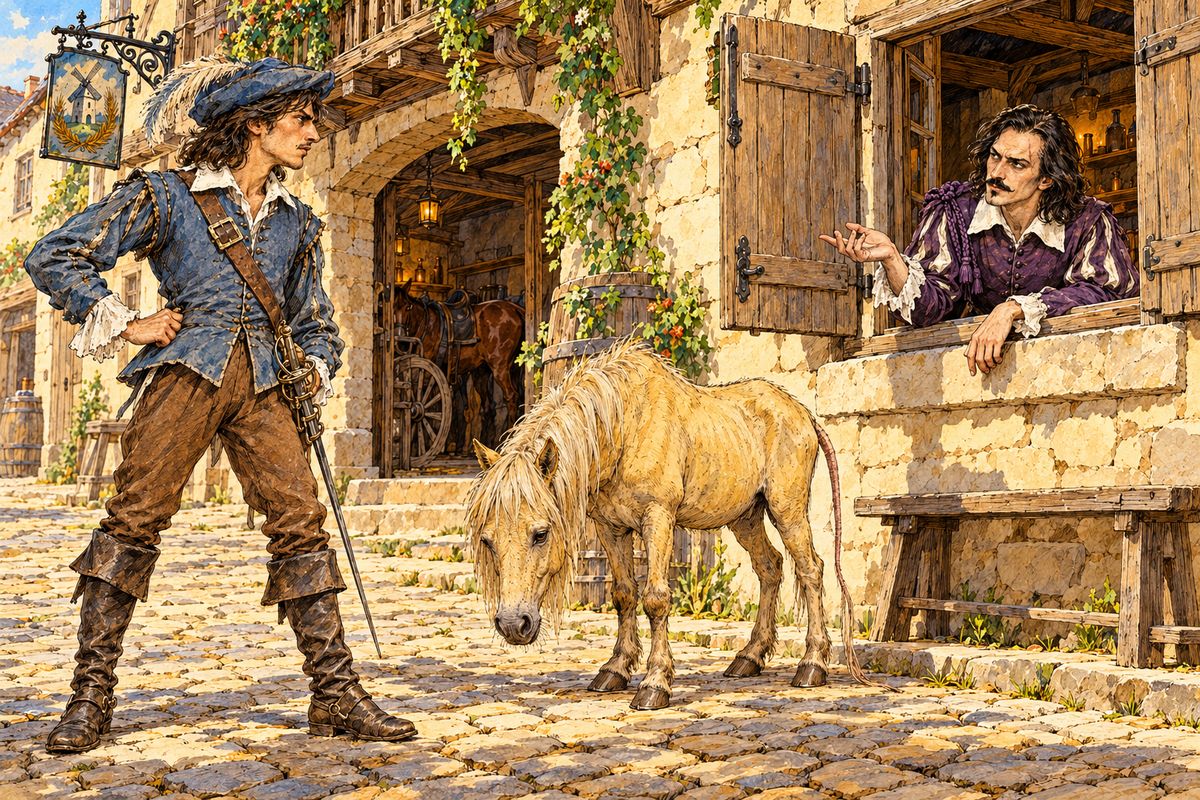
Adapted from The Three Musketeers by Alexandre Dumas and Auguste Maquet, public domain. Pictures are AI illustrations drawn for this edition.
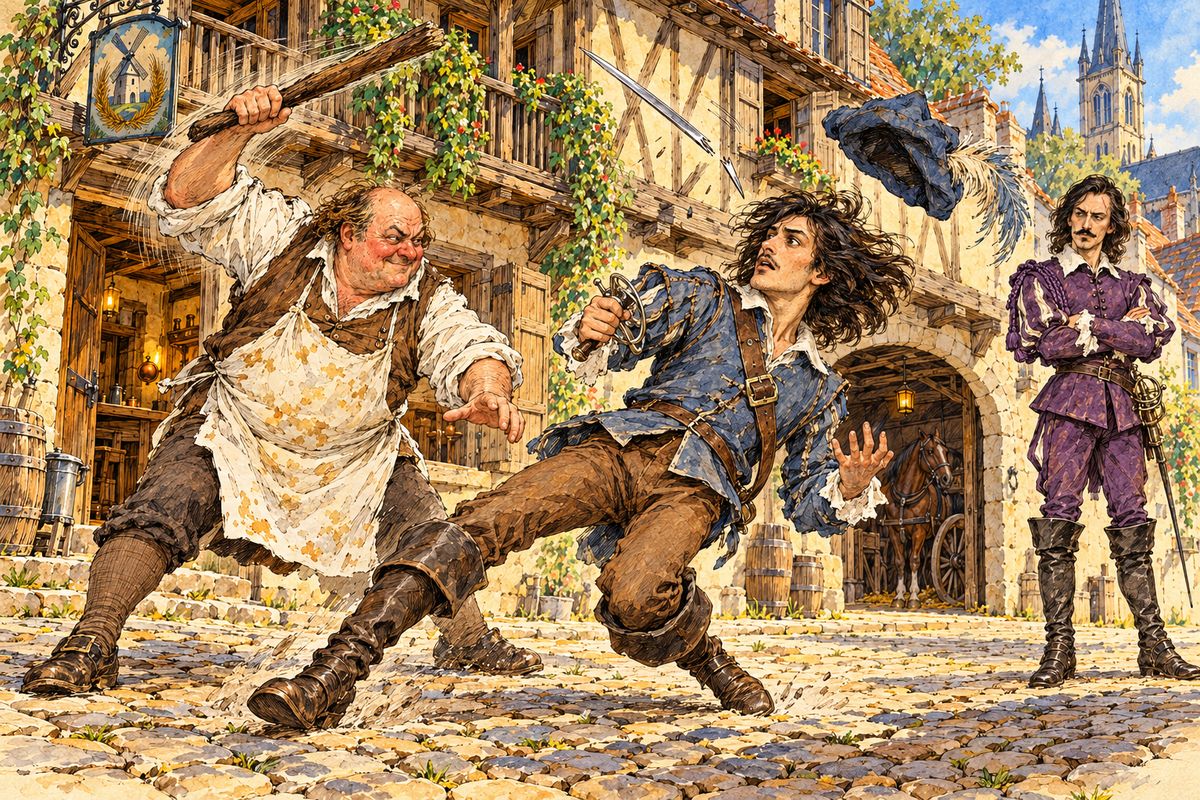
Add Stories to your Home Screen: tap
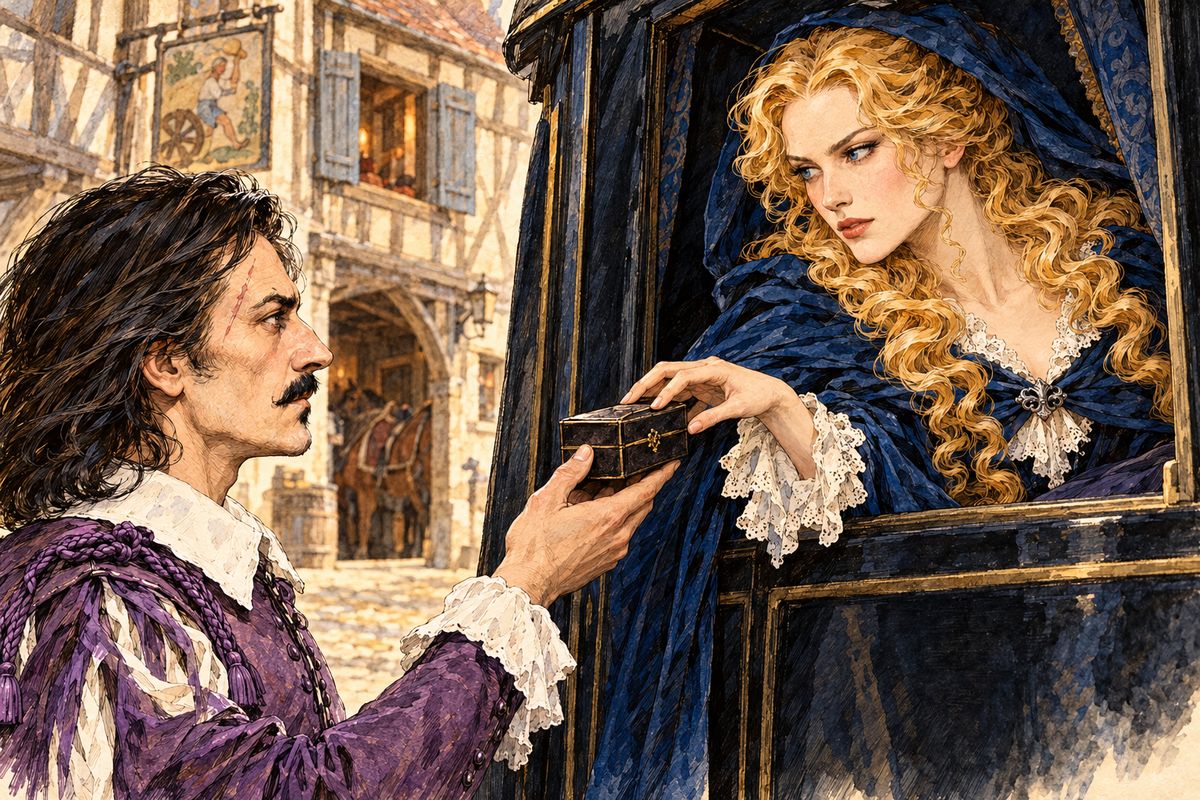
then Add to Home Screen.