A picture-story retelling, after Rudyard Kipling (1894)
Seven animal adventures, including peril, hunting and fights. Show danger at a distance and without gore. The animal societies reflect the period in which Kipling wrote; keep the narration clear and let the stories speak for themselves.
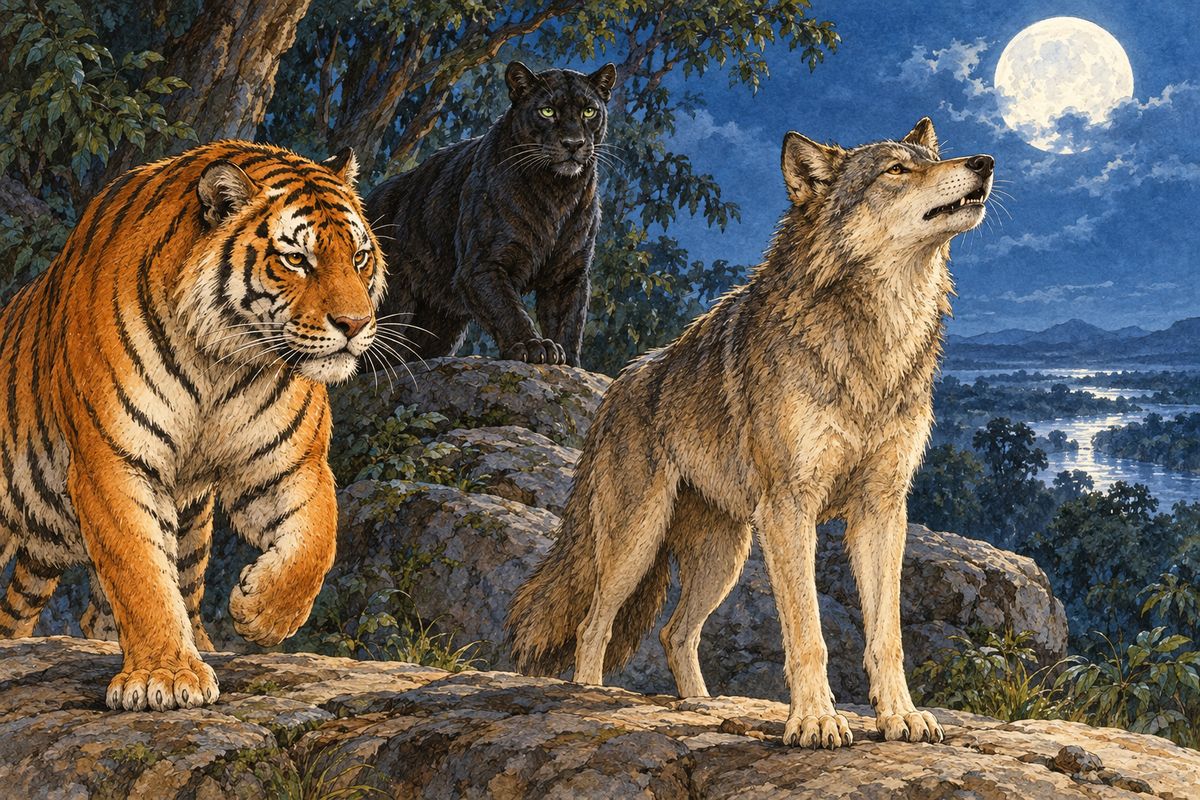
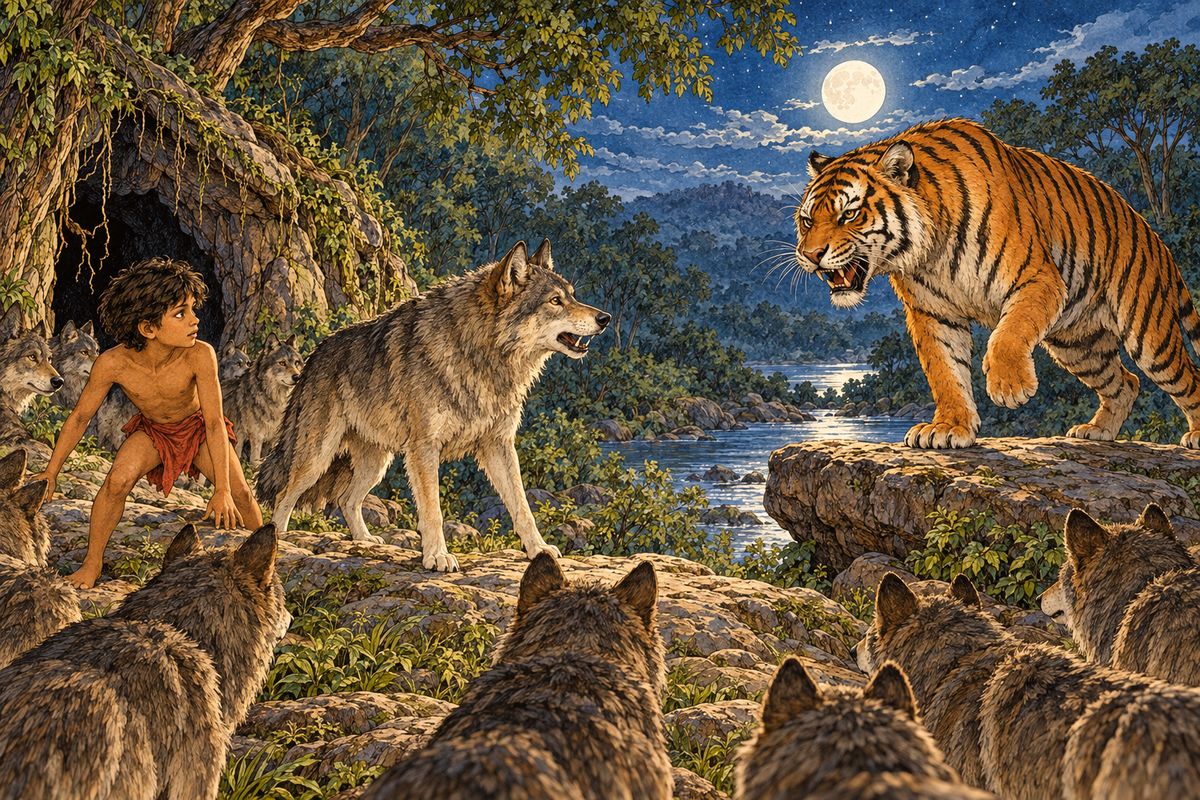
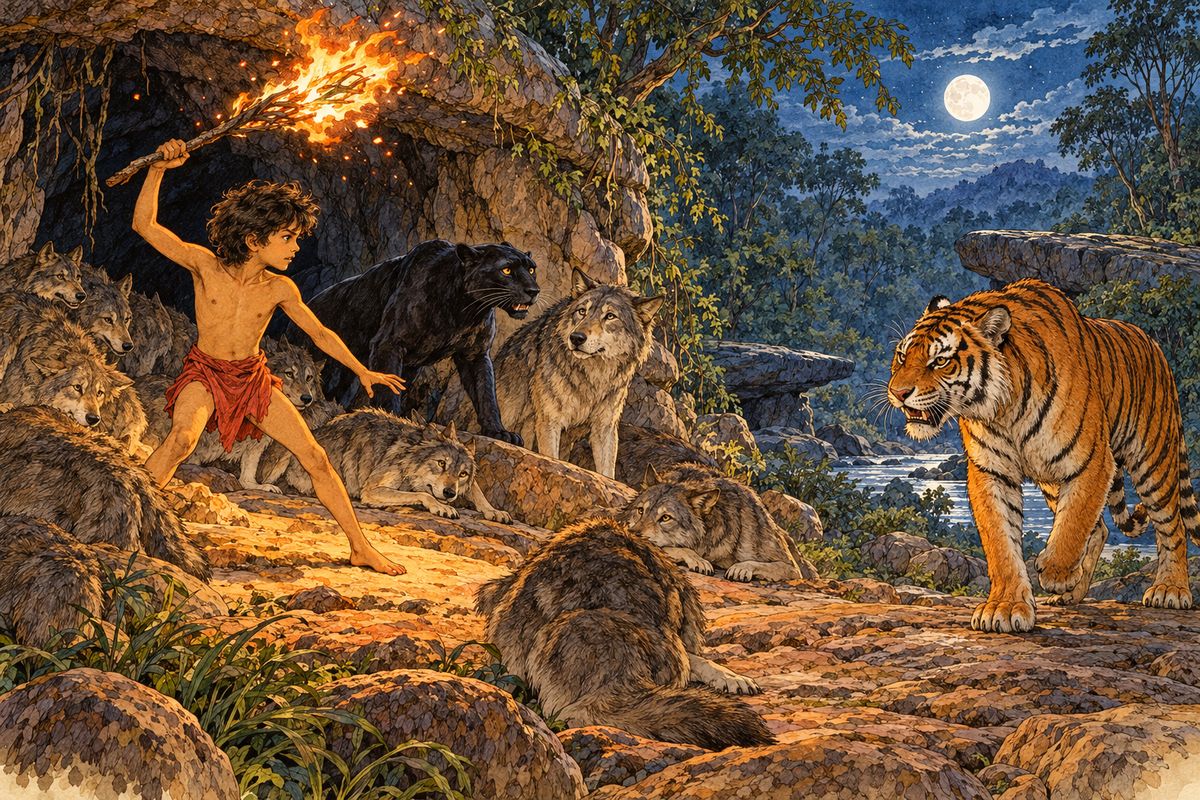
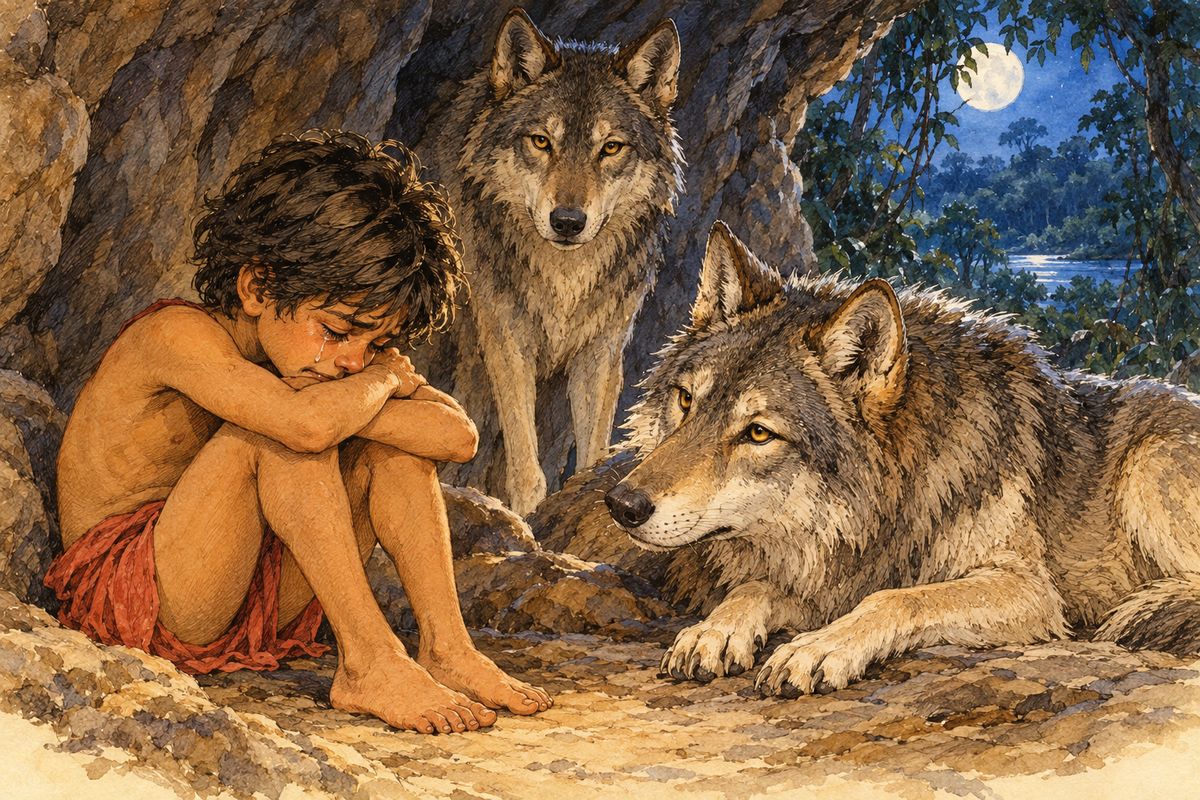
1Now Rann the Kite brings home the night That Mang the Bat sets free— The herds are shut in byre and hut For loosed till dawn are we. This is the hour of pride and power, Talon and tush and claw.2Now, Tabaqui knew as well as anyone else that there is nothing so unlucky as to compliment children to their faces. It pleased him to see Mother and Father Wolf look uncomfortable.3Then there was a howl—an untigerish howl—from Shere Khan. “He has missed,” said Mother Wolf. “What is it?” Father Wolf ran out a few paces and heard Shere Khan muttering and mumbling savagely as he tumbled about in the scrub. “The fool has had no more sense than to jump at a woodcutter’s campfire, and has burned his feet,” said Father Wolf with a grunt.4The moonlight was blocked out of the mouth of the cave, for Shere Khan’s great square head and shoulders were thrust into the entrance. Tabaqui, behind him, was squeaking: “My lord, my lord, it went in here!”5“Shere Khan speaks this much truth. The cub must be shown to the Pack. Wilt thou still keep him, Mother?” “Keep him!” she gasped. “He came naked, by night, alone and very hungry; yet he was not afraid! Look, he has pushed one of my babes to one side already. And that lame butcher would have killed him and would have run off to the Waingunga while the6The ‘Council Rock’ Father Wolf waited till his cubs could run a little, and then on the night of the Pack Meeting took them and Mowgli and Mother Wolf to the Council Rock—a hilltop covered with stones and boulders where a hundred wolves could hide. Akela, the great gray Lone Wolf, who…7Then the only other creature who is allowed at the Pack Council—Baloo, the sleepy brown bear who teaches the wolf cubs the Law of the Jungle: old Baloo, who can come and go where he pleases because he eats only nuts and roots and honey—rose upon his hind quarters and grunted. “The…8“To kill a naked cub is shame. Besides, he may make better sport for you when he is grown. Baloo has spoken in his behalf. Now to Baloo’s word I will add one bull, and a fat one, newly killed, not half a mile from here, if ye will accept the man’s cub according to the Law. Is it difficult?” There was a clamor of scores of voices, saying: “What matter? He9Bagheera would lie out on a branch and call, “Come along, Little Brother.” Bagheera would lie out on a branch and call, “Come along, Little Brother,” and at first Mowgli would cling like the sloth, but afterward he would fling himself through the branches almost as boldly as the gray ape.10Mother Wolf told him once or twice that Shere Khan was not a creature to be trusted, and that some day he must kill Shere Khan. But though a young wolf would have remembered that advice every hour, Mowgli forgot it because he was only a boy—though he would have called himself…11“But this is no time for sleeping. Baloo knows it; I know it; the Pack know it; and even the foolish, foolish deer know.12“Oh, thou art a man’s cub,” said the Black Panther very tenderly. “And even as I returned to my jungle, so thou must go back to men at last—to the men who are thy brothers—if thou art not killed in the Council.”13“Then, by the Bull that bought me, I will pay Shere Khan full tale for this, and it may be a little over,” said Mowgli, and he bounded away. “That is a man.14“They are very like me,” said Mowgli, blowing into the pot as he had seen the woman do. “This thing will die if I do not give it things to eat”; and he dropped twigs and dried bark on the red stuff.15Akela raised his old head wearily:— “Free People, and ye too, jackals of Shere Khan, for twelve seasons I have led ye to and from the kill, and in all that time not one has been trapped or maimed. Now I have missed my kill.16“No man’s cub can run with the people of the jungle,” howled Shere Khan. “Give him to me!” “He is our brother in all but blood,” Akela went on, “and ye would kill him here! In truth, I have lived too long. Some of ye are eaters of cattle, and of others I have heard that, under Shere Khan’s teaching, ye go by dark night and snatch children from the17Mowgli thrust his dead branch into the fire till the twigs lit and crackled, and whirled it above his head among the cowering wolves. “Thou art the master,” said Bagheera in an undertone.18“No, Little Brother. That is only tears such as men use,” said Bagheera. “Now I know thou art a man, and a man’s cub no longer. The jungle is shut indeed to thee henceforward. Let them fall, Mowgli. They are only tears.” So Mowgli sat and cried as though his heart would break; and he had never cried in all his life before. “Now,” he said, “I will go to men.19“But think how small he is,” said the Black Panther, who would have spoiled Mowgli if he had had his own way. “How can his little head carry all thy long talk?”20“Except his own tribe,” said Bagheera, under his breath; and then aloud to Mowgli, “Have a care for my ribs, Little Brother! What is all this dancing up and down?”21“They have no leader,” said Bagheera. “They lie. They have always lied.” “They were very kind and bade me come again. Why have I never been taken among the Monkey People? They stand on their feet as I do. They do not hit me with their hard paws. They play all day. Let me get up! Bad Baloo, let me up! I will play with them again.” “Listen, man-cub,” said the22The last words were shrieked as he was being swung through the air, but Rann nodded and rose up till he looked no bigger than a speck of dust, and there he hung, watching with his telescope eyes the swaying of the treetops as Mowgli’s escort whirled along.23Baloo in the forest “They never go far,” he said with a chuckle. “They never do what they set out to do.24So he rocked on his wings, his feet gathered up under him, and waited. Meantime, Baloo and Bagheera were furious with rage and grief.25“At least he gave me all the Words correctly a little time ago,” said Bagheera impatiently. “Baloo, thou hast neither memory nor respect.26“We are hunting,” said Baloo carelessly. He knew that you must not hurry Kaa. He is too big. “Give me permission to come with you,” said Kaa. “A blow more or less is nothing to thee, Bagheera or Baloo, but I—I have to wait and wait for days in a wood-path and climb half a night on the mere chance of a young ape. Psshaw! The branches are not what they were27“The Bandar-log have shifted their grounds,” he said quietly. “When I came up into the sun today I heard them whooping among the tree-tops.”28“We must remind them to speak well of their master. Aaa-ssp! We must help their wandering memories. Now, whither went they with the cub?” “The jungle alone knows. Toward the sunset, I believe,” said Baloo. “We had thought that thou wouldst know, Kaa.” “I? How? I take them when they come in my way, but I do not hunt the Bandar-log, or frogs—or green scum on29“It is half a night’s journey—at full speed,” said Bagheera, and Baloo looked very serious. “I will go as fast as I can,” he said anxiously.30“I will go to the west wall,” Kaa whispered, “and come down swiftly with the slope of the ground in my favor. They will not throw themselves upon my back in their hundreds, but—” “I know it,” said Bagheera.31“Stay there,” shouted the monkeys, “till we have killed thy friends, and later we will play with thee—if the Poison-People leave thee alive.”32“We be of one blood, ye and I,” said Mowgli, quickly giving the Snake’s Call. He could hear rustling and hissing in the rubbish all round him and gave the Call a second time, to make sure.33‘Kaa’ the python Generations of monkeys had been scared into good behavior by the stories their elders told them of Kaa, the night thief, who could slip along the branches as quietly as moss grows, and steal away the strongest monkey that ever lived; of old Kaa, who could make himself look…34“They will not move till I order them. Stay you sssso!” Kaa hissed, and the city was silent once more. “I could not come before, Brother, but I think I heard thee call”—this was to35“I—I may have cried out in the battle,” Bagheera answered. “Baloo, art thou hurt? “I am not sure that they did not pull me into a hundred little bearlings,” said Baloo, gravely shaking one leg after the other. “Wow! I am sore. Kaa, we owe thee, I think, our lives—Bagheera and36“Here, in a trap. I cannot climb out,” cried Mowgli. The curve of the broken dome was above his head. “Take him away. He dances like Mao the Peacock. He will crush our young,” said the cobras inside. “Hah!” said Kaa with a chuckle, “he has friends everywhere, this manling. Stand back, manling. And hide you, O Poison People. I break down the wall.” Kaa37“The moon sets,” he said. “Is there yet light enough to see?” From the walls came a moan like the wind in the tree-tops—“We see, O Kaa.” “Good. Begins now the dance—the Dance of the Hunger of Kaa. Sit still and watch.” He turned twice or thrice in a big circle, weaving his head from right to left. Then he began making loops and figures of eight with his38“He knows more than we,” said Bagheera, trembling. “In a little time, had I stayed, I should have walked down his throat.”39What of the hunting, hunter bold? Brother, the watch was long and cold. What of the quarry ye went to kill? Brother, he crops in the jungle still. Where is the power that made your pride? Brother, it ebbs from my flank and side. Where is the haste that ye hurry by? Brother, I go to my lair—to die. Now we must go back to the first tale. When40“What is there to be afraid of?” said the priest. “Look at the marks on his arms and legs. They are the bites of wolves. He is but a wolf-child run away from the jungle.” Of course, in playing together, the cubs had often nipped Mowgli harder than they intended, and there were white scars all over his arms and legs. But he would have been the last person in41“By the Bull that bought me,” said Mowgli to himself, “but all this talking is like another looking-over by the Pack! Well, if I am a man, a man I must become.”42So Mowgli stretched himself in some long, clean grass at the edge of the field, but before he had closed his eyes a soft gray nose poked him under the chin. “Phew!” said Gray Brother (he was the eldest of Mother Wolf’s cubs).43Mowgli, who naturally knew something about what they were talking of, had to cover his face not to show that he was laughing, while Buldeo, the Tower musket across his knees, climbed on from one wonderful story to another, and Mowgli’s shoulders shook. Buldeo was explaining how the tiger that had carried…44“Are all these tales such cobwebs and moontalk?” said Mowgli. “That tiger limps because he was born lame, as everyone knows.45Buldeo was speechless with surprise for a moment, and the head-man stared. “Oho! It is the jungle brat, is it?” said Buldeo. “If thou art so wise, better bring his hide to Khanhiwara, for the Government has set a hundred rupees on his life. Better still, talk not when thy elders speak.” Mowgli rose to go. “All the evening I have lain here listening,” he46“He has come back to this country, and has waited here a long time for thee. Now he has gone off again, for the game is scarce.47At last a day came when he did not see Gray Brother at the signal place, and he laughed and headed the buffaloes for the ravine by the dhk tree, which was all covered with golden-red flowers. There sat Gray Brother, every bristle on his back lifted.48“He has hidden for a month to throw thee off thy guard. He crossed the ranges last night with Tabaqui, hot-foot on thy trail,” said the Wolf, panting.49Mowgli slipped on to Rama’s back. “Drive the bulls away to the left, Akela. Gray Brother, when we are gone, hold the cows together, and drive them into the foot of the ravine.” “How far?” said Gray Brother, panting and snapping. “Till the sides are higher than Shere Khan can jump,” shouted Mowgli. “Keep them there till we come down.” The bulls swept off as50“I have—have hunted these too in my time,” gasped Akela in the dust. “Shall I turn them into the jungle?”51He put his hands to his mouth and shouted down the ravine—it was almost like shouting down a tunnel—and the echoes jumped from rock to rock. “Who calls?” said Shere Khan, and a splendid peacock fluttered up out of the ravine screeching.52Akela and Gray Brother ran to and fro nipping the buffaloes’ legs, and though the herd wheeled once to charge up the ravine again, Mowgli managed to turn Rama, and the others followed him to the wallows. Shere Khan needed no more trampling.53Buldeo, who was still stooping over Shere Khan’s head, found himself sprawling on the grass, with a gray wolf standing over him, while Mowgli went on skinning as though he were alone in all India. “Ye-es,” he said, between his teeth.54“I am an old man. I did not know that thou wast anything more than a herdsboy. May I rise up and go away, or will thy servant tear me to pieces?” “Go, and peace go with thee. Only, another time do not meddle with my game. Let him go, Akela.” Buldeo hobbled away to the village as fast as he could, looking back over his shoulder in case Mowgli should change55“They are not unlike the Pack, these brothers of thine,” said Akela, sitting down composedly. “It is in my head that, if bullets mean anything, they would cast thee out.”56When the moon rose over the plain the villagers saw Mowgli trotting across, with two wolves at his heels When the moon rose over the plain, making it look all milky, the horrified villagers saw Mowgli, with two wolves at his heels and a bundle on his head, trotting across at the…57They clambered up the Council Rock together, and Mowgli spread the skin out on the flat stone Ever since Akela had been deposed, the Pack had been without a leader, hunting and fighting at their own pleasure. But they answered the call from habit; and some of them were lame from the…58Oh! hush thee, my baby, the night is behind us, And black are the waters that sparkled so green. The moon, o’er the combers, looks downward to find us At rest in the hollows that rustle between.59He was scratched and bleeding in twenty places; one eye was almost out, and his sides were torn to ribbons. “Oh, you men, you men!”60“Bah! Only the holluschickie go to Otter Island. If we went there they would say we were afraid. We must preserve appearances, my dear.” Sea Catch sunk his head proudly between his fat shoulders and pretended to go to sleep for a few minutes, but all the time he was keeping a sharp lookout for a fight. Now that all the seals and their wives were on the61Ten fathoms deep “In a little time,” she said, “you’ll know where to swim to, but just now we’ll follow Sea Pig, the Porpoise, for he is very wise.” A school of porpoises were ducking and tearing through the water, and little Kotick followed them as fast as he could.62Kerick Booterin turned nearly white under his oil and smoke, for he was an Aleut, and Aleuts are not clean people. Then he began to mutter a prayer.63“I’m not going near him,” said Patalamon. “He’s unlucky. Do you really think he is old Zaharrof come back? I owe him for some gulls’ eggs.” “Don’t look at him,” said Kerick. “Head off that drove of four-year-olds. The men ought to skin two hundred to-day, but it’s the beginning of the season and they are new to the work. A hundred will do. Quick!” Patalamon64“The white seal is coming after us,” cried Patalamon. “That’s the first time a seal has ever come to the killing-grounds alone.”65“Hsh! Don’t look behind you,” said Kerick. “It is Zaharrof’s ghost! I must speak to the priest about this.” The distance to the killing-grounds was only half a mile, but it took an hour to cover, because if the seals went too fast Kerick knew that they would get heated and then their fur would come off in patches when they were skinned. So they went on very66“Isn’t there any such island?” began Kotick. “I’ve followed the poltoos [the halibut] for twenty years, and I can’t say I’ve found it yet.67“Go and find out,” said Sea Vitch, shutting his eyes. “Run away. We’re busy here.” Kotick made his dolphin-jump in the air and shouted as loud as he could: “Clam-eater! Clam-eater!” He knew that Sea Vitch never caught a fish in his life but always rooted for clams and seaweed; though he pretended to be a very terrible person. Naturally the Chickies and the68“Well!” said Kotick. “You’re the only people I’ve ever met uglier than Sea Vitch—and with worse manners.” Then he remembered in a flash what the Burgomaster gull had screamed to him when he was a little yearling at Walrus Islet, and he tumbled backward in the water, for he knew that he had found Sea Cow at last. The sea cows went on schlooping and grazing69He began to think of the seal he had left behind him, but though he was in a hurry to go back to Novastoshnah, he thoroughly explored the new country, so that he would be able to answer all questions. Then he dived and made sure of the mouth of the tunnel…70“I’ve no nursery to fight for,” said Kotick. “I only want to show you all a place where you will be safe.71“Oh, if you’re trying to back out, of course I’ve no more to say,” said the young seal with an ugly chuckle. “Will you come with me if I win?” said Kotick.72“Very good,” said the young seal carelessly. “If you win, I’ll come.” He had no time to change his mind, for Kotick’s head was out and his teeth sunk in the blubber of the young seal’s neck. Then he threw himself back on his haunches and hauled his enemy down the beach, shook him, and knocked him over. Then Kotick roared to the seals: “I’ve done my best for73“My wig!” said old Sea Catch, boosting himself up stiffly, for he was fearfully mauled. “The Killer Whale himself could not have cut them up worse.74There was a murmur like the ripple of the tide all up and down the beaches. “We will come,” said thousands of tired voices.75At the hole where he went in Red-Eye called to Wrinkle-Skin. Hear what little Red-Eye saith: “Nag, come up and dance with death!”76“Now,” said the big man (he was an Englishman who had just moved into the bungalow), “don’t frighten him, and we’ll see what he’ll do.” It is the hardest thing in the world to frighten a mongoose, because he is eaten up from nose to tail with curiosity.77But Teddy’s mother wouldn’t think of anything so awful. Early in the morning Rikki-tikki came to early breakfast in the veranda riding on Teddy’s shoulder, and they gave him banana and some boiled egg.78“We are very miserable,” said Darzee. “One of our babies fell out of the nest yesterday and Nag ate him.”79“Well,” said Rikki-tikki, and his tail began to fluff up again, “marks or no marks, do you think it is right for you to eat fledglings out of a nest?” Nag was thinking to himself, and watching the least little movement in the grass behind Rikki-tikki.80In the dark he ran up against Chuchundra, the muskrat. Teddy carried him off to bed, and insisted on Rikki-tikki sleeping under his chin.81“Those who kill snakes get killed by snakes,” said Chuchundra, more sorrowfully than ever. “And how am I to be sure that Nag won’t mistake me for you some dark night?”82“There’s not the least danger,” said Rikki-tikki. “But Nag is in the garden, and I know you don’t go there.”83“But are you sure that there is anything to be gained by killing the people?” said Nag. “Everything. When there were no people in the bungalow, did we have any mongoose in the garden? So long as the bungalow is empty, we are king and queen of the garden; and remember that as soon as our eggs in the melon bed hatch (as they may tomorrow), our children will84Then Rikki-tikki was battered to and fro as a rat is shaken by a dog. Then he jumped. The head was lying a little clear of the water jar, under the curve of it; and, as his teeth met, Rikki braced his back against the bulge of the red earthenware to hold down the head. This gave him just one second’s purchase, and he made the most of it. Then he was85Then Teddy’s mother came in with a very white face, and saw what was left of Nag, and Rikki-tikki dragged himself to Teddy’s bedroom and spent half the rest of the night shaking himself tenderly to find out whether he really was broken into forty pieces, as he fancied. When morning came…86“For the great, the beautiful Rikki-tikki’s sake I will stop,” said Darzee. “What is it, O Killer of the terrible Nag?”87Nagaina lifted up her head and hissed, “You warned Rikki-tikki when I would have killed him. Indeed and truly, you’ve chosen a bad place to be lame in.”88Teddy’s eyes were fixed on his father, and all his father could do was to whisper, “Sit still, Teddy. You mustn’t move.89“Yes, you will go away, and you will never come back. For you will go to the rubbish heap with Nag.90“Now,” he said, when he awoke, “I will go back to the house. Tell the Coppersmith, Darzee, and he will tell the garden that Nagaina is dead.”91It is all over. The Coppersmith is a bird who makes a noise exactly like the beating of a little hammer on a copper pot; and the reason he is always making it is because he is the town crier to every Indian garden, and tells all the news to everybody who cares to listen.92I will remember what I was, I am sick of rope and chain— I will remember my old strength and all my forest affairs. I will not sell my back to man for a bundle of sugar-cane: I will go out to my own kind, and the wood-folk in their lairs.93Kala Nag He knew what he was talking of; for he had been born under Kala Nag’s shadow, had played with the end of his trunk before he could walk, had taken him down to water as soon as he could walk, and Kala Nag would no more have dreamed of disobeying…94“He throw a rope? He is smaller than a picket-pin. Little one, what is thy name?” said Petersen Sahib. Little Toomai was too frightened to speak, but Kala Nag was behind him, and Toomai made a sign with his hand, and the elephant caught him up in his trunk and held him level with Pudmini’s forehead, in front of the great Petersen Sahib. Then Little Toomai95“Not green corn, Protector of the Poor,—melons,” said Little Toomai. “Not green corn, Protector of the Poor,—melons,” said Little Toomai, and all the men sitting about broke into a roar of laughter.96“He is Toomai, my son, Sahib,” said Big Toomai, scowling. “He is a very bad boy, and he will end in a jail, Sahib.”97“Must I never go there, Sahib?” asked Little Toomai with a big gasp. “Yes.” Petersen Sahib smiled again. “When thou hast seen the elephants dance. That is the proper time. Come to me when thou hast seen the elephants dance, and then I will let thee go into all the Keddahs.” There was another roar of laughter, for that is an old joke among elephant-catchers,98“What did Petersen Sahib mean by the elephant dance?” he said, at last, softly to his mother. Big Toomai heard him and grunted.99“What will they do?” Little Toomai called out. “Ohe, little one. Art thou there? Well, I will tell thee, for thou hast a cool head. They will dance, and it behooves thy father, who has swept all the hills of all the elephants, to double-chain his pickets to-night.” “What talk is this?” said Big Toomai. “For forty years, father and son, we have tended100The grass began to get squashy, and Kala Nag’s feet sucked and squelched as he put them down, and the night mist at the bottom of the valley chilled Little Toomai. There was a splash and a trample, and the rush of running water, and Kala Nag strode through the bed of…101Elephant-dance At last Kala Nag stood still between two tree-trunks at the very top of the hill. They were part of a circle of trees that grew round an irregular space of some three or four acres, and in all that space, as Little Toomai could see, the ground had been trampled…102Little Toomai looked down upon scores and scores of broad backs. Still lying down, Little Toomai looked down upon scores and scores of broad backs, and wagging ears, and tossing trunks, and little rolling eyes.103The third elephant watched the two go away, snorted, wheeled round, and took his own path. He may have belonged to some little native king’s establishment, fifty or sixty or a hundred miles away.104They looked at one another and up and down, and they wondered. For the ways of elephants are beyond the wit of any man, black or white, to fathom.105When they got back to camp it was time for the evening meal. Petersen Sahib ate alone in his tent, but he gave orders that the camp should have two sheep and some fowls, as well as a double ration of flour and rice and salt, for he knew that there would be a feast.106Toomai of the elephants Big Toomai had come up hotfoot from the camp in the plains to search for his son and his elephant, and now that he had found them he looked at them as though he were afraid of them both. And there was a feast by the blazing campfires…107And at that last wild yell the whole line flung up their trunks till the tips touched their foreheads, and broke out into the full salute—the crashing trumpet-peal that only the Viceroy of India hears, the Salaamut of the Keddah. But it was all for the sake of Little Toomai, who had…108You can work it out by Fractions or by simple Rule of Three, But the way of Tweedle-dum is not the way of Tweedle-dee. You can twist it, you can turn it, you can plait it till you drop, But the way of Pilly Winky’s not the way of Winkie Pop!109“Oh, it was you,” said the mule, “you and your friends, that have been disturbing the camp? All right. You’ll be beaten for this in the morning. But I may as well give you something on account now.” I heard the harness jingle as the mule backed and caught the camel two kicks in the ribs that rang like a drum. “Another time,” he said, “you’ll know better110“Then why didn’t you stay and carry baggage for the 39th Native Infantry, instead of running all round the camp?” said the mule. “They were such very bad dreams,” said the camel.111They went on chewing. “That comes of being afraid,” said Billy. “You get laughed at by gun-bullocks. I hope you like it, young un.” The young mule’s teeth snapped, and I heard him say something about not being afraid of any beefy old bullock in the world. But the bullocks only clicked their horns together and went on chewing. “Anybody can be forgiven for112“Don’t the knives hurt?” said the young mule. “Well, I got one cut across the chest once, but that wasn’t Dick’s fault—”113“Oh, no, you wouldn’t. You know that as soon as the guns are in position they’ll do all the charging.114“And yet,” said Billy, “you dream bad dreams and upset the camp at night. Well, well! Before I’d lie down, not to speak of sitting down, and let a man fire across me, my heels and his head would have something to say to each other. Did you ever hear anything so awful as that?” There was a long silence, and then one of the gun bullocks lifted up his big head115“Of course,” said the troop horse, “everyone is not made in the same way, and I can quite see that your family, on your father’s side, would fail to understand a great many things.” “Never you mind my family on my father’s side,” said Billy angrily, for every mule hates to be…116“We don’t, but we have to pull the guns,” said the bullocks. “I know it, and I know you are a good deal braver than you think you are.117“You’ll understand better in a minute,” said Two Tails angrily. “Now you just explain to me why you don’t like this!”118“Hukm hai!” (It is an order!), said the camel with a gurgle, and Two Tails and the bullocks repeated, “Hukm hai!”119“I’m coming to the parade to-morrow in my dog-cart,” she said. “Where will you be?” “On the left hand of the second squadron. I set the time for all my troop, little lady,” he said politely. “Now I must go back to Dick. My tail’s all muddy, and he’ll have two hours’ hard work dressing me for parade.” The big parade of all the thirty thousand men was held120Then I heard an old grizzled, long-haired Central Asian chief, who had come down with the Amir, asking questions of a native officer. “But are the beasts as wise as the men?” said the chief.
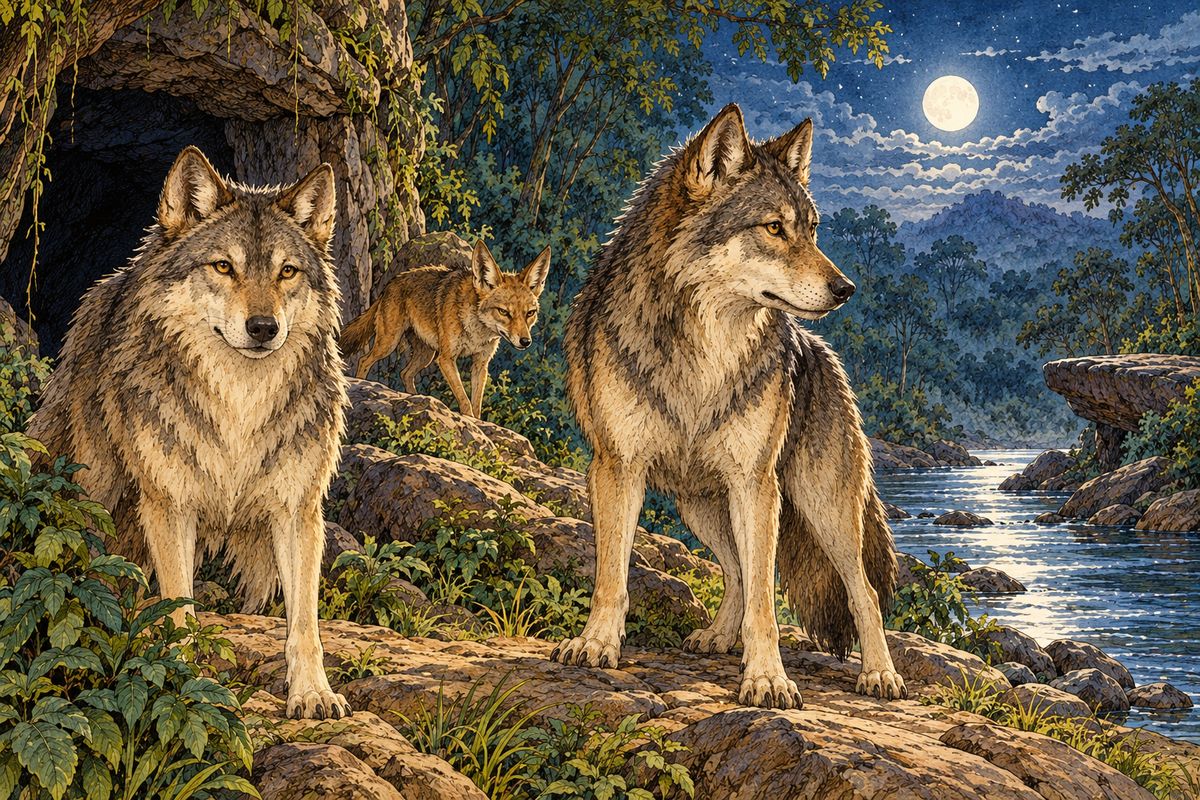
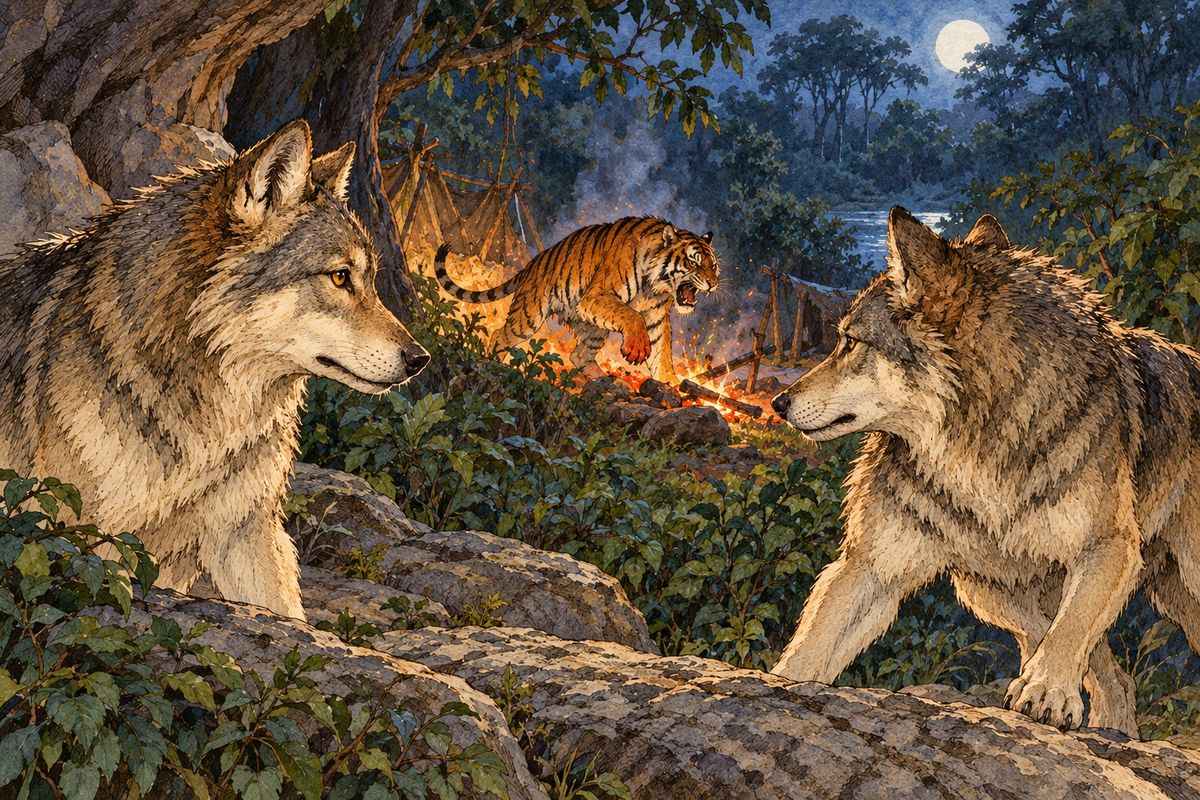
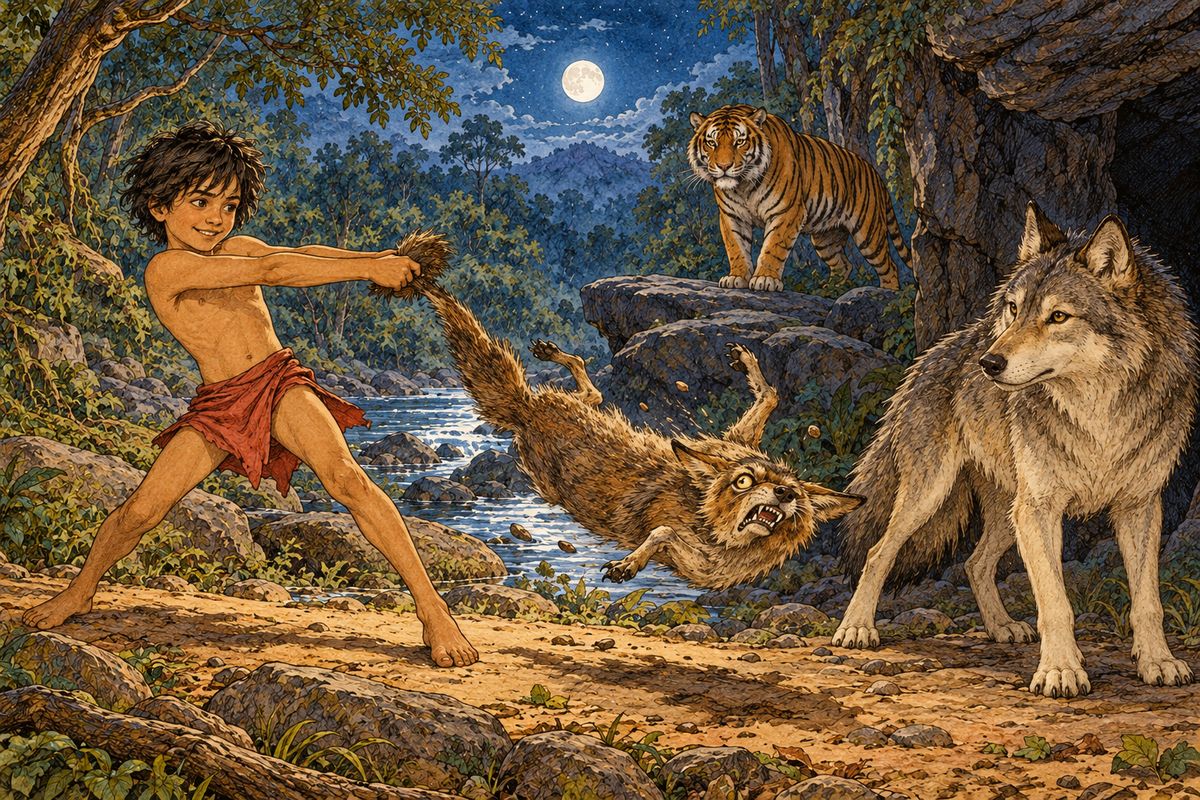
Adapted from The Jungle Book by Rudyard Kipling, public domain. Pictures are AI illustrations drawn for this edition.
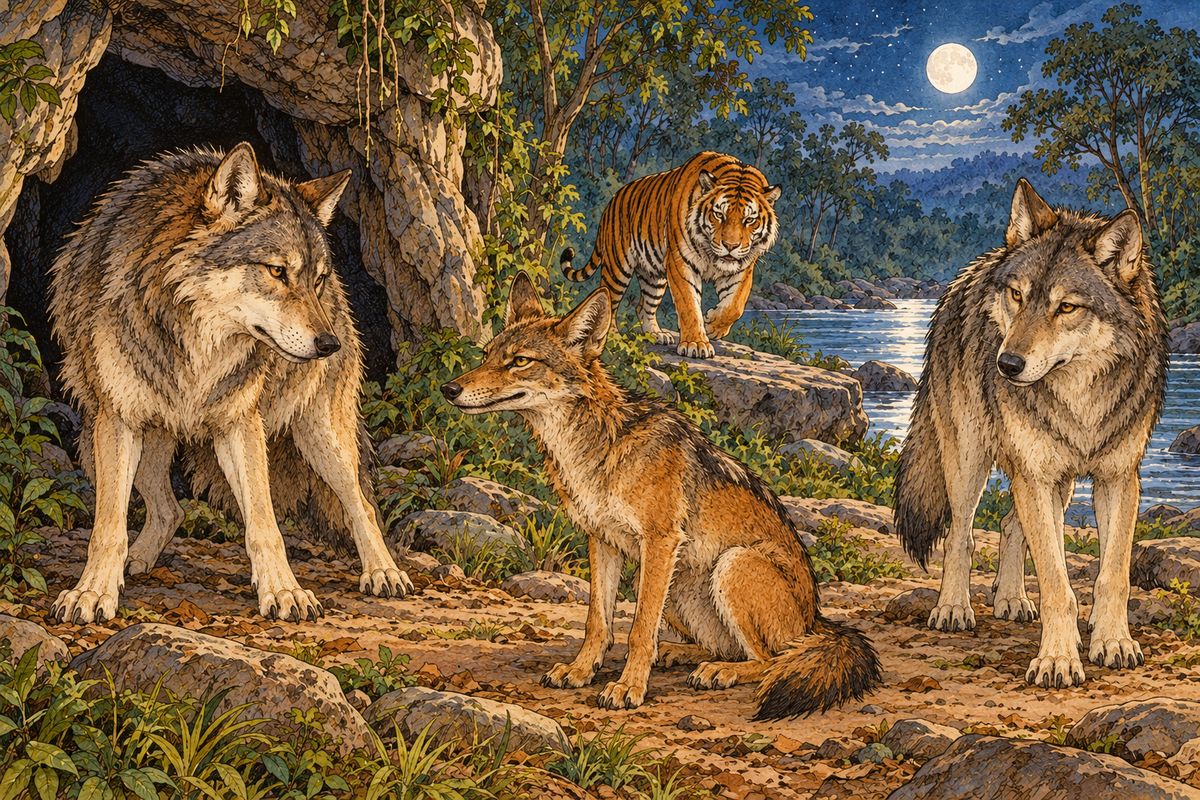
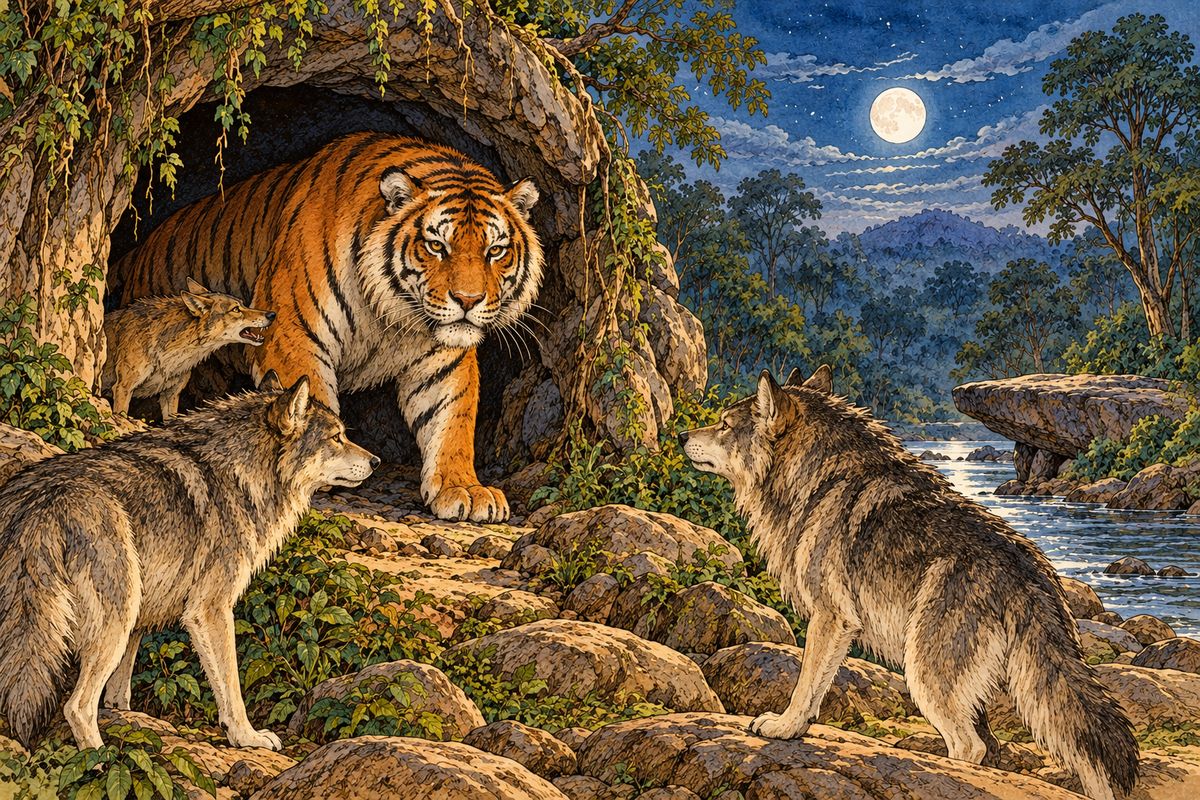
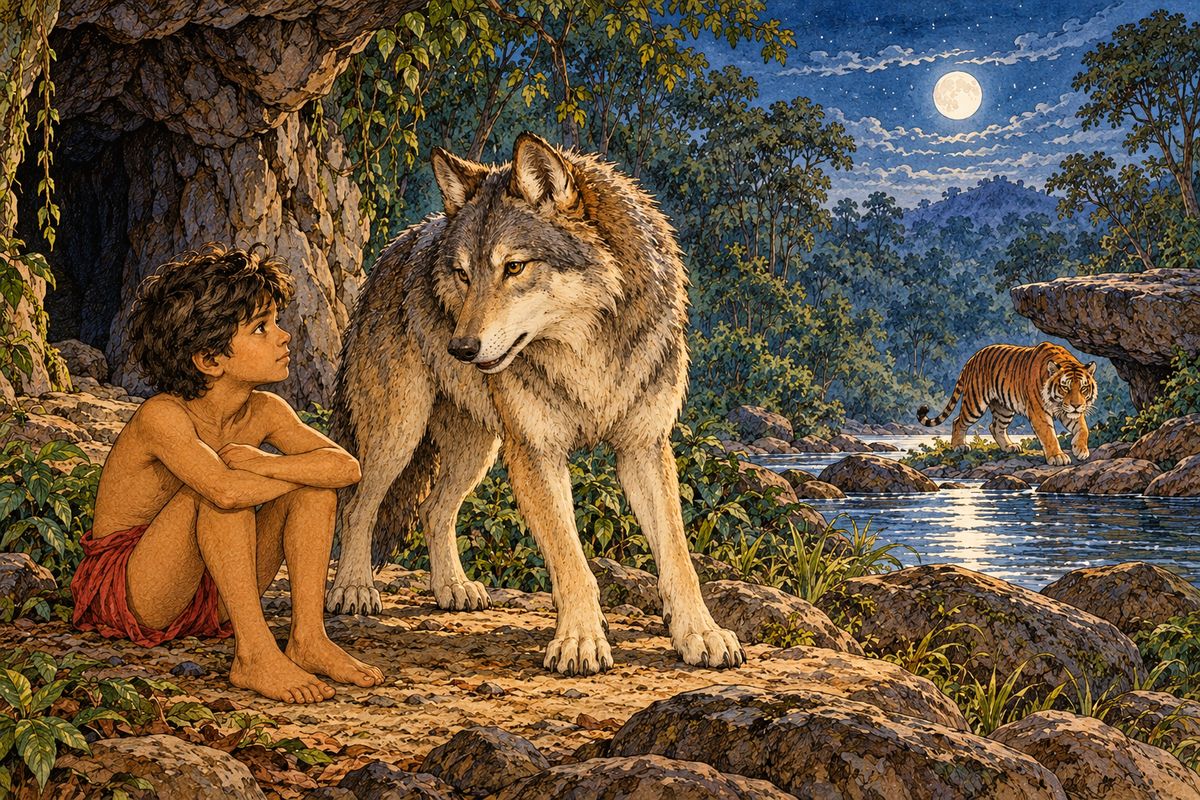
Add Stories to your Home Screen: tap
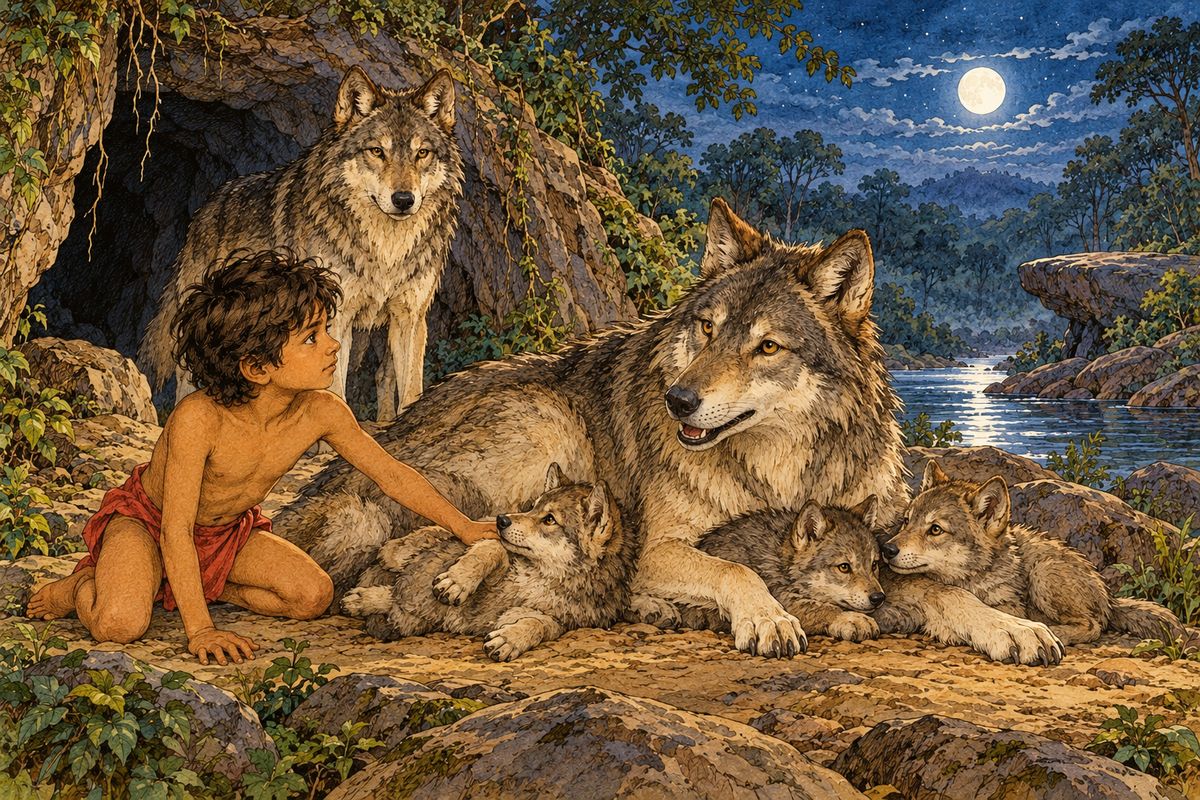
then Add to Home Screen.
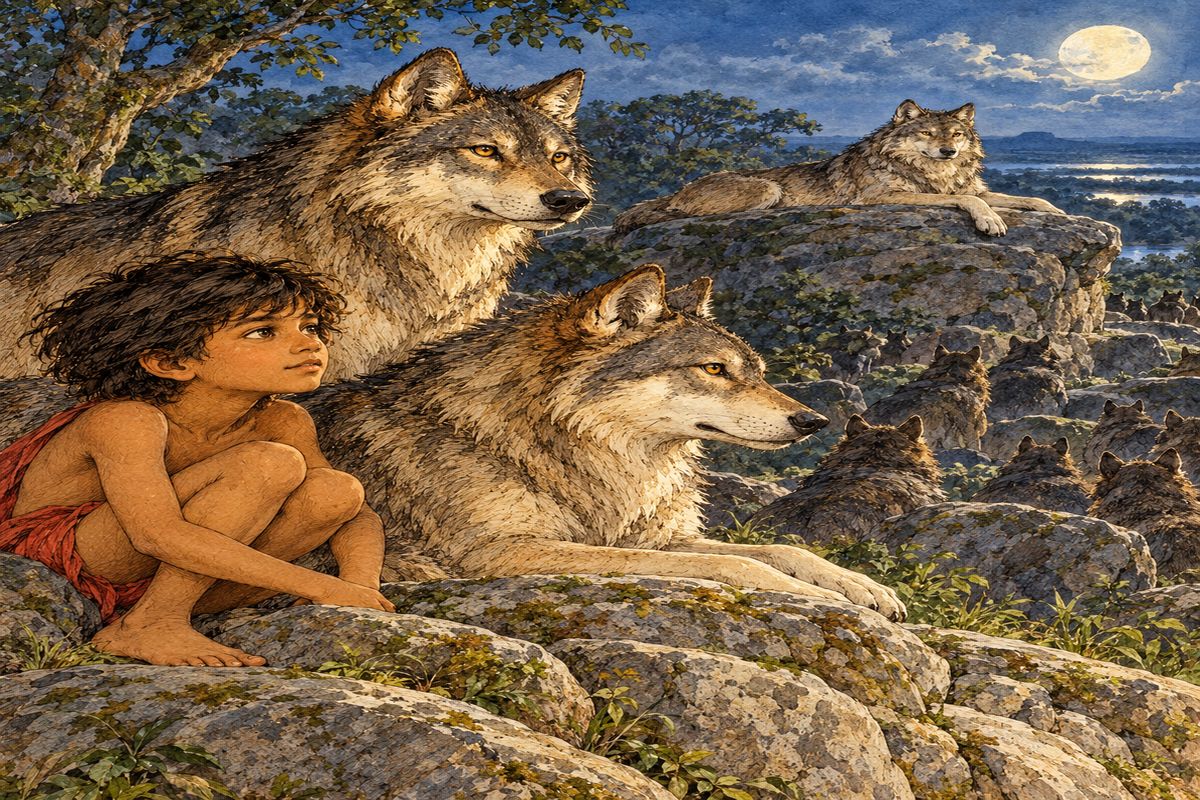
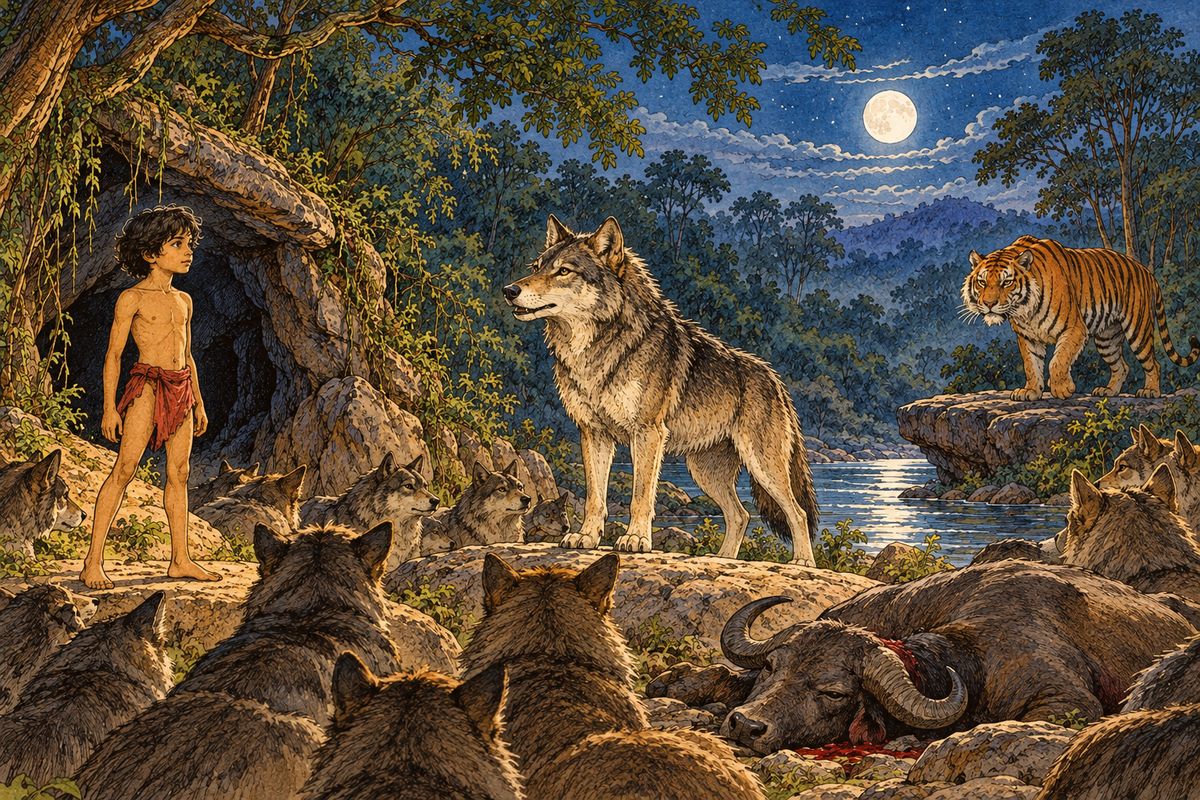
![“Isn’t there any such island?” began Kotick. “I’ve followed the poltoos [the halibut] for twenty years, and I can’t say I’ve found it yet.](/book/the-jungle-book/read/s/vol1/p/066.jpg)