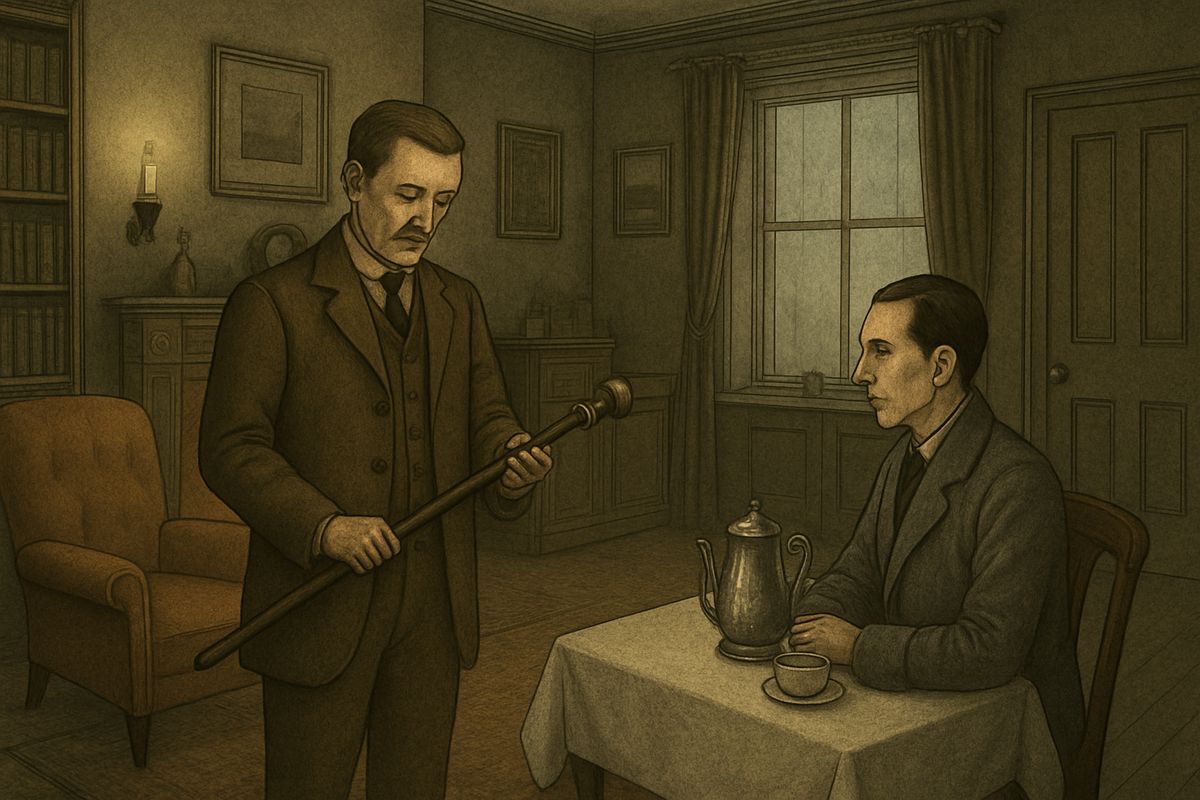
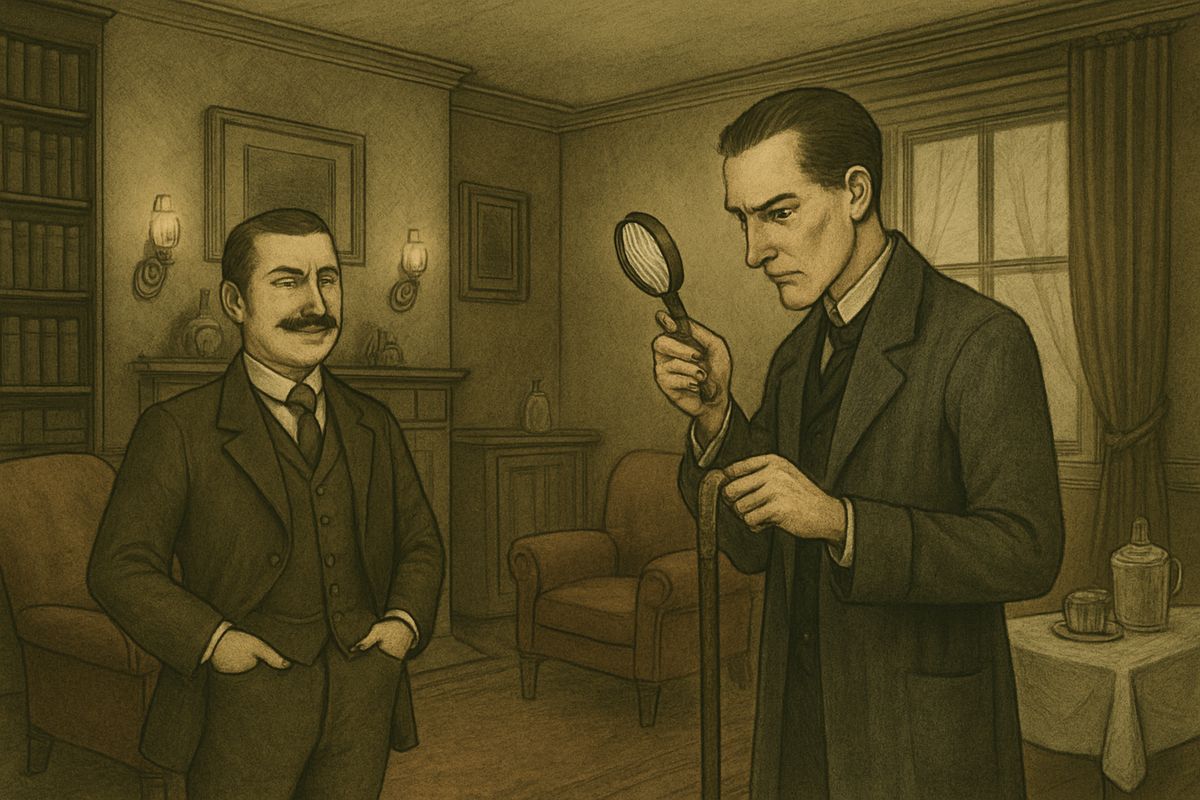
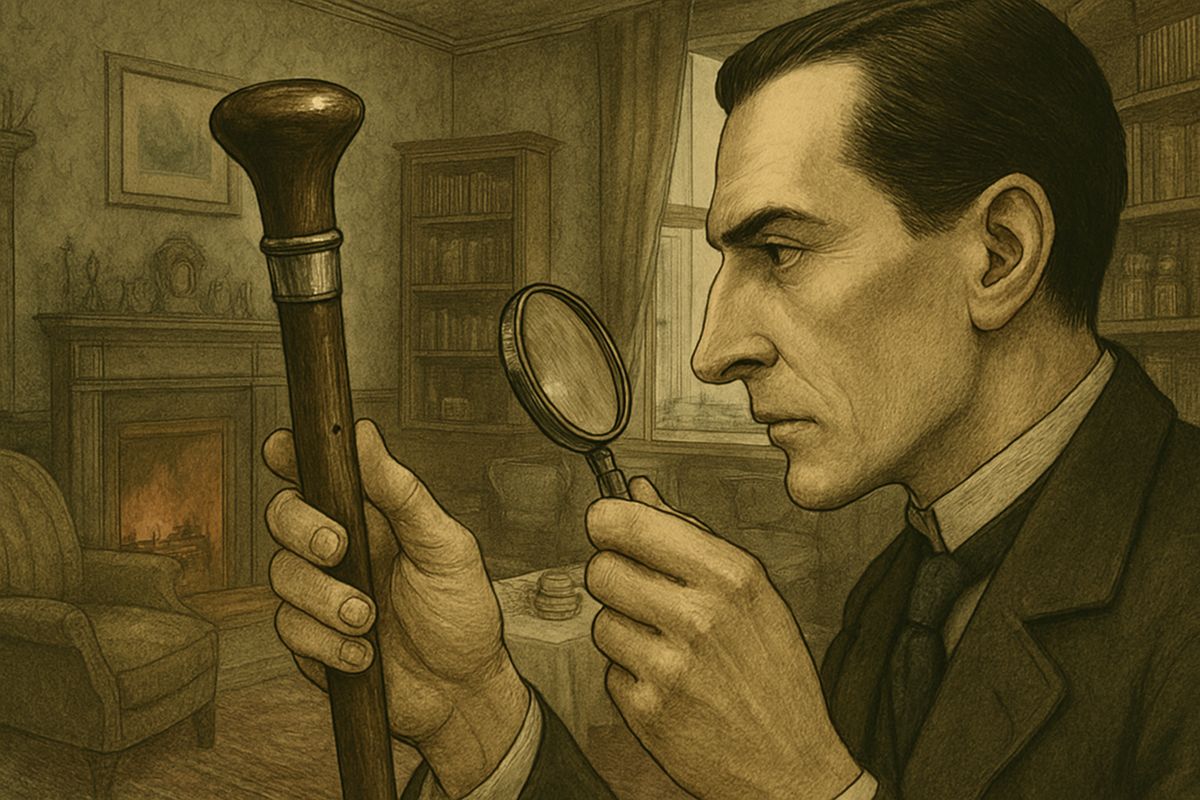
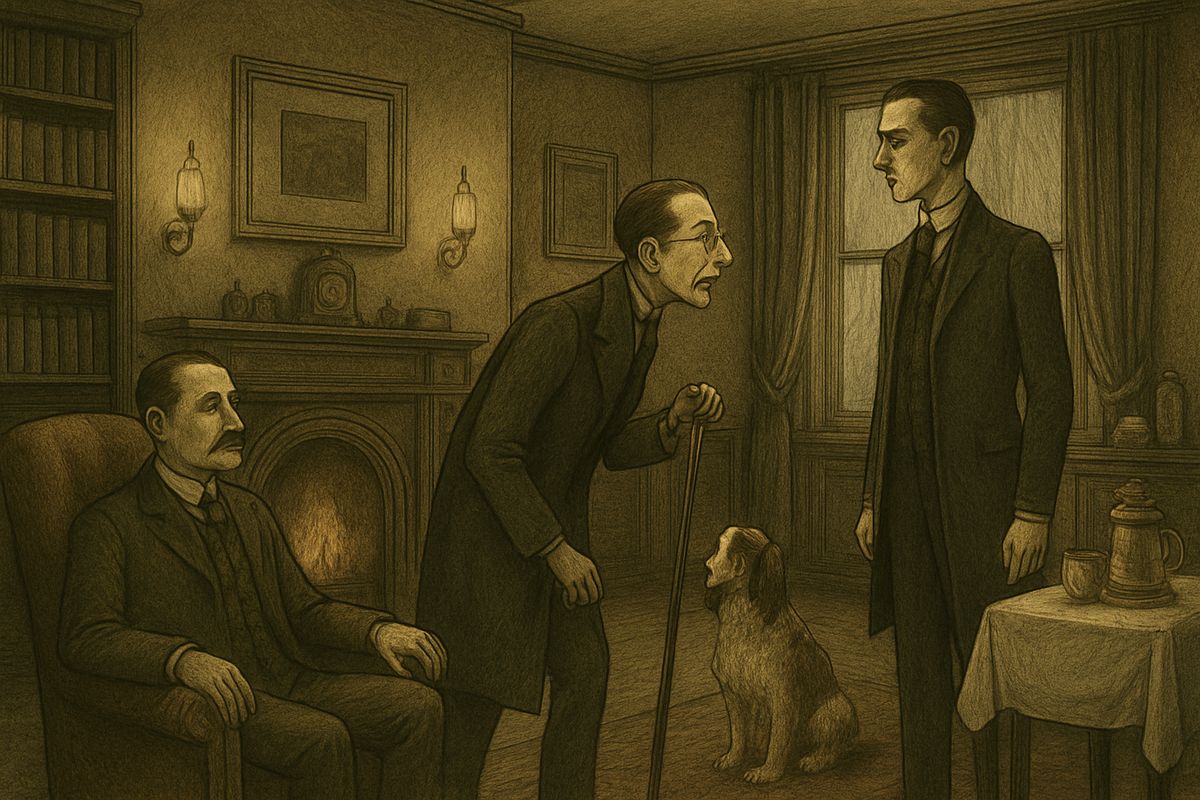
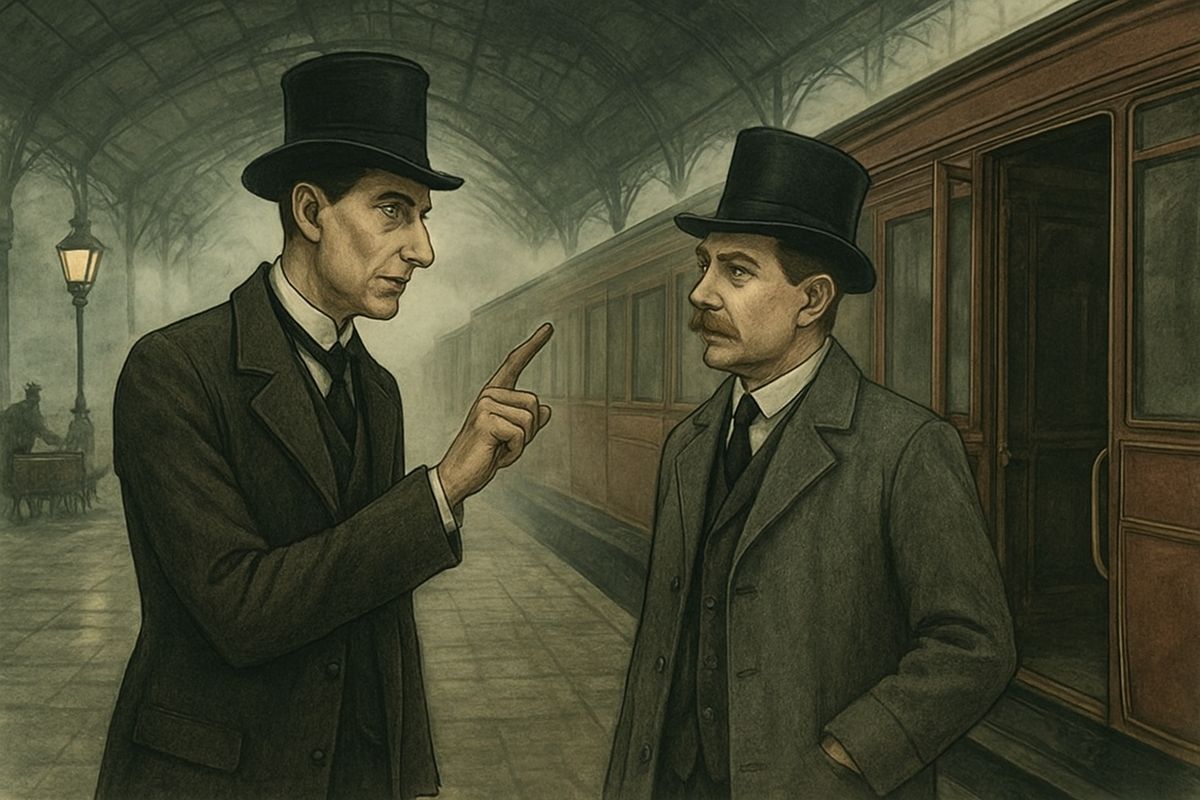
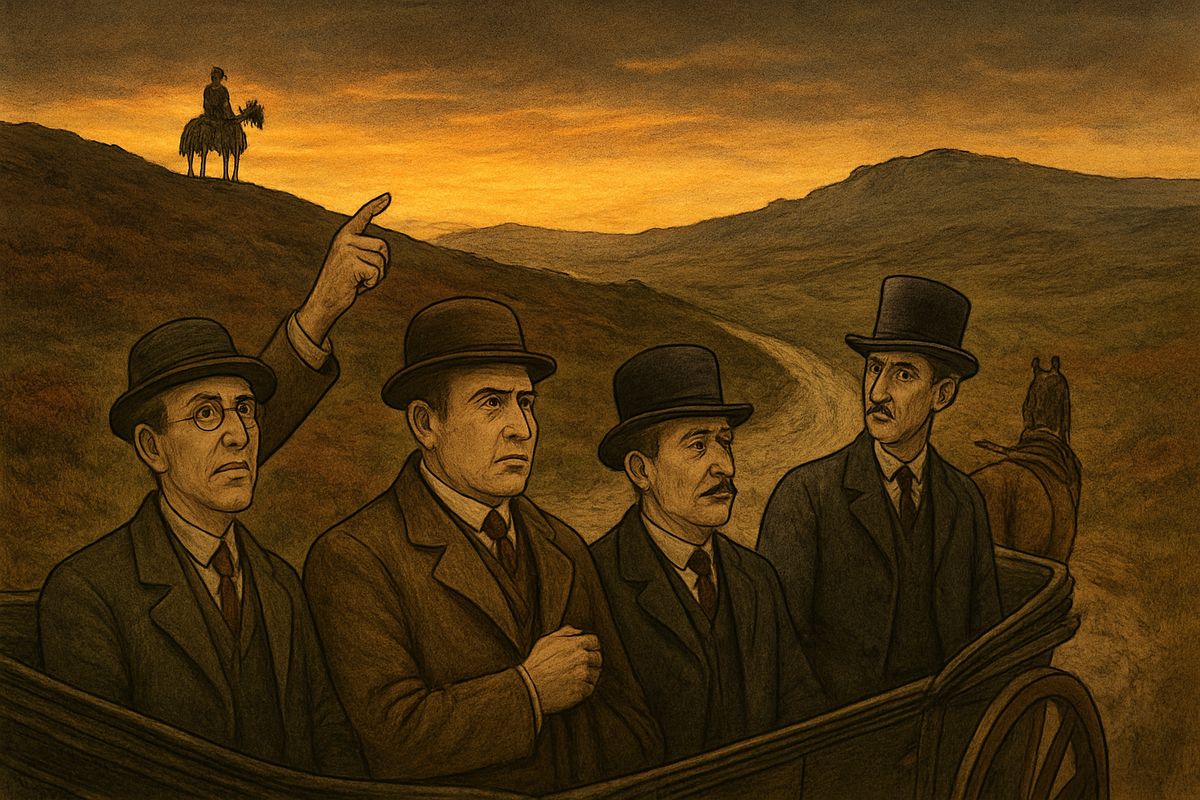
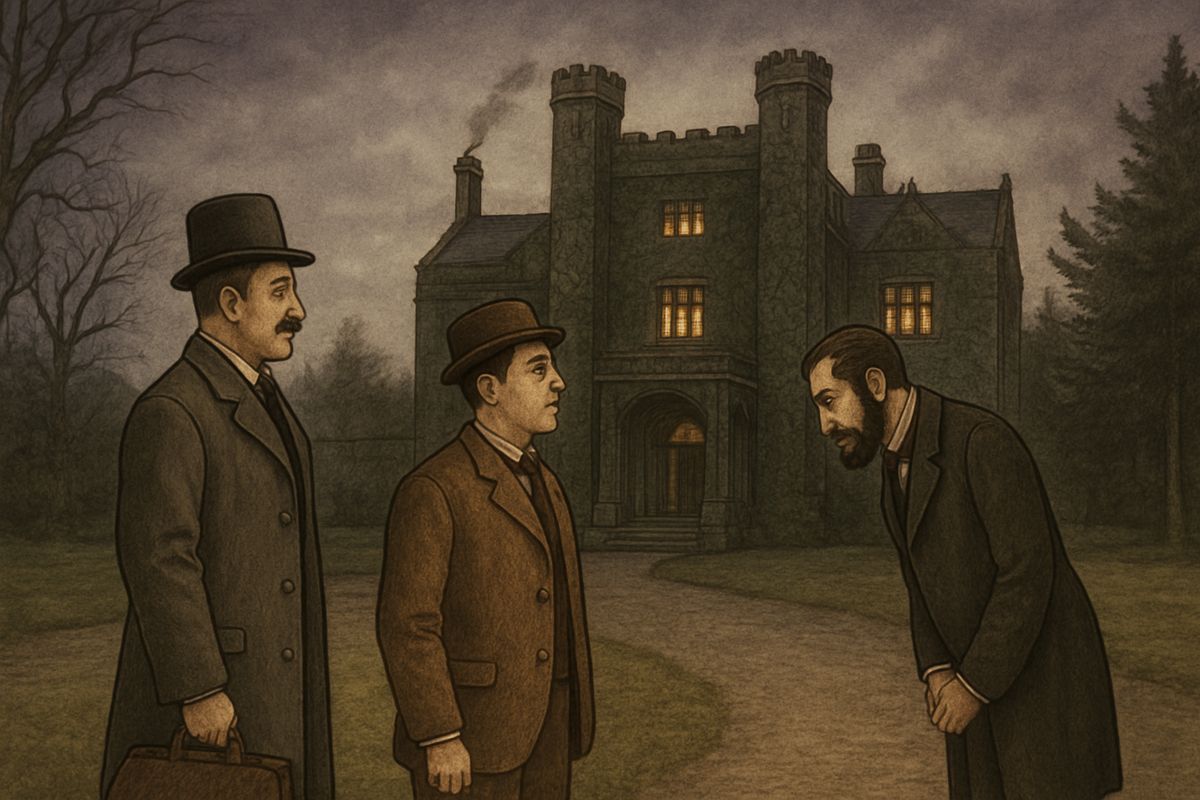
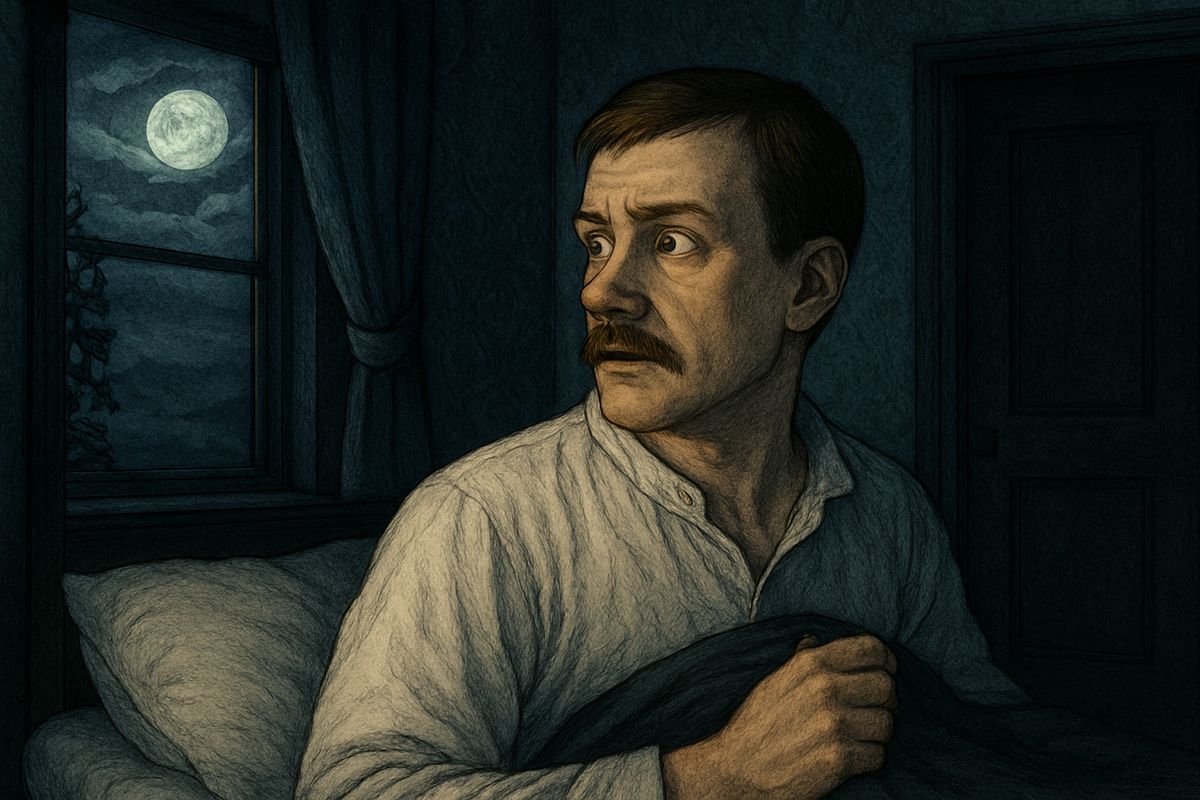
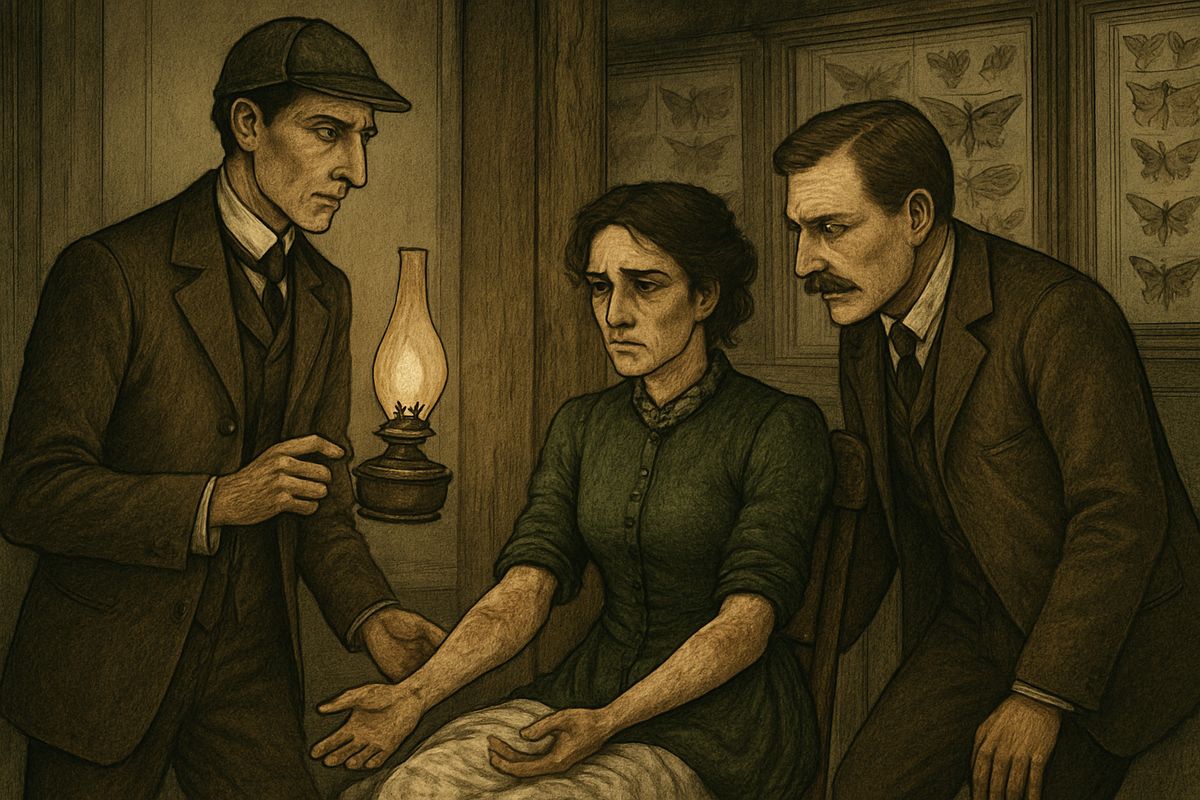
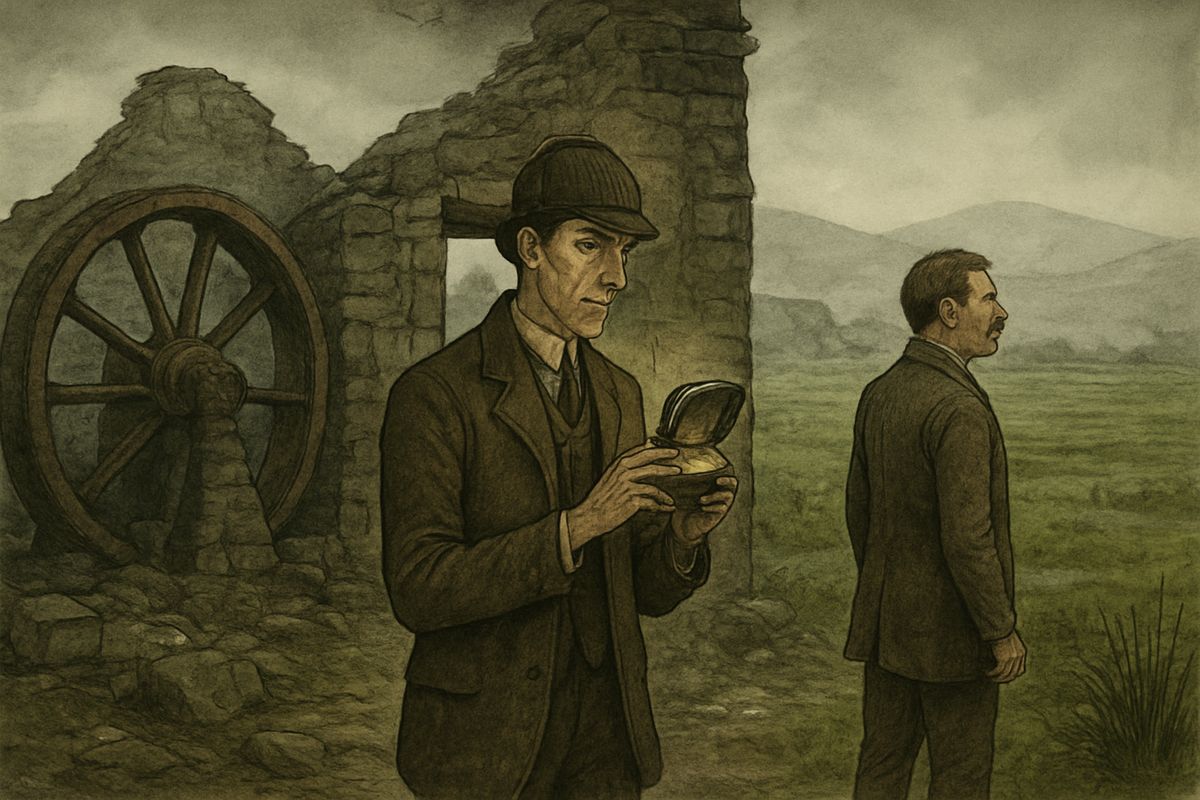
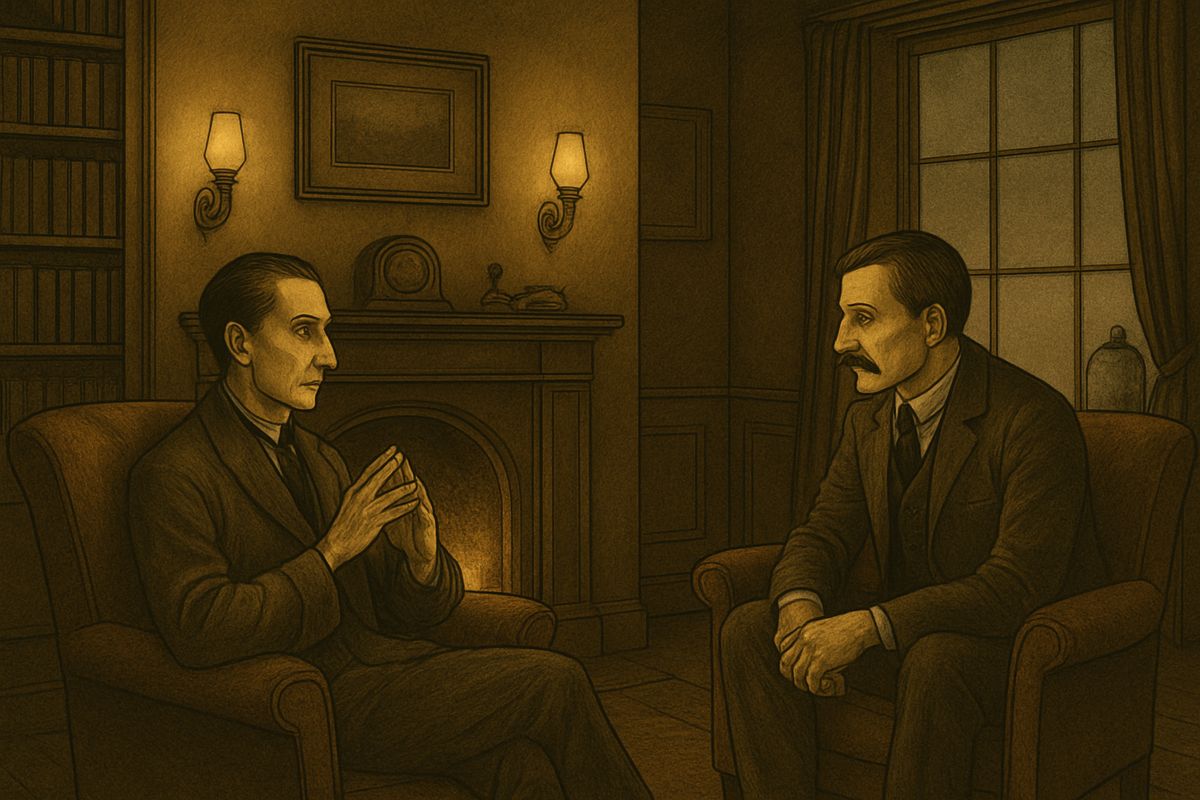
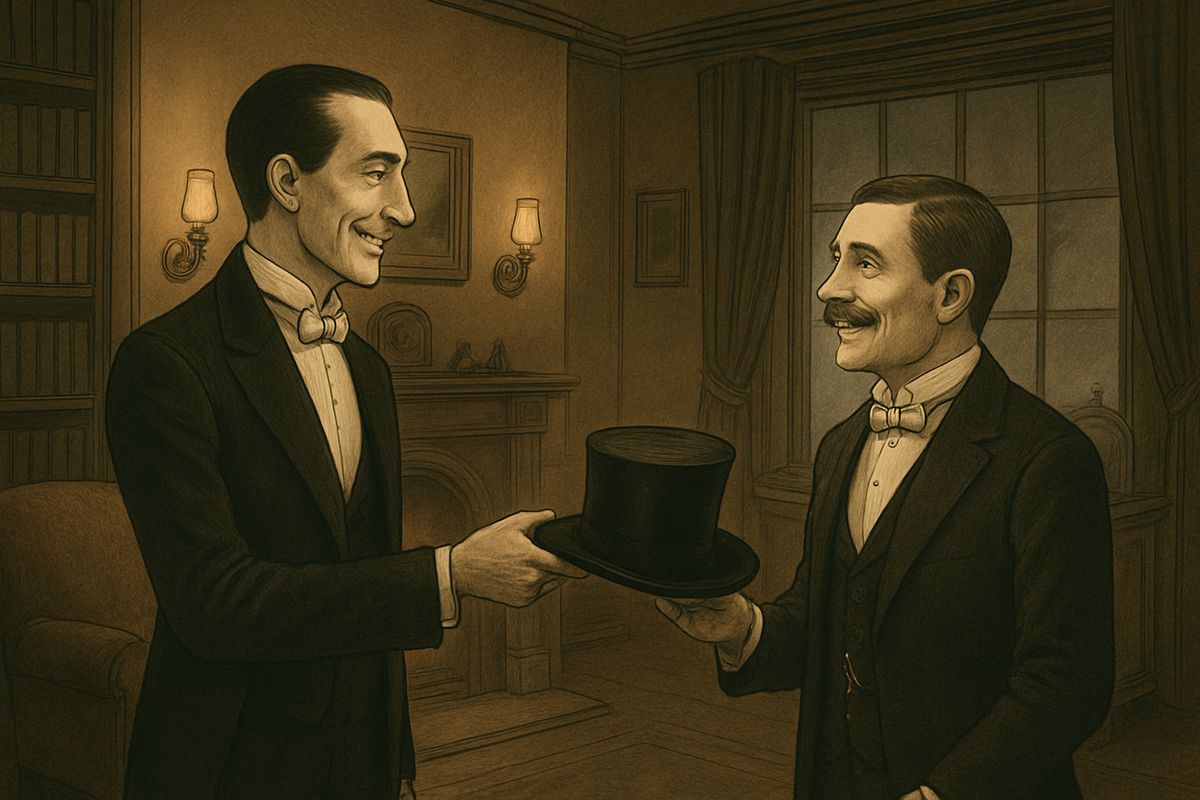
1One morning at Baker Street, Watson picked up the walking-stick that a visitor had left behind the night before. A silver band under its head read 'To James Mortimer, M.R.C.S., from his friends of the C.C.H., 1884.' Holmes, sitting with his back turned, asked what Watson made of it. He could see him perfectly well in the shiny coffee-pot.2Watson decided that the owner must be an elderly, well-respected country doctor who walked a great deal, and that 'C.C.H.' was probably some local hunt. Holmes was full of praise. "Really, Watson, you excel yourself," he said. Then he took the stick over to the window and looked at it through his lens.3Most of it was wrong, Holmes said kindly. 'C.C.H.' meant Charing Cross Hospital. The man had been a young house-surgeon there who left five years before to work in the country. He was friendly, unambitious and absent-minded, and he had a dog. The tooth marks on the stick showed that the dog's jaw was just the right size for a curly-haired spaniel.4Just then a curly-haired spaniel trotted in, followed by its owner, Dr. James Mortimer. He was tall, thin and beak-nosed, and he grabbed his precious stick with joy. He admired Holmes's skull so much that he said he wanted it, and he called Holmes the second-best expert in Europe. Then he explained why he had come: "I am suddenly confronted with a most serious and extraordinary problem."5Dr. Mortimer drew an old yellow paper from his breast-pocket. Sir Charles Baskerville, who had died suddenly three months before, had trusted it to him. Holmes dated it at a glance, then leaned back and closed his eyes while Mortimer read out the 1742 family legend. "Baskerville Hall," the heading said.6The manuscript told of wicked Hugo Baskerville, who carried off a yeoman's daughter and locked her in an upper room while he and his friends drank below. Terrified by their shouting and oaths, the girl climbed down the ivy on the south wall and fled for home across the moor.7When Hugo found the room empty, he leapt onto the table and swore that he would give his body and soul to the Powers of Evil if he could only catch her. Then he called for his black mare, let loose the hounds, and rode after her across the moonlit moor.8Thirteen revellers rode after him. Only three dared go down into a deep goyal, where two great stones stood. There lay the maid, dead of fear, and Hugo beside her. Over him stood a huge black beast shaped like a hound, which tore out his throat. The three fled screaming across the moor.9Holmes yawned and said it was a tale "to a collector of fairy tales." So Mortimer read a newspaper report instead. Kind, generous Sir Charles took a walk down his yew alley every night. On the fourth of May he never came back. Barrymore the butler took a lantern and found his master lying dead at the far end.10The paper blamed his weak heart, though his footprints changed to tiptoe past the moor-gate and his face was terribly twisted. Then Mortimer gave the private facts. Sir Charles had dreaded the legend, and near the body Mortimer had seen fresh tracks. His voice sank to a whisper: "Mr. Holmes, they were the footprints of a gigantic hound!"11Holmes questioned Dr. Mortimer closely. The yew alley ran between hedges twelve feet high, broken only by a padlocked moor-gate. There Sir Charles had stood five or ten minutes, for his cigar ash had dropped twice. And the giant hound's prints lay on the path some twenty yards off; the creature had never gone near the body.12Mortimer confessed that three locals had seen a huge, glowing creature on the moor before the death. Now the heir, Sir Henry, was arriving from Canada within the hour. Should he go to Dartmoor? Holmes was dry: “A devil with merely local powers like a parish vestry would be too inconceivable a thing.” He asked to see them both at ten next morning.13That evening Watson found the room thick with pipe smoke; Holmes had spent all day over the Ordnance map of Dartmoor. “He was running, Watson—running for his life,” he said. The changed footprints were not tiptoeing. And an old man standing on a raw night by the moor-gate must have been waiting for someone.14At ten o'clock Dr. Mortimer brought the young baronet, Sir Henry Baskerville, to Baker Street. He laid down a strange letter, 'keep away from the moor', pasted together from printed words. Holmes traced them to yesterday's Times leading article, cut out with nail-scissors, and said the rough address had been written with a spluttering hotel pen.15Sir Henry added a small puzzle of his own: one of his new brown boots, never worn, had vanished from outside his hotel door. Then Dr. Mortimer told him the whole legend, and his dark brows knitted. 'There is no man upon earth who can prevent me from going to the home of my own people,' he swore.16Holmes and Watson secretly followed the pair down Regent Street. A hansom crept behind them, and through its window glared a bushy black beard. The cab dashed away, but Holmes had its number, 2704. He then sent Cartwright, a sharp messenger boy, to search twenty-three hotels for the cut-up Times.17At the Northumberland Hotel they met Sir Henry on the stairs, red with fury and waving an old, dusty boot. 'Last night they took one of my brown ones, and today they have sneaked one of the black!' While the others called it a silly joke, Holmes took the trifle very seriously.18After lunch, Dr. Mortimer said that Barrymore the butler had a full black beard, and that Sir Charles had left close on a million; if Sir Henry died, it would pass to an elderly clergyman cousin, James Desmond. Holmes could not leave London, so he asked Watson to go with Sir Henry to Devon. Watson gladly agreed.19As they rose to leave, Sir Henry pulled the missing brown boot from under a cabinet, in a room searched before lunch. It was a clue: someone wanted a boot Sir Henry had actually worn. The new one, never on his feet, had been the wrong boot to take first.20That evening, wires reported that Barrymore was at the Hall and that Cartwright had found nothing. Then cabman John Clayton arrived: his bearded fare had called himself 'Mr. Sherlock Holmes'. Holmes laughed heartily at the clever trick, but he was uneasy. 'It's an ugly, dangerous business, Watson,' he said.21On the day of departure, Holmes drove Watson to the station. He would offer no theories: Watson was simply to report facts, and to watch the Barrymores, the naturalist Stapleton and his sister, and Mr. Frankland of Lafter Hall. "Keep your revolver near you night and day," Holmes said gravely, "and never relax your precautions."22The train sped into Devon, and Sir Henry cried out with delight at every red field and granite hill. But as their wagonette climbed toward the moor, they saw a mounted soldier watching the road, rifle ready. "There's a convict escaped from Princetown, sir," said the driver. It was Selden, the Notting Hill murderer, a man who would stick at nothing.23At dusk they reached Baskerville Hall, its ivy-draped front and twin towers gloomy in the fading light, and Dr. Mortimer drove home to his wife. Barrymore stepped from the porch with a welcome, yet over the evening he quietly asked to leave: since Sir Charles's death, he and his wife could never again be easy in their minds here.24Dinner was a hushed meal beneath long rows of staring ancestors, and the two men went to bed early, hoping morning would be more cheerful. Watson lay sleepless. Then, in the dead of night, he heard it, clear and unmistakable: a woman sobbing as if torn by uncontrollable sorrow, somewhere inside the house.25At breakfast Barrymore swore that the sobbing in the night could not have come from his wife. But in the corridor Watson saw Mrs. Barrymore's eyes, red and swollen from weeping. Then the postmaster's boy admitted he had handed Holmes's test telegram to Mrs. Barrymore, not her husband — so Barrymore might have been the spy in London after all.26On the walk home Watson was overtaken by Stapleton, a naturalist from Merripit House, carrying a green butterfly-net. From a moor-path he pointed to the bright green patches below. "That is the great Grimpen Mire," he said. As they watched, a moor pony floundered there and was sucked down.27Then a long, low moan swept over the moor. It swelled into a deep roar and sank away again, and nobody could tell where it came from. Stapleton looked oddly at Watson. "The peasants say it is the Hound of the Baskervilles calling for its prey," he said, and then suggested it might just be a rare bird.28While Stapleton chased a moth across the mire, a tall dark woman hurried up to Watson. "Go back to London! Start tonight!" she whispered. She was Beryl, Stapleton's sister, and she thought Watson was Sir Henry. When her brother came back, she quickly took it all back and said she had only been talking about orchids.29After a short visit to Merripit House, Watson set off back alone. But Beryl had run ahead by a short cut and was waiting by the path, out of breath. She begged him to forget her warning and not to tell her brother. "He would be very angry," she said, and then she slipped away among the boulders.30From the Hall, Watson sent Holmes long letters about the moor, where the grey stone huts of forgotten ancient people covered the hills. Sir Henry had fallen for Miss Stapleton at first sight, and the two met almost daily. Yet her brother looked on with plain disapproval and took pains never to leave them alone together.31Watson also met Mr. Frankland of Lafter Hall, a red-faced, quarrelsome old gentleman. As an amateur astronomer he owned a fine telescope, and he lay on his roof all day, sweeping the moor in hope of spotting the escaped convict.32At two in the morning a stealthy step woke Watson. He followed Barrymore, barefoot with a candle, to an empty room in the far wing. Peeping round the door, he saw the butler crouch at the window and hold the light to the glass, staring out at the black moor. At last Barrymore groaned and blew it out.33Next day Sir Henry slipped out alone, and Watson followed. From a hill he saw the baronet take Miss Stapleton into his arms, until Stapleton came running up, wild with rage, and led his sister away. That afternoon the naturalist apologised, and Sir Henry promised to let the matter rest for three months.34On their second night of watching, Watson and Sir Henry caught Barrymore at the window again. Watson took the candle, and far out on the moor a tiny answering light appeared. Then Mrs. Barrymore came to the door. "My unhappy brother is starving on the moor," she confessed. He was Selden, the escaped convict, and the light told him food was ready.35The two men set out in the rain to catch the convict. On the way, a long, deep howl rose out of the darkness, and Sir Henry went cold. "It was the cry of a hound," he said, but he pressed on. At the candle among the rocks, a savage face rose up, and Selden hurled a stone before running off.36The convict outran them and vanished among the boulders. As they turned for home, Watson saw a tall, thin man standing on a tor, black against the low moon, arms folded and head bowed over the moor. It was not Selden. Watson turned to point him out, but in that instant the figure was gone.37The morning after the chase, Barrymore begged Sir Henry not to betray Selden, who would soon sail for South America. Sir Henry agreed, and the grateful butler shared a secret: on the day he died, Sir Charles had received a letter from Coombe Tracey. Its burnt postscript begged him to be at the gate by ten, signed only 'L. L.'38Next evening, in pouring rain, Watson climbed the black tor where he had seen the tall stranger. From the top he saw only mist, the distant towers of the Hall and the ancient stone huts, but no living soul. Driving him home, Dr. Mortimer named one woman with those initials: Laura Lyons of Coombe Tracey, old Frankland's daughter.39That night, over coffee in the library, Barrymore let slip something more. Selden had told him of another man hiding on the moor, a kind of gentleman living in the old stone huts, with a lad who brought him all his food. 'There's foul play somewhere,' Barrymore said, 'and there's black villainy brewing!'40In Coombe Tracey Watson found Laura Lyons at her typewriter. Trapped by a husband she hated, she had needed money to win her freedom, so she had written begging Sir Charles to meet her at the gate at ten. But she swore she never went, since she got help 'from another source'. Her deathly pale face told Watson she was hiding something.41Driving home, Watson was waved in by Frankland, who boasted of his lawsuits and claimed to have spied the convict's food carrier through his rooftop telescope. 'Quick, Dr. Watson, quick!' Through the lens Watson saw a ragged boy with a bundle toiling up the stony hill beyond the Black Tor. This was surely the lad Barrymore had spoken of.42Watson tracked the boy to a ring of stone huts. One was empty, but held blankets, tins, the boy's bundle and a pencilled note reporting Watson's own trip to Coombe Tracey. So he was the one being watched! He waited in the dark, revolver cocked, until boots rang on stone and a shadow fell across the doorway. 'It is a lovely evening, my dear Watson.'43The voice outside the hut belonged to Sherlock Holmes. He had been on the moor all along in secret, with young Cartwright bringing him bread and clean collars. Watson felt hurt at being kept in the dark, until Holmes pulled out Watson's own letters, well thumbed. "I must compliment you exceedingly upon the zeal and the intelligence which you have shown."44As dusk fell they sat inside the hut, and Watson told Holmes what he had heard from Mrs. Laura Lyons. Then Holmes gave him startling news. The naturalist was their hidden enemy, the man who had followed them in London, and the woman everyone called Miss Stapleton was really his wife. "It is murder, Watson—refined, cold-blooded, deliberate murder."45Suddenly a long scream of horror broke the silence of the dark moor. It came again, nearer, and with it a deep, rumbling bay that rose and fell like the sea. Holmes, the man of iron, was shaken. "The hound! Come, Watson, come! Great heavens, if we are too late!" They ran blindly into the night.46Below a sheer cliff they found a man lying face down in Sir Henry's ruddy tweed suit, and they grieved, each blaming himself. But when the moon rose Holmes saw a beard. It was Selden the convict, wearing the old clothes Sir Henry had given Barrymore. The hound had been set on Sir Henry's scent and had hunted the wrong man.47Then Stapleton strolled up out of the dark, cigar glowing. When he saw that the dead man was not Sir Henry, the cigar fell from his fingers, though he quickly calmed himself. Holmes played along, blaming the fall on madness and saying he was going back to London. On the way to the Hall, he told Watson to say nothing to Sir Henry about the hound.48That night Watson broke the news of Selden's death, and Mrs. Barrymore wept bitterly into her apron, for to her he was still the little brother who had once clung to her hand. Later, over a late supper beneath the family portraits, Holmes suddenly fell silent, his eyes fixed on the picture of wicked Hugo.49When Sir Henry had gone to bed, Holmes stood on a chair with his candle and curved his arm over Hugo's broad plumed hat and long curls. Out of the canvas sprang the face of Stapleton! “The fellow is a Baskerville,” said Holmes. The naturalist was secretly after the family inheritance.50Next morning Holmes told a hurt Sir Henry that he and Watson must go to London. Sir Henry was to dine at Merripit House and walk home alone, but only by the straight path. At Coombe Tracey station, Holmes sent young Cartwright off to London on the train with a telegram to send, so the trip would look real.51Holmes then called on Laura Lyons and showed her a photograph of “Mr. and Mrs. Vandeleur”. Beryl was not Stapleton's sister but his wife! Furious, Laura admitted that Stapleton had told her what to write in her letter to Sir Charles. At five-forty, Inspector Lestrade jumped down from the London express, ready for a night on the moor.52After a long, silent drive in the dark, Holmes, Watson and Inspector Lestrade crept along the track towards Merripit House, where Sir Henry was dining with Stapleton. Two hundred yards off, Holmes halted them among the rocks. "We shall make our little ambush here," he whispered, while a great lake of white fog lay over the Mire.53Watson crept behind the orchard wall. Through the window he saw Sir Henry, pale and uneasy, smoking with his host. Then Stapleton slipped outside, unlocked a little out-house, and went in; from within came a curious scuffling noise. A minute later he locked it again and returned to his guest.54The fog rolled steadily nearer, swallowing the orchard until the house floated on it like a ship, and Holmes stamped with impatience. At last quick steps sounded, and Sir Henry stepped out of the white wall into the starlight, walking homeward and glancing nervously over either shoulder as he passed the hidden watchers.55A thin, crisp patter came from inside the fog. Then out of it burst a hound such as mortal eyes had never seen: an enormous coal-black beast with fire seeming to pour from its open jaws and eyes glowing with a smouldering glare. Lestrade yelled and threw himself flat, and Watson's hand froze on his pistol.56Holmes and Watson fired; the hound howled but bounded on after Sir Henry. Holmes ran as Watson had never seen a man run. The beast sprang and hurled the baronet to the ground, but Holmes emptied five barrels into its flank, and the giant hound rolled over dead. Sir Henry, though senseless, was unhurt.57Watson touched the dead hound's muzzle, and his own fingers gleamed in the dark. "Phosphorus," he said. Leaving Sir Henry to recover, they searched Merripit House. Stapleton had fled, but in a locked room they found his wife tied to a post, bruised and whip-marked. She told them he had gone to his hiding place, an old tin mine on an island in the Mire.58Next morning Beryl led them to the marked path. Deep in the bog Holmes pulled out Sir Henry's old black boot, which Stapleton had used to set the hound on his trail, but no tracks reached the island; the Mire had swallowed him. On the island they found a chain, gnawed bones, a tin of glowing paste, and the skeleton of Mortimer's poor spaniel.59On a raw, foggy November night, after Sir Henry and Dr. Mortimer had left on a long voyage to mend his nerves, Holmes explained everything by the Baker Street fire. Stapleton was really Rodger Baskerville's son. He had fled Costa Rica and hidden as Vandeleur. He bought a savage dog in London, kennelled it in the Grimpen Mire and painted it to glow, then used Laura Lyons's letter to lure Sir Charles out.60The new boot sent back from the hotel had proved it was a real hound, because it needed an old boot for the scent. Beryl, Stapleton's true wife, had tried again and again to warn Sir Henry until he tied her up. Then Holmes closed the case. "For one evening we may turn our thoughts into more pleasant channels," he said, and took Watson to dinner at Marcini's and on to the opera.
Adapted from The Hound of the Baskervilles by Arthur Conan Doyle, public domain. Pictures are AI illustrations drawn for this edition.
Add Stories to your Home Screen: tap
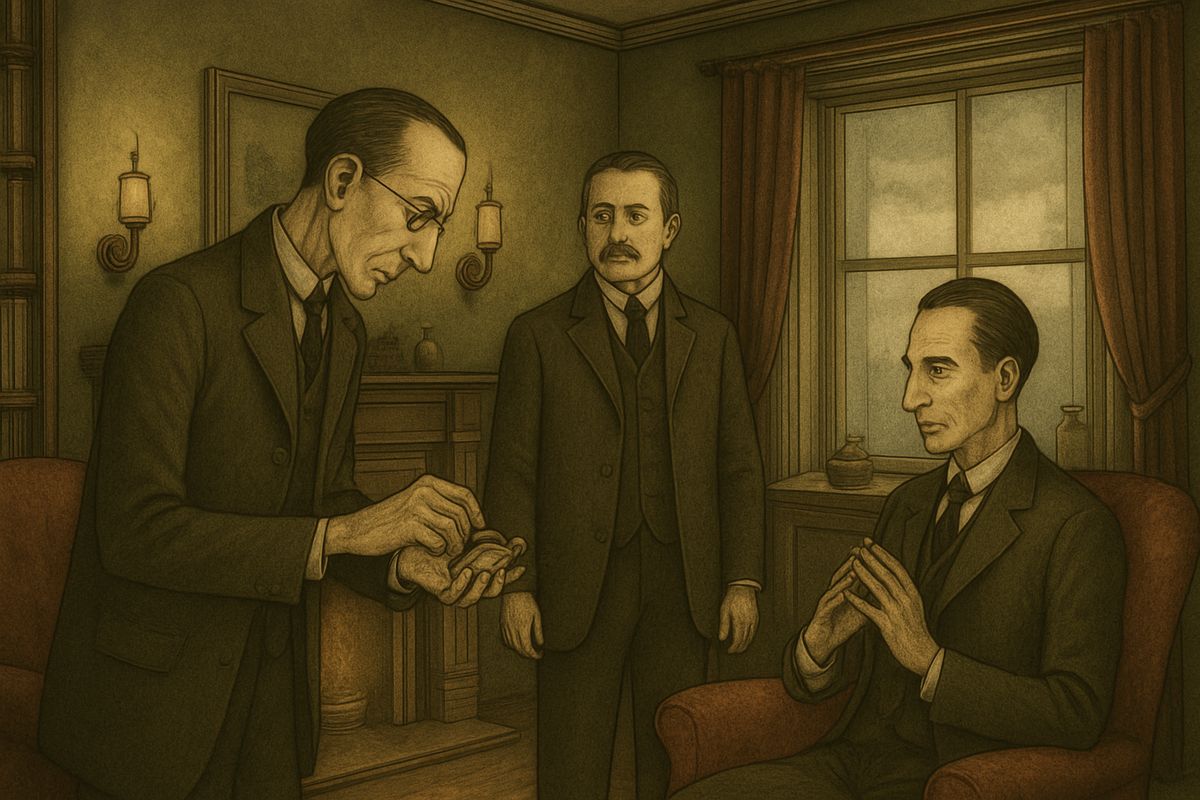
then Add to Home Screen.