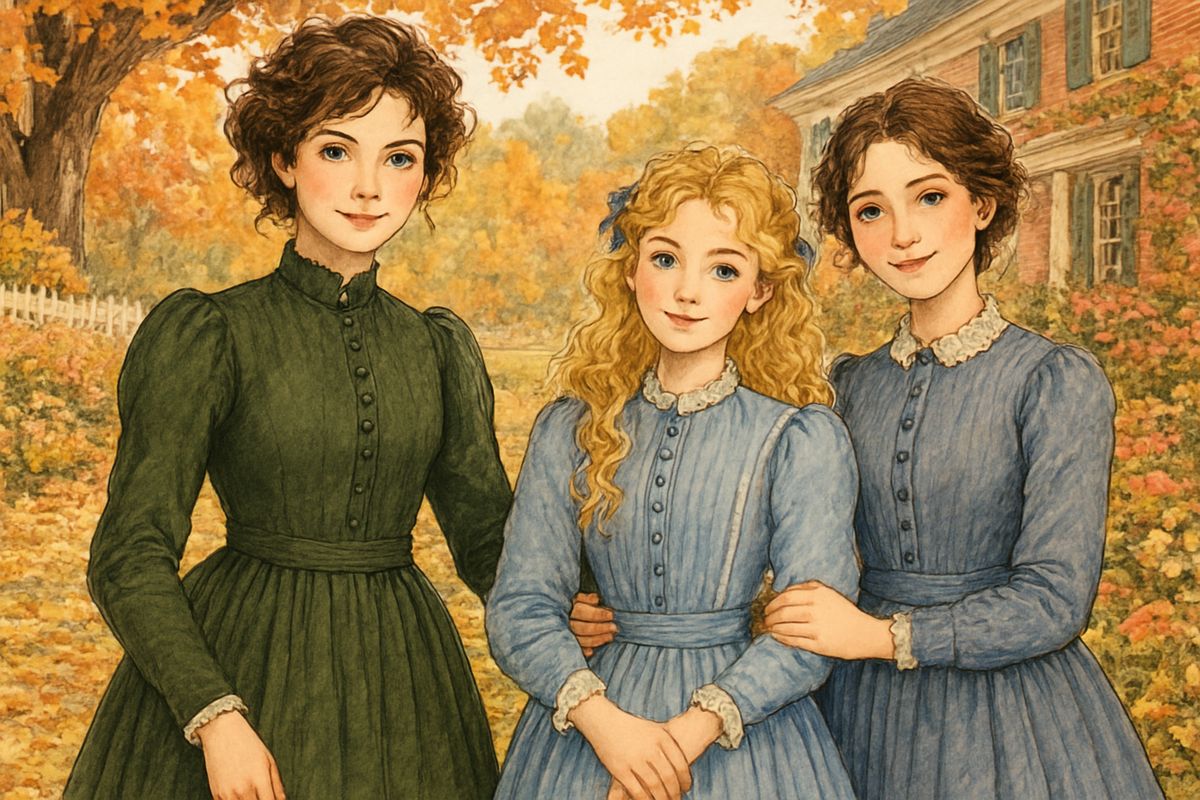
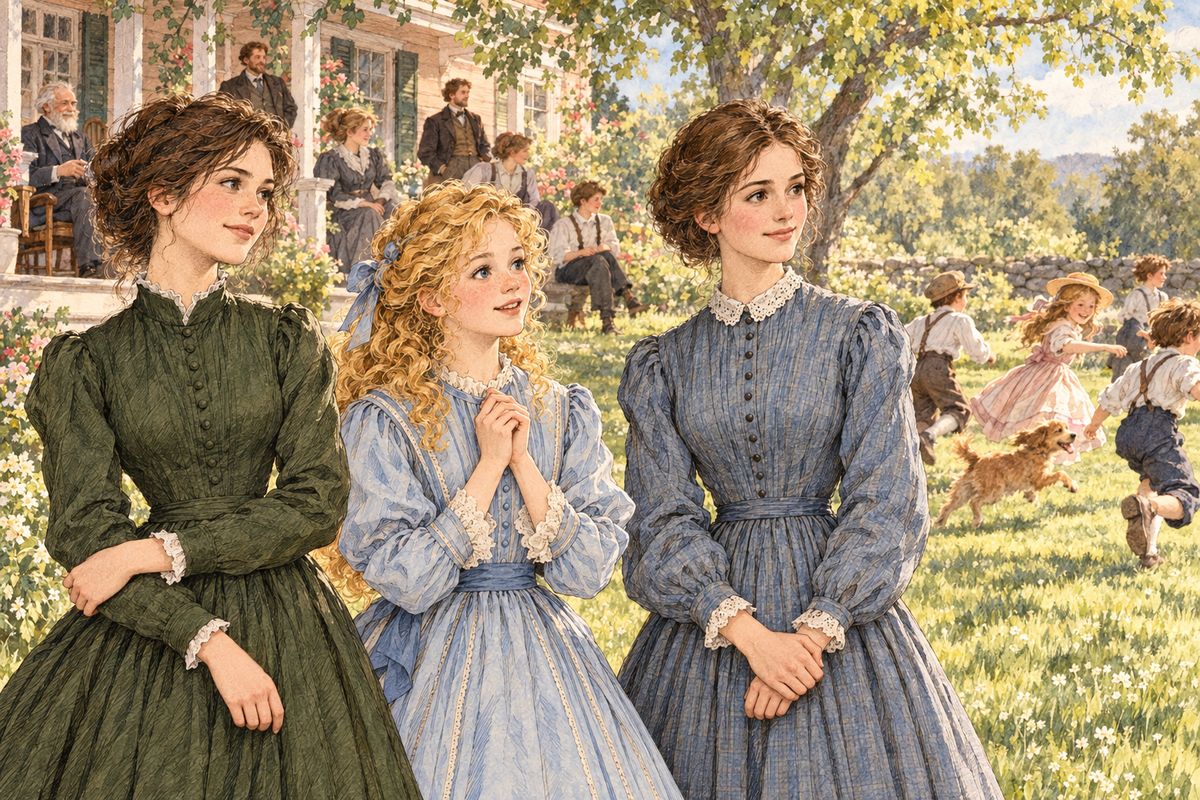
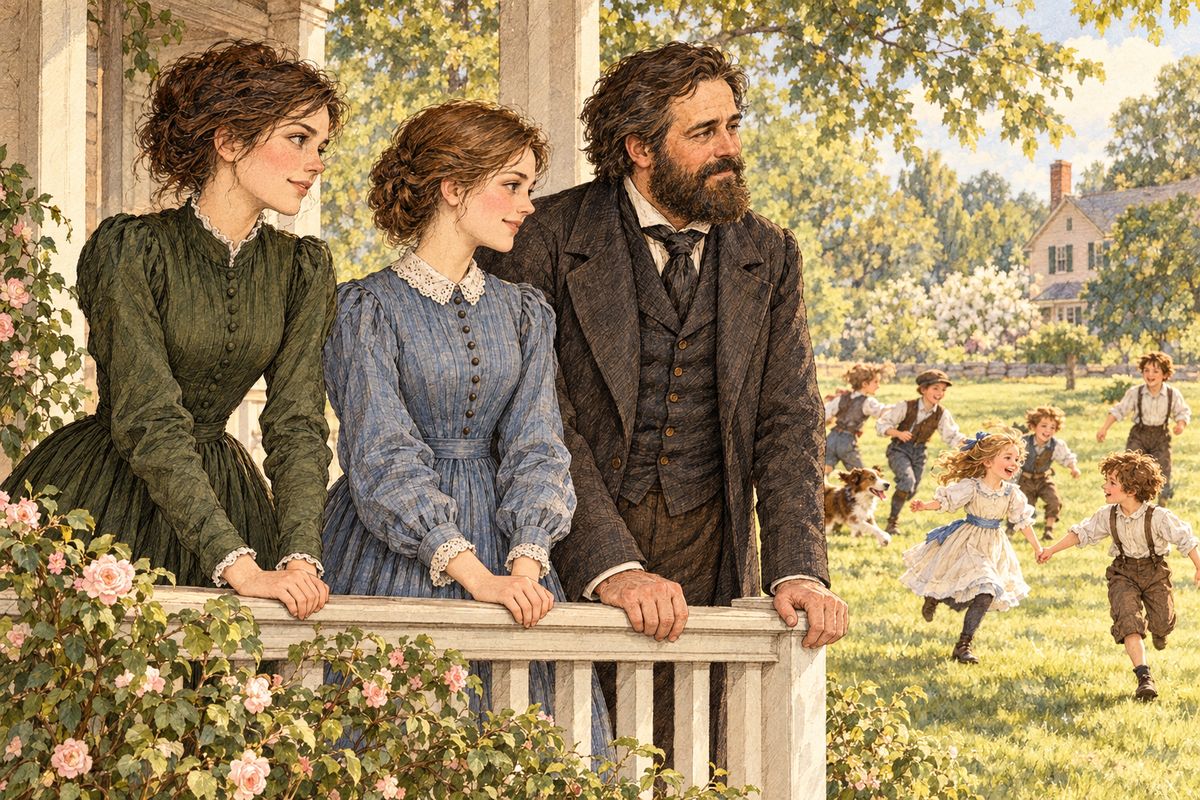
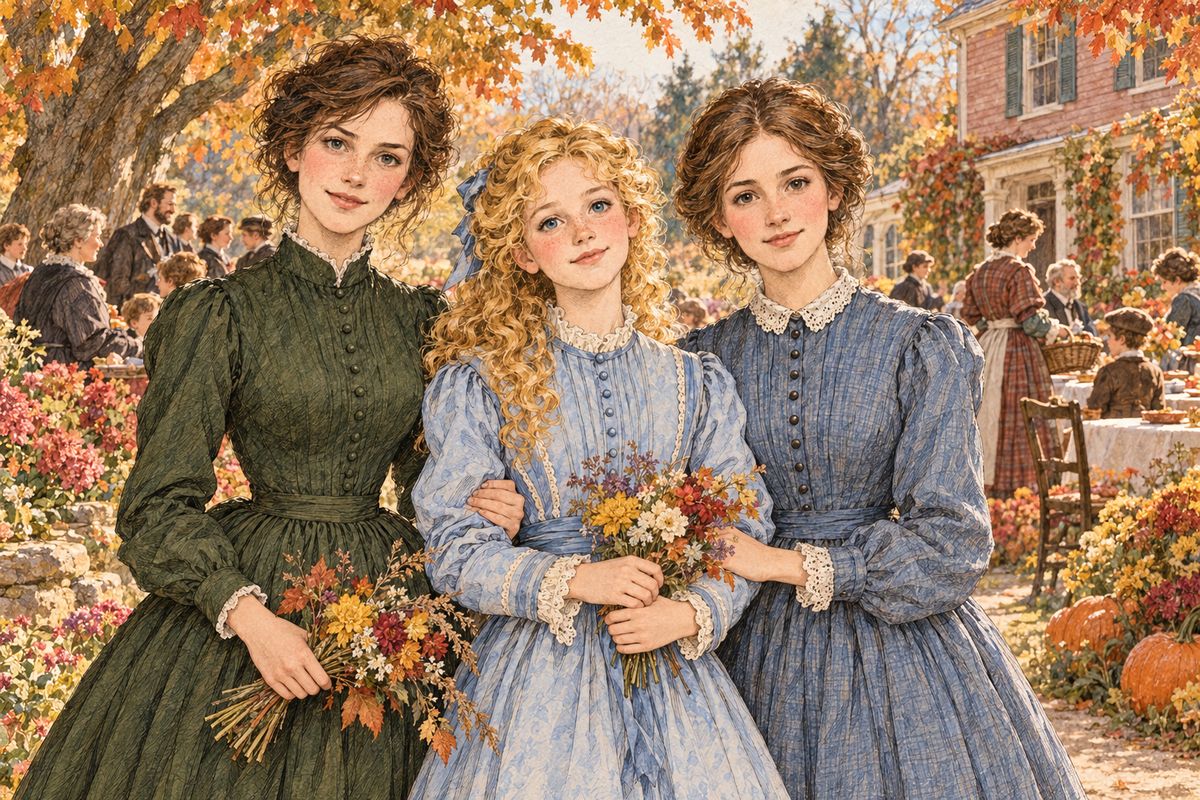
A picture-story retelling, after Louisa May Alcott (1868)
A warm family story with humor and a few serious turns. Keep the sisters distinct, preserve the book’s gentle moral voice, and handle illness, grief, and the Civil War without graphic or sensational detail.
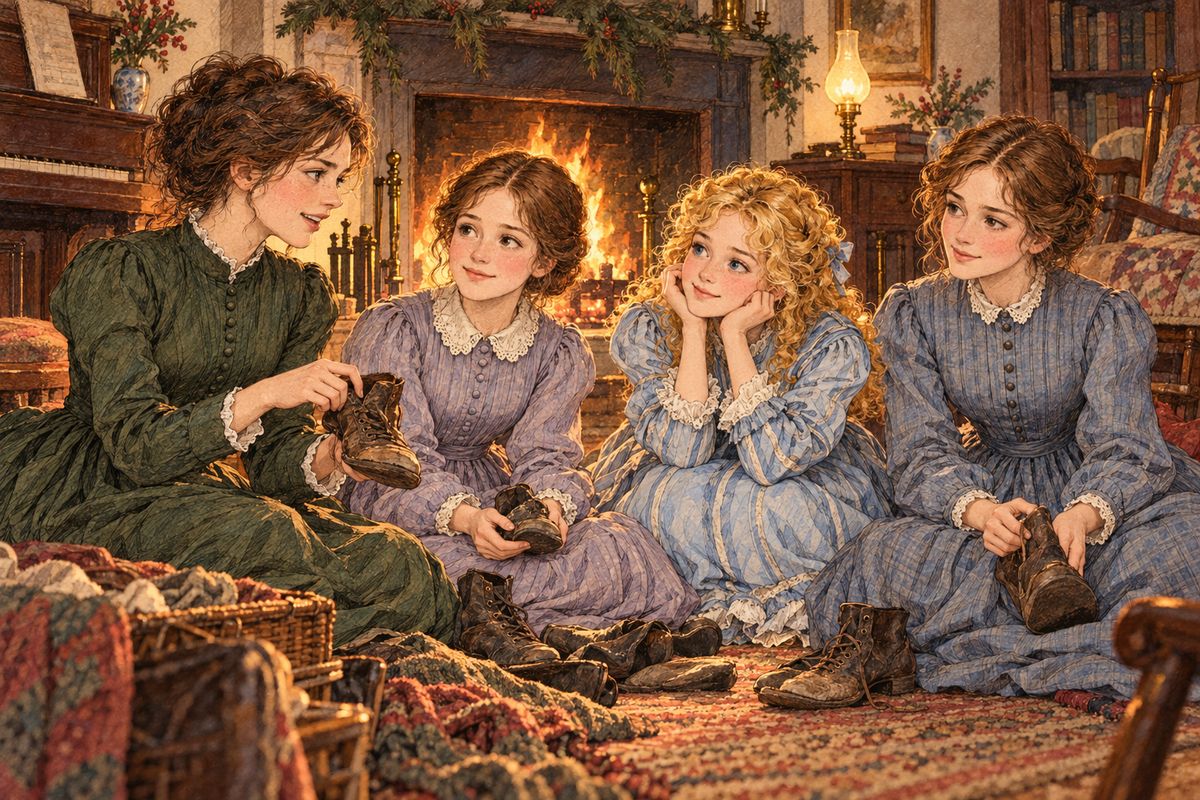
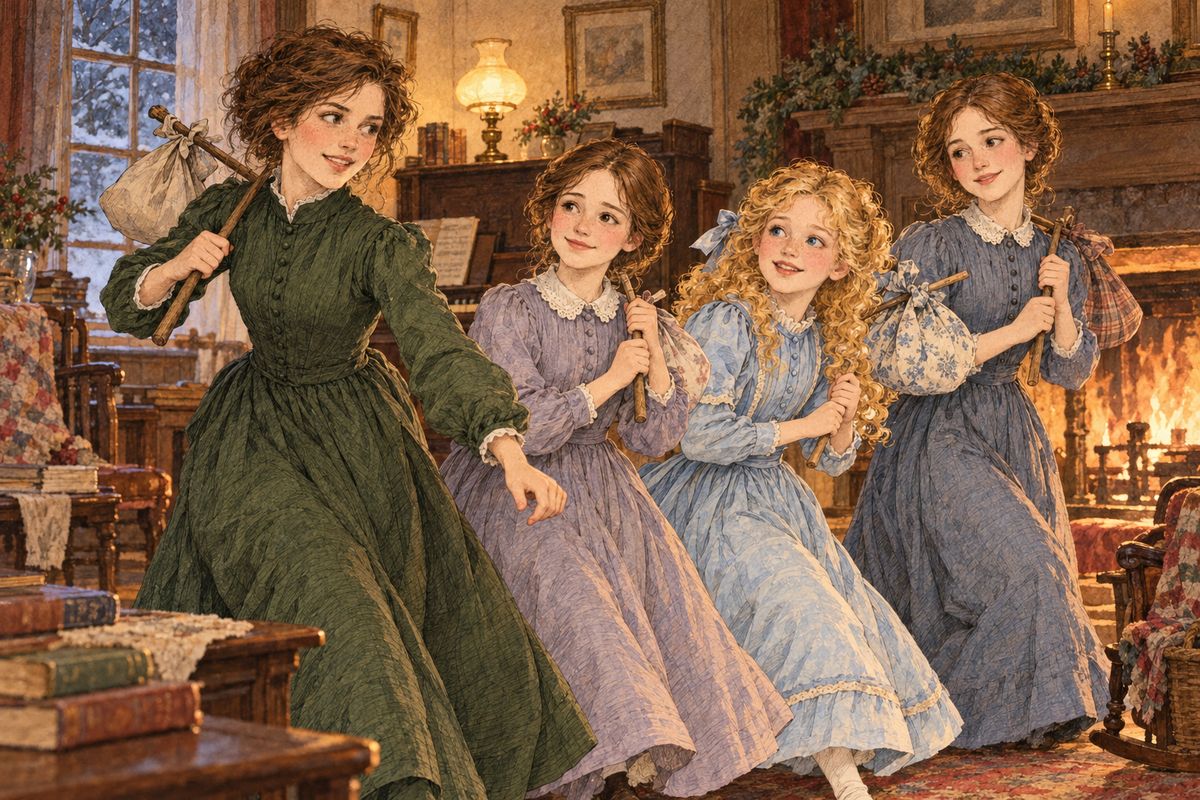
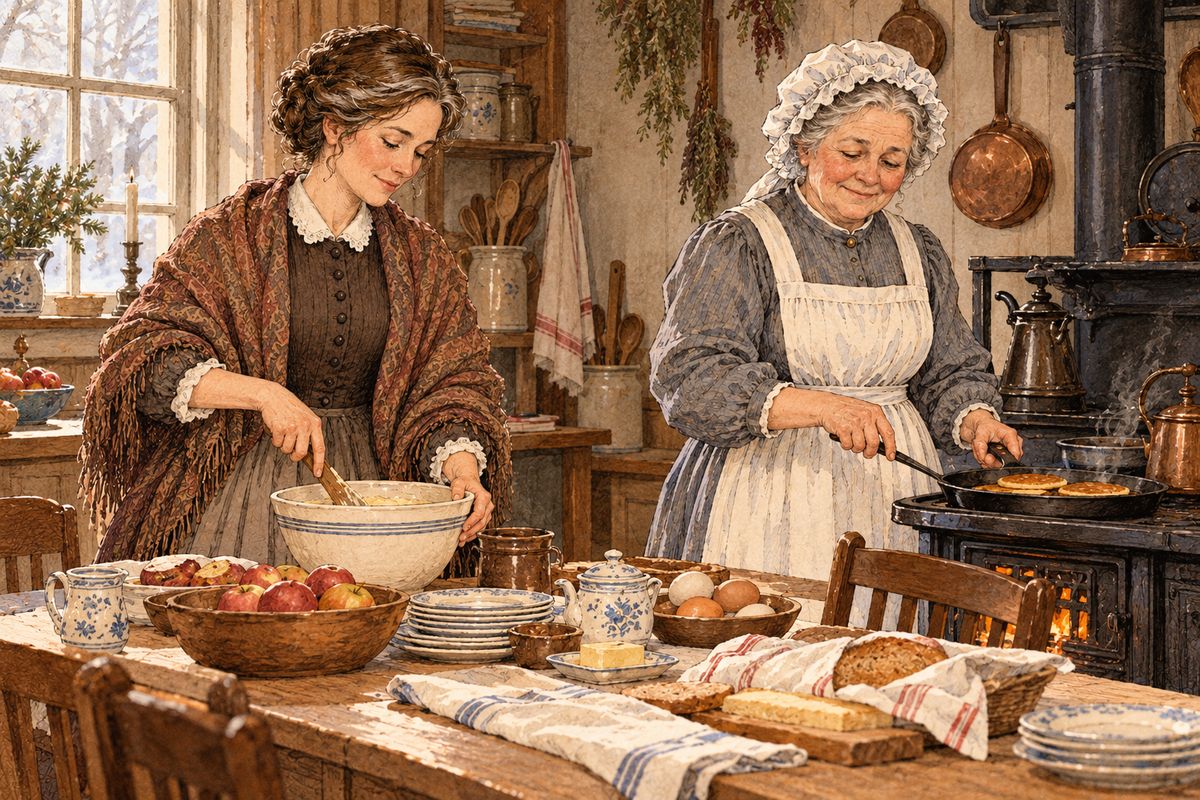
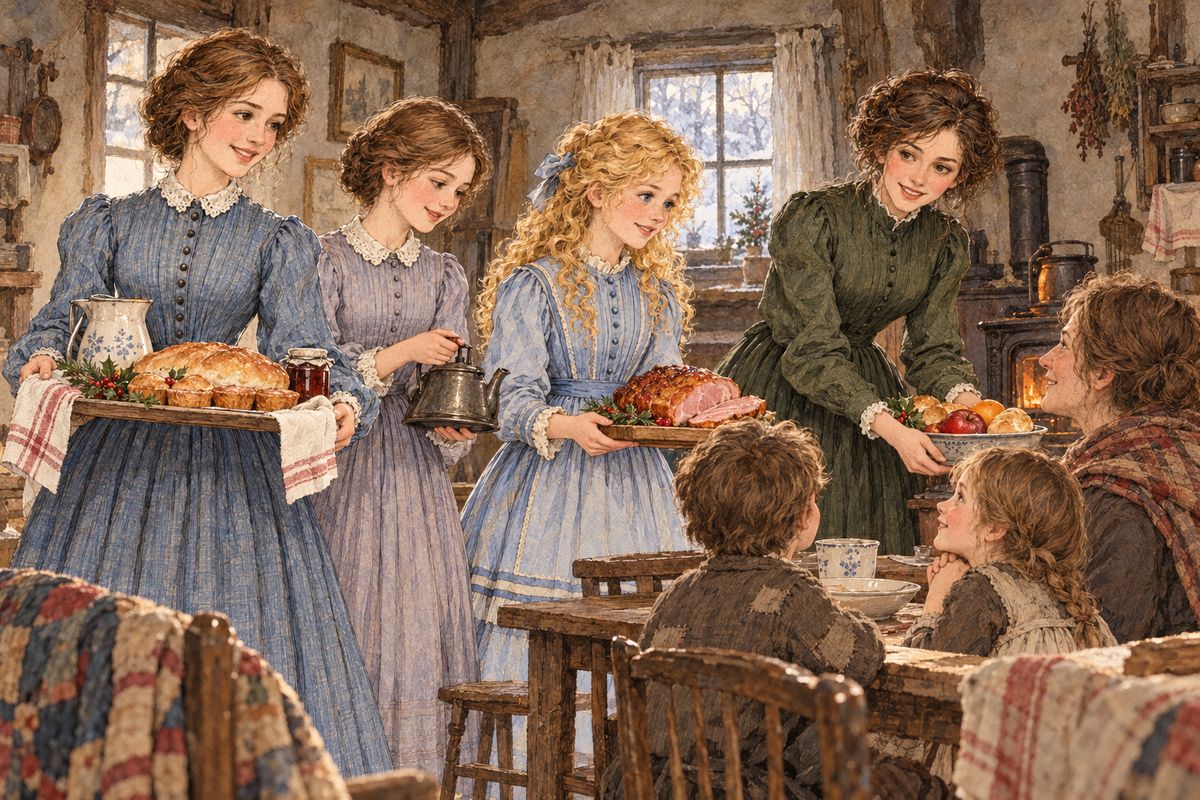
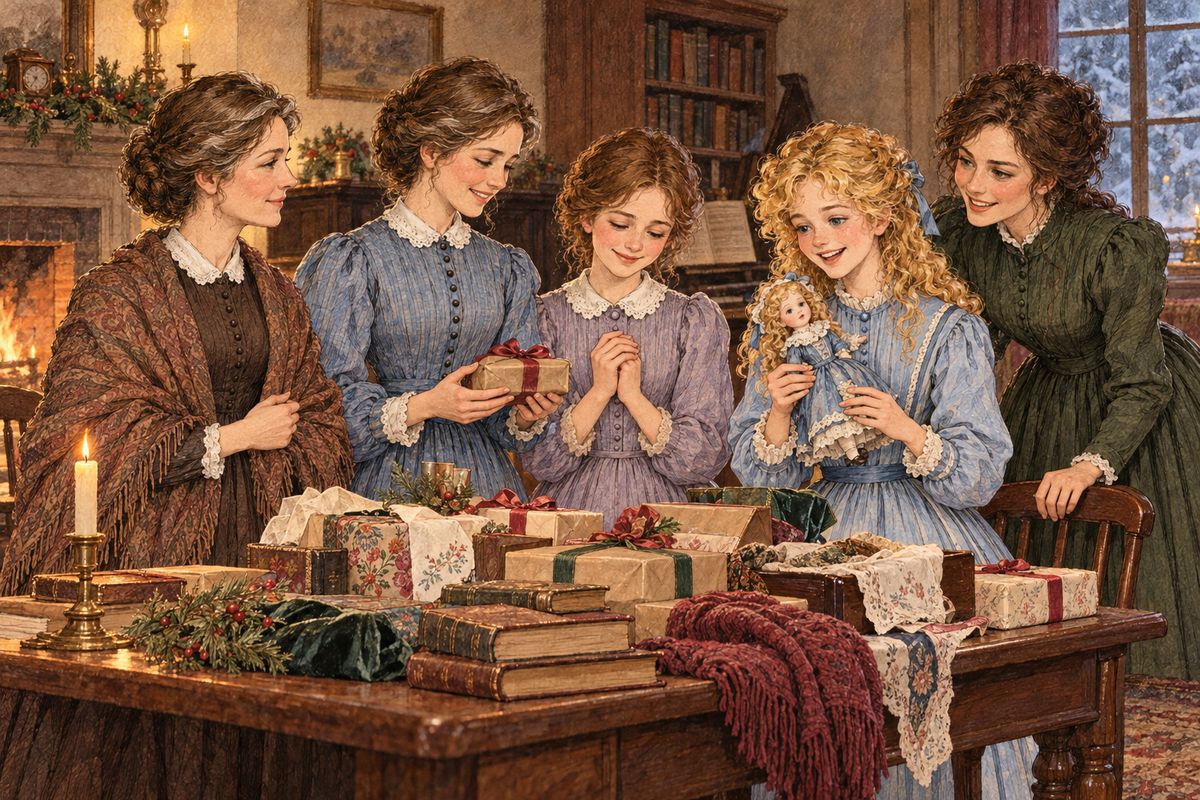
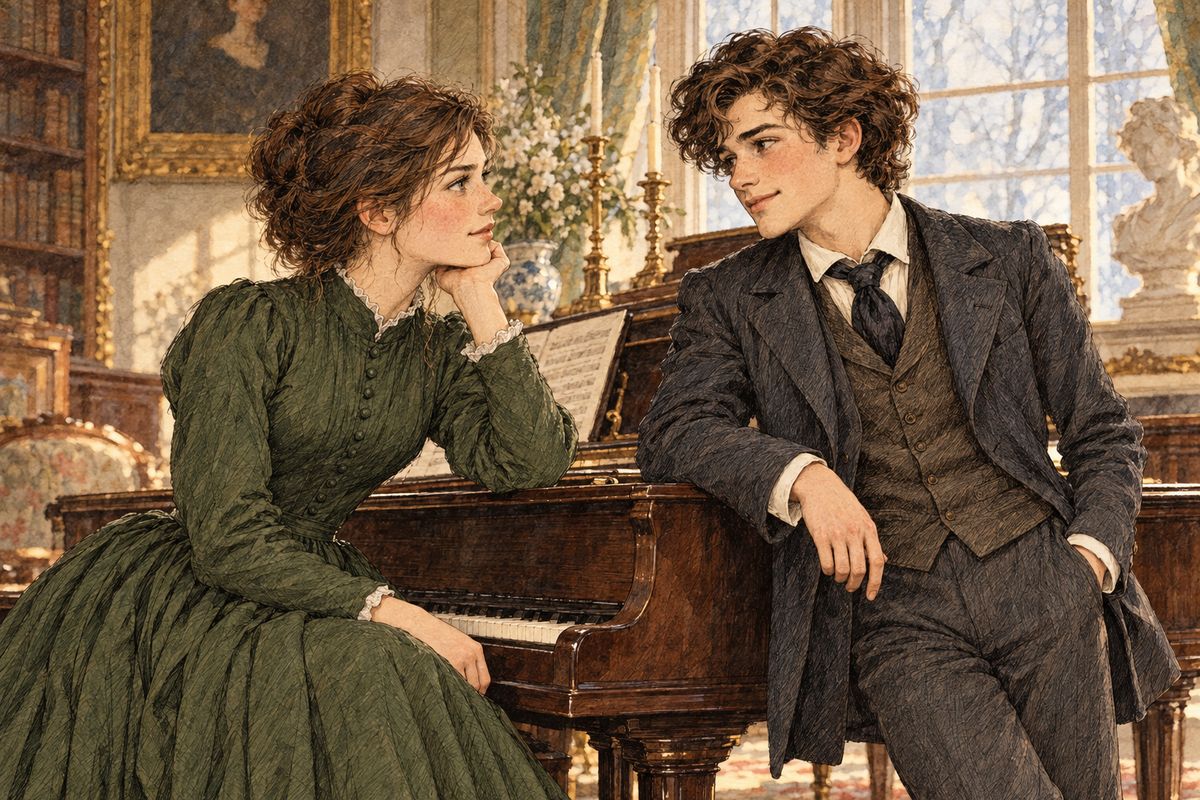
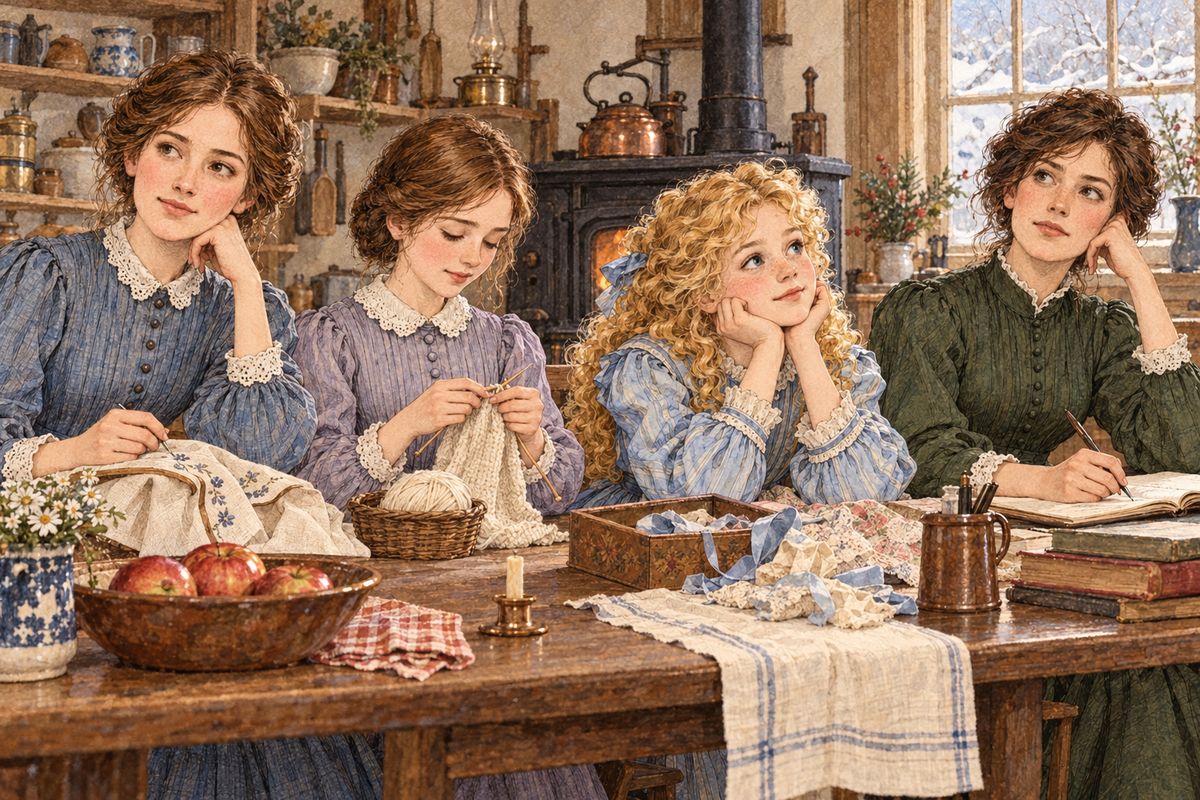
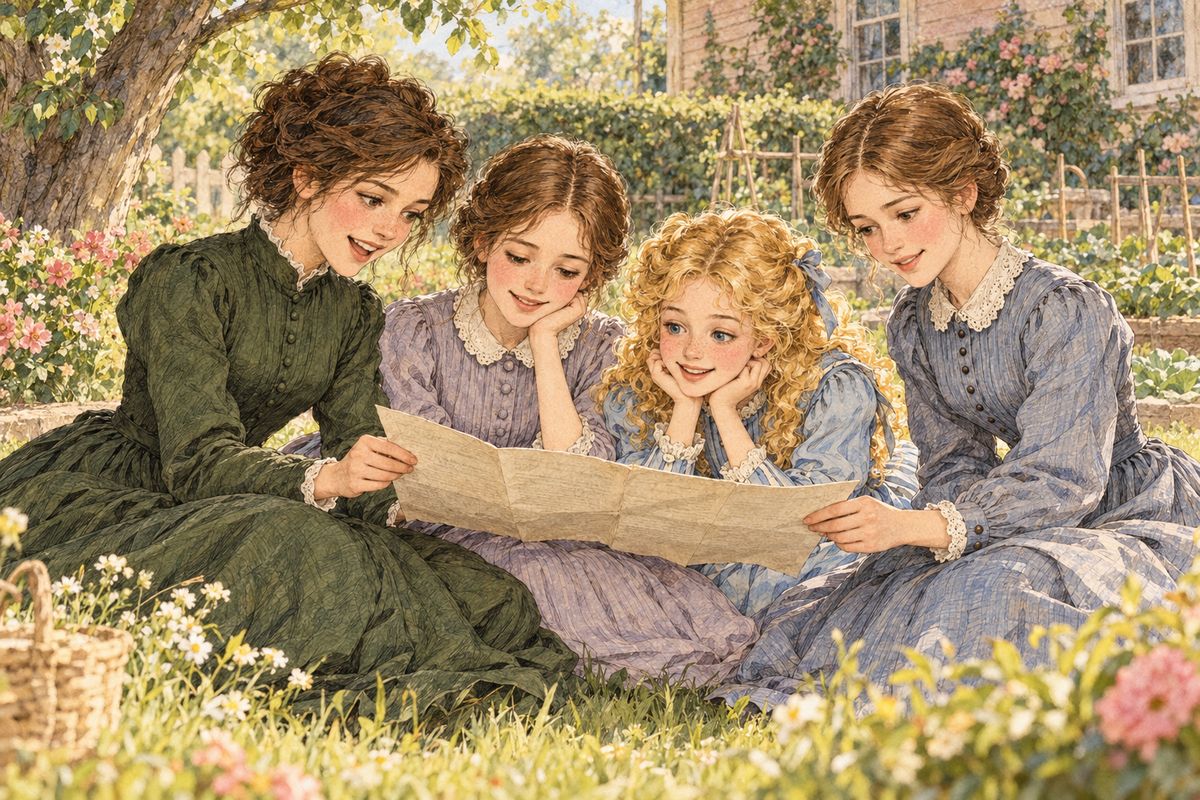
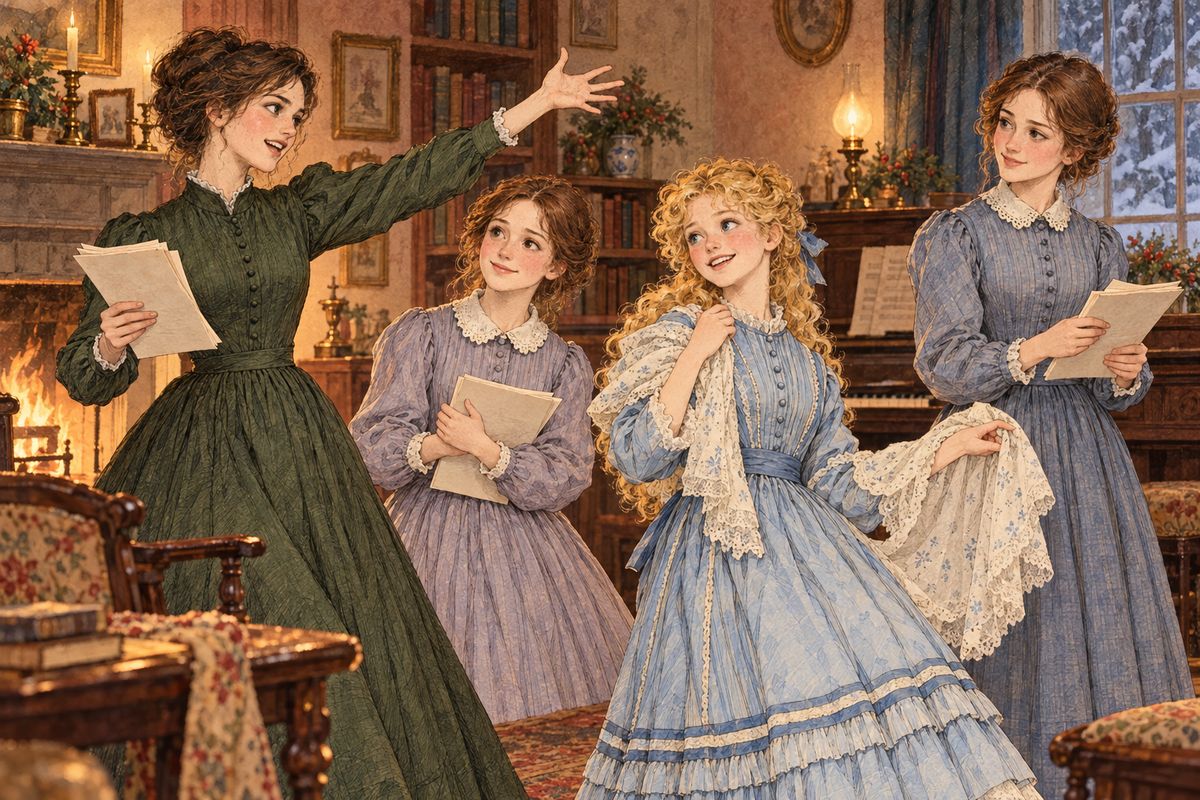
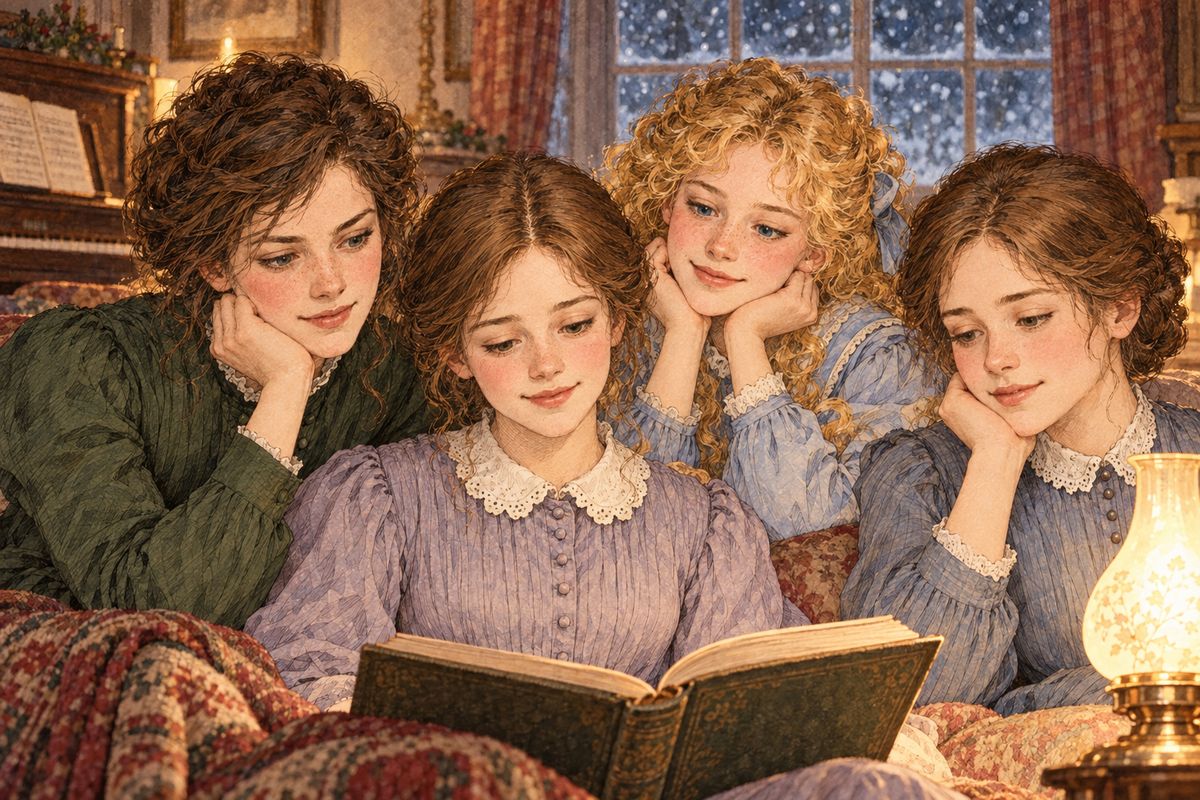
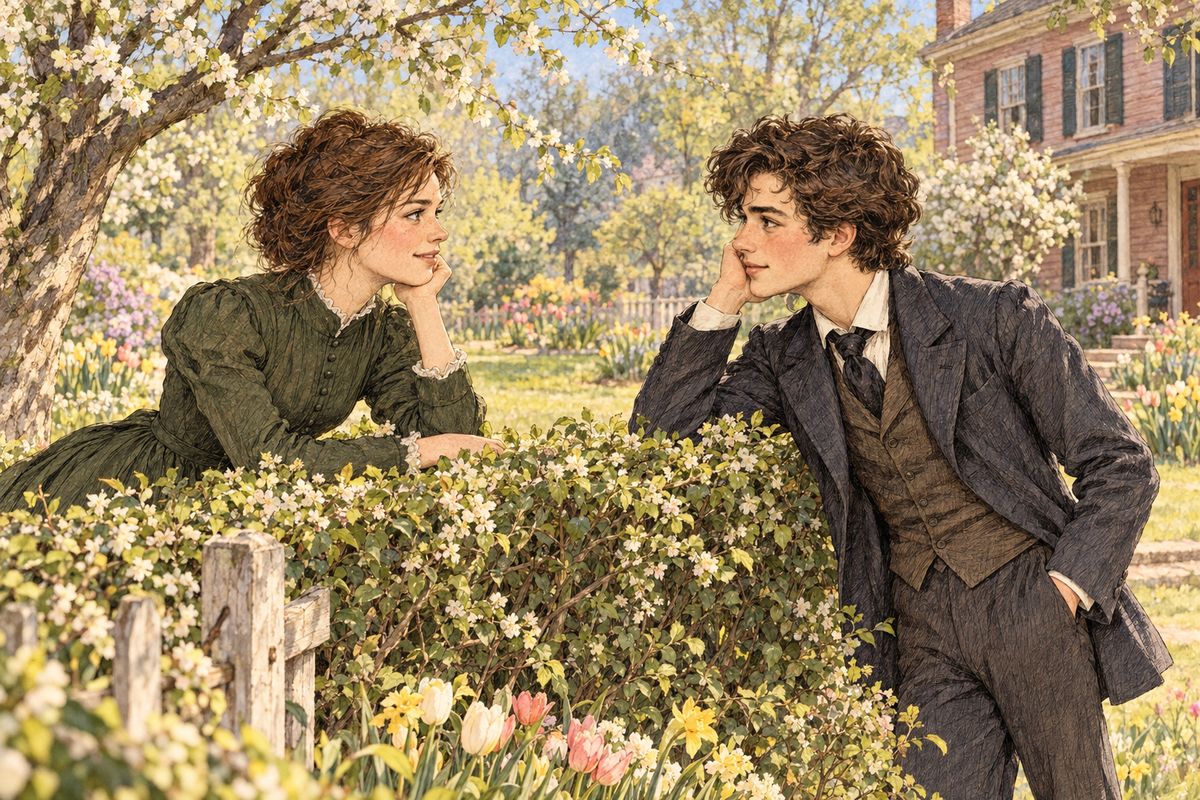
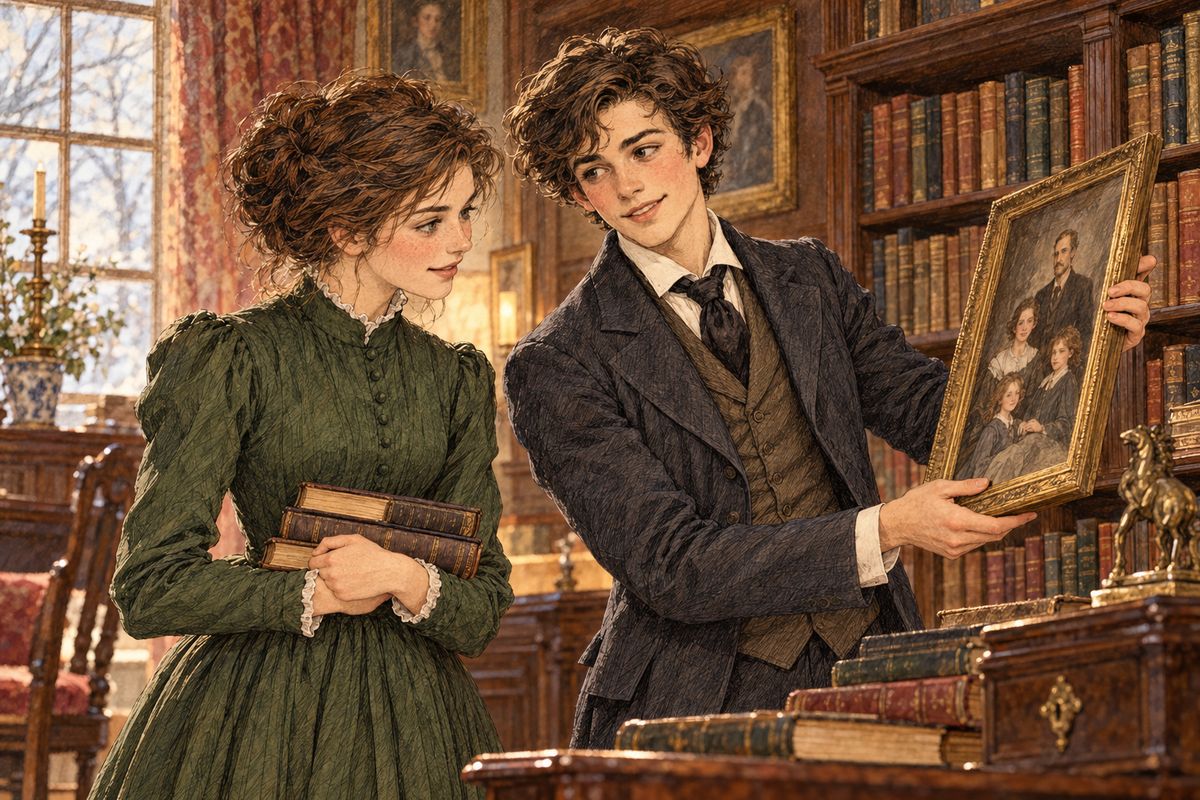
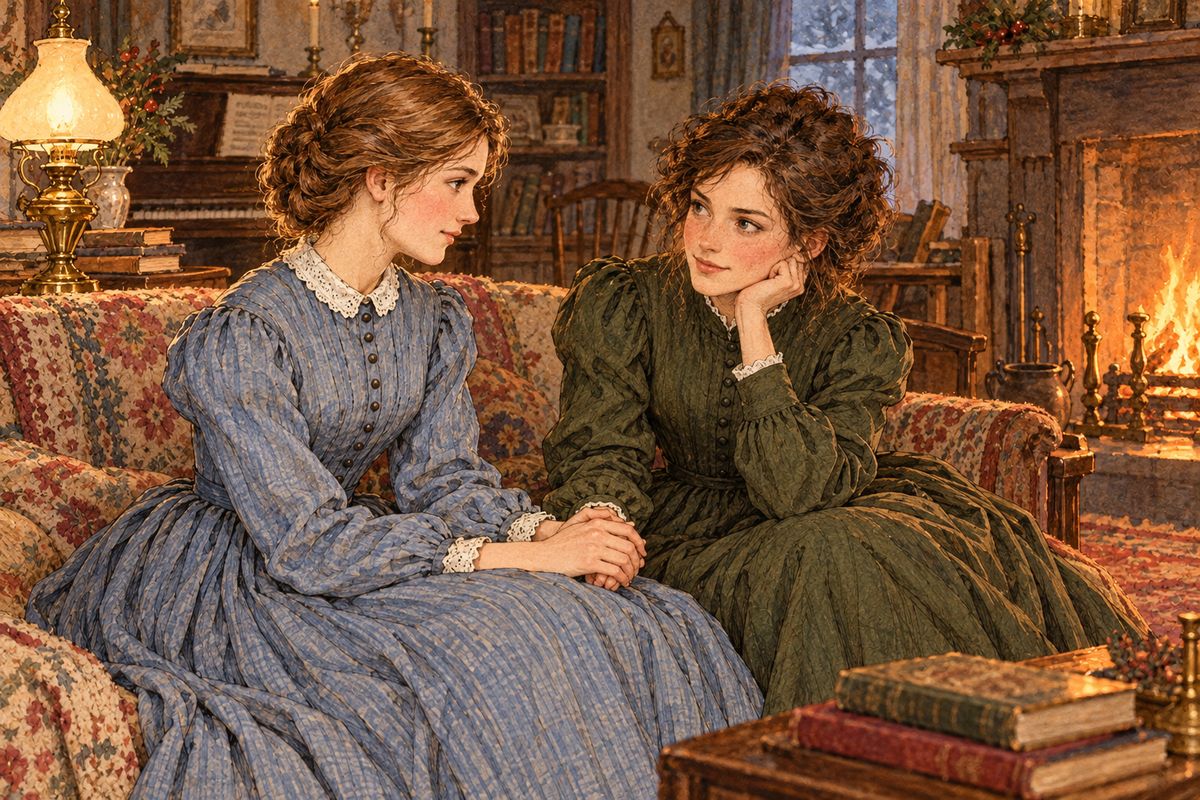
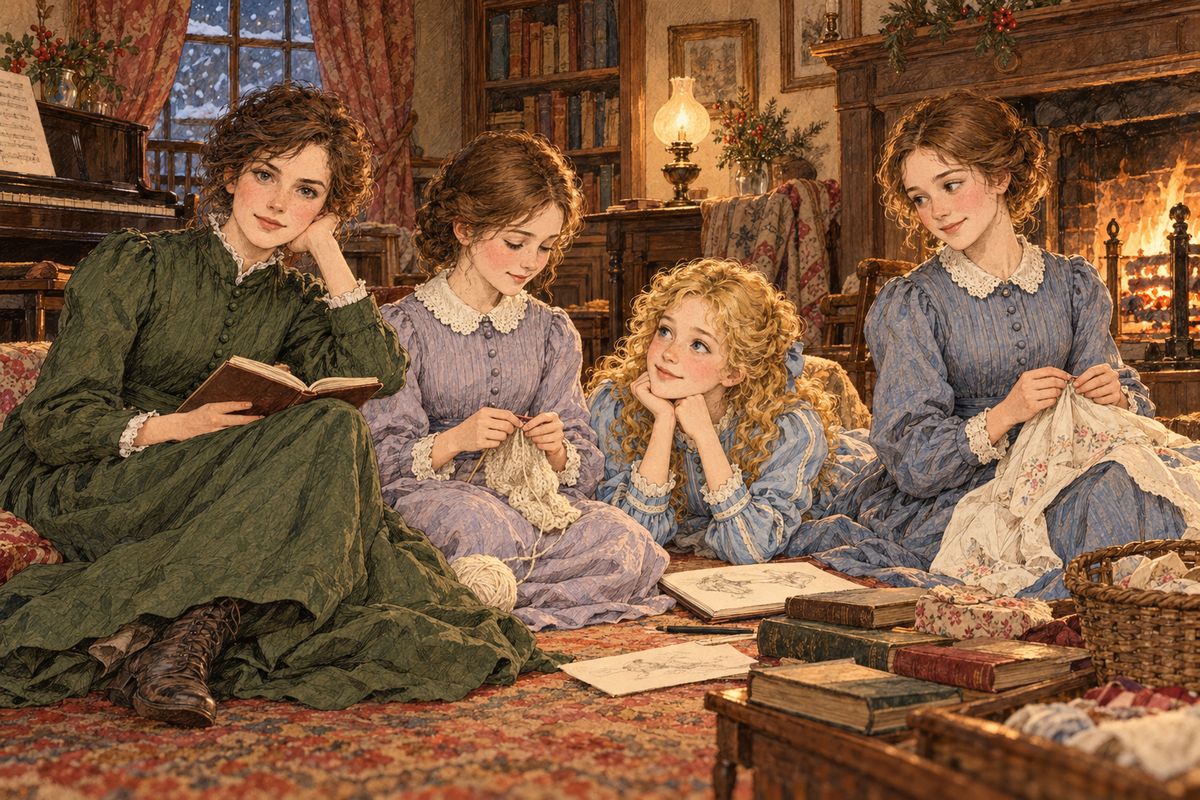
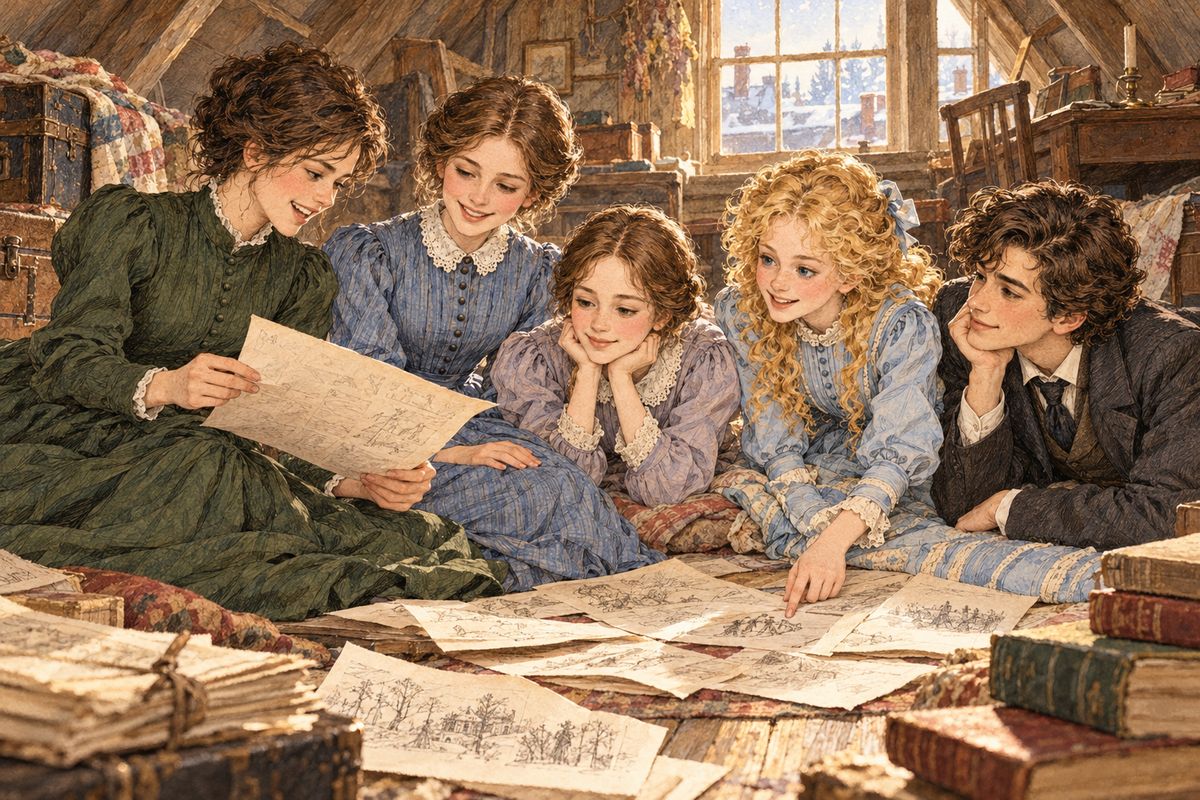
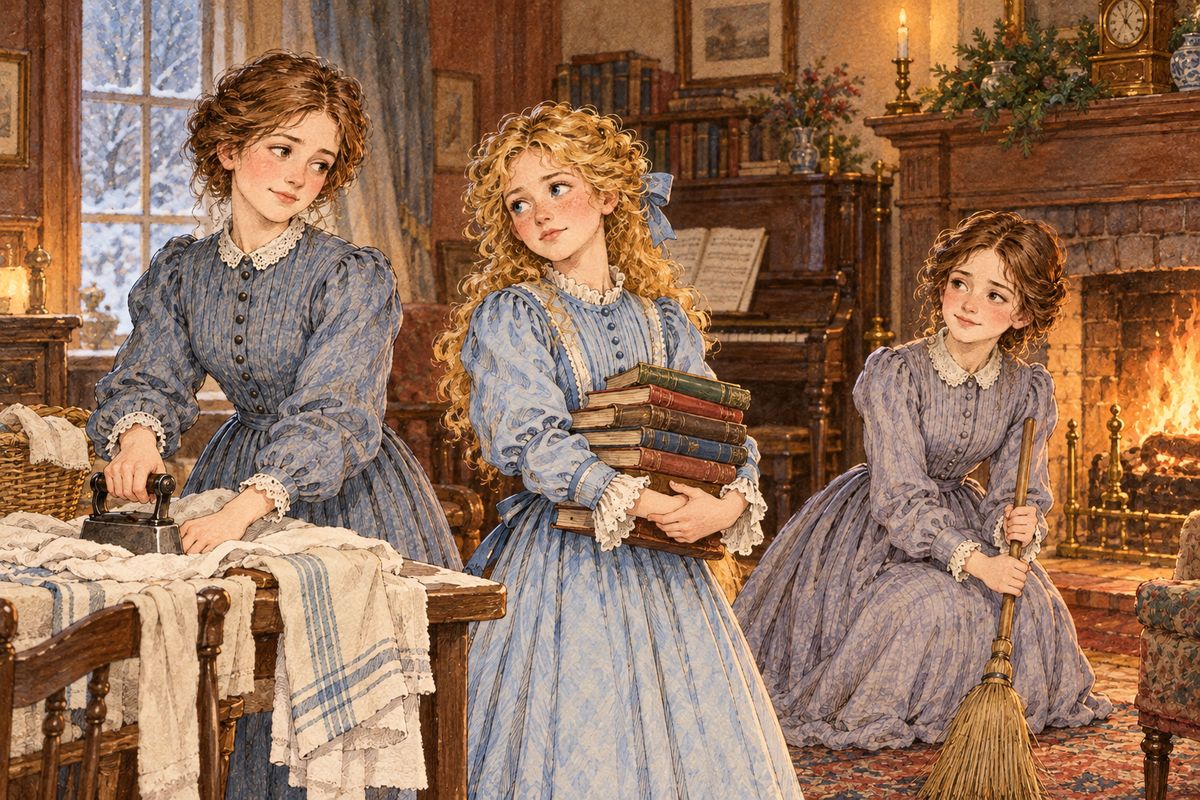
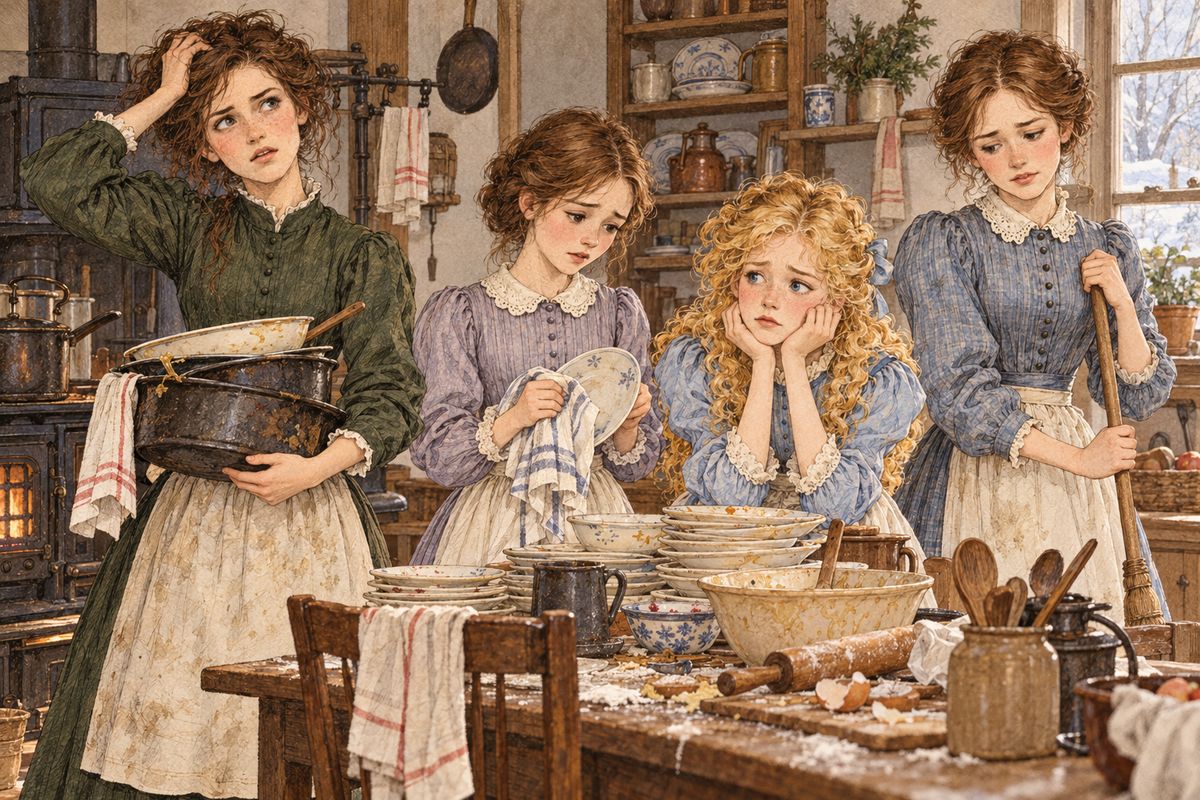
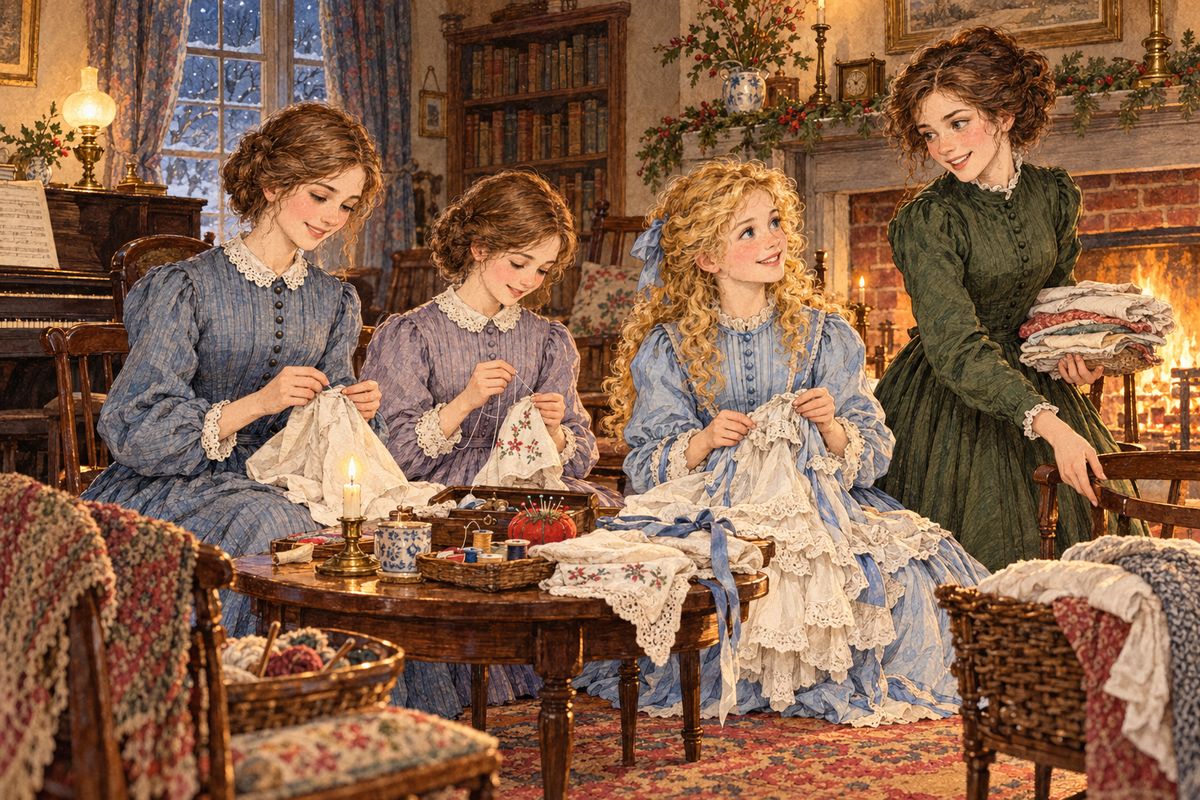
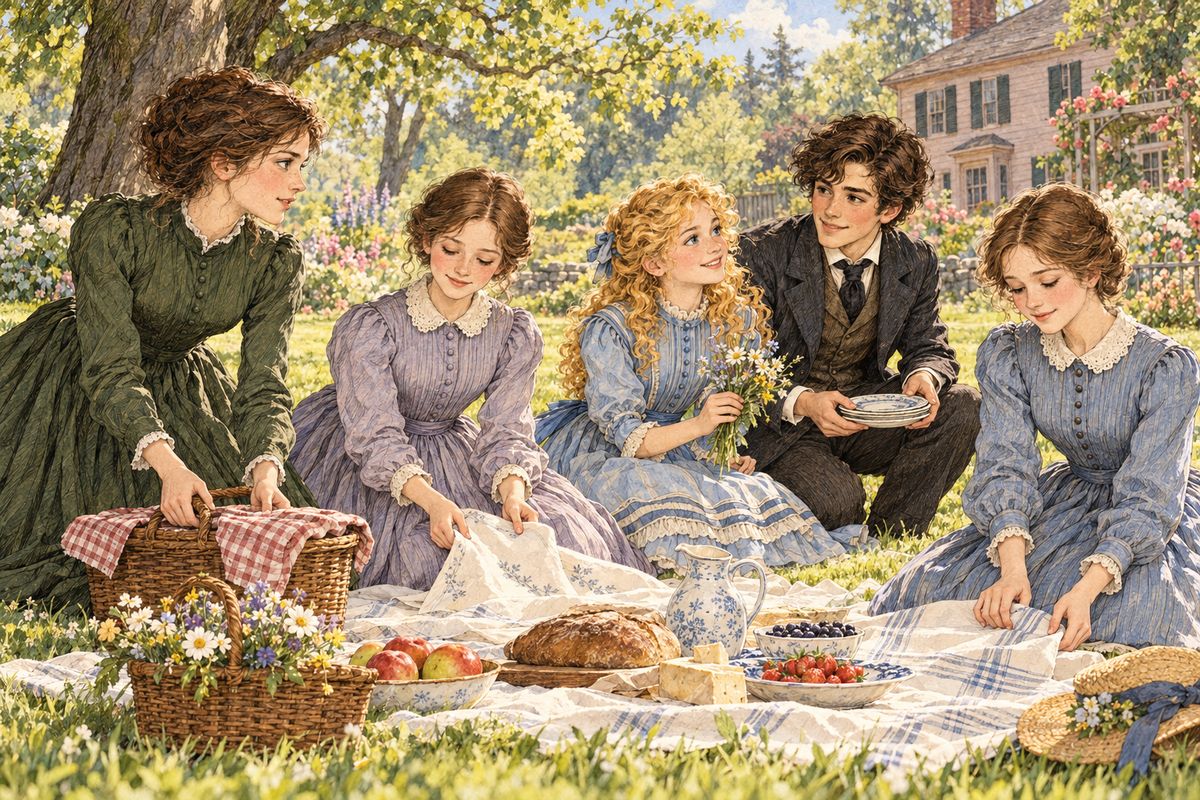
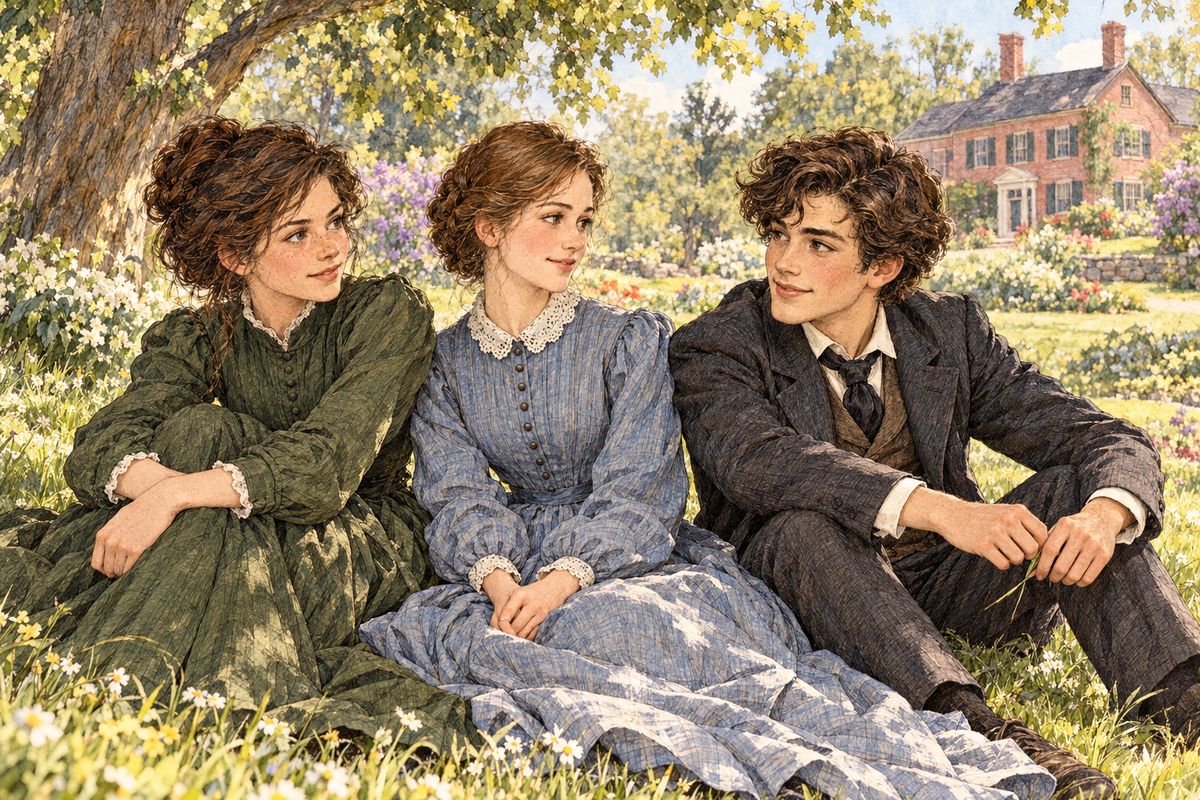
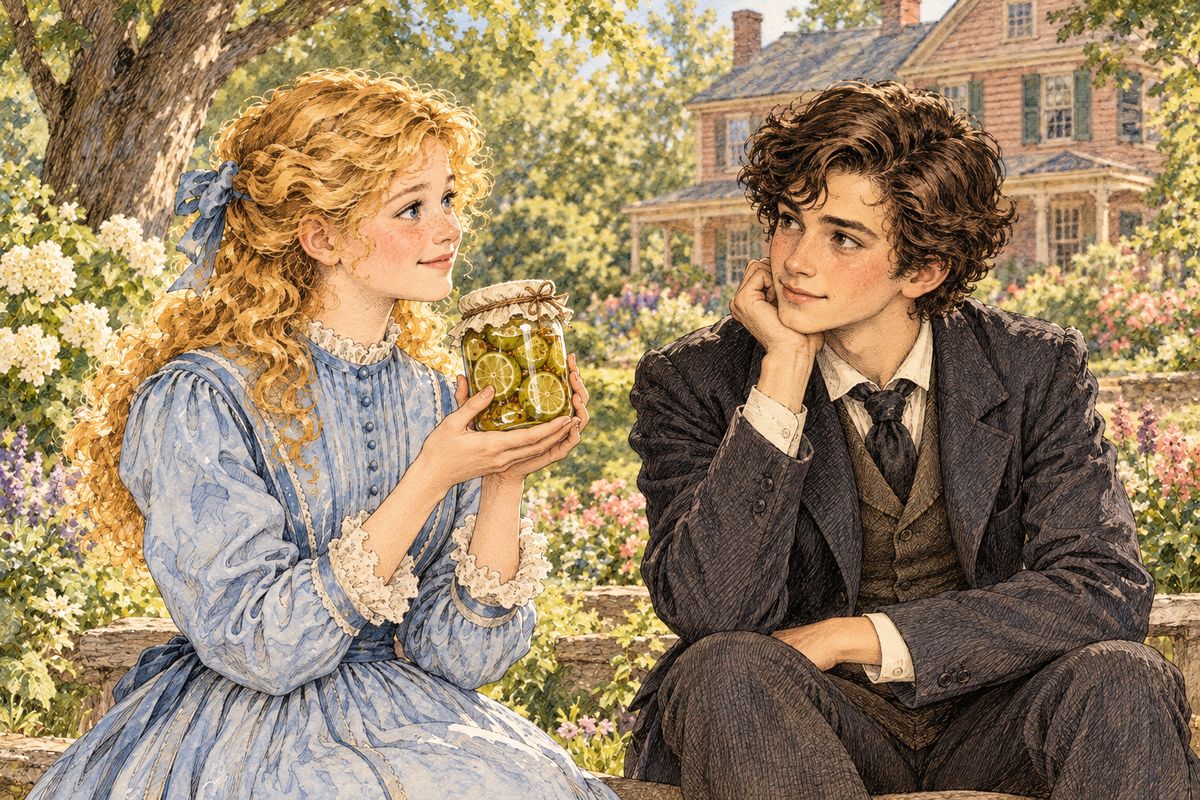
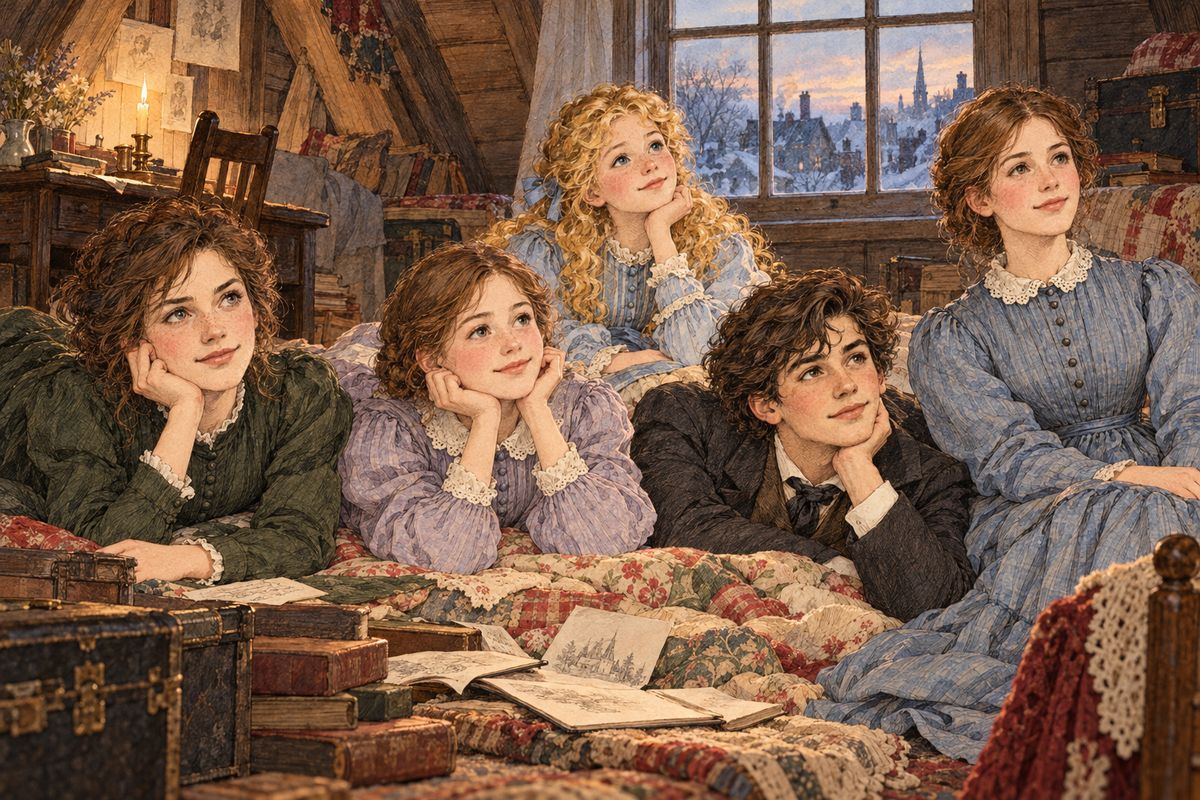
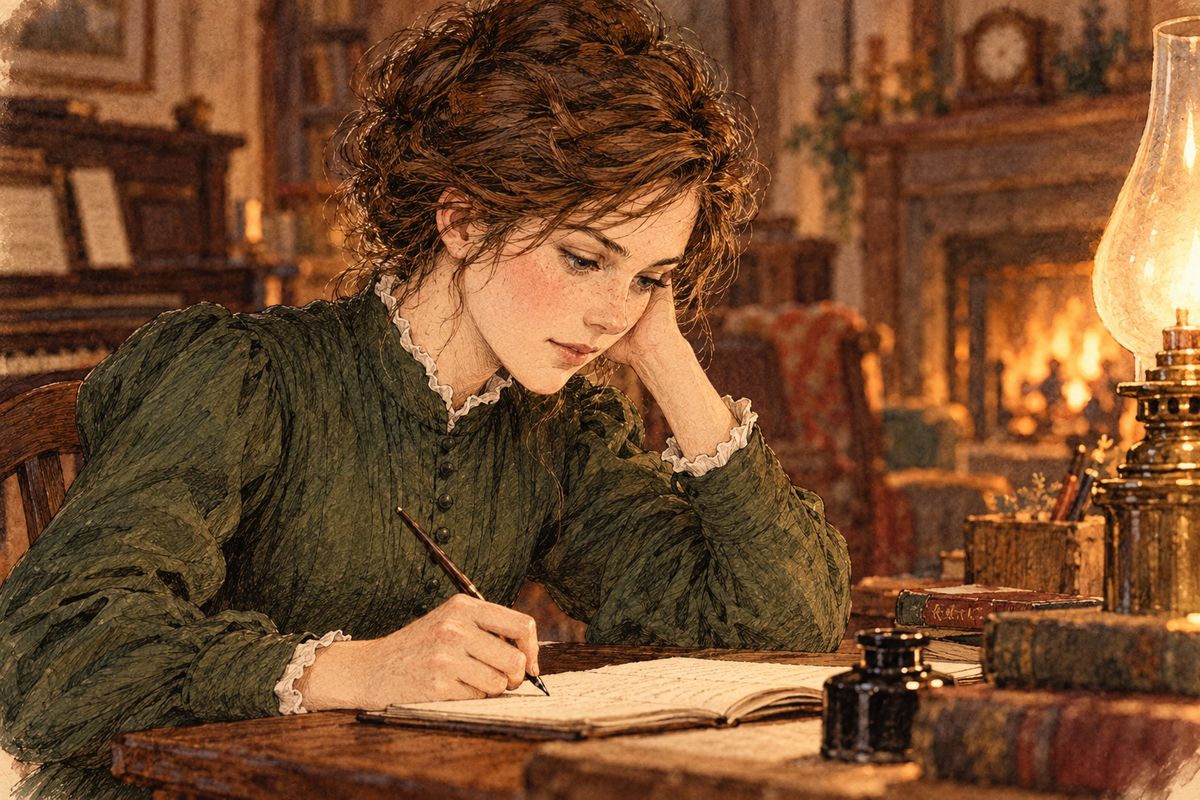
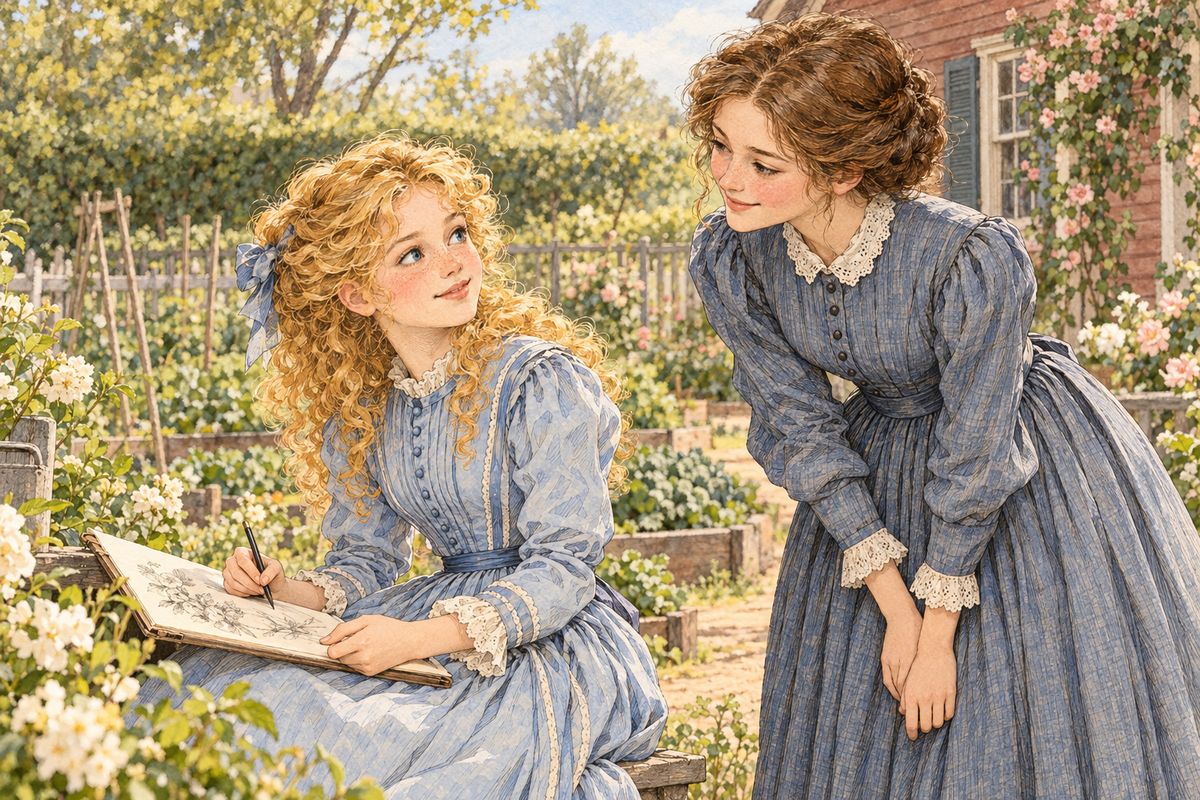
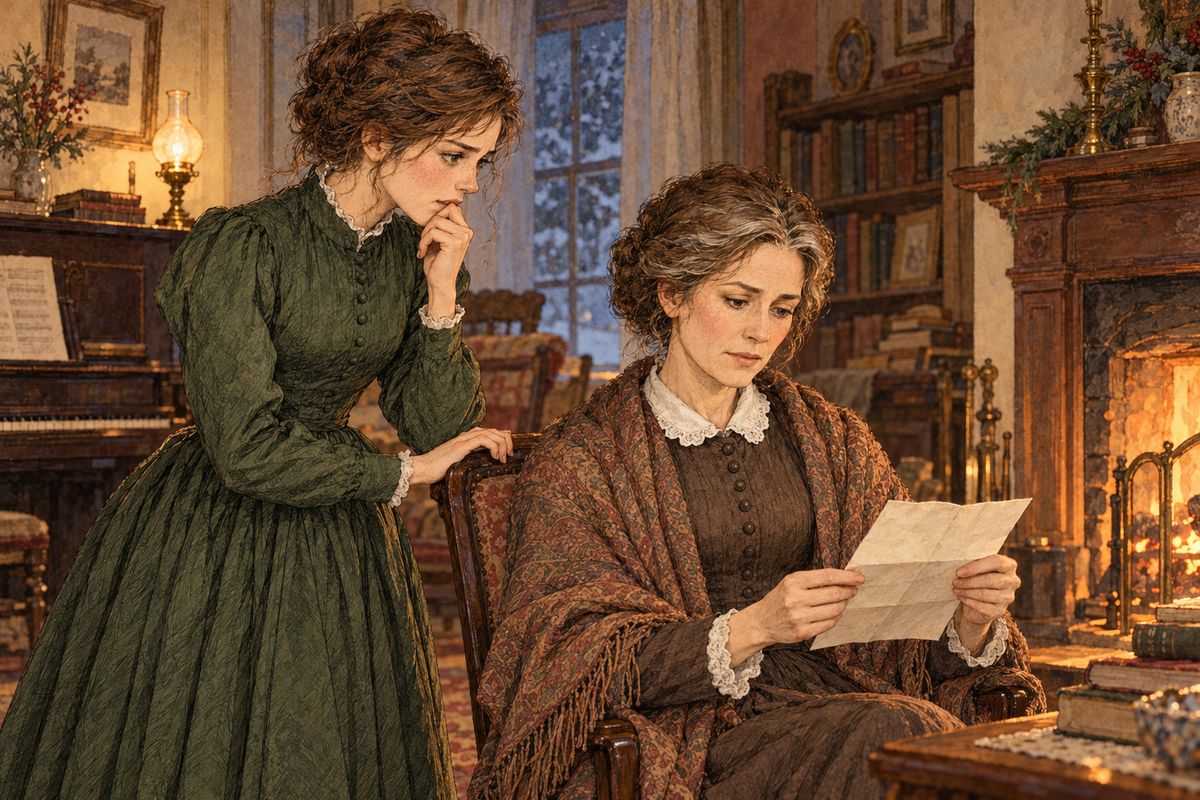
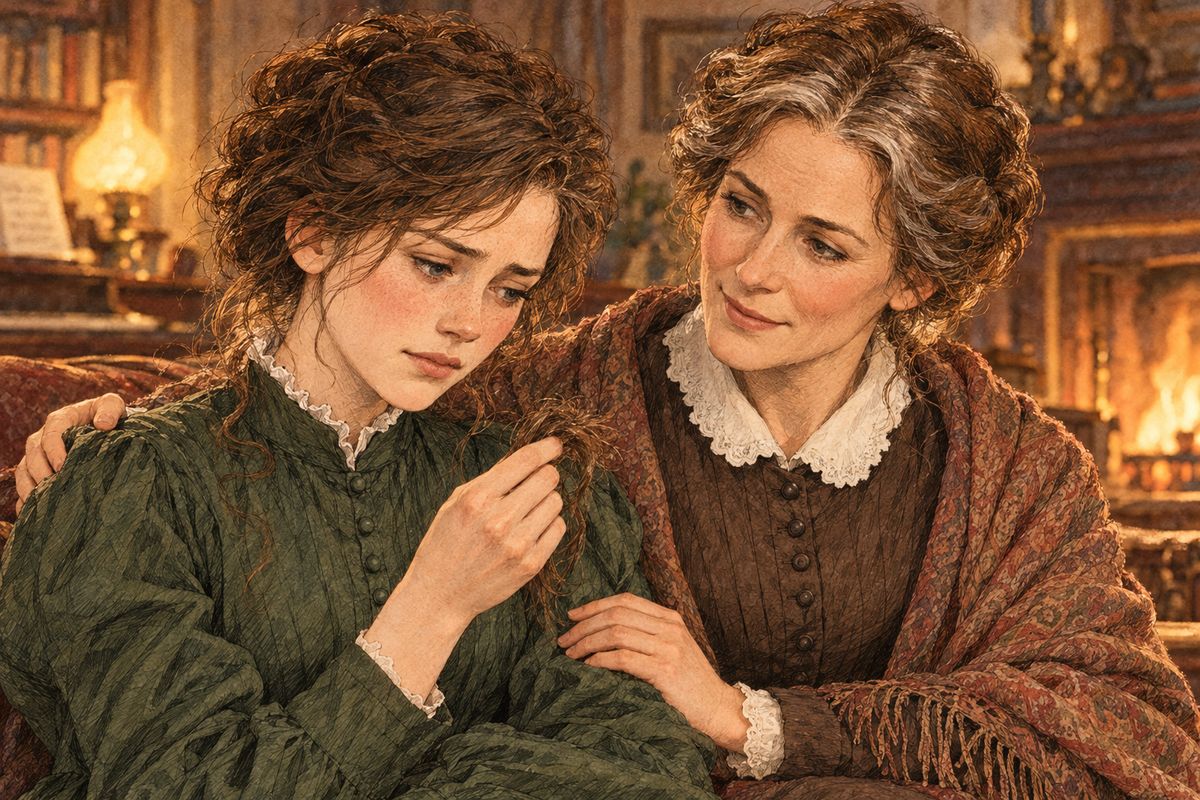
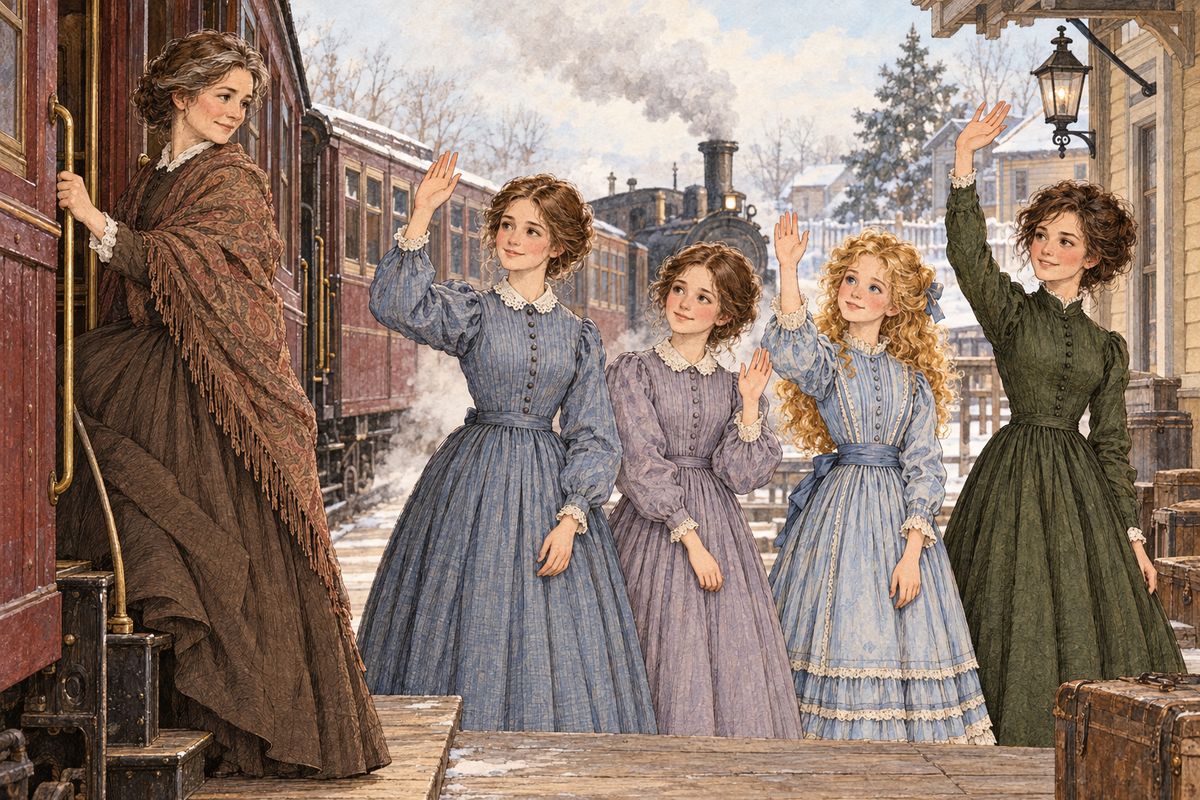
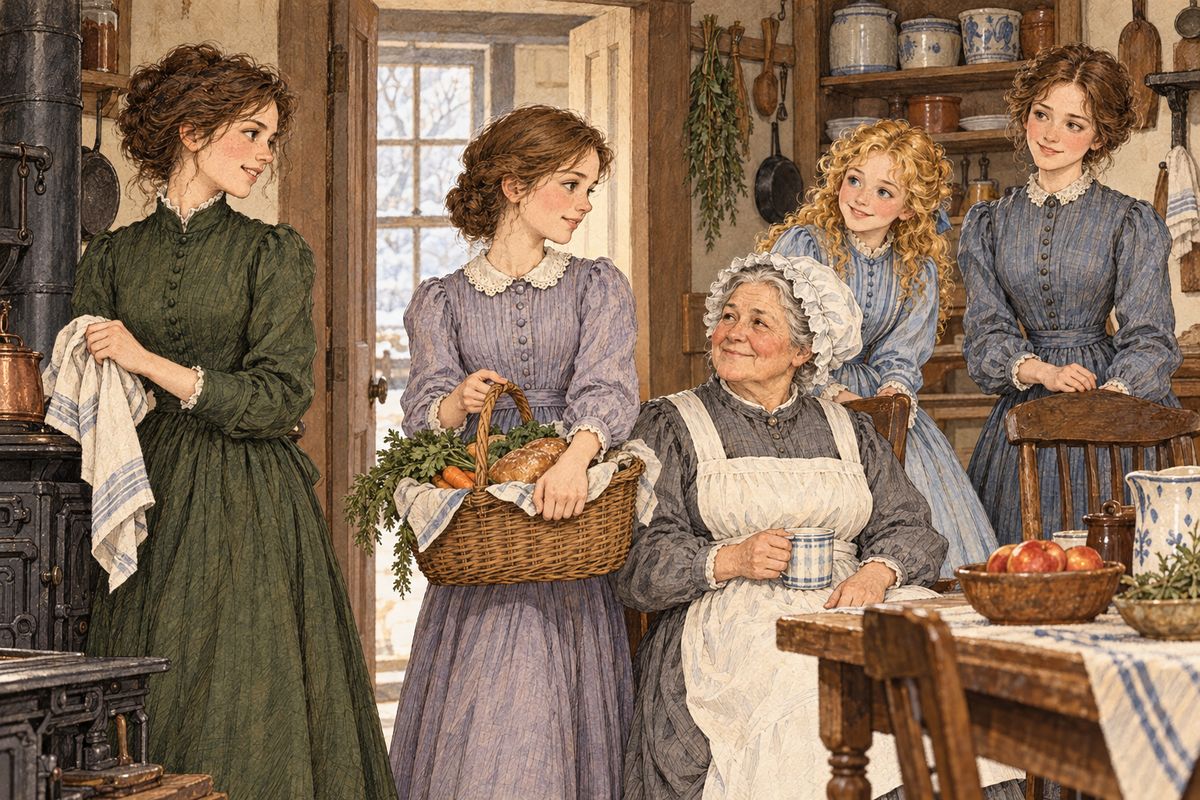
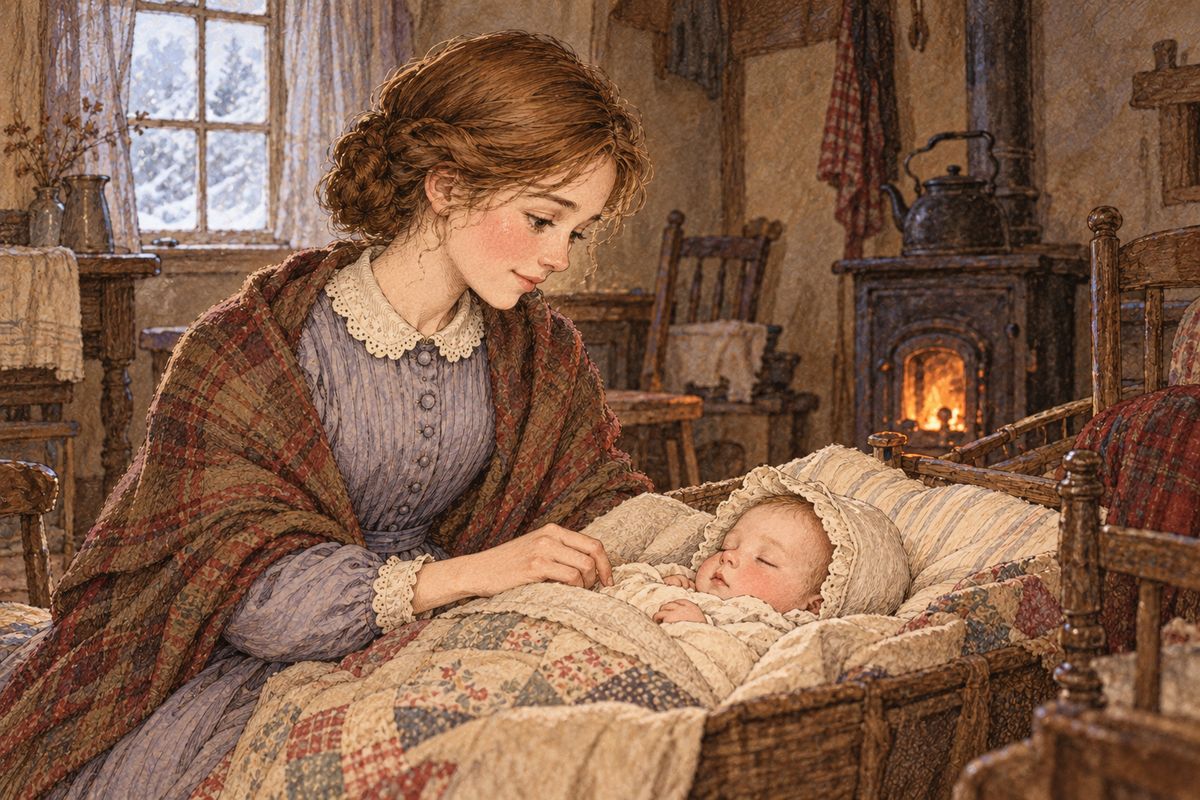
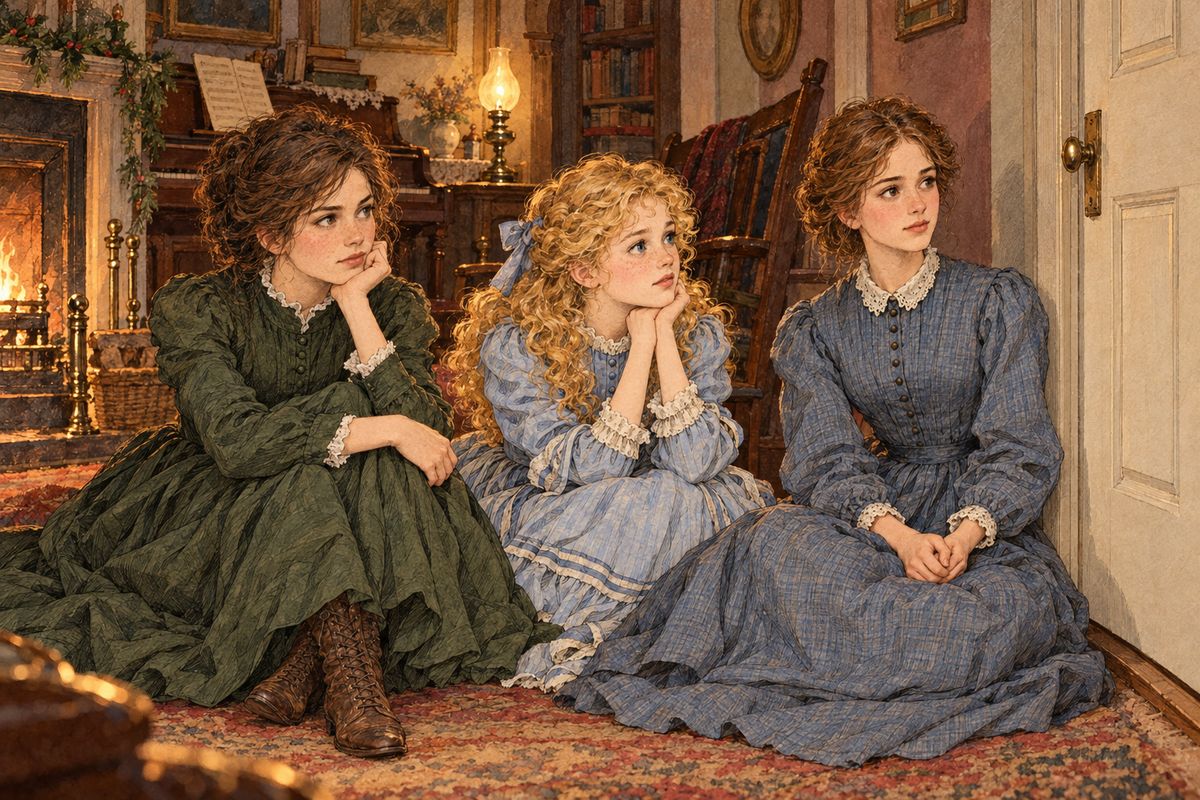
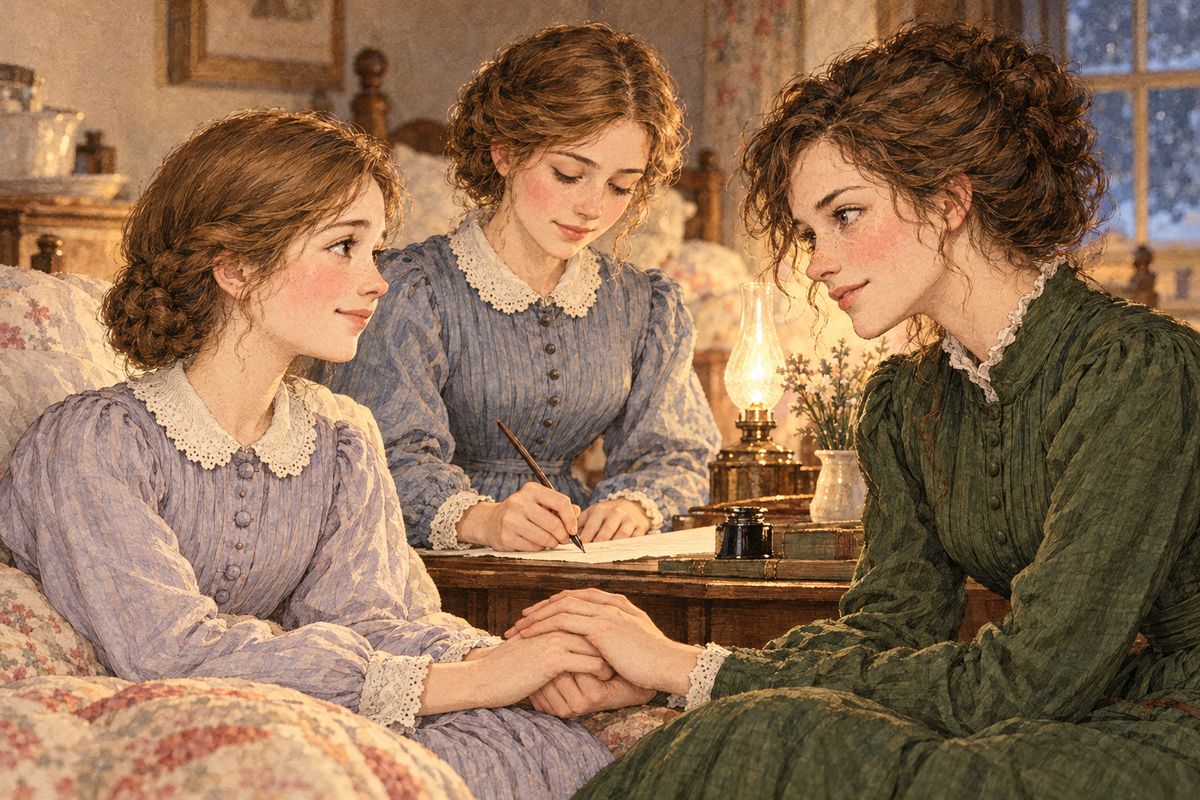
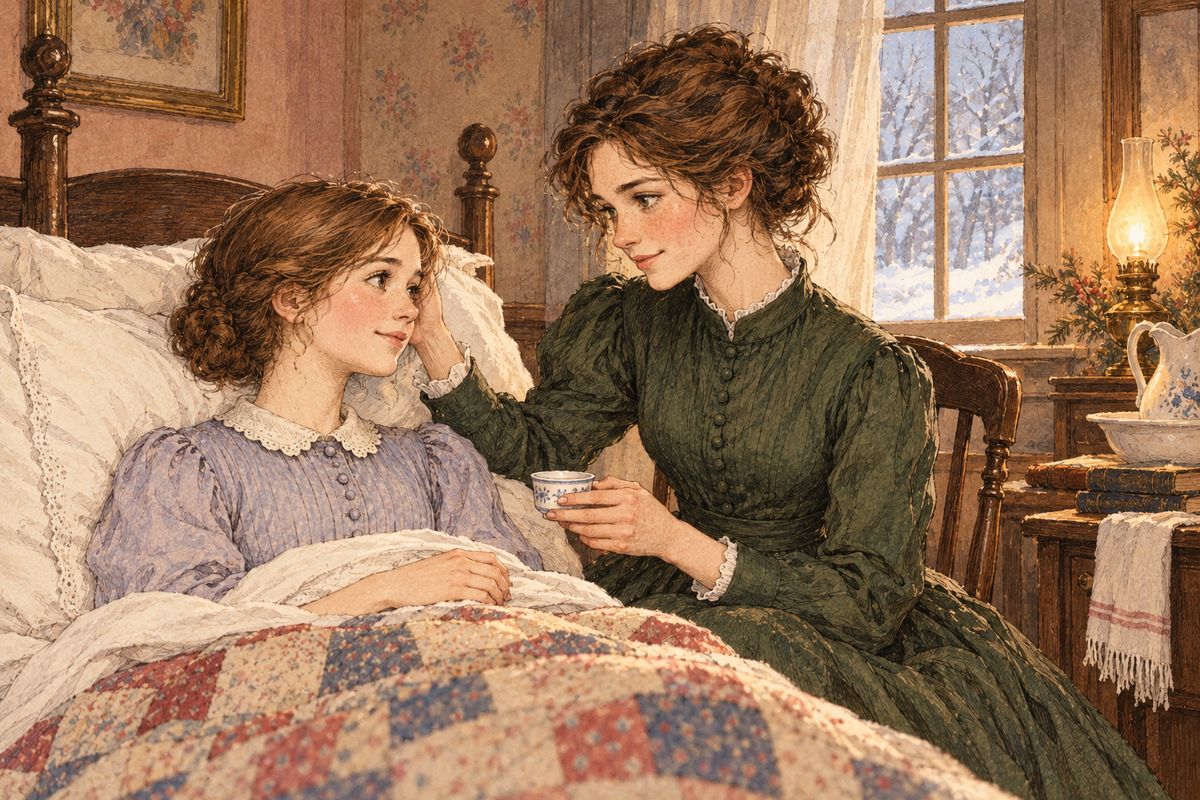
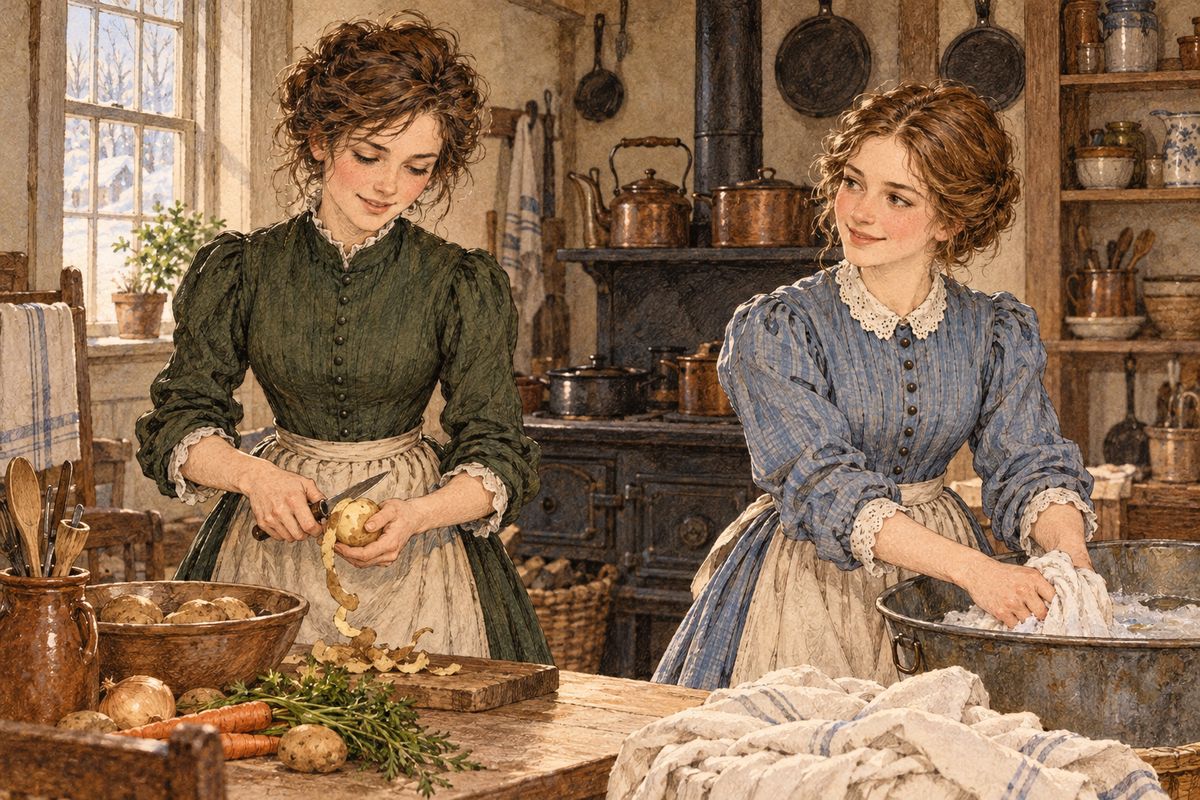
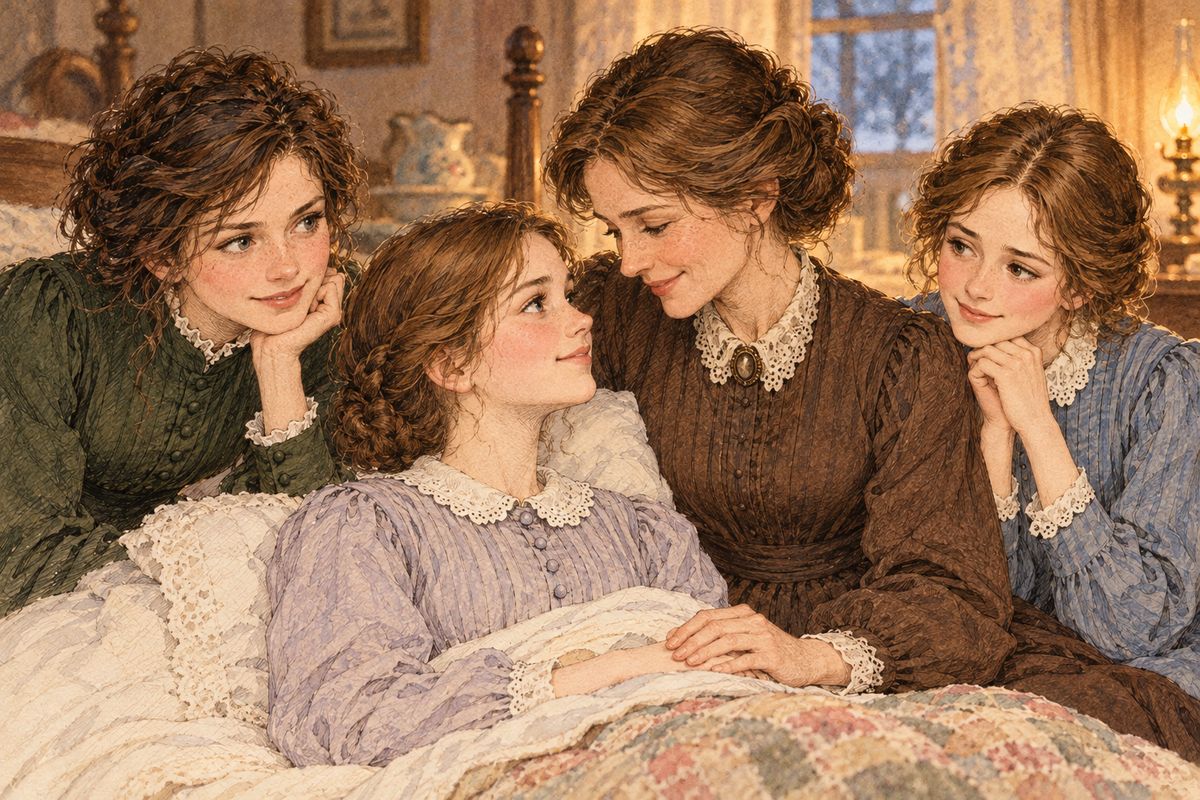
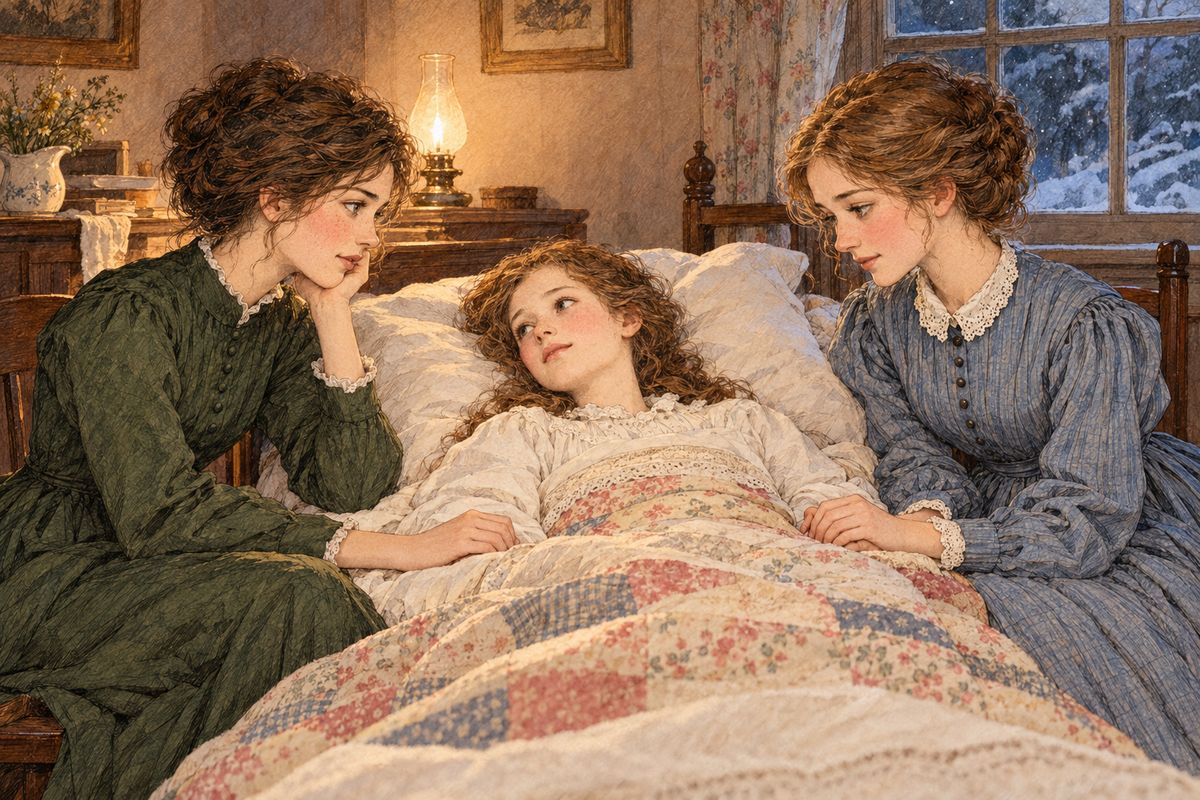
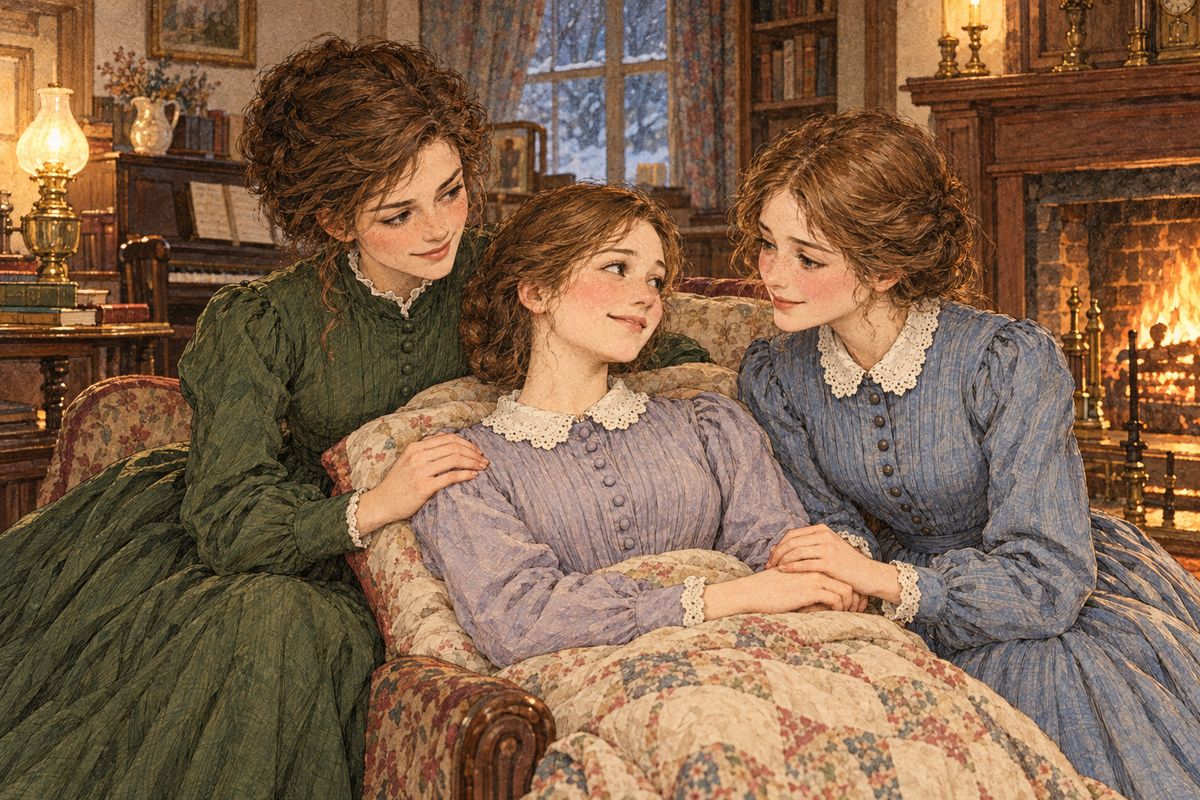
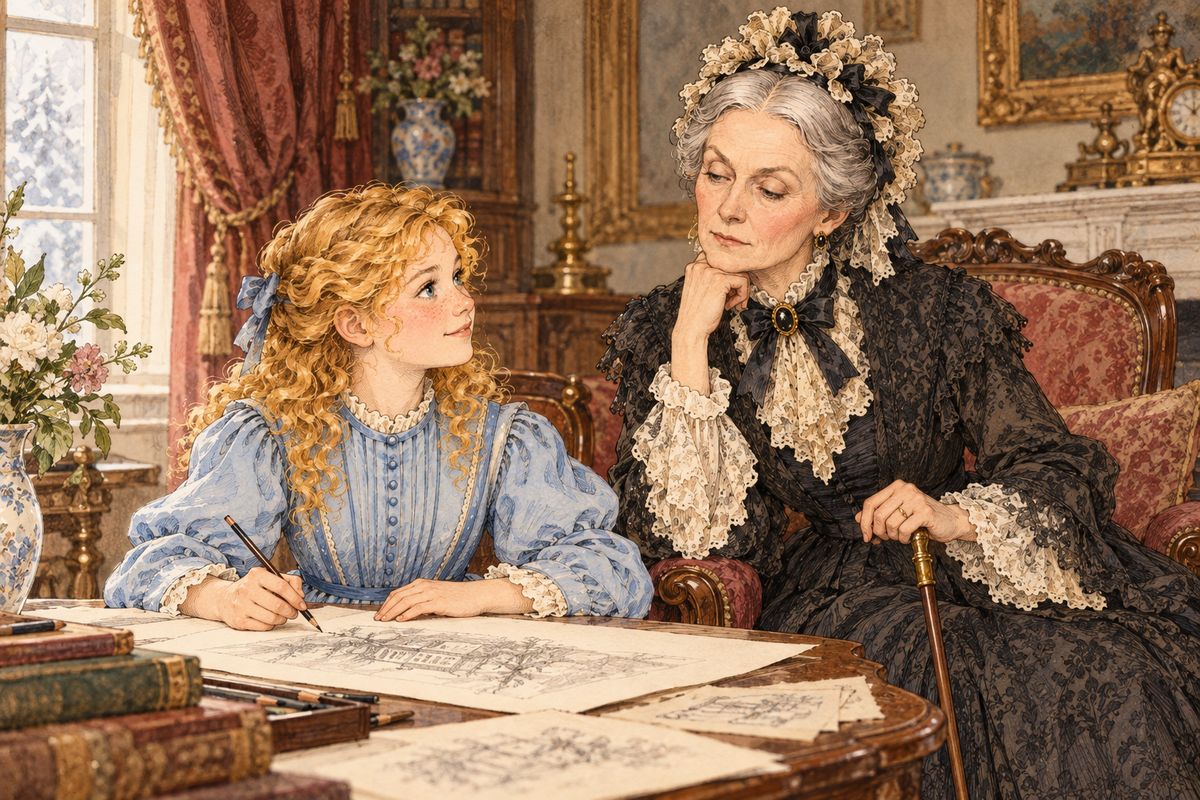
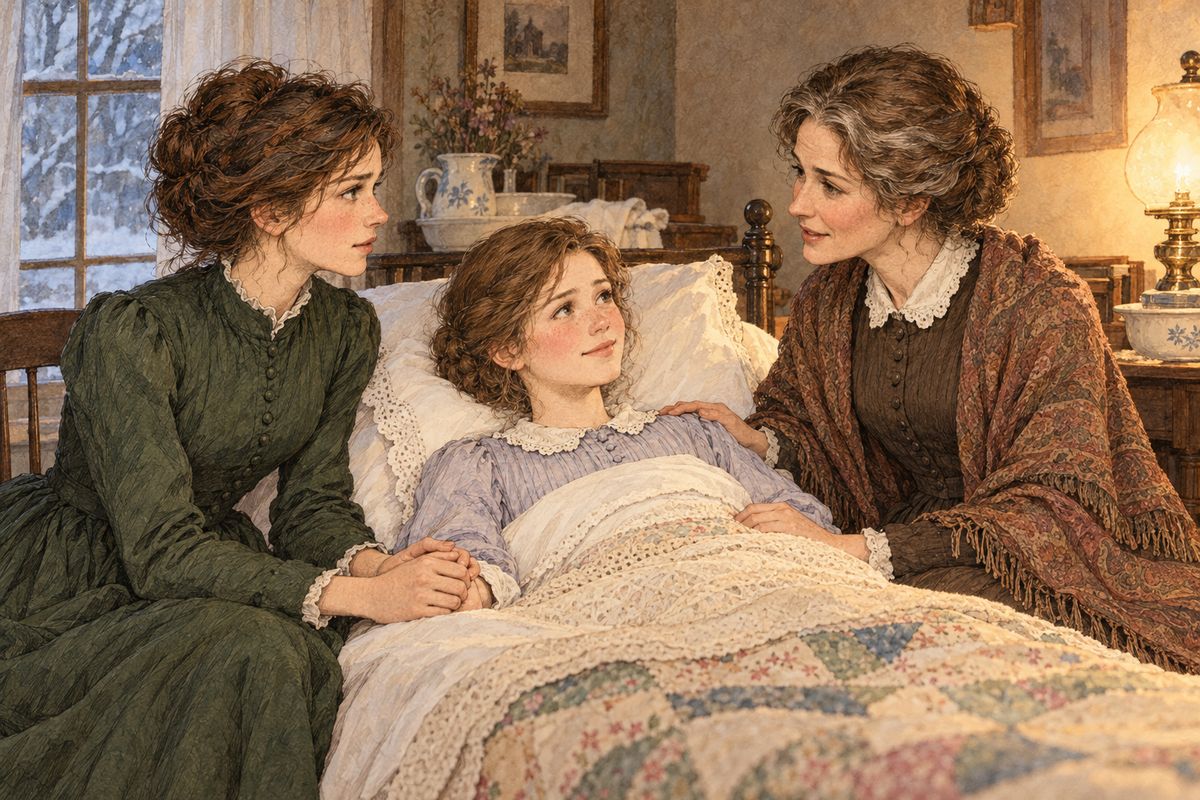
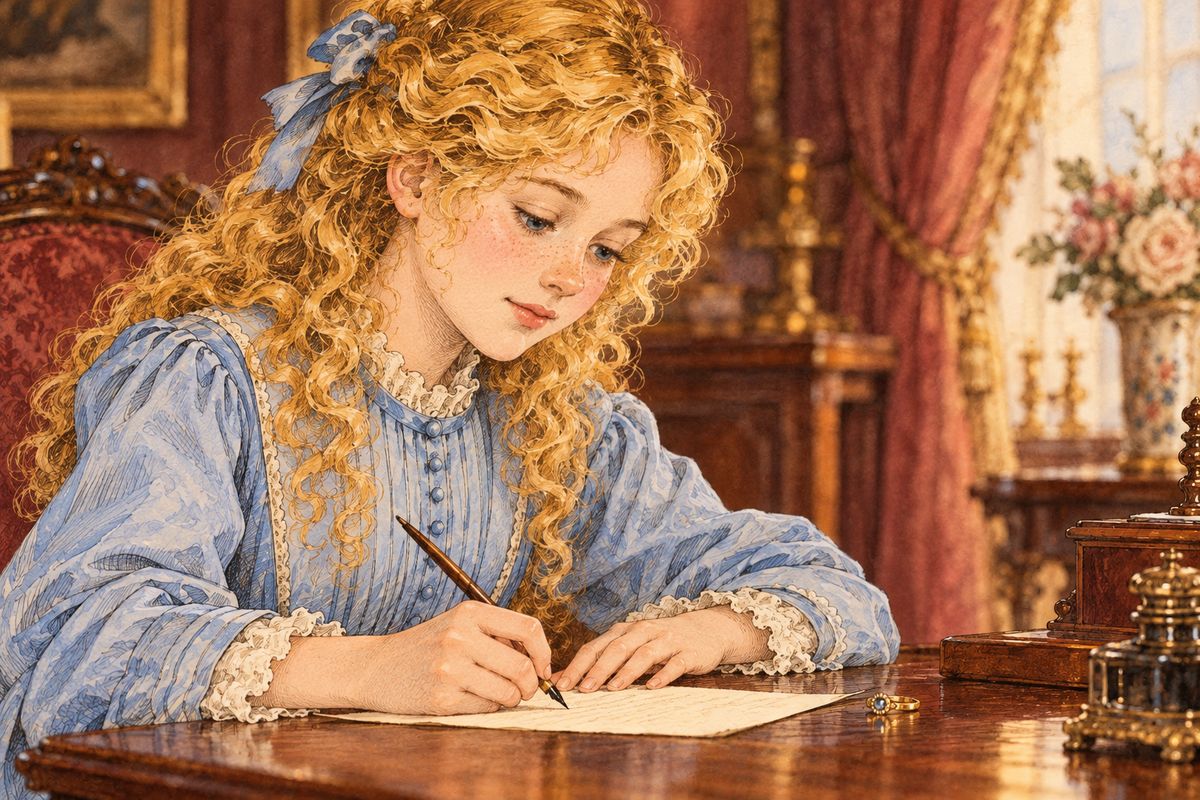
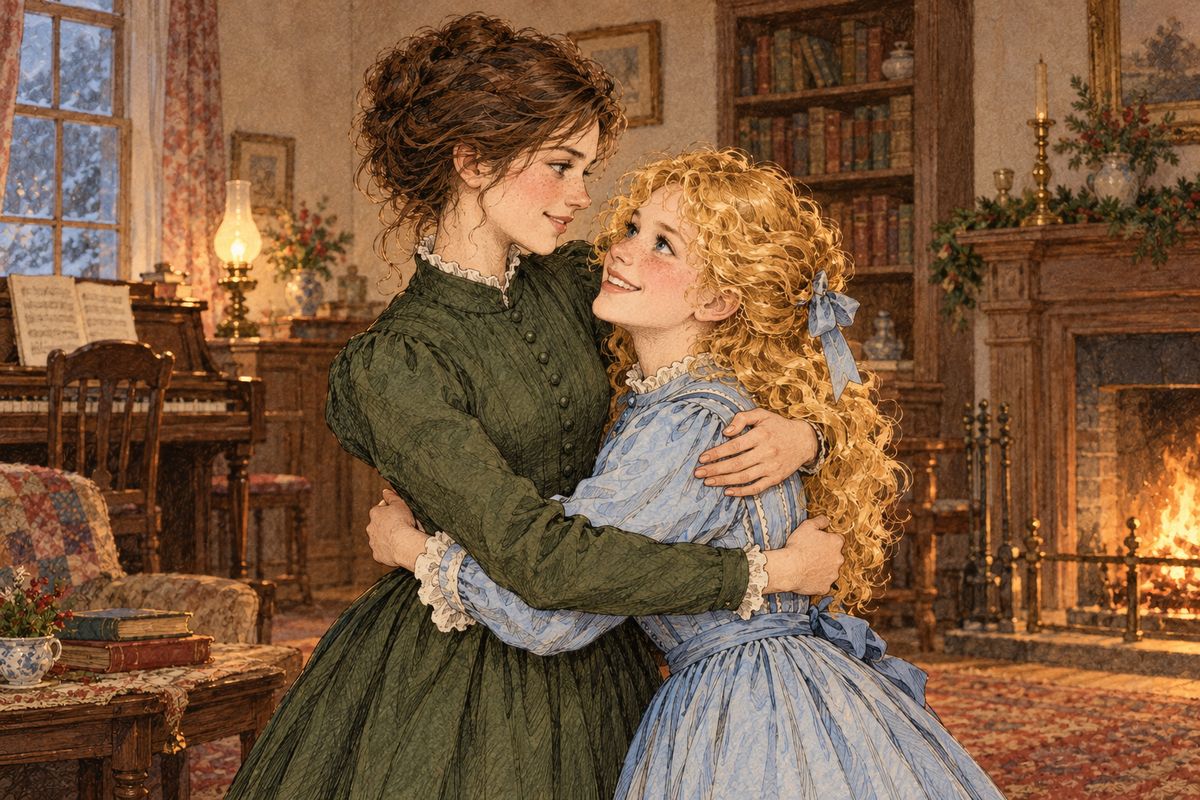
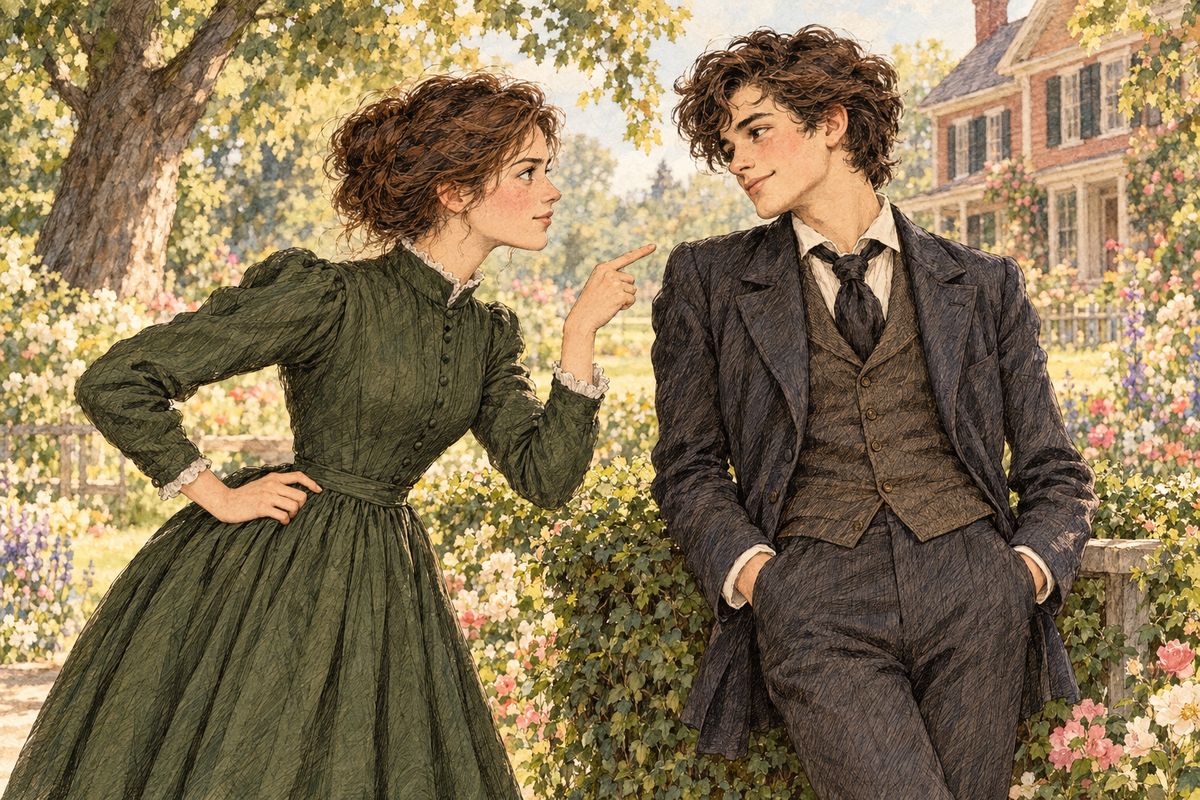
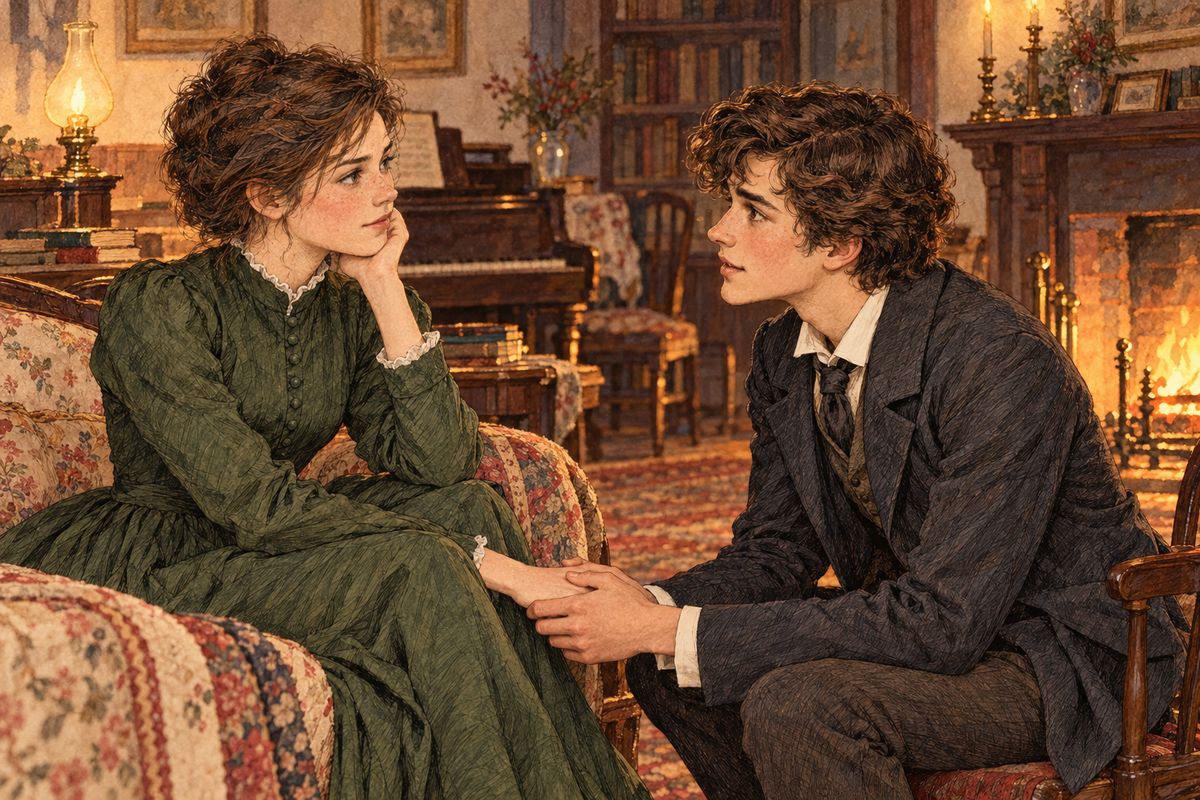
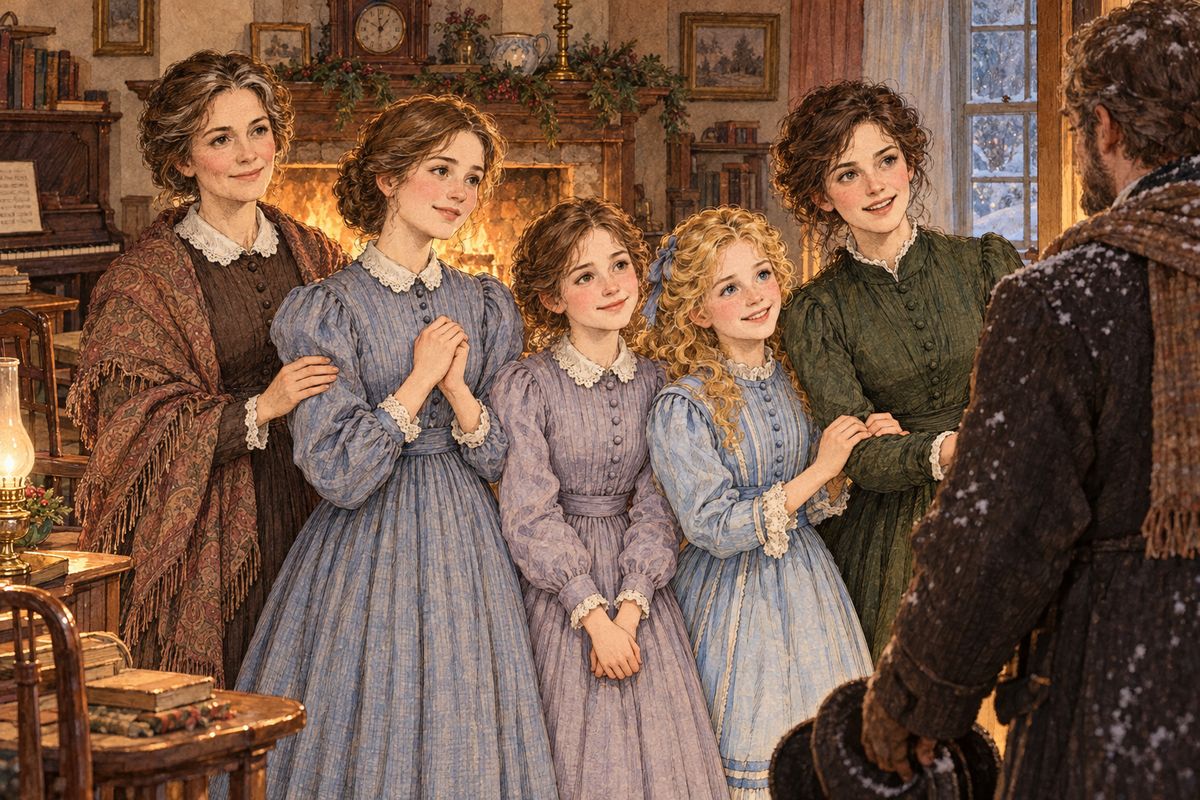
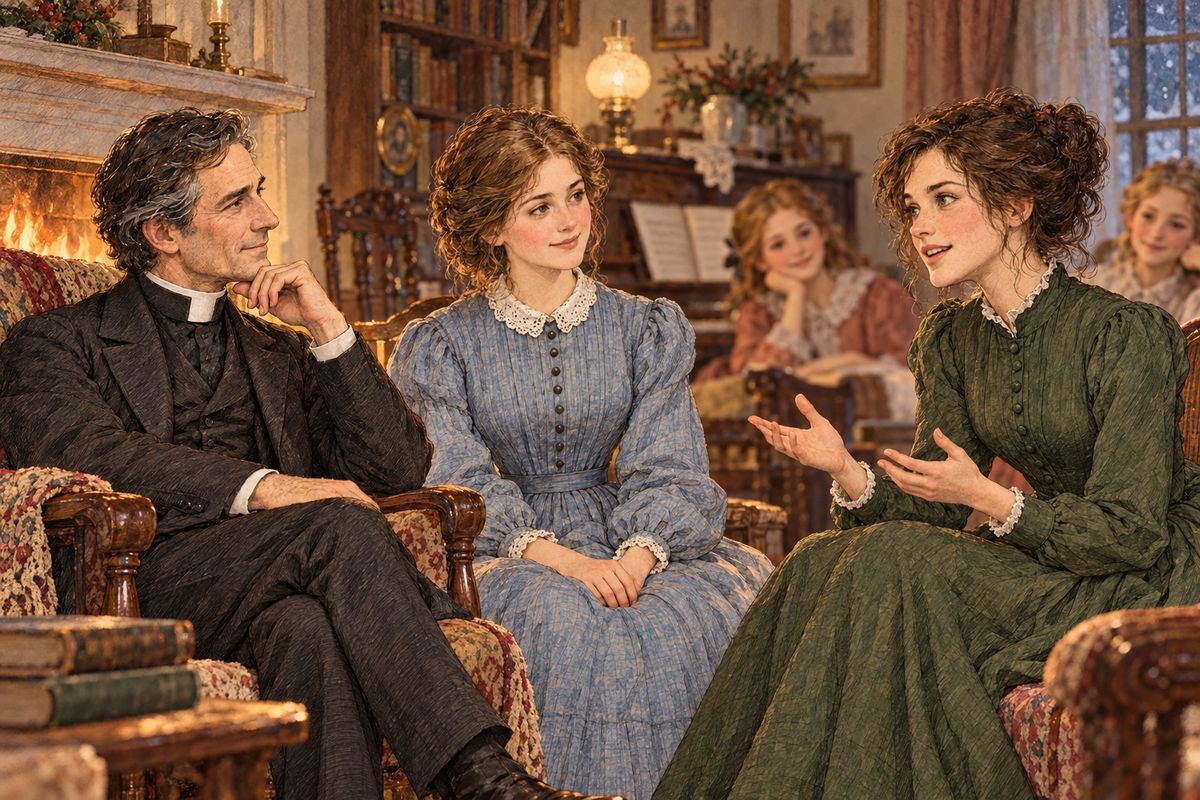
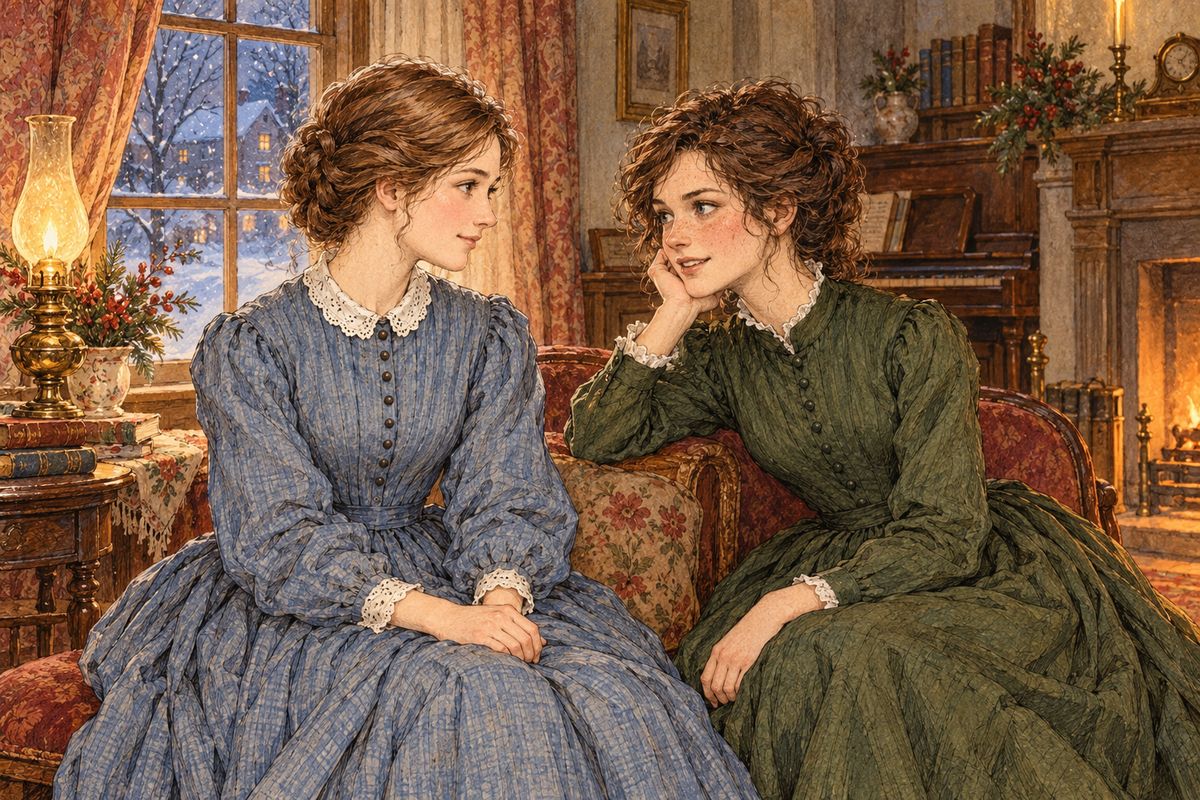
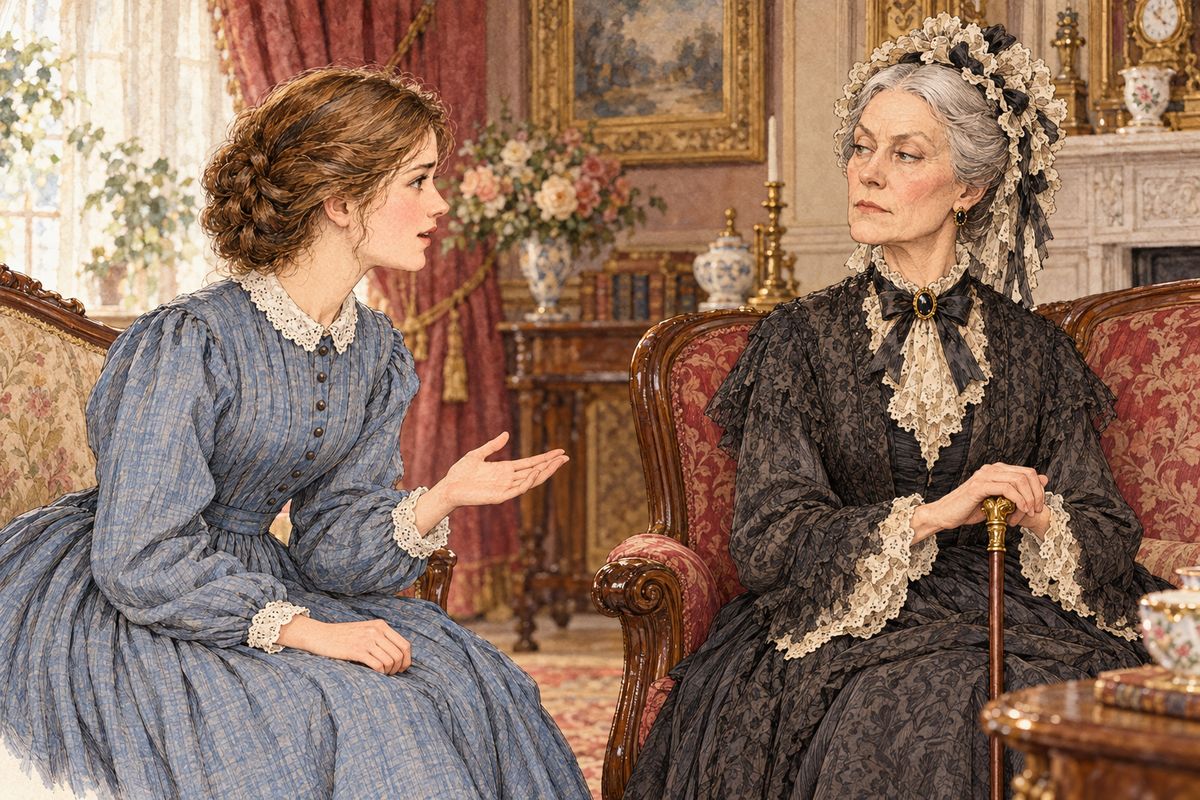
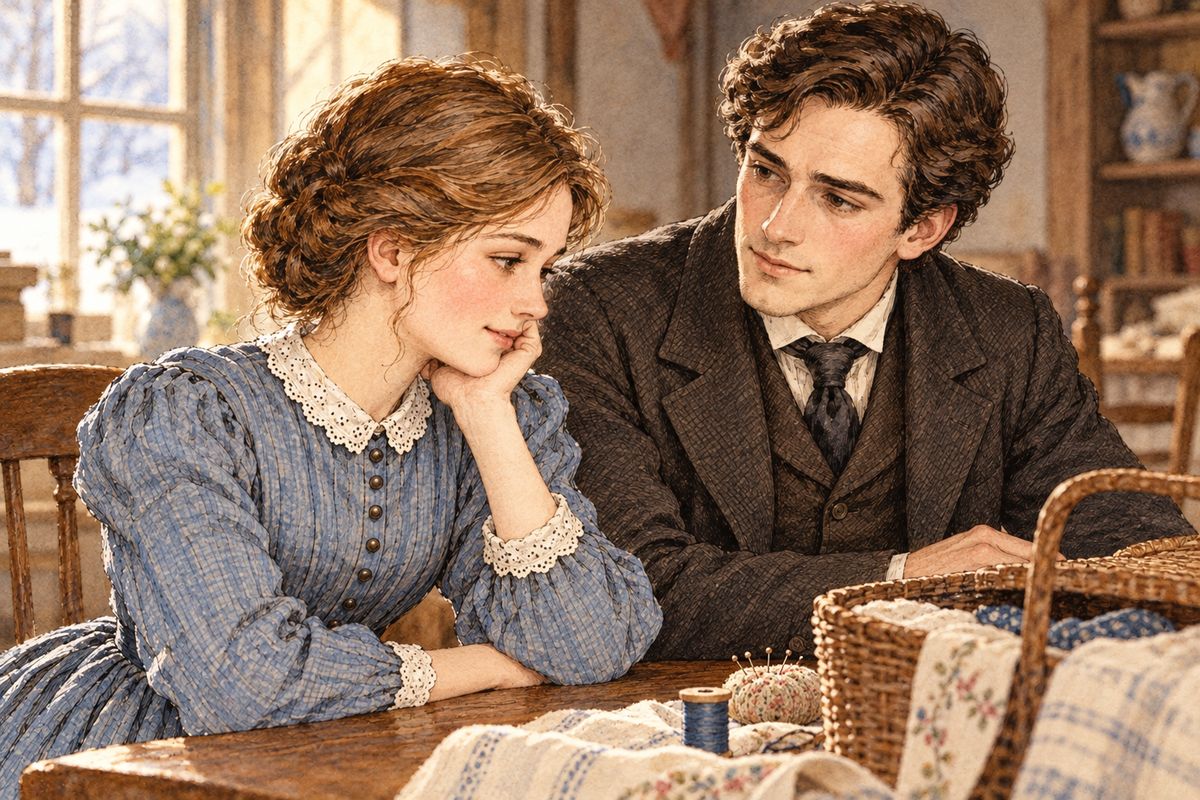
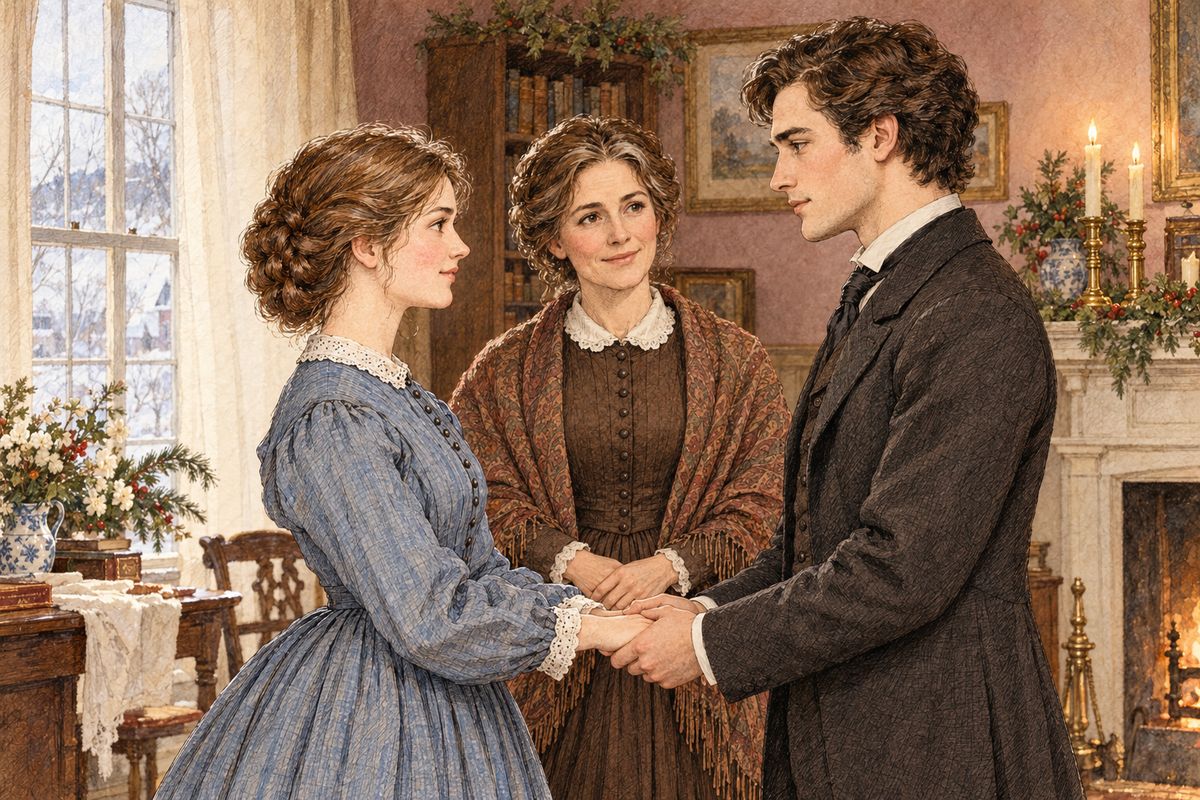
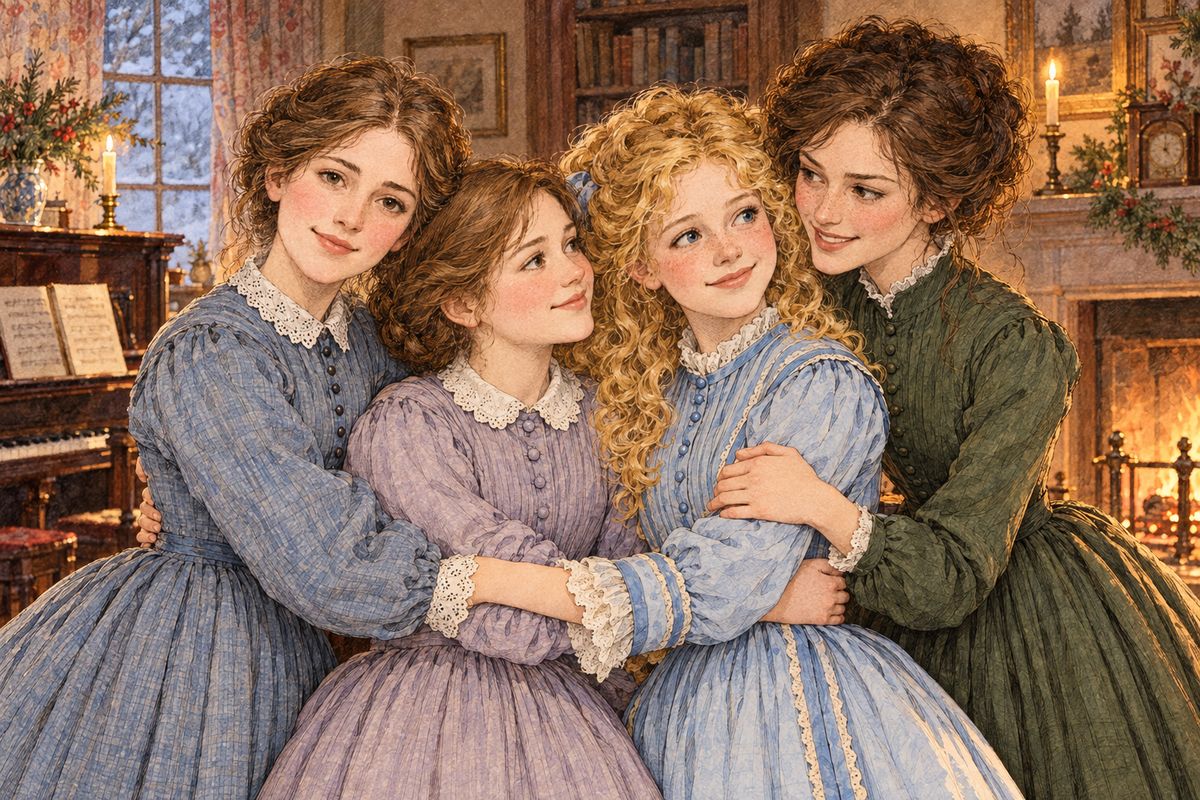
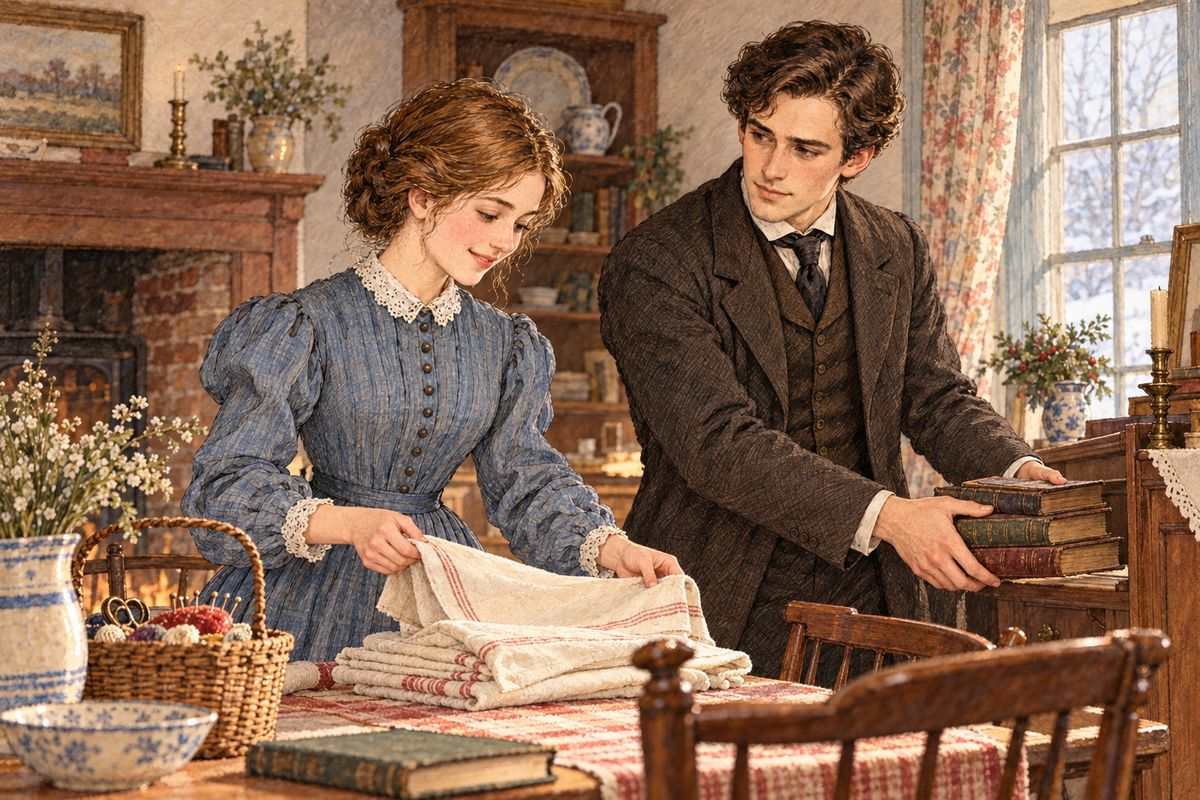
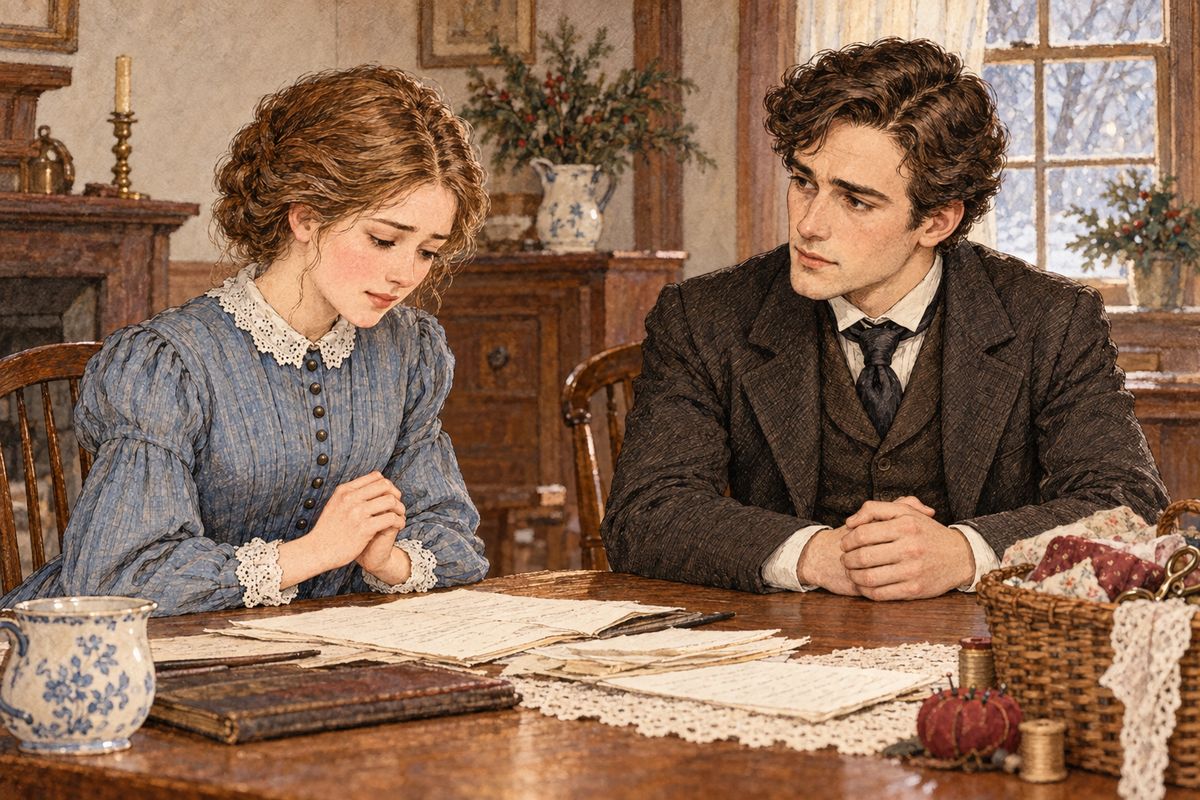
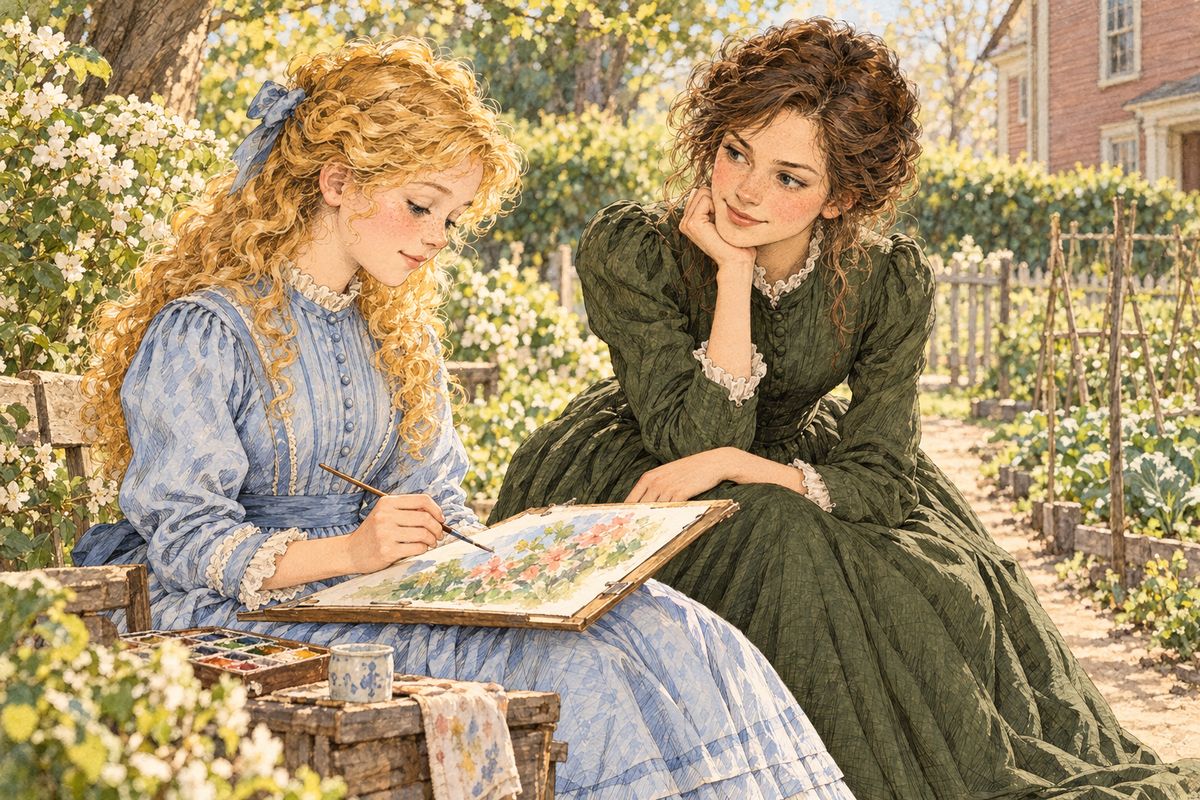
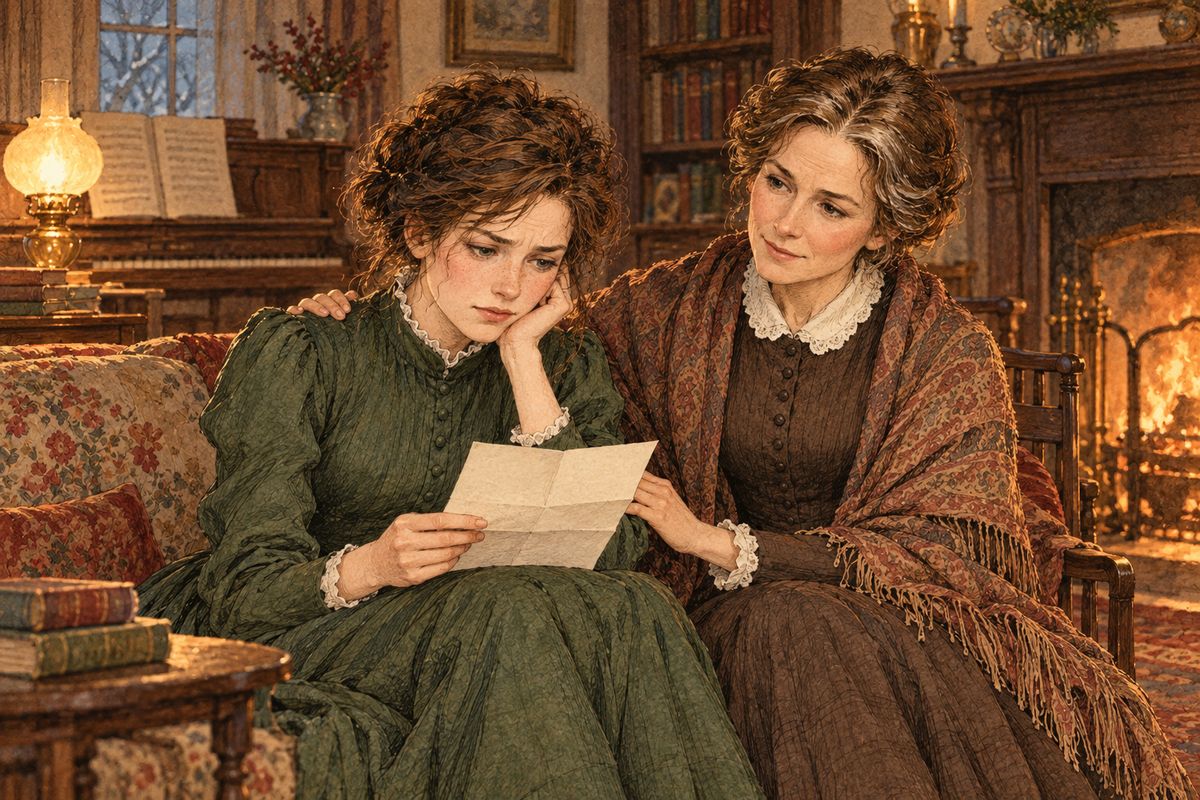
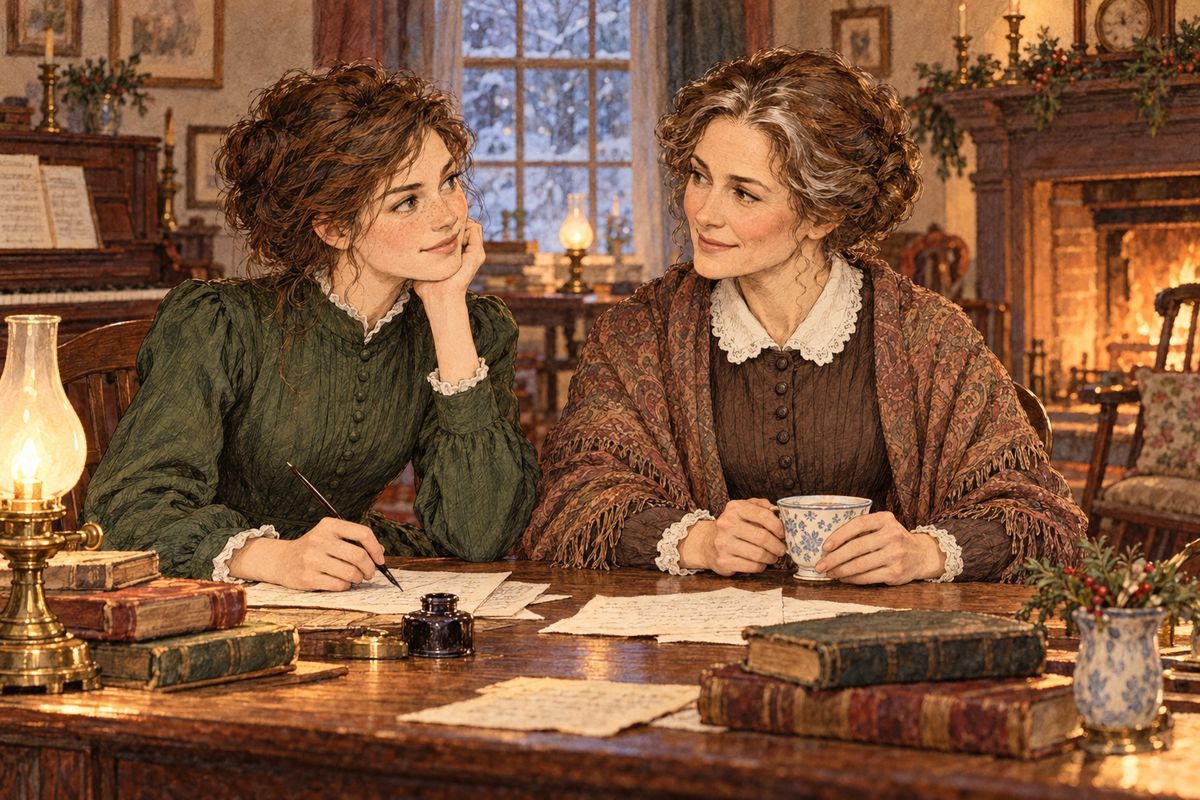
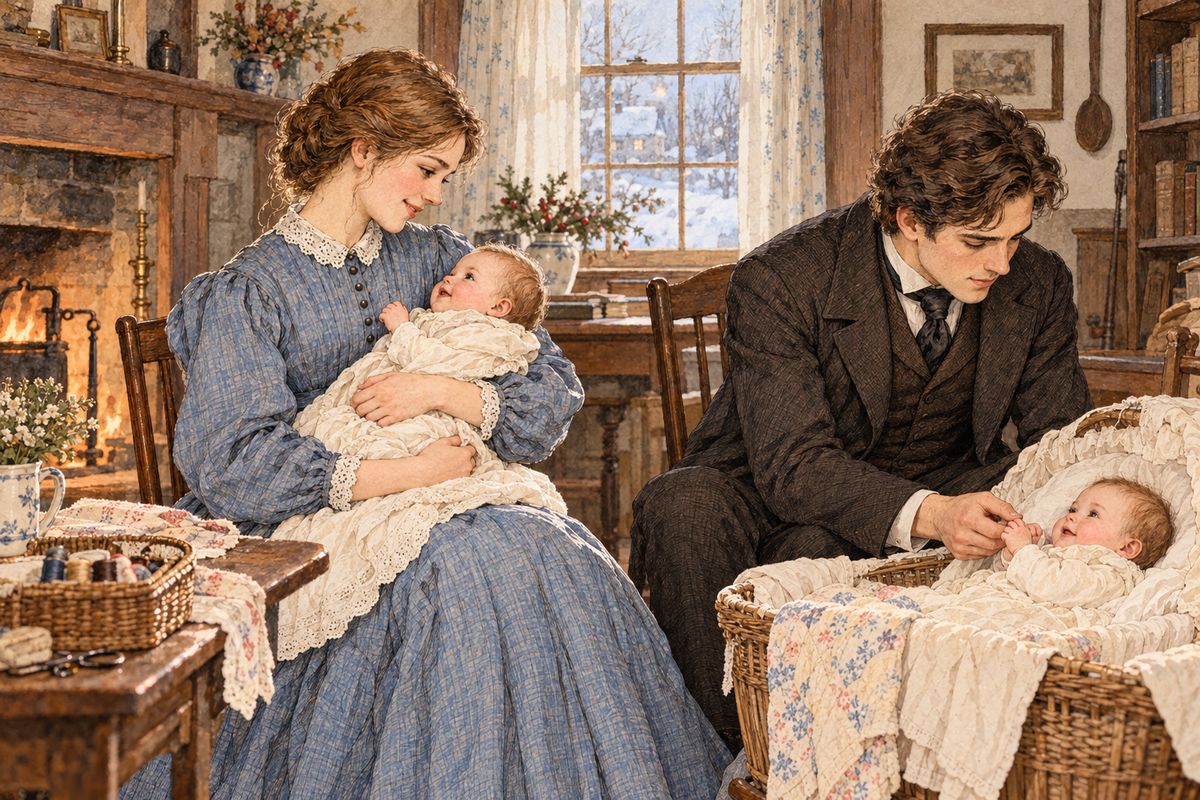
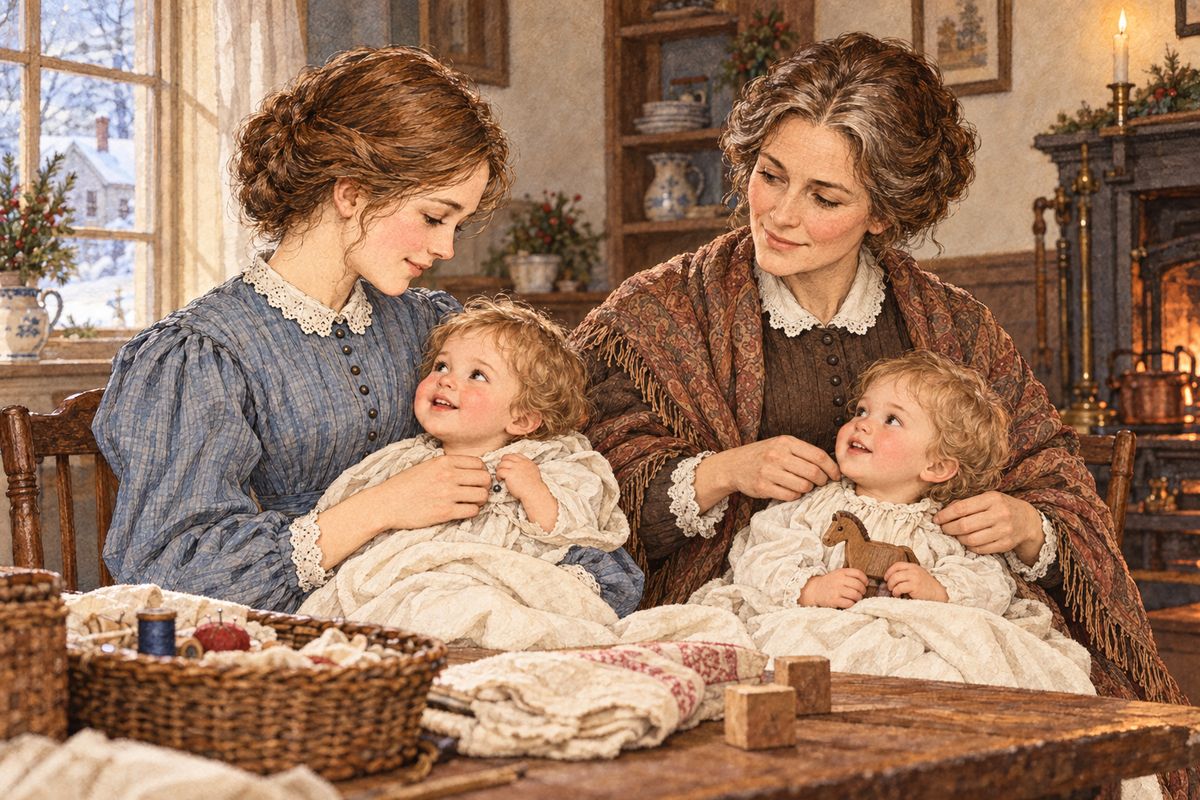
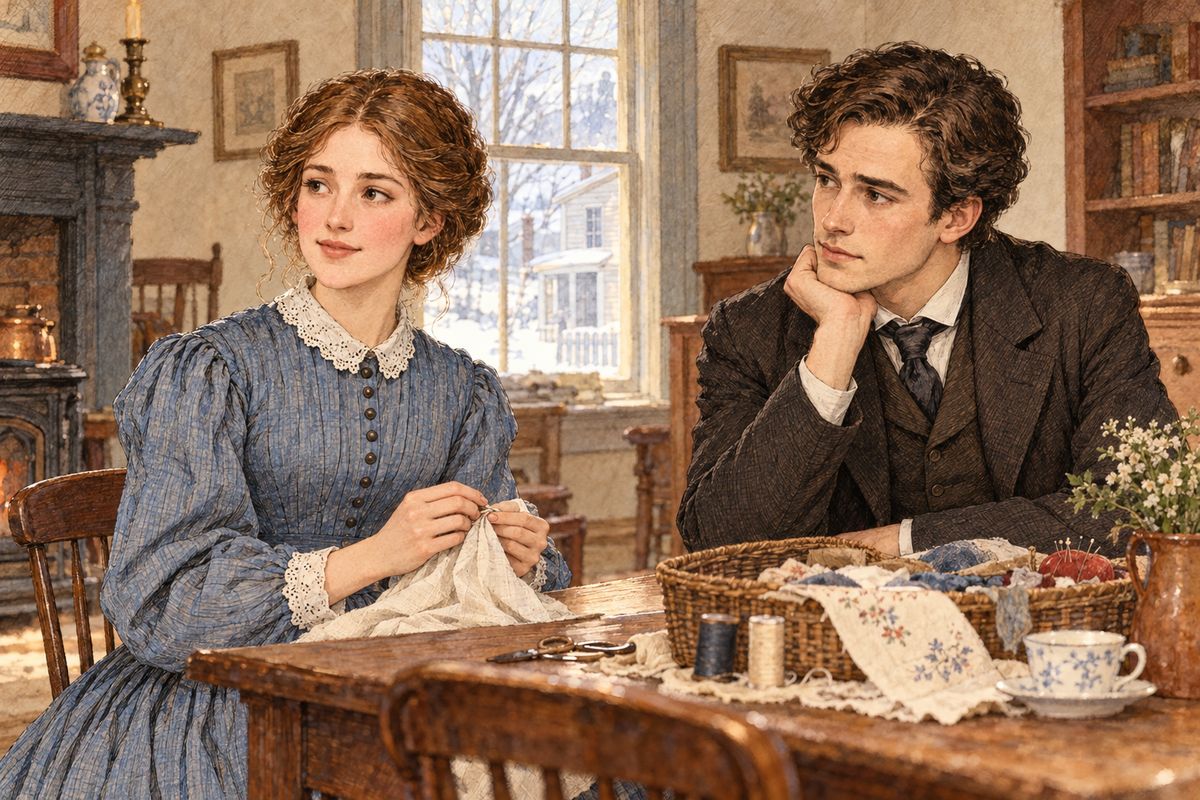
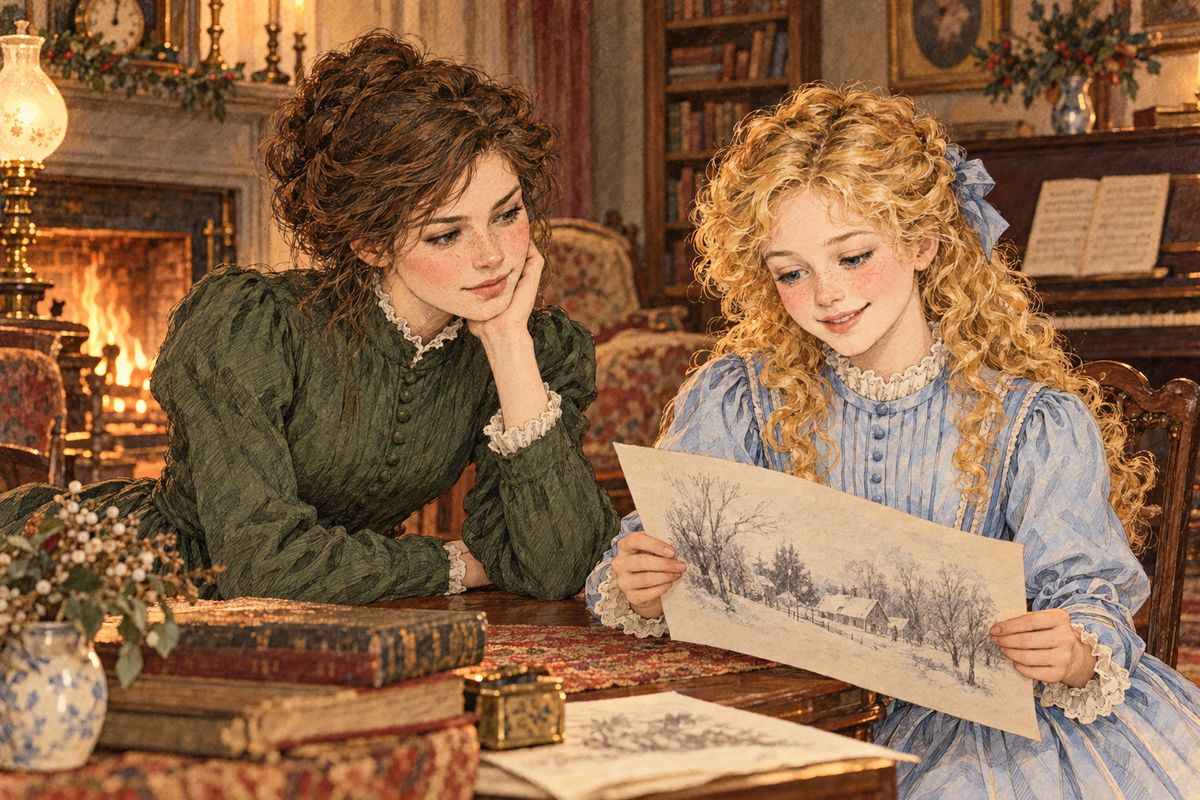
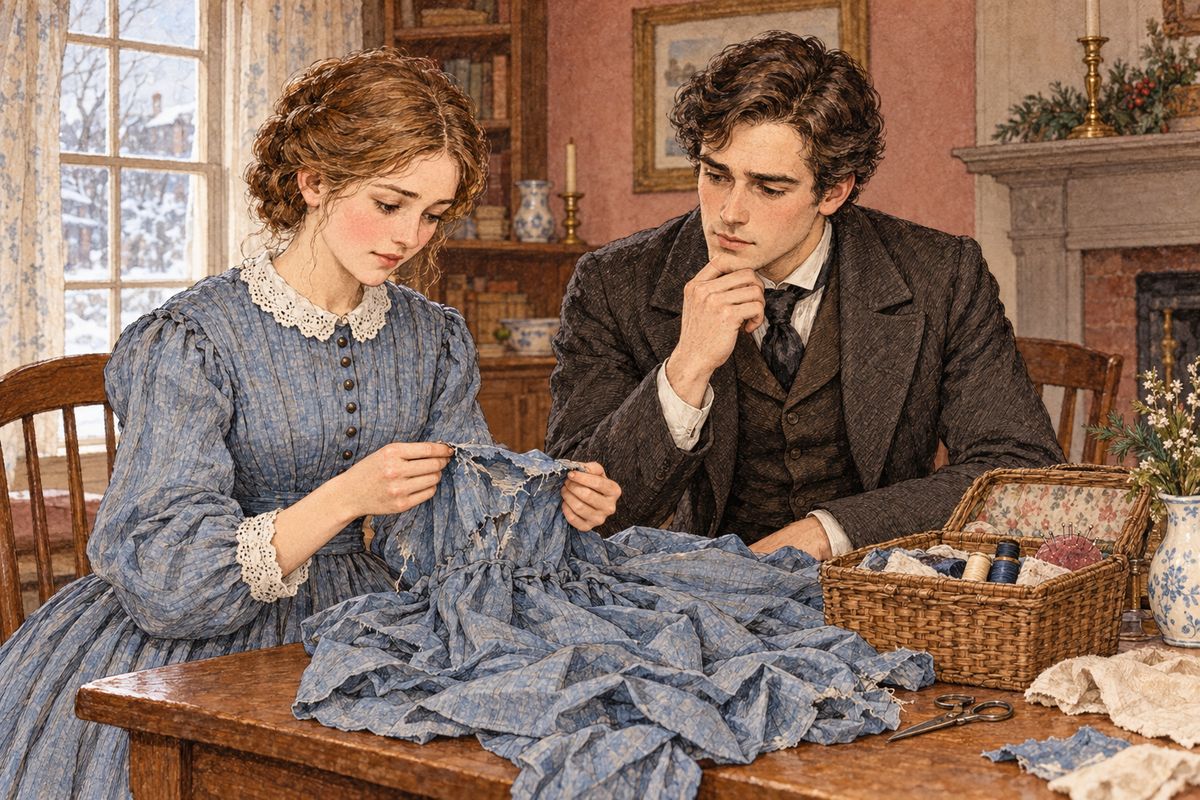
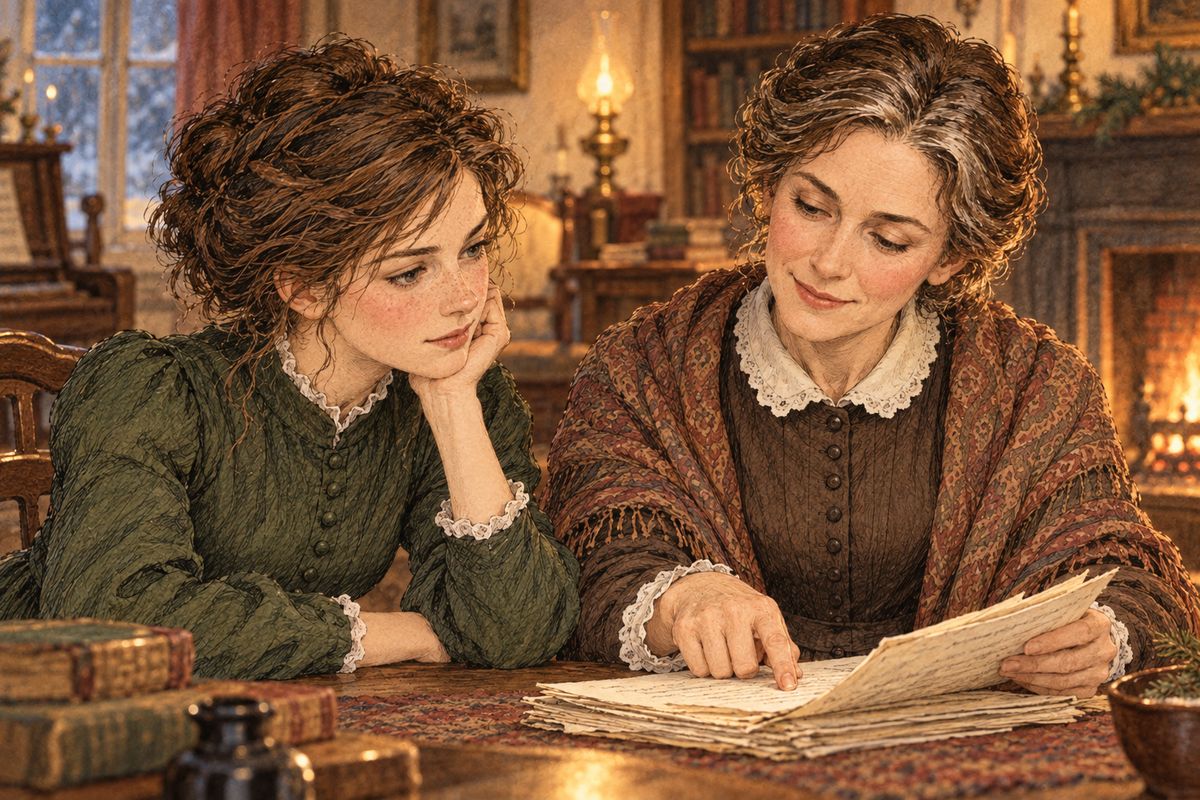
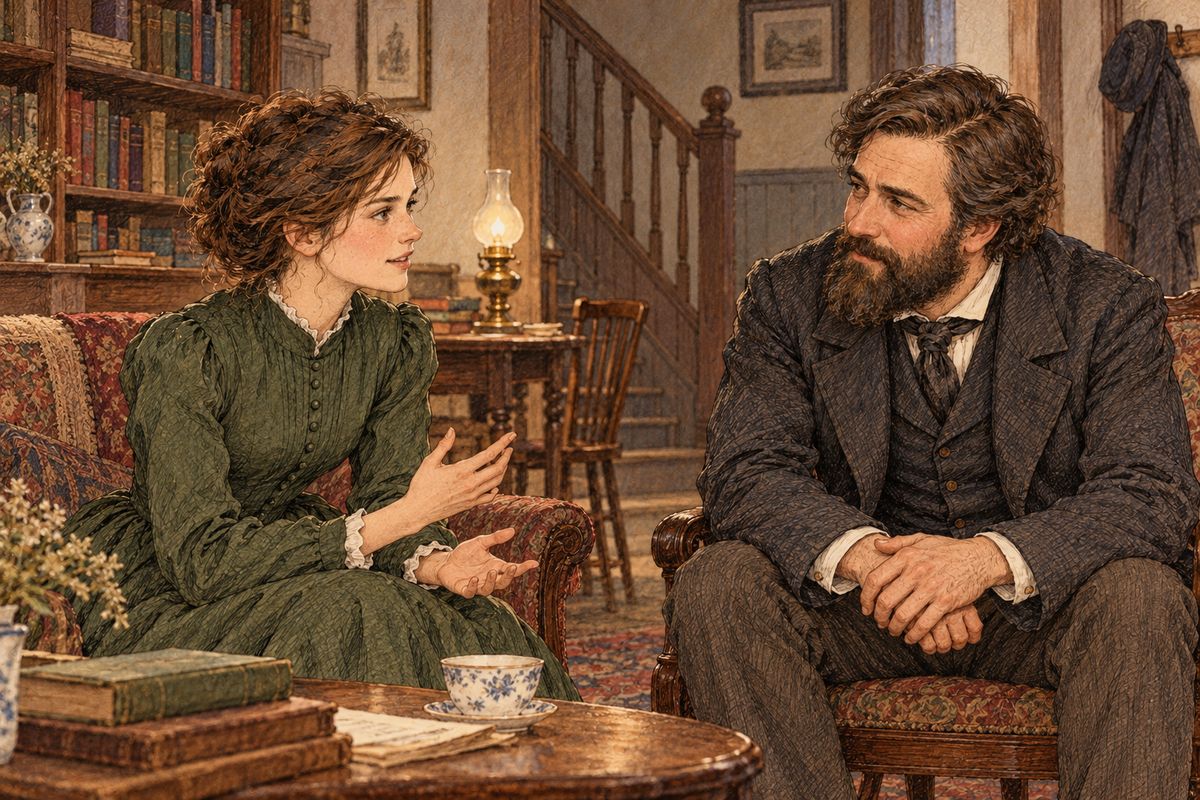
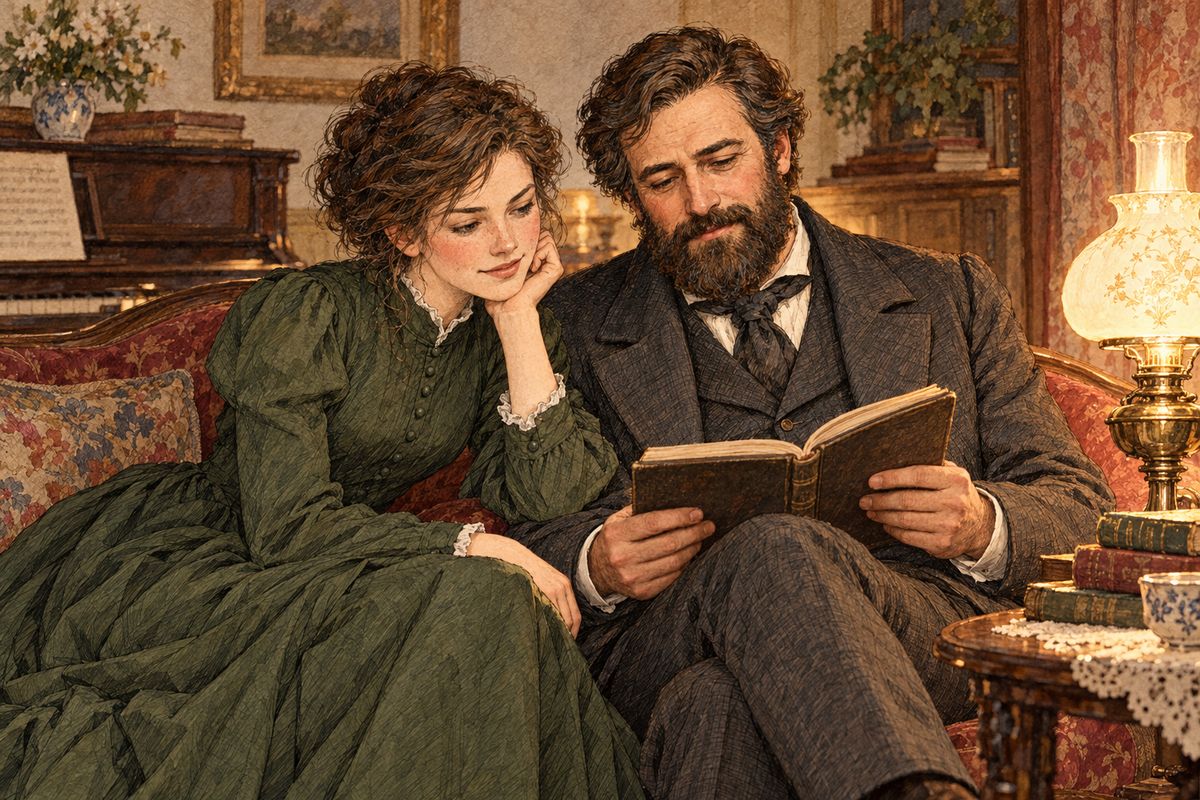
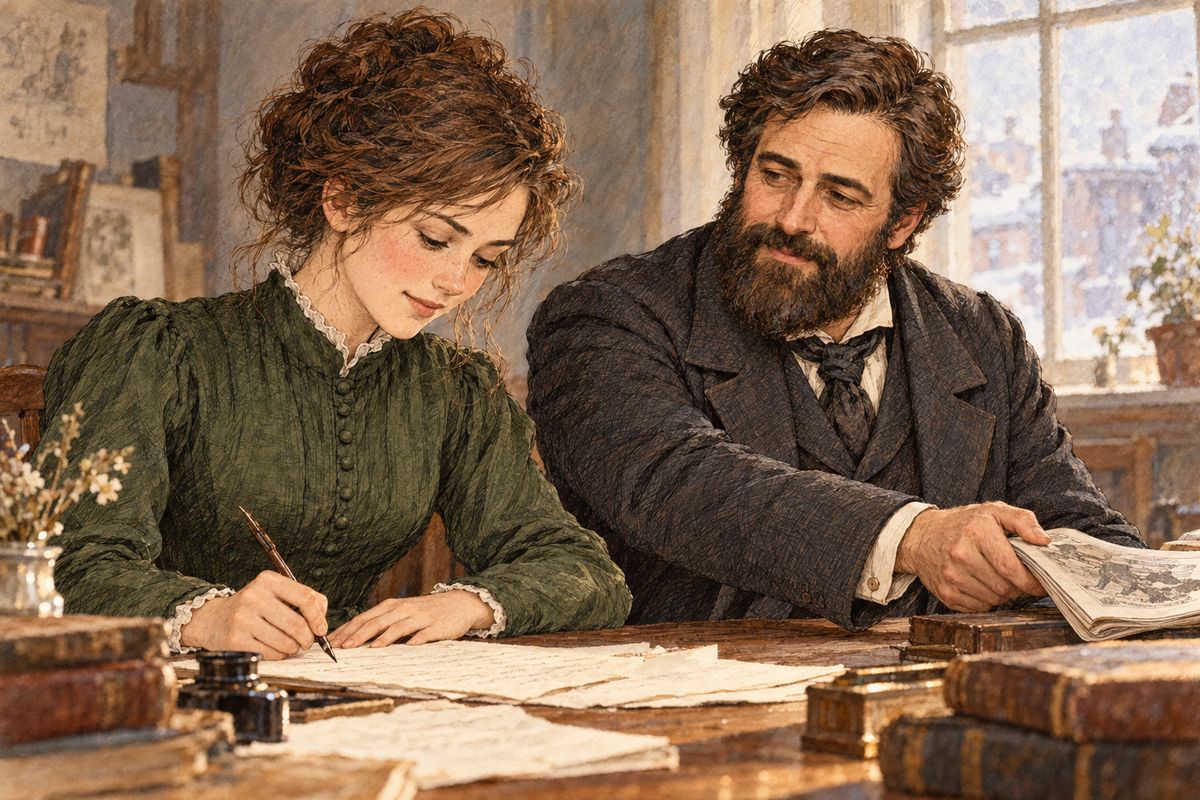
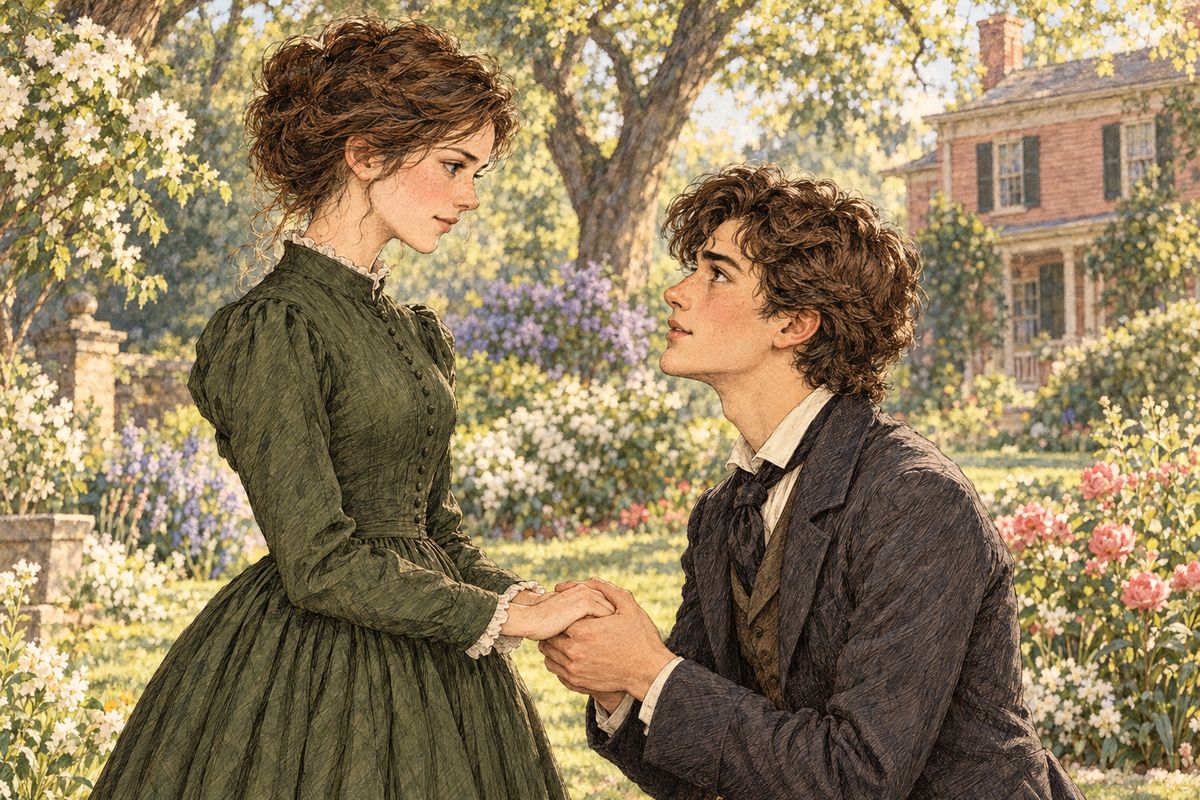
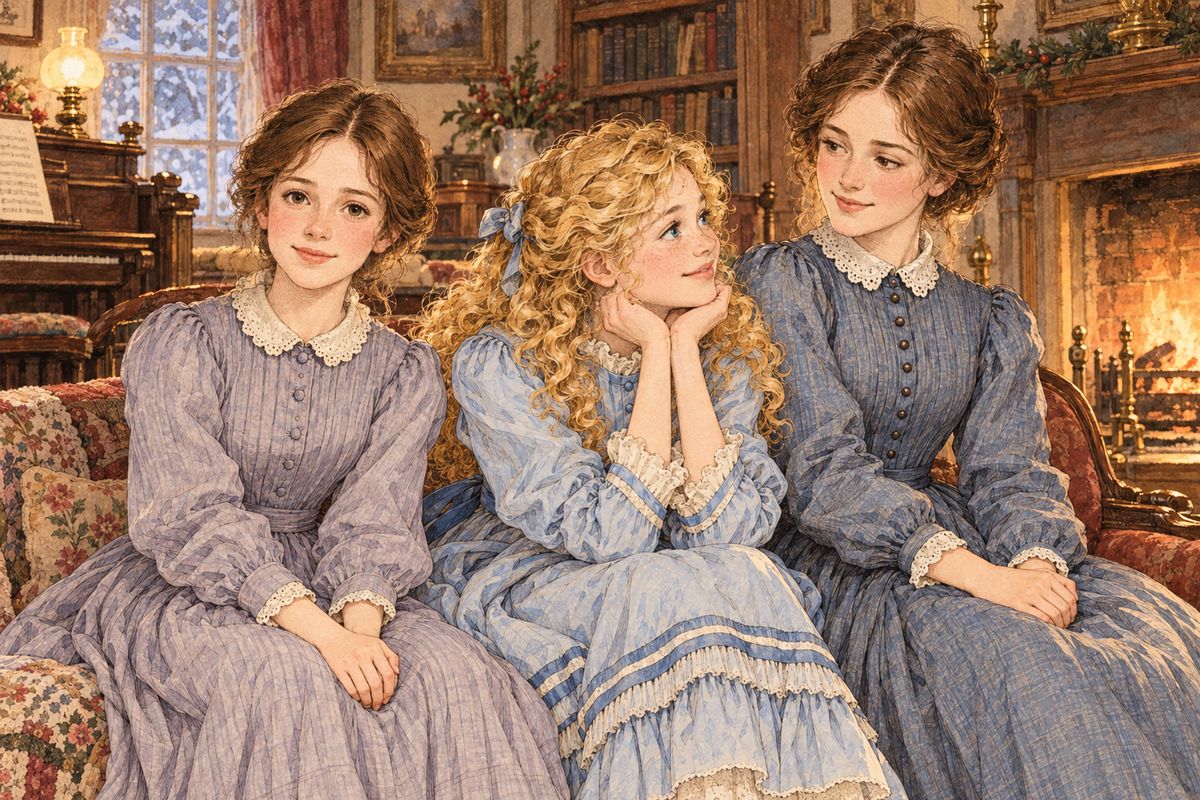
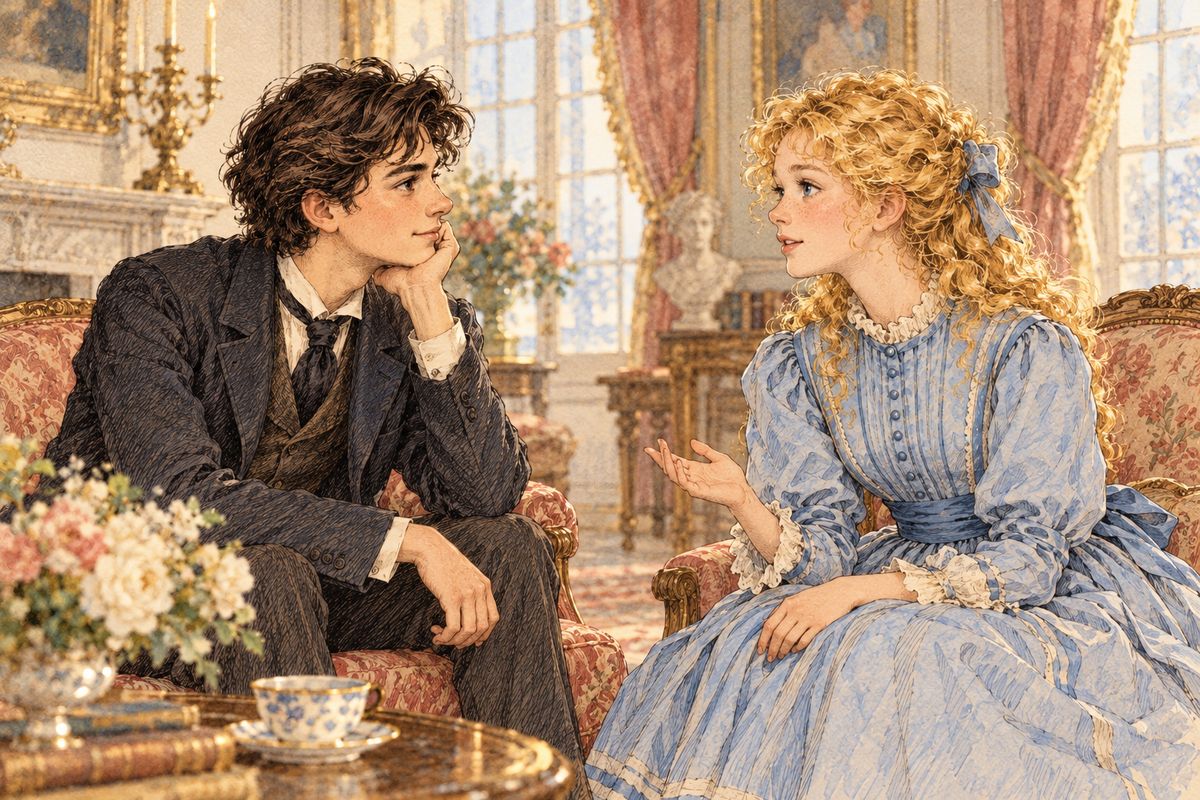
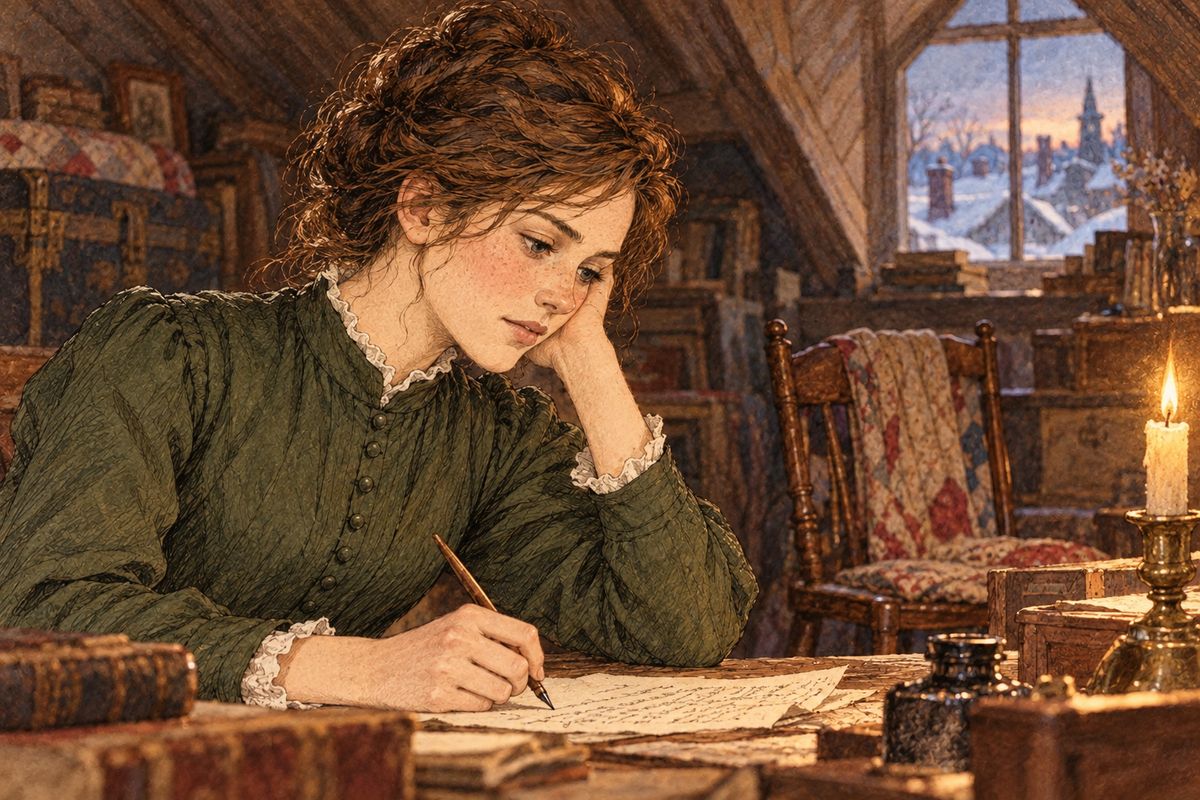
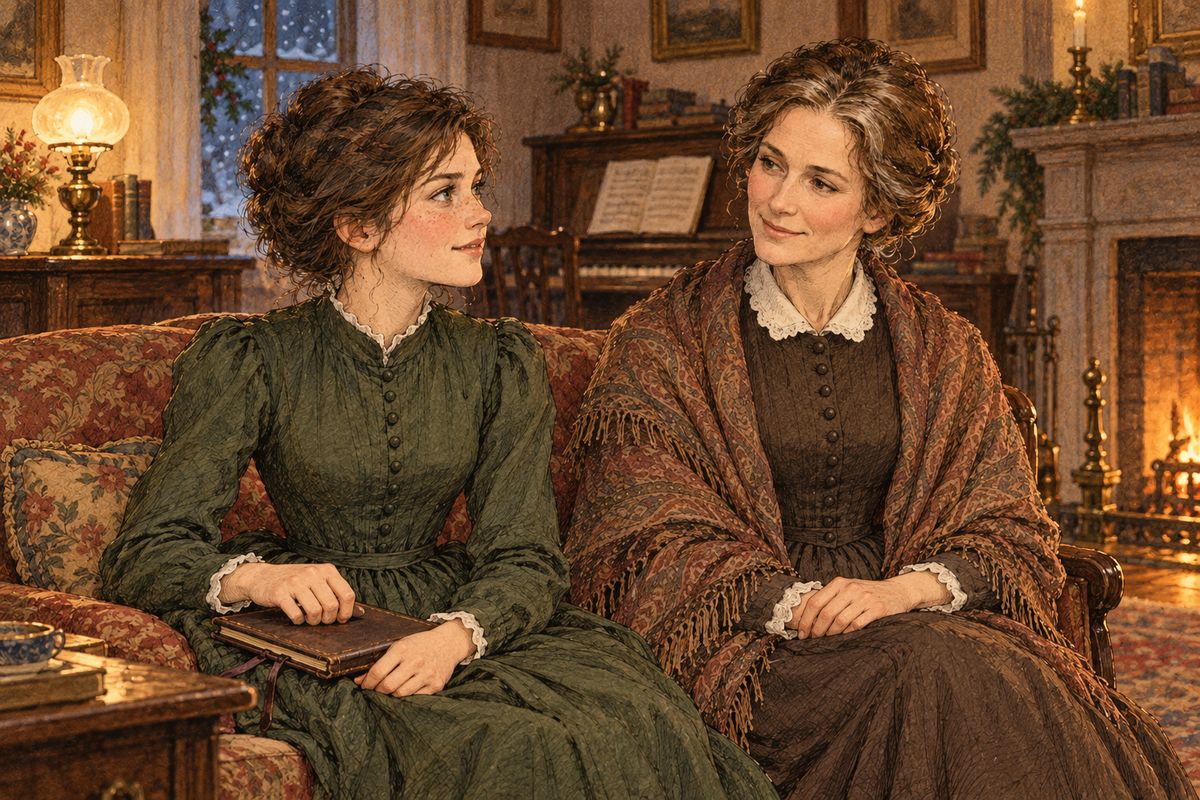
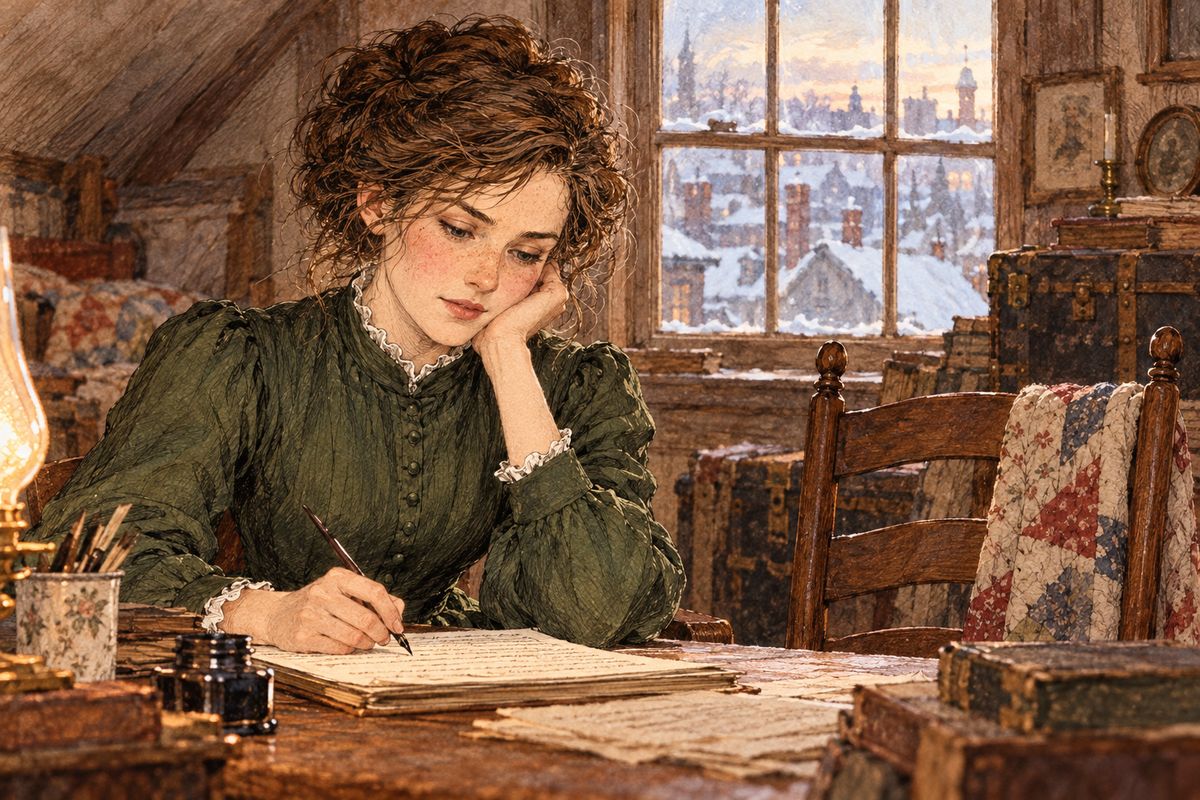
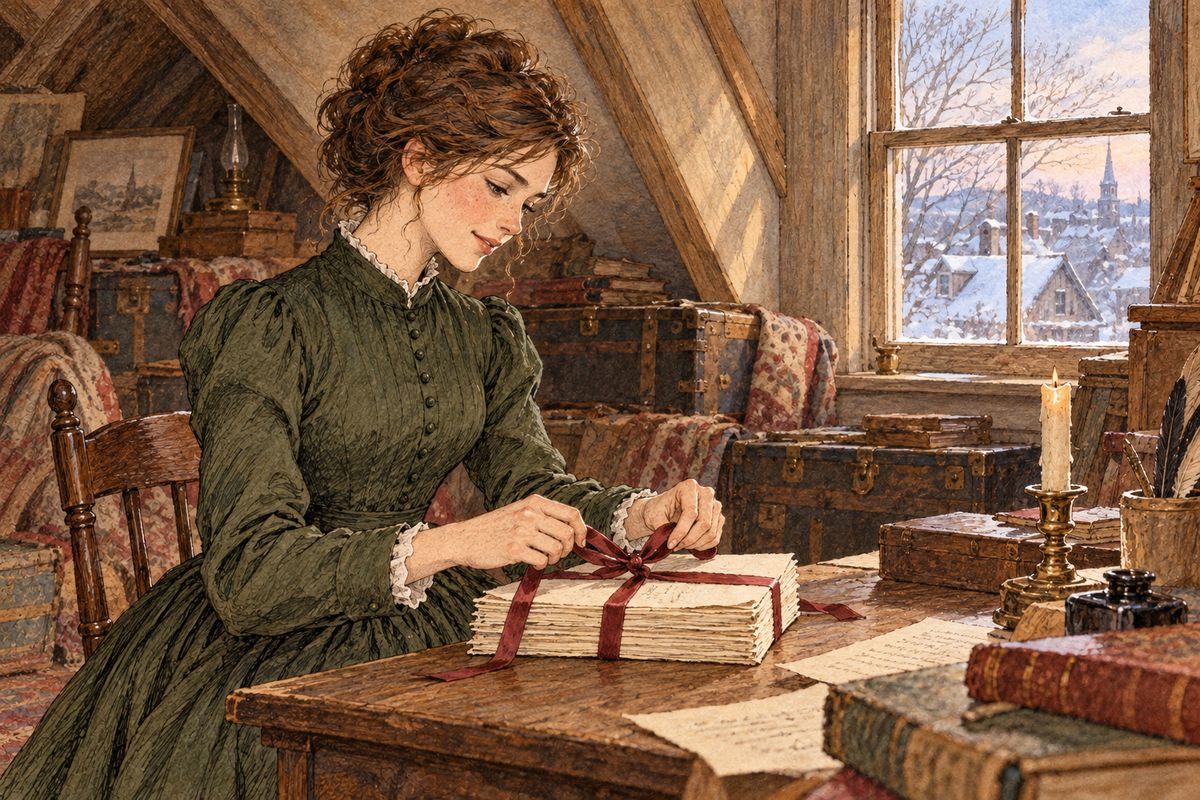
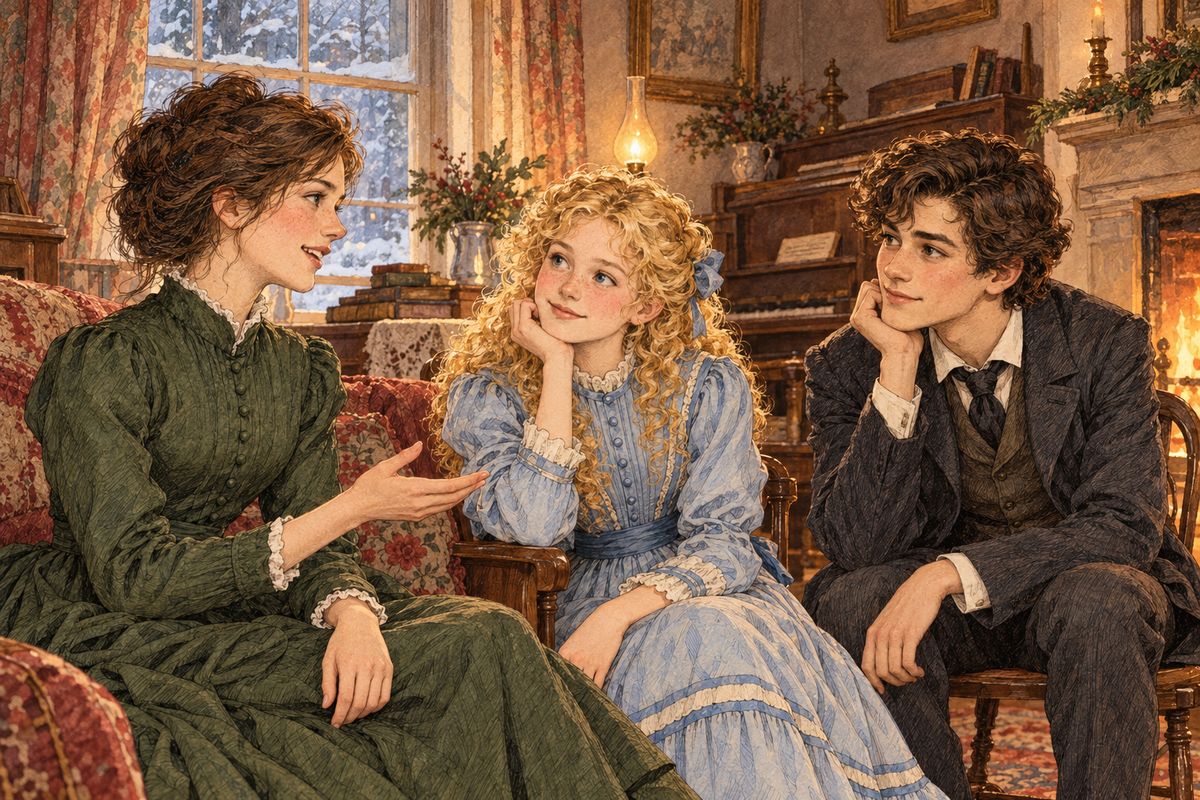
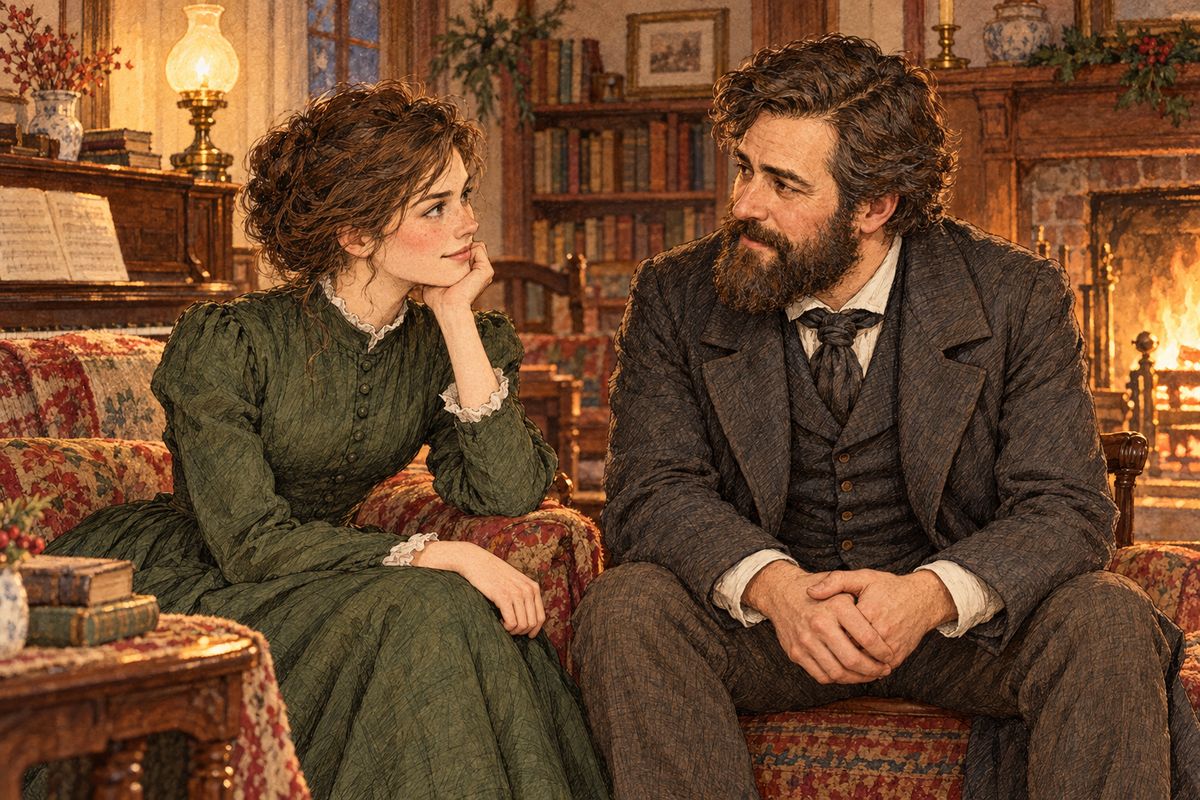
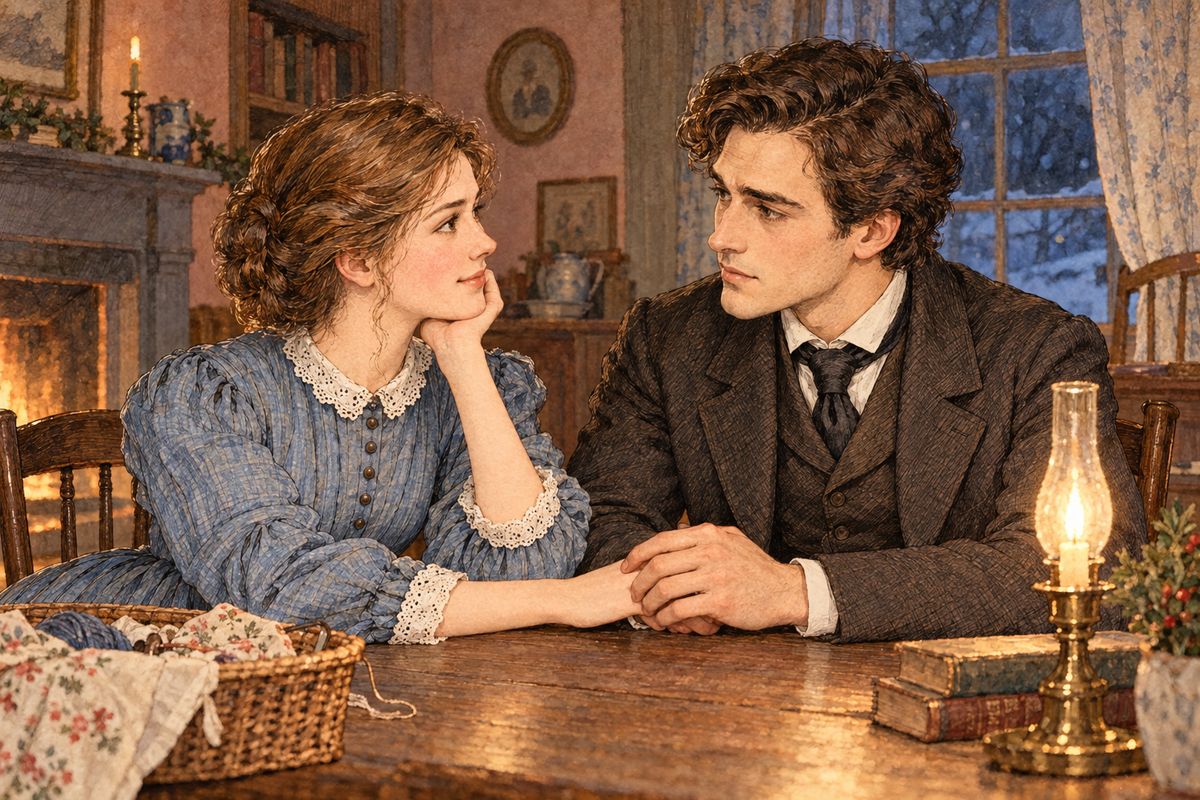
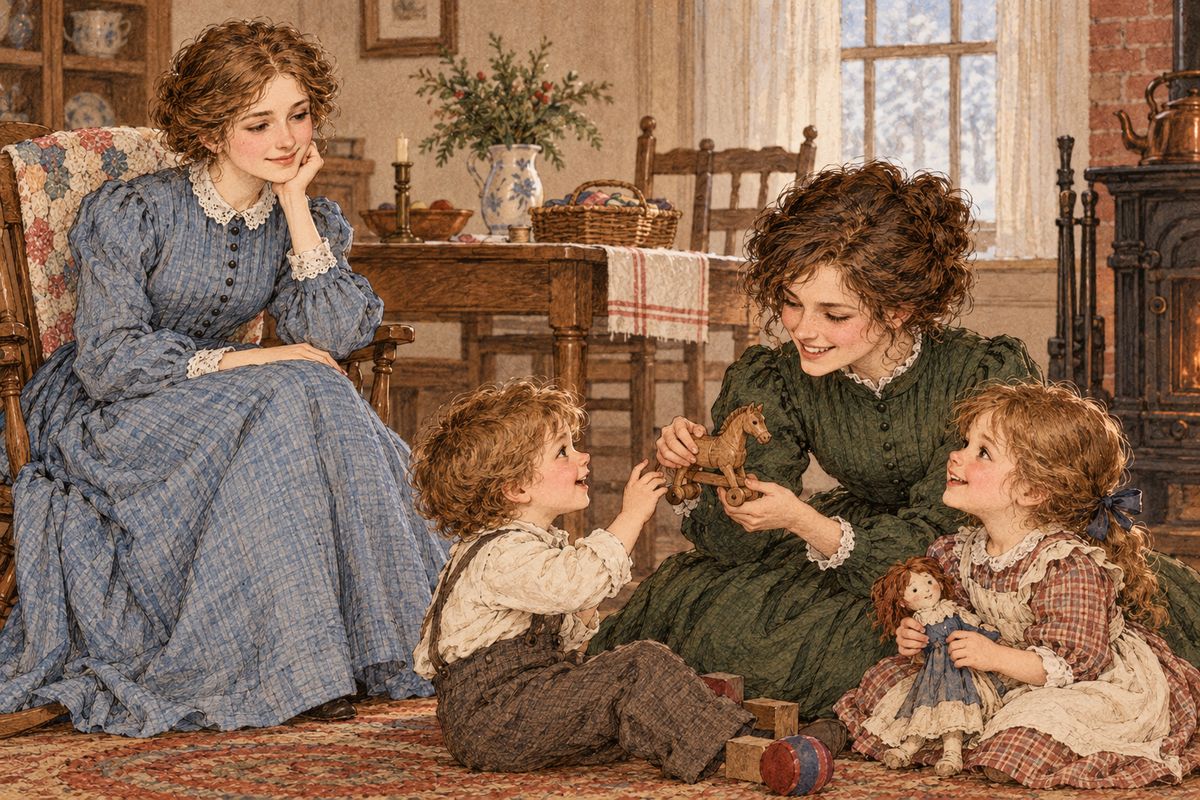
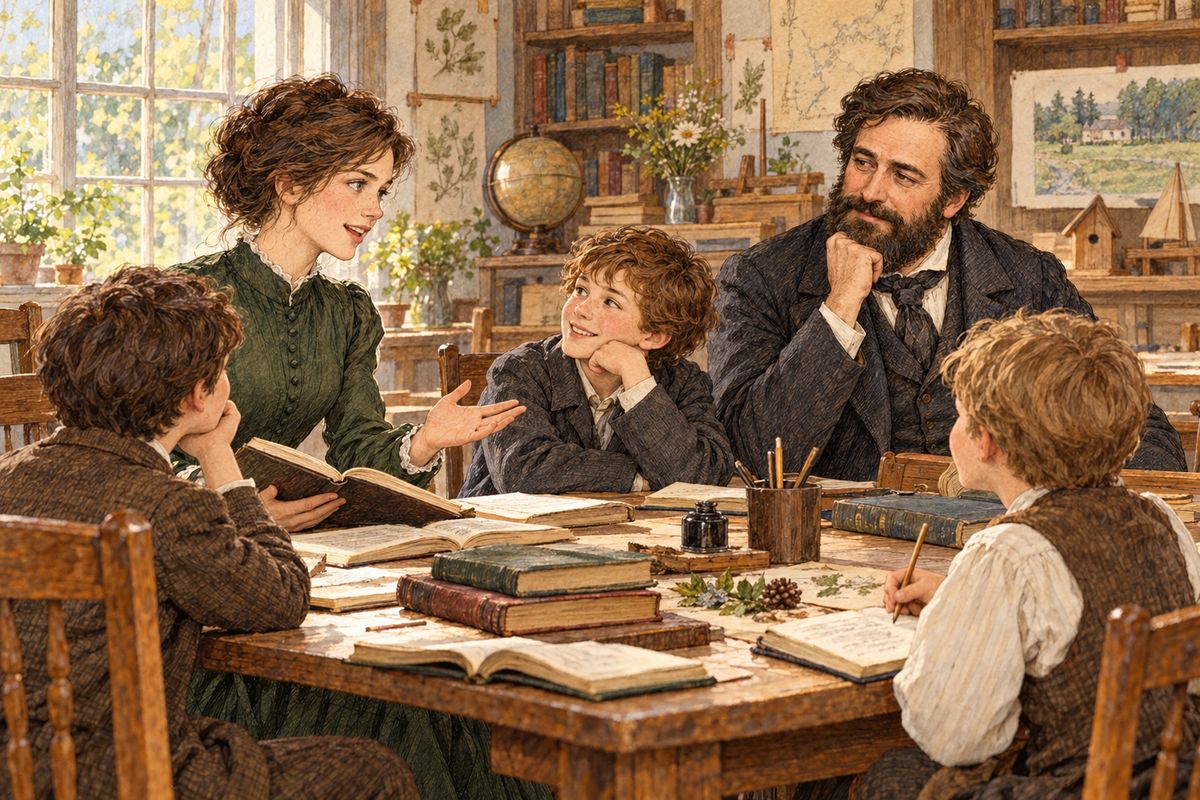
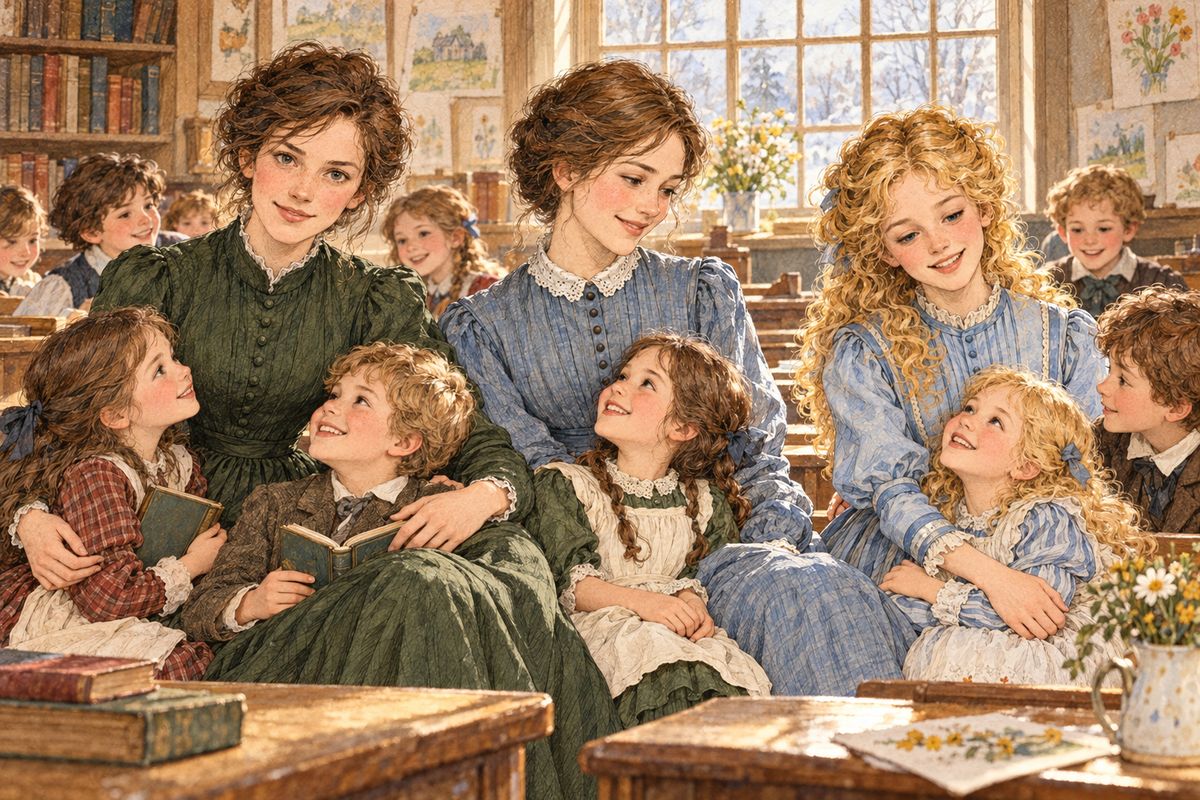
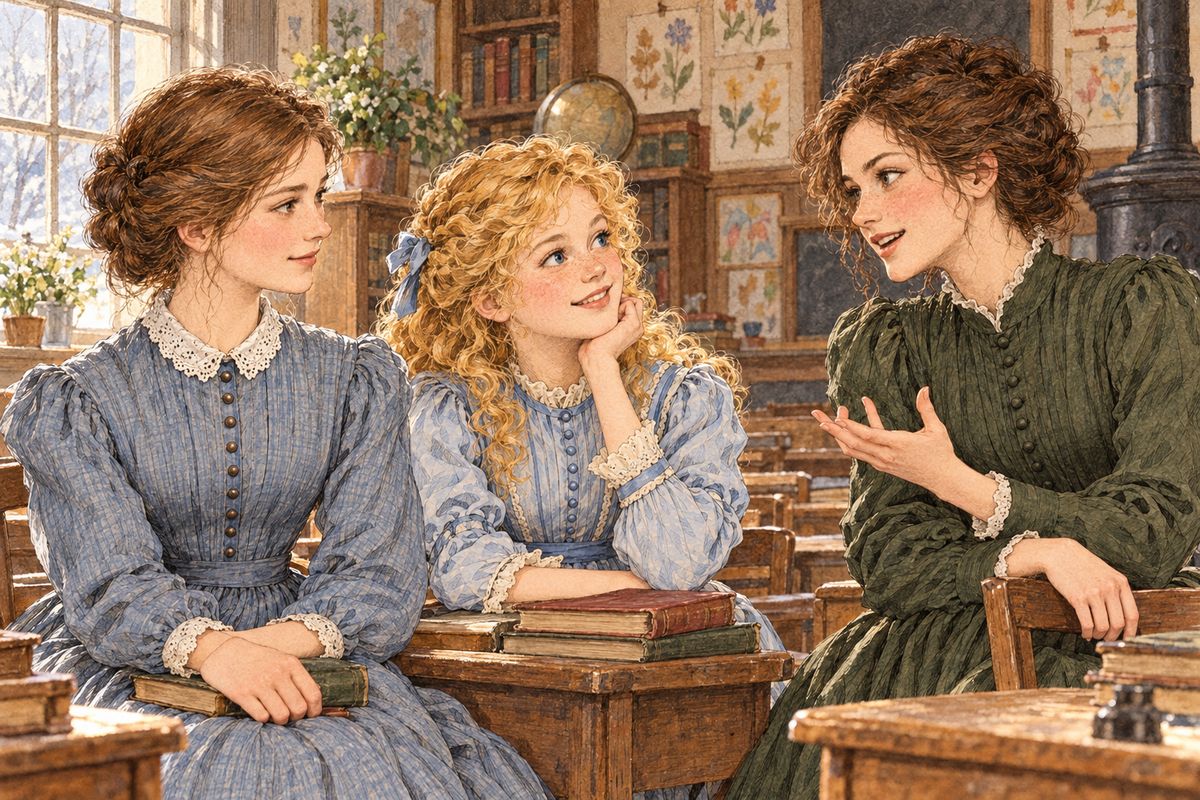
1“Christmas won’t be Christmas without any presents,” grumbled Jo by the fire, and her sisters sighed over their old dresses and their one dollar each. But when Beth set Marmee’s worn-out slippers to warm, the girls forgot their grumbling and secretly agreed to spend their money on gifts for Marmee instead.2That evening a letter came from Father, far away with the army, hoping to be prouder than ever of his little women. Marmee reminded them how they once played Pilgrim’s Progress, climbing from cellar to housetop with bundles on their backs. “Now, my little pilgrims, suppose you begin again,” she said.3On Christmas morning each girl found a little book under her pillow, and they read together quietly while the sun rose. Downstairs, with Hannah’s buckwheat cakes ready, Marmee came in from the cold with news of a hungry mother and six children. “Will you give them your breakfast as a Christmas present?” she asked.4Through quiet back streets they carried the breakfast to a bare, cold room where pale children huddled under one old quilt. Hannah made a fire, and the girls fed the little Hummels like hungry birds. “Funny angels in hoods and mittens,” said Jo, and everyone laughed.5That night, after their homemade play, the girls found a table heaped with ice cream, cake, bonbons, and flowers. “Old Mr Laurence sent it,” Marmee explained, for the breakfast story had pleased him. His shy grandson had brought the flowers himself, and Jo was determined to know the Laurence boy someday.6A week later, at a New Year’s Eve dance, Jo hid her scorched dress behind a curtain and found herself face to face with that very boy. Soon they were chatting like old friends. “I’m not Mr Laurence, I’m only Laurie,” he said, and later he drove both sisters home when Meg sprained her ankle.7Shy Beth loved music dearly and practised patiently on the jingling old piano at home. “I know I’ll get my music some time, if I’m good,” she told herself. Nobody guessed then that stern old Mr Laurence would one day sit listening to her play, his gruff face growing soft.8“Oh, dear, how hard it does seem to take up our packs and go on,” sighed Meg the morning after the party. The holidays were over, and every sister had a burden: Meg her four spoiled pupils, Jo peppery Aunt March, Beth her shyness, and Amy her flat nose and hand-me-down dresses.9Still, each sister found small joys. Jo hurried into Aunt March’s dusty library to devour books whenever the old lady napped, until a shrill voice called, “Josy-phine!” Beth nursed a hospital of shabby dolls, and Amy, whom her sisters called Little Raphael, filled her slates with drawings.10That evening Jo told the story of her day like a little play. She had read The Vicar of Wakefield to Aunt March and then stopped meekly at a thrilling place. “Finish the chapter, and don’t be impertinent, miss,” snapped the old lady. Then Meg and Amy shared tales of disgrace at the Kings’ and at school.11All the next day, Meg and Jo kept talking about the party and the kind boy next door. On the way home Laurie had ridden outside on the box, so that Meg could keep her hurt foot up. When they reached home, the sisters thanked him warmly and said good night.12Last, by lamplight, Marmee told a story about four girls very like themselves, who learned this secret: “When you feel discontented, think over your blessings, and be grateful.” The sisters stole sly looks at one another and promised to stop complaining.13One afternoon Jo swept a path down to the hedge and spied Laurie’s curly head at his window, looking wistfully over at their garden. “How do you do? Are you sick?” she called. He had been shut up a week with a cold, with no one to talk to, so Jo promised to visit.14Jo soon arrived with blanc mange and Beth’s kittens, and after a merry talk Laurie led her to the library, lined with books beneath his grandfather’s portrait. “Theodore Laurence, you ought to be the happiest boy in the world,” she sighed. But Laurie shook his head, for a fellow can’t live on books.15Shy Beth was too frightened of gruff Mr Laurence to touch his grand piano, until he kindly invited her to play whenever she liked. To thank him, she stitched him a pair of pansy slippers. In return he gave her a little piano that had belonged to the granddaughter he had lost.16“For me?” gasped Beth, when she saw the little piano standing in the parlor. Meg lifted the lid to show its green silk and gold rose, and Beth touched the keys with the happiest face in the world. Then, to everyone’s amazement, she marched next door and kissed Mr Laurence.17Amy, who was twelve, liked to be very elegant and use grand words, though they often came out wrong. When she called Laurie on horseback “a perfect cyclops,” meaning a centaur, Jo burst out laughing. Amy also confessed she owed a dozen pickled limes at school, and Meg gave her a quarter to pay.18Jenny Snow told the teacher about Amy’s forbidden limes. He made Amy throw them out of the window, two by two, struck her palm, and set her on the platform before the whole school. Amy stood white and still, thinking, “I shall have to tell at home, and they will be so disappointed in me!”19When Jo and Meg went to the theater with Laurie and left her behind, Amy took revenge: she burned Jo’s precious book of fairy tales, the loving work of several years. When Amy humbly begged pardon, Jo only answered sternly, “I never shall forgive you,” and from then on she ignored Amy entirely.20Next day Jo went skating with Laurie, and Amy hurried after them, hoping to make peace. Laurie called back, “Keep near the shore. It isn’t safe in the middle.” Jo heard but Amy didn’t, and Jo let her be, until the rotten ice cracked and Amy went down into the black water.21“Bring a rail. Quick, quick!” cried Laurie, lying flat on the ice to hold Amy up with his arm and hockey stick. Jo dragged a rail from the fence, and together they pulled her out, more frightened than hurt. Wrapped in their coats, shivering, dripping, and crying, Amy was hurried home.22That night, as Amy slept by the fire, Jo sobbed to Marmee, “It’s my dreadful temper!” Marmee confessed she had fought the very same fault for forty years. When Amy woke in her blankets and held out her arms, the sisters hugged close, and everything was forgiven and forgotten in one hearty kiss.23In April, Meg spent a fortnight with the fashionable Moffats, dazzled by their splendid rooms. She overheard them pity her shabby tarlatan and whisper that Marmee had plans for rich Laurie. So at the next party she let Belle lace her into a borrowed blue silk.24That evening she saw Laurie staring at her. “I don’t like fuss and feathers,” he said bluntly, and Meg flounced off to a quiet window, where she heard a guest call her nothing but a doll. Laurie soon came to beg her pardon, and Meg whispered that this sort of fun didn’t pay.25Home again, Meg sat by the fire with Marmee and Jo and bravely said, “Marmee, I want to ‘fess.’” She owned up to the powder, the champagne, and the silly gossip about Laurie. Jo called it rubbish, and Marmee told her girls that love and self-respect mattered far more than money.26Meg had learned that home was a nice place, though it wasn’t splendid. So the four sisters gathered again for their quiet evenings of sewing, reading, and Beth’s music, glad that their plain, loving home was worth more than any borrowed silk.27Every Saturday night the Pickwick Club met in the garret, badges tied round their heads, to read Jo’s homemade newspaper. When Jo proposed Laurie as a member, shy Beth bravely declared, “I say he may come.” Then Jo flung open the closet, and there sat Laurie on a rag bag, twinkling with laughter.28On the first of June, the sisters came home weary. Beth cuddled Jo’s tired feet, Amy stirred lemonade, and Meg sighed that she meant to rest all summer. Marmee let them try a week of play, warning that “all play and no work is as bad as all work and no play.”29By Saturday the house was a muddle, and Marmee gave Hannah a holiday. There was no fire and no breakfast, poor Pip the canary had died for want of seed, and Jo’s grand dinner for Laurie went wrong in every dish. “Salt instead of sugar, and the cream is sour,” Meg announced tragically.30That evening Marmee asked if they wanted another week of it. “I don’t!” cried Jo, and they all agreed it was pleasanter to help one another. Meg promised to sew Father’s shirts, Jo to learn plain cooking, Beth to study, and Amy to make buttonholes, and they set to work like busy bees.31One July day, Laurie invited them all to a picnic with his English friends. Jo wore the huge old hat he had sent her as a joke, and at Longmeadow he cried, “Welcome to Camp Laurence!” After croquet, Mr Brooke and Meg spread the lunch, while acorns dropped into the milk and ants came uninvited.32Jo had kept her temper when Fred cheated at croquet, and Meg whispered how glad she was. Later, in a game of Truth, Laurie admitted he liked Jo best. Asked her dearest wish, Jo first said boot laces, then owned, “Genius. Don’t you wish you could give it to me, Laurie?”33Amy chattered happily to her new friend Grace about Ellen Tree, the low apple branch the girls rode with an old sidesaddle. When Grace spoke of riding in the Row, Amy answered grandly, “I’d rather go to Rome than the Row,” though she had no idea what the Row was.34One September afternoon, Laurie joined the sisters’ busy pilgrim game, and as the sunset glowed they shared their castles in the air. Laurie dreamed of music in Germany, Meg of a lovely house, Jo of famous books, and Amy of painting in Rome. Beth only wished “we may all keep well and be together.”35As October grew chilly, Jo wrote and wrote in the garret, while Scrabble the pet rat strolled the beams above. At last she signed her name with a flourish. “There, I’ve done my best!” she cried, then tied her story with a red ribbon and slipped off secretly to town.36For weeks Jo behaved so oddly that her sisters were puzzled. Meg watched Laurie chase her all over the garden into Amy’s bower, amid shrieks of laughter and flapping newspapers. “What shall we do with that girl? She never will behave like a young lady,” Meg sighed to Amy.37Soon Jo came in and read a romantic tale aloud from a newspaper, hiding her face behind the sheet. When Beth asked who wrote it, Jo burst out, “Your sister.” There was her own name in print, and Marmee read it with shining pride while Jo waited, flushed and anxious.38Jo explained that the editor paid nothing yet, but Laurie would help get her next story paid for. Then she hid her face in the paper and shed a few happy tears, for earning her own way and the praise of those she loved was her dearest wish.39But soon a telegram came: Father was very ill in Washington. Marmee hurried away to nurse him, with Mr Brooke to help her, and the four sisters waved bravely, promising to take good care of one another until she came home again.40At first the girls kept Marmee’s motto, “Hope and keep busy,” and good news came from Washington: Father was mending. But soon they slipped back into old ways. One chilly afternoon, while Meg tried on a dress, Jo scribbled, and Hannah dozed by the fire, Beth filled a basket for the poor Hummels and went alone.41At the Hummels’ cottage, Beth took the sick baby onto her lap so little Lottchen could rest. Suddenly it gave a small cry, trembled, and died in her arms. The doctor said, “Scarlet fever, ma’am,” and sent Beth straight home to take medicine, or she would catch it too.42Beth crept home with red eyes, already feeling ill. Amy had never had the fever, so she was sent to Aunt March’s, and when Hannah asked who should nurse Beth, she leaned on her sister and said, “Jo, please.” That night Meg and Jo sat up near her door, too worried to sleep.43Beth was much sicker than anyone but Hannah and the doctor guessed. In her fever she played on the coverlet as if it were her little piano, and she called for Mother. Jo never left her side, while Meg wrote to Washington, feeling guilty because Hannah would not let her mention Beth’s illness.44Hour after hour Jo sat in the darkened room, learning how sweet and unselfish her little sister had always been. Then one snowy morning the doctor held Beth’s hot hand and said quietly, “If Mrs March can leave her husband, she’d better be sent for.” Jo ran out into the storm with the telegram.45When Jo came back, Laurie told her a secret: he had telegraphed Marmee the day before, and she would arrive that very night! Jo threw her arms round his neck, then hurried to the kitchen, where Hannah baked pies and the sisters set the house in order, whispering, “Mother’s coming, dear! Mother’s coming!”46But Beth lay in a heavy sleep, knowing nothing of the good news, and roused only to whisper for water with parched lips. All day, as the snow fell, Meg and Jo watched over her, trusting in God and Mother, and picturing the moment Marmee would sit beside the bed and take Beth’s hand.47Night came, and the sisters sat on either side of the bed while the wind wailed and tired Hannah slept. “If God spares Beth, I never will complain again,” whispered Meg. The clock struck twelve, then one, then two, and still Marmee had not come.48Past two, Jo saw a change in Beth’s face and feared the worst, but Hannah felt her hands and gasped that the fever had turned. Beth lay breathing quietly, the pain gone from her pale little face. Then, at dawn, bells rang at the door, and Laurie whispered joyfully, “Girls, she’s come!”49All through those dark days, Amy had been living with strict Aunt March, minding her lessons, dusting, sewing, and longing for home. Kind old Esther made her a little chapel where she could pray for Beth. Afraid she might fall ill herself, Amy even wrote a will, leaving her treasures to her family.50At home, when Beth woke from her long, healing sleep, the first things she saw were a white rose Meg had set beside her and Mother’s face. Marmee would not let go of the thin hand that clung to hers, and she whispered to Jo that Father was mending and Mr Brooke would stay to nurse him.51When Laurie brought Amy the happy news, she dried her tears, waited patiently, and spent a long time writing her mother a note. She hardly thought of the turquoise ring she had longed for. But Aunt March was so pleased that she kissed her, slipped it onto her finger, and called her a credit to the family.52When Marmee visited, Amy said she would wear the ring “to remind me not to be selfish,” and would try to be like Beth. Not long afterward Amy came home at last, and Jo hugged her tight, glad to have her little sister back where she belonged.53Laurie was cross that Jo kept a secret from him, so he wrote pretend love letters to Meg and signed them "Your devoted John." Poor Meg cried as if her heart would break. Jo, burning with anger, marched straight over to fetch the culprit, who soon stood twirling his hat with a guilty air.54Laurie begged pardon so humbly that Jo forgave him on the spot, though she kept a stern face, and he walked off hurt. Soon she missed him, went to make peace, and even coaxed Mr Laurence into writing him an apology. "Turn over a new leaf and begin again, Teddy," she told him.55Christmas came bright and mild, and Beth, wrapped in crimson, was as happy as could be. Then Laurie popped his head in: "Here's another Christmas present for the March family," and there stood Father! Everyone hugged him at once, Amy tumbled over a stool, and Beth ran straight into his arms.56That evening by the fire, the girls talked over their hard year while Father listened. He took Meg's hand, rough from work, and said it was prettier now than when it was white and smooth. He told Jo she had grown into a gentle, helpful young woman, and her eyes grew dim.57Still, something hung in the air. Ever since Laurie's prank, Meg had been shy and dreamy, starting when the bell rang and blushing whenever John Brooke's name was mentioned. John had been so good to Father, and when he spoke to her kindly, Meg's heart gave a little flutter.58Jo hated waiting: "If you mean ever to do it, make haste and have it over," she grumbled. Meg answered that she had a calm little speech ready to turn him down, and rose to practise her dignified exit. But at a step in the hall, she flew back to her sewing.59It was John, come for his umbrella, and when he asked for her love, Meg forgot her speech and, in a contrary mood, sent him away. Then Aunt March hobbled in and declared that not one penny would ever go to her. "I shall marry whom I please, Aunt March," Meg answered bravely.60Standing up for John showed Meg how much she cared, and she whispered, "Yes, John." Three years later, he had worked hard and made ready a tiny brown house that Laurie named the Dovecote. Meg sometimes envied Sallie Moffat's fine home, but thinking of John's patient love, she felt like the happiest girl alive.61Everyone helped, from Beth's dishcloths to Hannah's polished pans. "Does it seem like home?" asked Marmee, and Meg was too happy to talk about it. The next day, in a plain parlor full of flowers, Meg and John made their promises before the people who loved them.62Jo had made Laurie promise not to make her laugh, and she had insisted she never cried. Now, with Meg a bride, the sisters held each other tight. "We don't want any more marrying in this family for years to come," Jo had said, yet she smiled to see Meg so happy.63There was no grand bridal journey, only a quiet walk with John from the old home to the new. The wedding gifts were already waiting in the little house, and at first the young couple played keep-house and frolicked over it like children. Meg was determined that John should find home a paradise.64Evenings over the account books brought frugal fits of hash and bread pudding, and the little paradise was not always tranquil. When Meg's jelly wouldn't 'jell' and John brought a friend home to no dinner, they quarreled. That evening Meg thought, "I will be the first to say, 'Forgive me,'" and softly kissed his forehead.65Meanwhile Amy tried every kind of art. Once she cast her own foot in plaster and got stuck, and Jo laughed so hard digging her out that the knife slipped. Next Amy haunted fields and riverbanks, catching colds on damp grass, still sure that someday she would make 'high art'.66Jo had her own ambitions. At a lecture, a boy showed her a newspaper offering a hundred-dollar prize for a thrilling story, so she secretly wrote one that ended in an earthquake. Six weeks later a letter came, a check fell into her lap, and Jo read the kind words and began to cry.67Jo proudly announced her prize, and when the story came, everyone read and praised it. Father said gently, "You can do better than this, Jo. Aim at the highest, and never mind the money." But the prize sent Marmee and Beth to the seaside, and more stories soon paid the butcher's bill.68Next Jo tried to publish her novel, but the publisher wanted it cut by a third. At the family council Marmee said, "Criticism is the best test of such work." Jo took everyone's advice and pleased nobody, and the reviews bewildered her terribly, yet she laughed at last and resolved to try again.69When the year rolled round to midsummer, the deepest and tenderest joy came to the little house: twins, a boy and a girl! John beamed at the little red squirmers as if they were angels. "Boy and girl. Aren't they beauties?" he asked everyone proudly.70Marmee and the sisters gathered round to help Meg with the babies. Amy tied a blue ribbon on the boy and a pink one on the girl, so everyone could tell them apart. The girl would be Daisy, and when Laurie said, "Name him Demijohn, and call him Demi for short," the name stuck.71Meg never forgot the autumn before the babies came. Sallie Moffat often invited 'that poor dear' to her big house, and seeing Sallie's pretty things made Meg long for them. She hated being pitied, so she began buying pretty trifles, though she always felt wicked afterward.72That July, Amy finished the crayon portrait of Beth she had promised Jo, so Jo had to pay her side of the bargain: a day of formal calls in her best clothes. Tired and cross at Aunt March's, Jo announced, "I don't like favors, they oppress and make me feel like a slave."73In that same autumn, Meg could not resist a violet silk for fifty dollars, half of it from the household money. At home it looked less silvery, and when John opened the account books, she confessed. "Twenty-five yards of silk seems a good deal to cover one small woman," he said dryly.74At Mrs. Chester's fair, Amy answered an unkind slight with kindness, and Aunt Carrol was pleased. A week later she wrote inviting Amy, not Jo, to go abroad, and Marmee showed Jo why: her own words about hating favors and French. "Oh, my tongue, my abominable tongue!" groaned Jo.75Back on that autumn evening, Meg sighed that she was tired of being poor, and John said quietly, "I do my best, Meg." Those words broke her heart. After a long talk, she asked Sallie to buy the silk, ordered John the greatcoat he had given up, and gadded no more.76Soon Amy was packing her pencils for Europe, dreaming of Rome, and she promised to send for Jo in a year or two. Jo bore up bravely until the last flutter of blue ribbon vanished; then she went to her refuge, the garret, and cried among her papers till she couldn't cry any more.77Meanwhile Amy had sailed for Europe with her aunt, her uncle and her cousin Flo. While the others lay seasick below, Amy spent whole days on deck, delighting in the sunsets, the splendid air and the rushing waves. "I wish Beth could have come," she wrote home.78In London Amy gazed at Raphael's great paintings, and in Paris she spent rainy days in the Louvre with her sketchbook, revelling in pictures. Jo would turn up her nose at some of the finest, she wrote, but she herself was training her eye and taste as fast as she could.79At home, Laurie had grown graver, and Jo talked with him about the future, urging him to spend his time with the modest girls he respected instead of silly ones. When she teased him about turning over a new leaf, he answered soberly, "So I am, and I mean this one shall stay turned."80Back home, Jo feared that Laurie was growing too fond of her, so she went to New York to teach Mrs Kirke's children. In the big boarding house she met Professor Bhaer, a poor, kind German who carried a little servant girl's heavy coal up the stairs. "It goes better so," he said.81Professor Bhaer caught Jo mending his socks and insisted on repaying her with German lessons. When the dry grammar nearly made her cry, he tossed it aside and opened Hans Andersen's fairy tales instead. "Das ist gut! Now we go well!" he cried when she finished her first page.82One evening Professor Bhaer found a sensational newspaper and said such stories put "poison in the sugarplum." Jo's cheeks burned, because she had been secretly writing thrilling tales for the Weekly Volcano. That night she reread them, saw they were trash, and stuffed the whole bundle into her stove.83Jo stayed with Mrs Kirke until June. Early on her last morning Professor Bhaer came to the station with a bunch of violets, and as the train carried her home, Jo thought happily, "I've made a friend worth having and I'll try to keep him all my life."84Laurie graduated with honor, and the next day Jo walked out to meet him, as she always had. On the path home through the grove, his merry talk faltered. Then, his voice going choky, he said, “I’ve loved you ever since I’ve known you, Jo.”85Jo’s heart ached, but she would not lie. She was proud and fond of him, yet she could not love him as he wished. When he caught her hands and asked if she truly meant it, she answered gently, “Really, truly, dear,” and Laurie laid his head on the mossy post.86Laurie rowed hard up the river, and soon Mr Laurence took him abroad to forget. When they parted, Laurie asked one last time, “Oh, Jo, can’t you?” Jo could only wish she could, and afterward she wept in Marmee’s arms, knowing the boy Laurie would never come again.87With Laurie gone, Jo’s worry about Beth returned, for Beth’s hands had grown almost too thin to hold the little shells they gathered. One day Beth looked up tenderly and said, “Jo, dear, I’m glad you know it.” She had known for a long while that she would not get well.88Beth loved her sisters dearly and pictured each as a bird: Jo the gull, strong and wild, Meg the gentle turtledove, and Amy the lark, who flew high but never forgot home. The hard part, she told Jo, was leaving them all. “It seems as if I should be homesick for you even in heaven.”89Across the sea in Nice, on Christmas Day, Amy came driving her pony carriage and spied Laurie at last. “I promised to spend Christmas with you, and here I am,” he said. Later, on Castle Hill, as she fed the peacocks, Amy saw that her merry boy had grown older and graver.90As they drove up a shady road where tea roses bloomed, Amy read that Beth was very poorly, and Laurie’s brotherly “my dear” comforted her. That night at the Christmas ball she danced with spirit and grace, and Laurie decided that little Amy was going to make a very charming woman.91When Amy rested at last from dancing, Laurie fanned her and asked where she had learned such style. Amy frankly confessed that tulle was cheap and posies free: "I am used to making the most of my poor little things." Laurie admired her brave, cheerful spirit and stayed by her side all evening.92Laurie stayed on in Nice for a month, drifting idly. One day among the roses at Valrosa, Amy told him that she and Flo had a new name for him, Lazy Laurence, and said honestly that he was wasting his time and gifts. "Well, I despise you," she said gravely.93As they went home in the evening light, the two laughed and chatted, yet each felt a shadow over their friendship. When they parted, Amy asked for a hearty handshake instead of a kiss on the hand, and Laurie gave her one. "Goodbye, dear," he said, and by the next morning he had gone to his grandfather.94Back in Concord, there had been no need to tell Beth’s secret, for Father and Mother saw it plainly. Beth’s little chair stood empty now while she rested, and Jo sat writing beside it. She remembered her promise, for Beth had asked, “You must stand by Father and Mother, won’t you, Jo?”95Marmee came to sit with Jo, bringing news of Meg, who had been so busy with her babies that she had forgotten lonely John. Marmee had gently shown her the secret of a happy home: “At home we work together, always.” Jo closed her notebook, smiling to hear it.96Soon, with John’s firm help with Demi, Meg’s little house was cheerful again. But Jo’s thoughts stayed with Beth, and one night, alone beside the empty chair, she wrote a poem called “My Beth,” asking her sister to leave her the gift of patience. Her tears fell and blurred the lines.97Beth grew weaker, and Jo never left her, sleeping on a couch in her room. One night Beth found Jo’s poem and asked, “Have I been all that to you, Jo?” Then one spring night, in the dark hour before dawn, Beth slipped away in Marmee’s arms, as gently as the tide going out.98When morning came, the fire was out, Jo’s place was empty, and the room was very still. Jo walked out beneath the bare trees, where a bird sang on a budding bough and snowdrops bloomed. She remembered Beth’s wish, that she take her place and be everything to Father and Mother.99Gathered together, Marmee and her girls remembered how tenderly they had made Beth ready for the long sleep that pain would never trouble again. Her face had been so full of painless peace that, through their tears, they smiled and thanked God that Beth was well at last.100In the lonely days after Beth died, Jo often woke at night crying for her sister, and Marmee always came to hold her. One day, as they sat together and Jo looked sad and idle, Marmee asked gently, “Why don’t you write? That always used to make you happy.”101Jo got out her old manuscripts, and soon she was scratching away in her black pinafore. She put her whole heart into a simple story, and when Father sent it to a magazine, strangers wrote to praise it. “There is truth in it, Jo,” Father said, “that’s the secret.”102On the evening before her birthday, Jo had a wonderful surprise: Laurie and Amy were home from Europe! Laurie, too eager to wait, had hurried ahead to tell her the grand news himself. They were married! Then Amy's voice rang out, “Where's my dear old Jo?” and Jo gladly welcomed them both home.103In trooped the whole family, and everyone was hugged and kissed all over again. Amy, in silk from head to foot, was looked at and admired, and Laurie hovered happily around her. How they all talked, trying to tell the history of three years in half an hour!104Watching the young pair, Jo thought, “How well they look together!” Amy’s face shone with the soft brightness of a peaceful heart, and Laurie could not stop admiring her. He had already promised Jo she would never be lonely again, for she must share everything with them, just as in the old days.105Later, when the others had gone upstairs, Jo felt suddenly lonely, and then a knock came at the porch door. There stood a tall, bearded gentleman, beaming like a midnight sun. “Oh, Mr. Bhaer, I am so glad to see you!” cried Jo, pulling him inside.106“You haf been ill, my friend?” Bhaer asked gently, seeing the tired sorrow in Jo’s face, and his kind eyes comforted her. All evening by the fire, Jo knitted quietly, stealing glances at him. When she dropped her ball, they both dived for it, bumped heads, and came up flushed and laughing.107Jo strolled with Amy and Laurie in the garden, laughing as in old times. She had promised Laurie, “We will be brother and sister,” and it felt true now. She wondered, too, what business kept Professor Bhaer in the city, for he had promised to come again.108While Laurie and Amy set their new house in order, Meg and John had their hands full at the little Dovecote. Once the twins were tucked in at last, the tired parents sat together and smiled over the day: Daisy's kisses for everyone, and Demi's endless "What for?"109The twins called Jo Aunt Dodo, and she was their chief playmate; the three of them turned the little house topsy-turvy while Meg looked on. When Demi tried to hoist his patient sister up in a basket, bumping her head, he told his mother indignantly, "Why, Marmar, dat's my lellywaiter!"110Romping with the twins reminded Jo of a dream older than her friendship with the Professor. Someday she meant to have a big house full of poor, forlorn little lads who hadn't any mothers. In her daydreams, she and kind Professor Bhaer stood at the gate, welcoming them in.111She pictured herself feeding, nursing, petting, and scolding them, and gathering them round a table for lessons and stories. Jo believed that even the clumsiest, naughtiest boy hid a warm, honest heart, and she longed dearly to be a mother to such lads.112One day Jo told her plan to Professor Bhaer, and he said it was just what he would like. He had been helping poor boys all his life, though money never stayed in his pocket for long. They agreed to try it someday, when they were rich.113One rainy afternoon Jo went to town without her umbrella, secretly hoping to meet the Professor, and a shabby blue umbrella appeared above her bonnet. When he said he was going far away to the West, Jo's tears came. "Heart's dearest, why do you cry?" he asked.114Jo sobbed that it was because he was going away, and gladly gave old Fritz a place in her heart. Then he showed her what had brought him: her own little poem of the sisters, Meg a happy mother among her babies, Amy hearing bridal bells, and all "nearest and dearest evermore."115They would have to wait, for the Professor must help his boys first, and Jo had her own work. When he said he had only a full heart and empty hands to give, Jo put her hands in his, whispered, "Not empty now," and kissed him under the umbrella.116For a year they worked and waited and wrote long letters. Then Aunt March died and left Plumfield to Jo, and her old dream could come true: a school full of boys! "It will be an immense care for Jo," said Meg, but Amy's eyes said she approved.117Jo went on eagerly: Plumfield was just the place for boys, with room for dozens inside and splendid grounds outside. "I do think that families are the most beautiful things in all the world!" she cried. Almost before she knew it, she was married and settled there.118Plumfield became a boys' paradise, which Laurie named the 'Bhaer-garten.' Boys feasted on forbidden plums and played cricket where Aunt March's cross old cow once grazed, and in time Jo's own little sons, Rob and Teddy, tumbled among them. On holidays the whole family came to join the fun.119On a mellow October day five years after the wedding, everyone came for apple-picking. At four o'clock Jo and Meg set supper on the grass, and some boys drank milk standing on their heads while turnovers roosted in the trees. Then the Professor raised the first toast: "Aunt March, God bless her!"120After the boys sang from the treetops for Marmee's sixtieth birthday, the sisters gathered round her under the festival tree, counting their blessings. Marmee stretched out her arms to gather them all in: "Oh, my girls, however long you may live, I never can wish you a greater happiness than this!"
Adapted from Little Women by Louisa May Alcott, public domain. Pictures are AI illustrations drawn for this edition.
Add Stories to your Home Screen: tap
then Add to Home Screen.