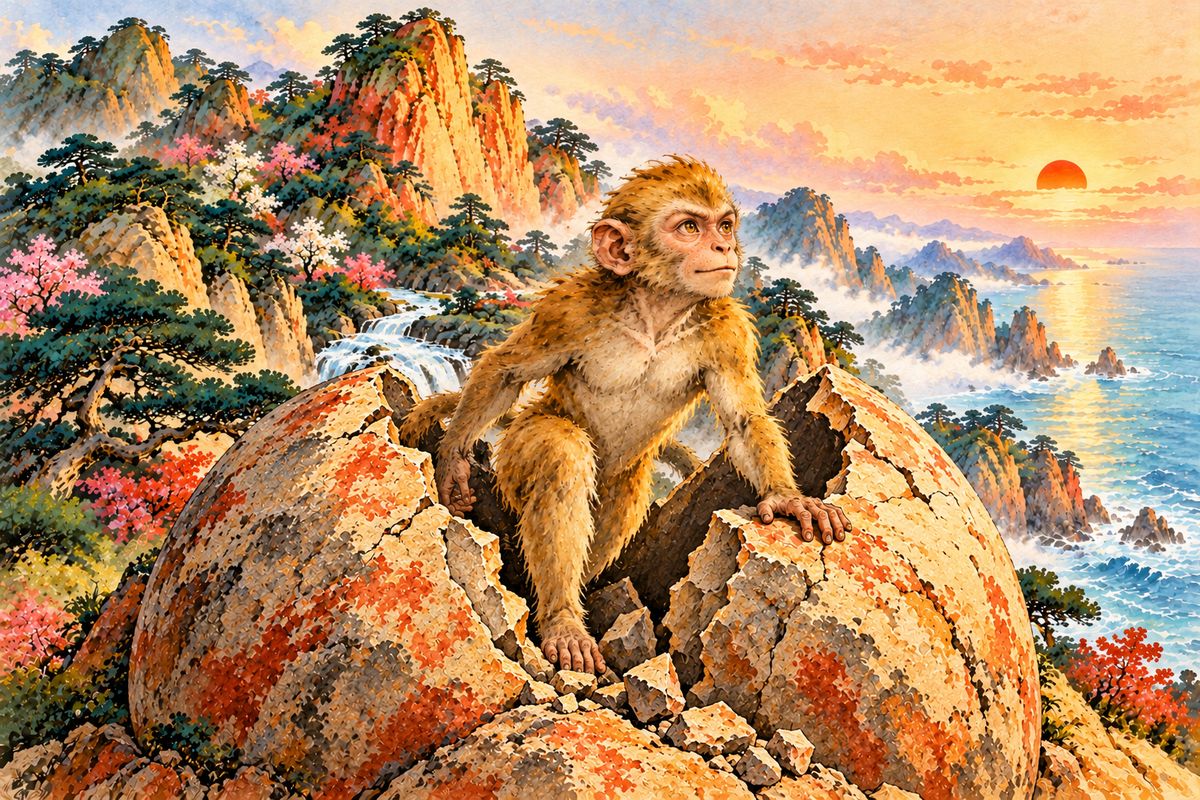
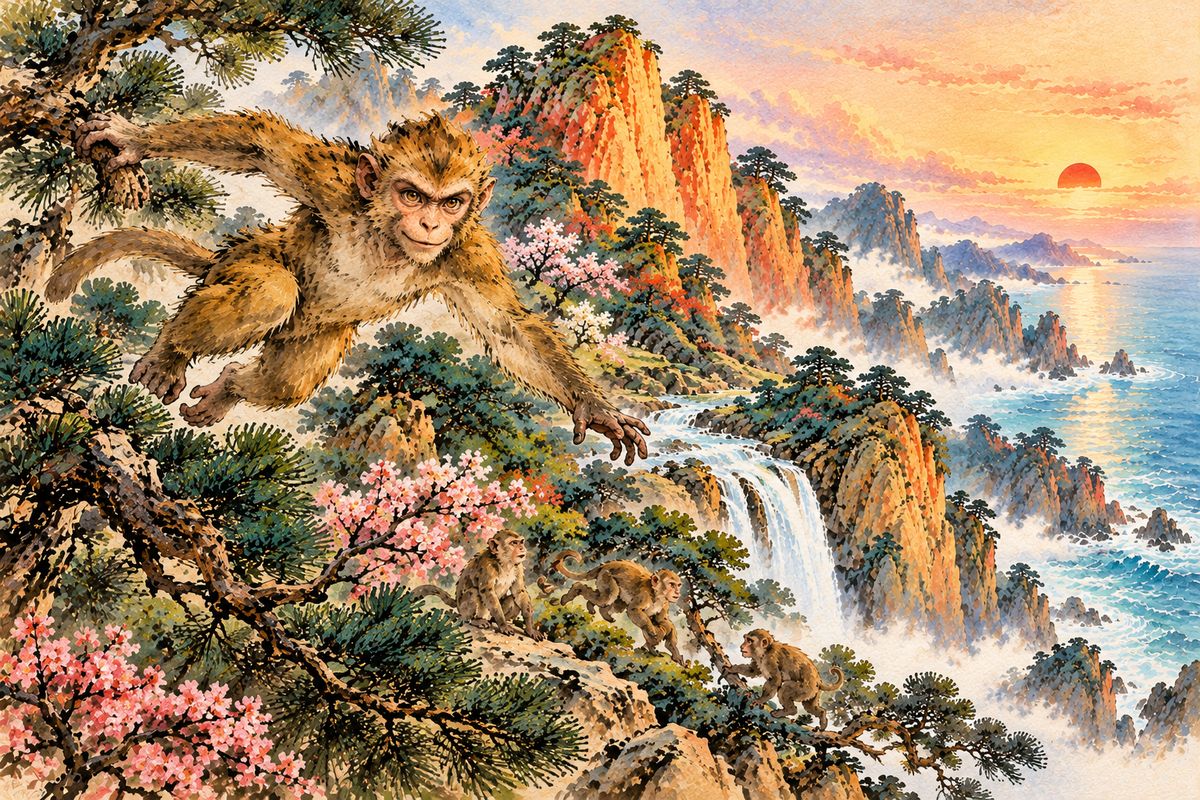
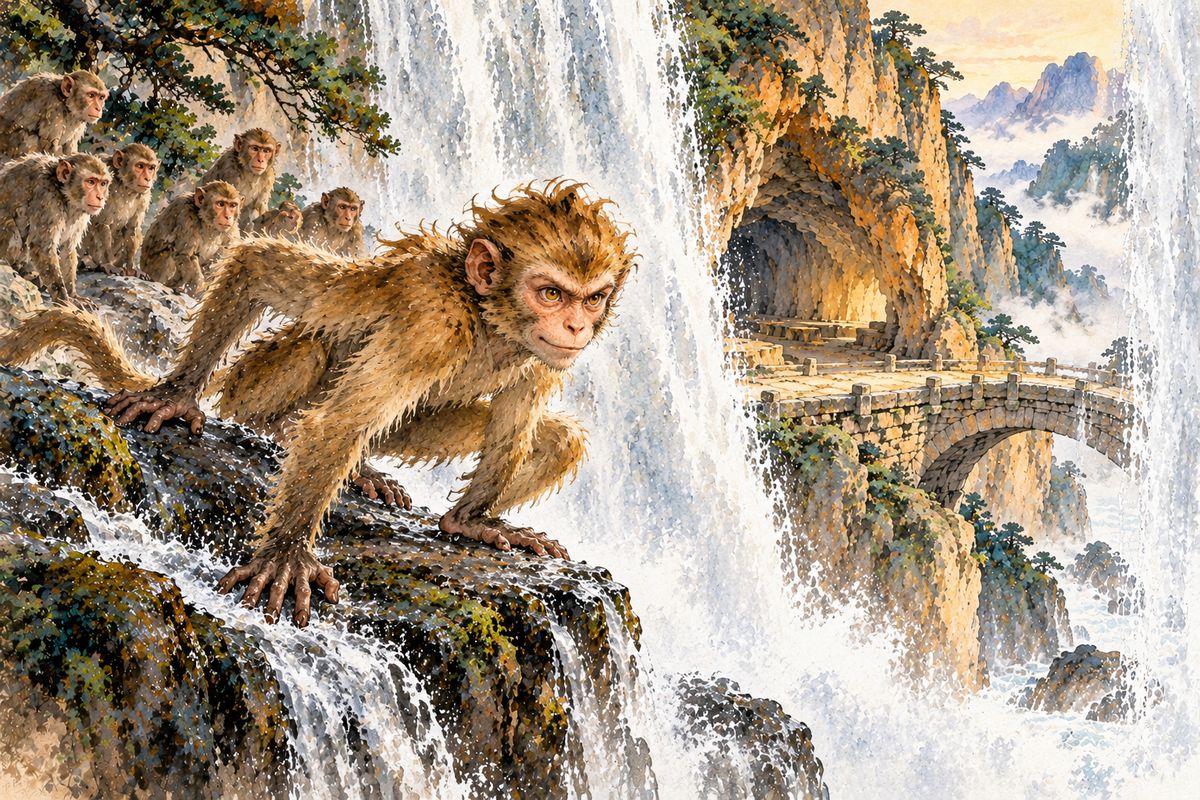
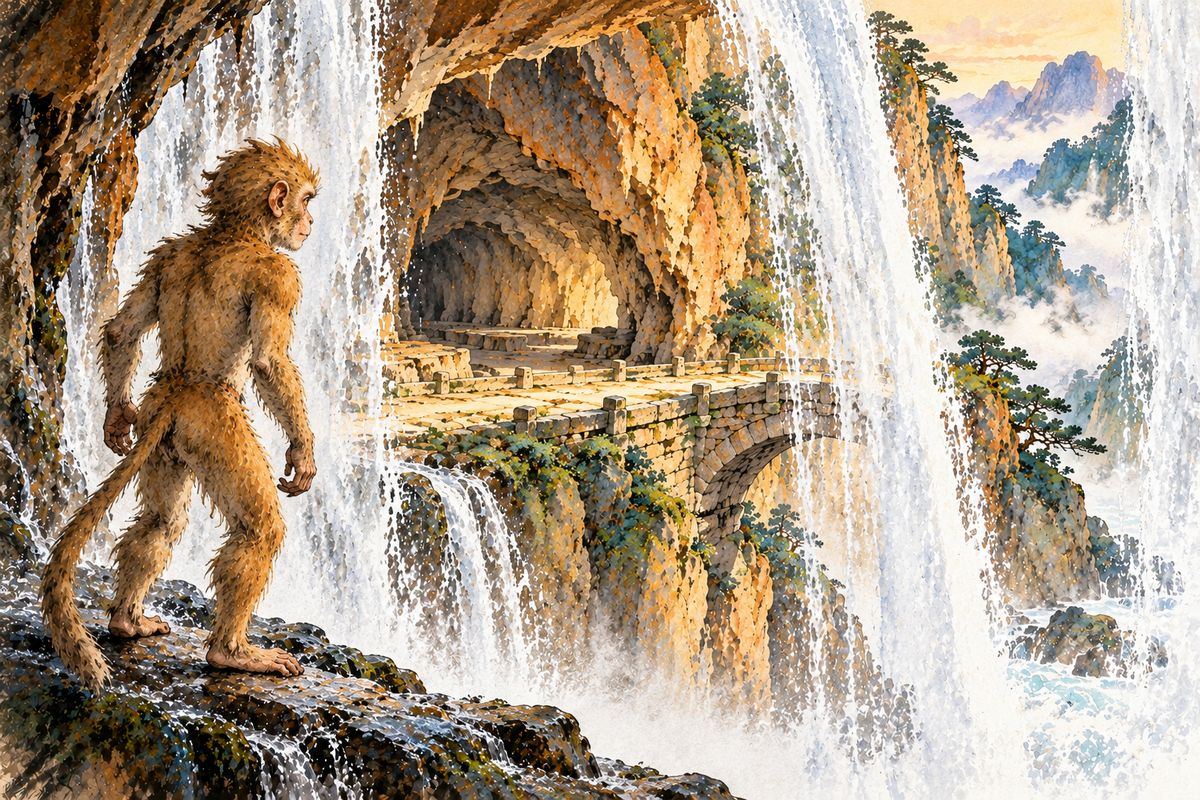
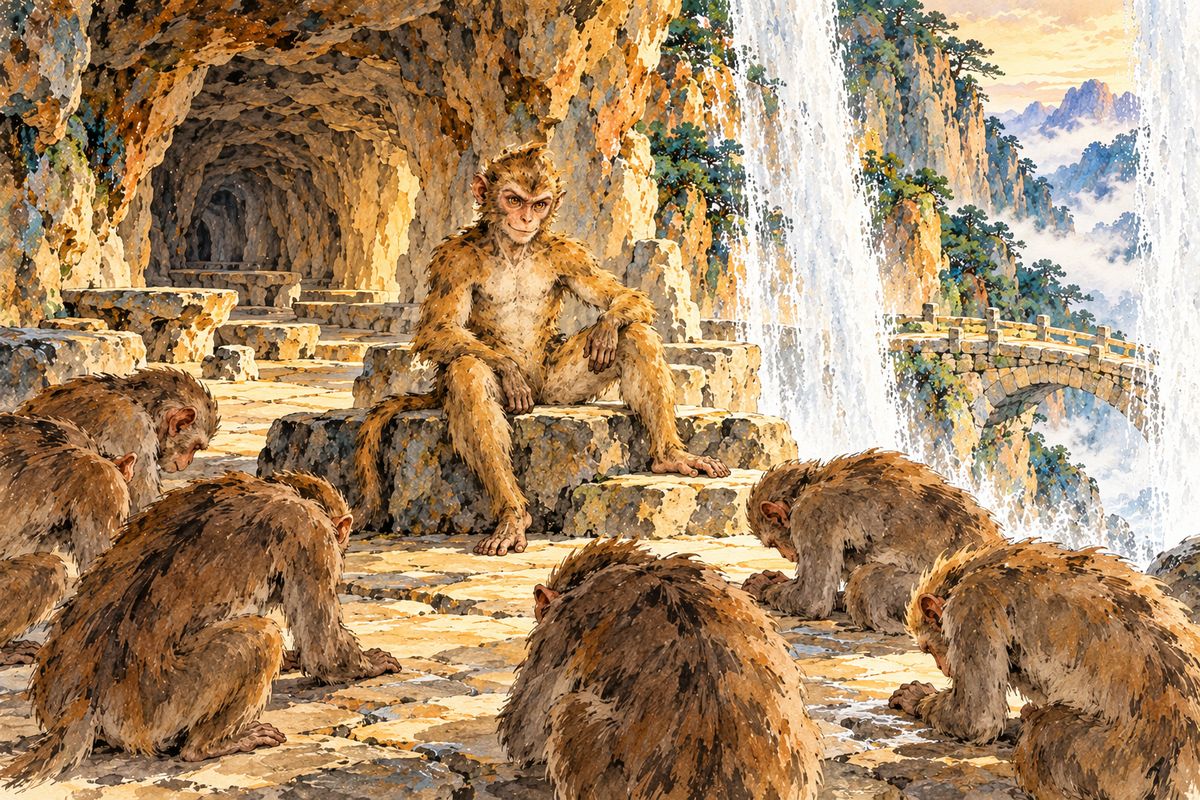
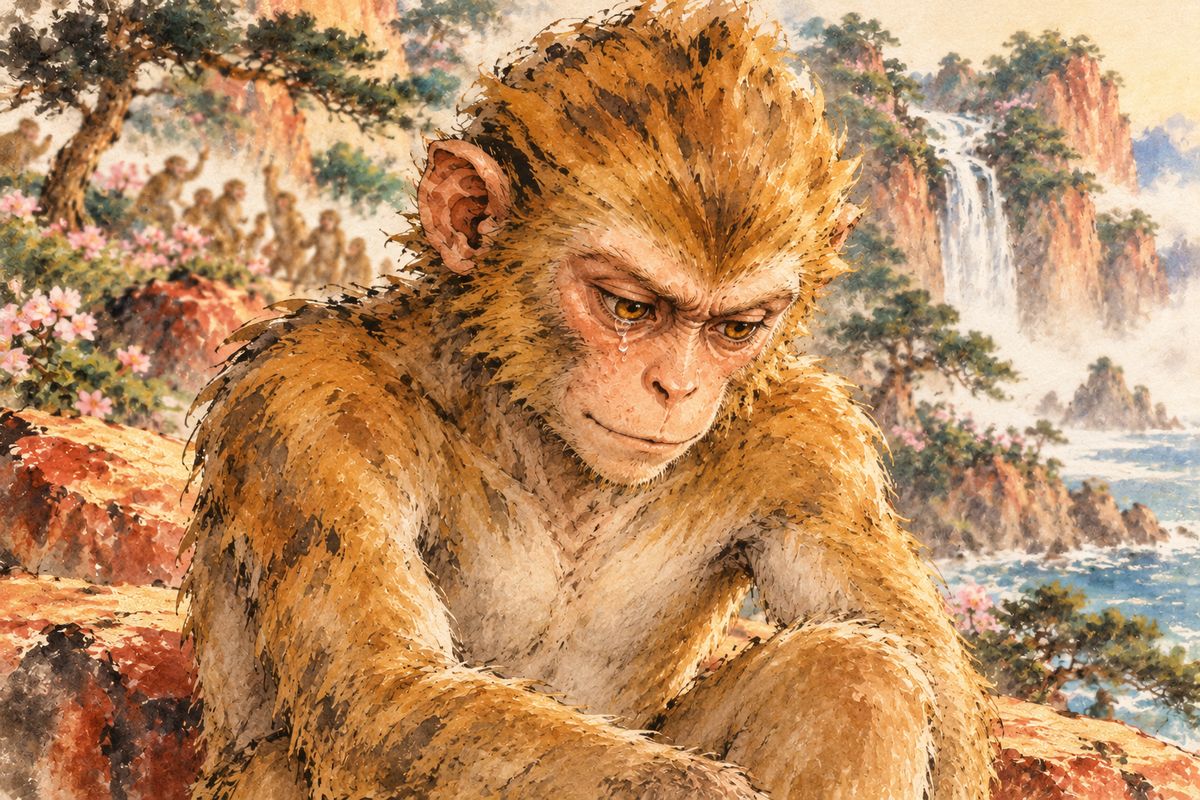
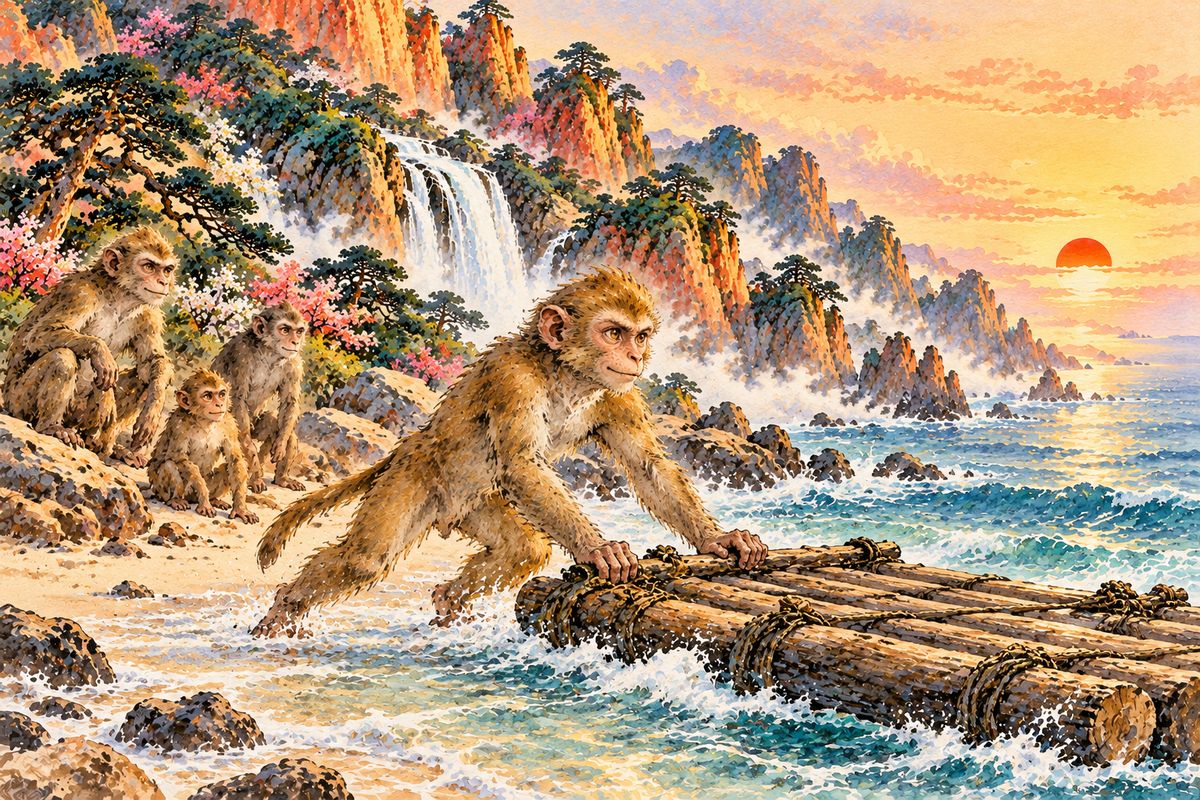
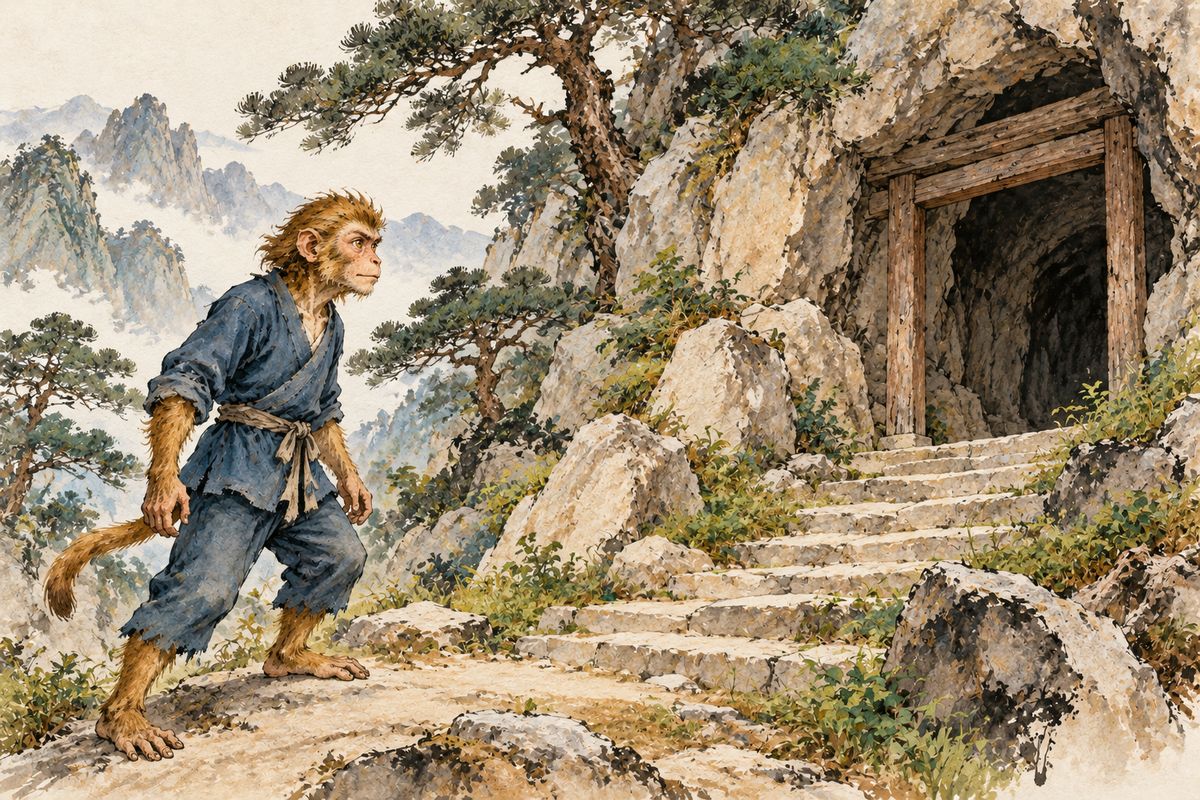
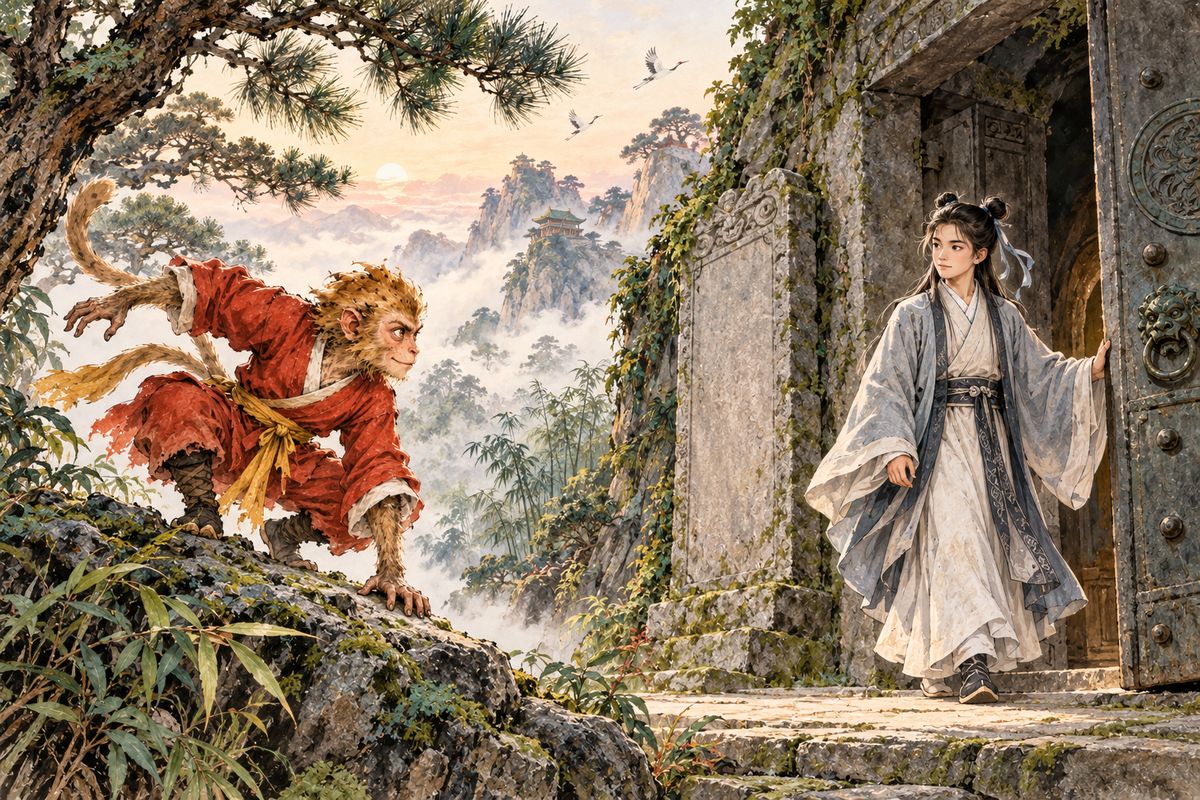
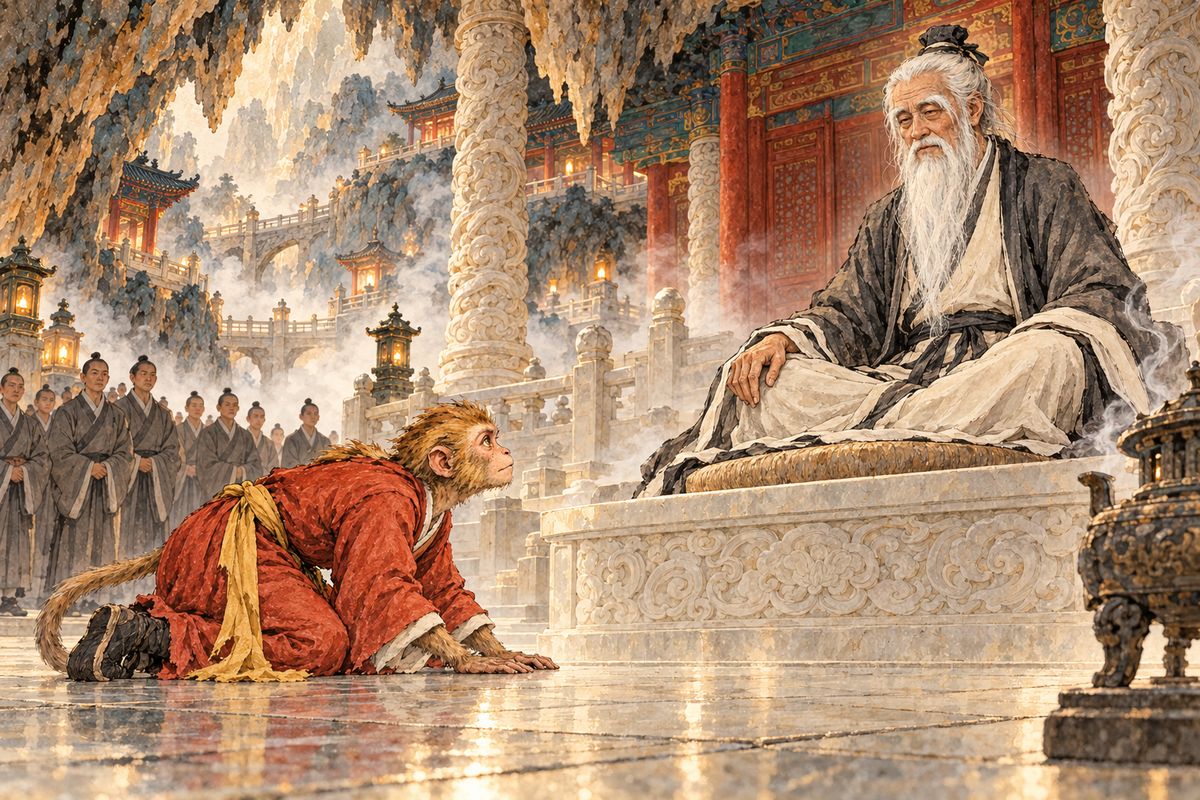
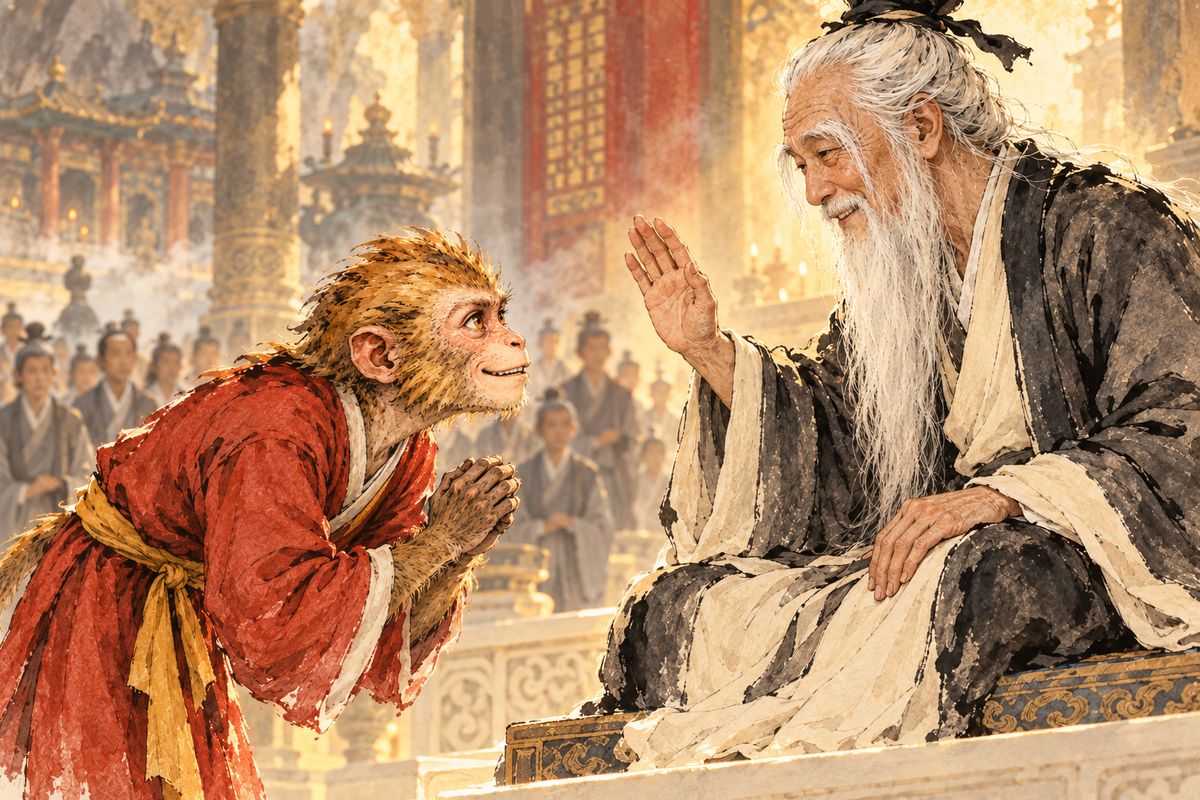
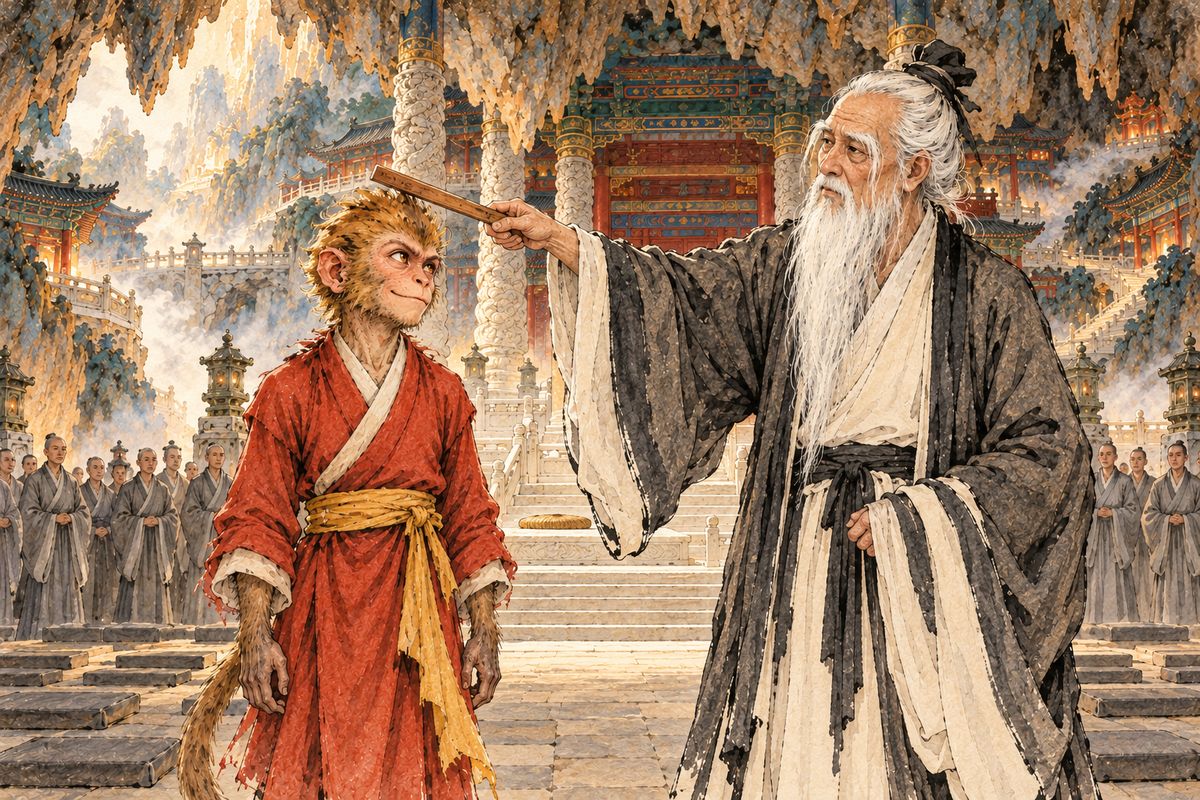
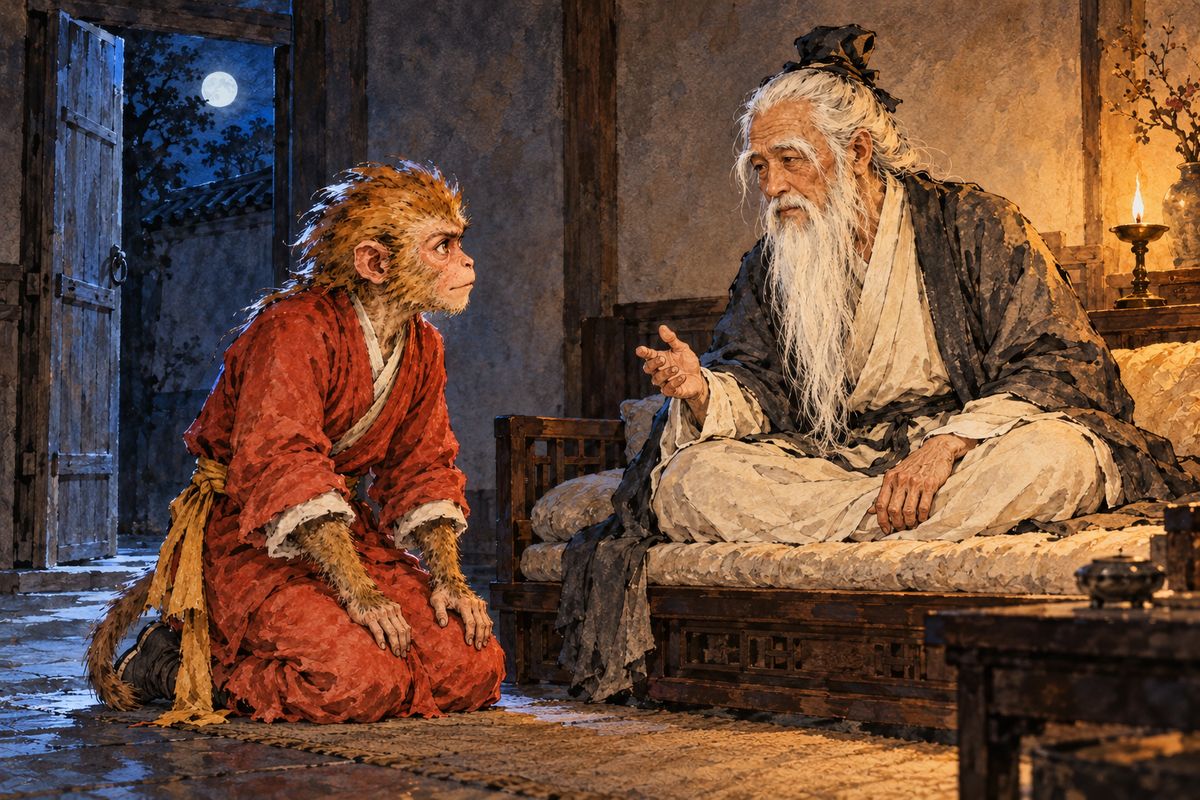
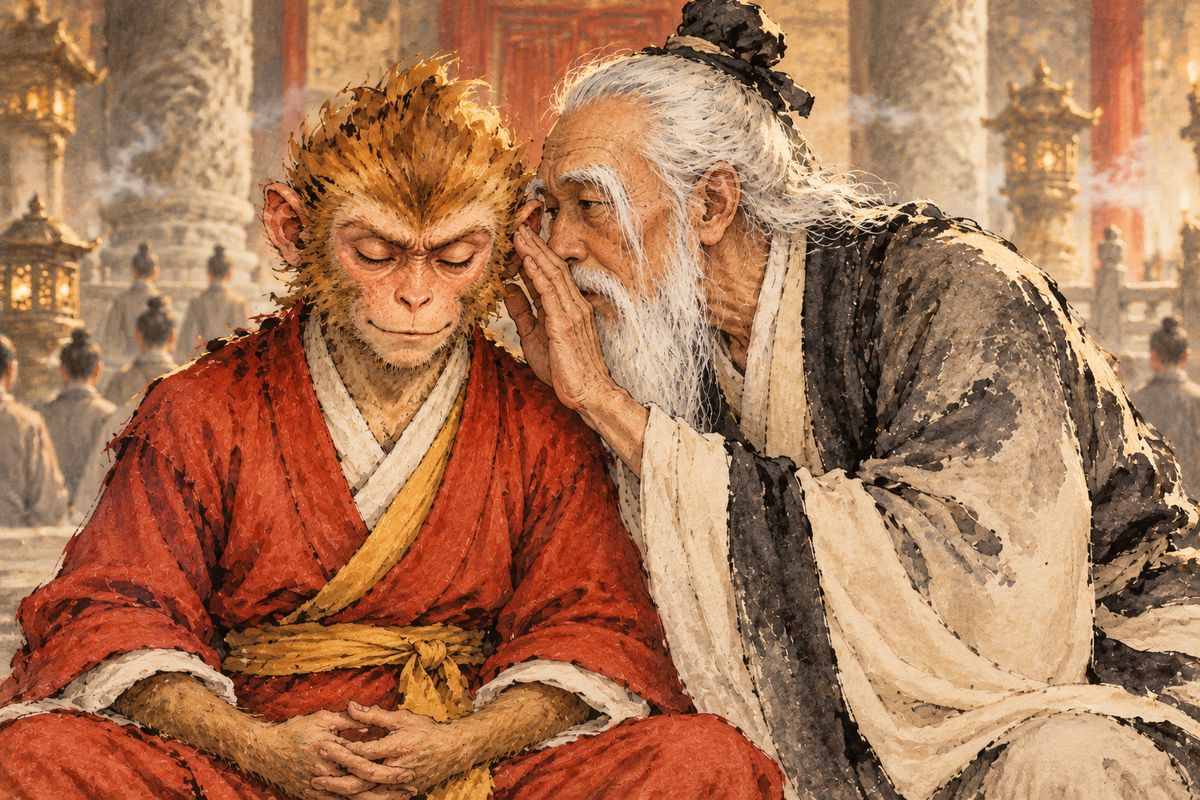
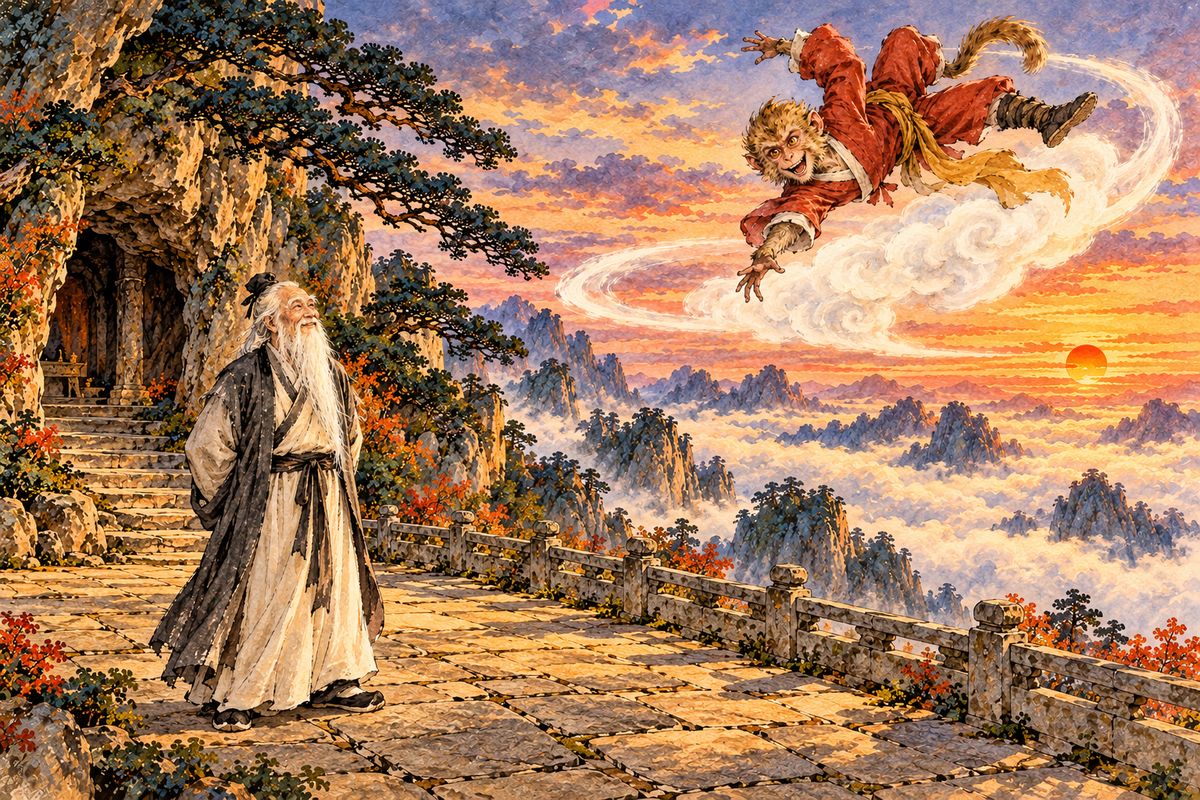
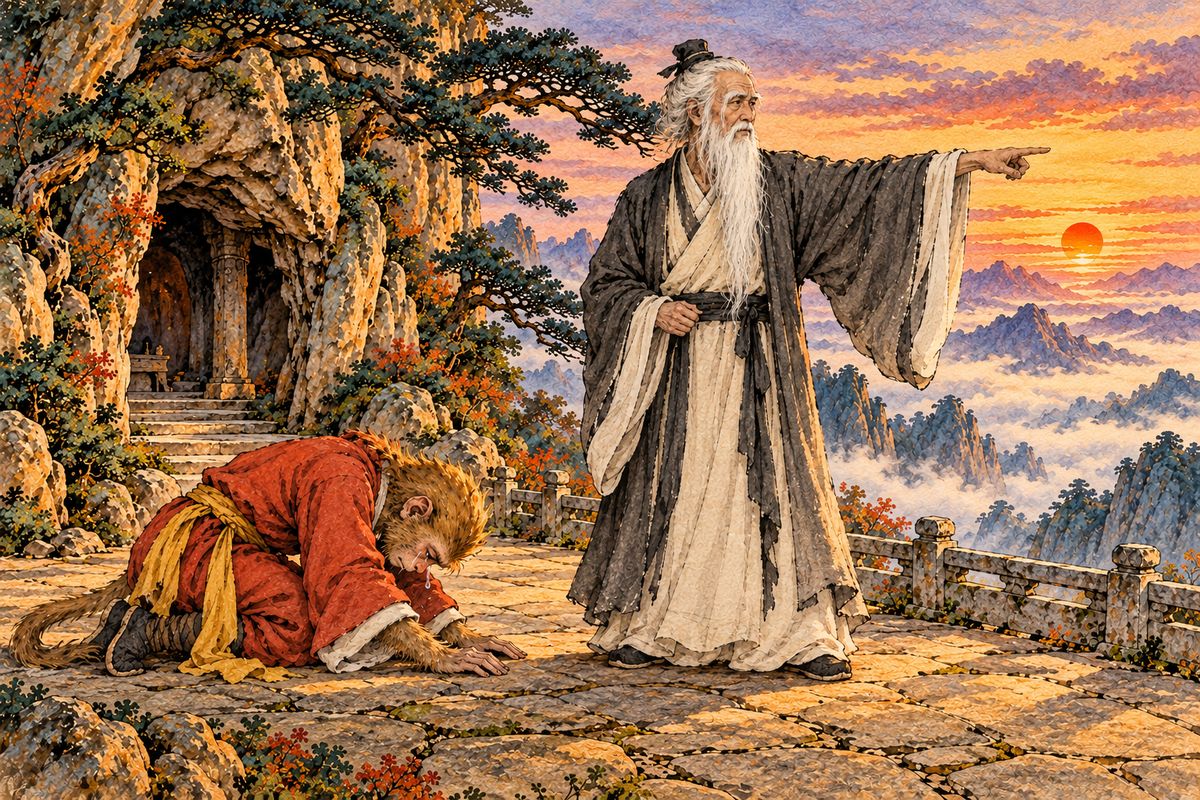
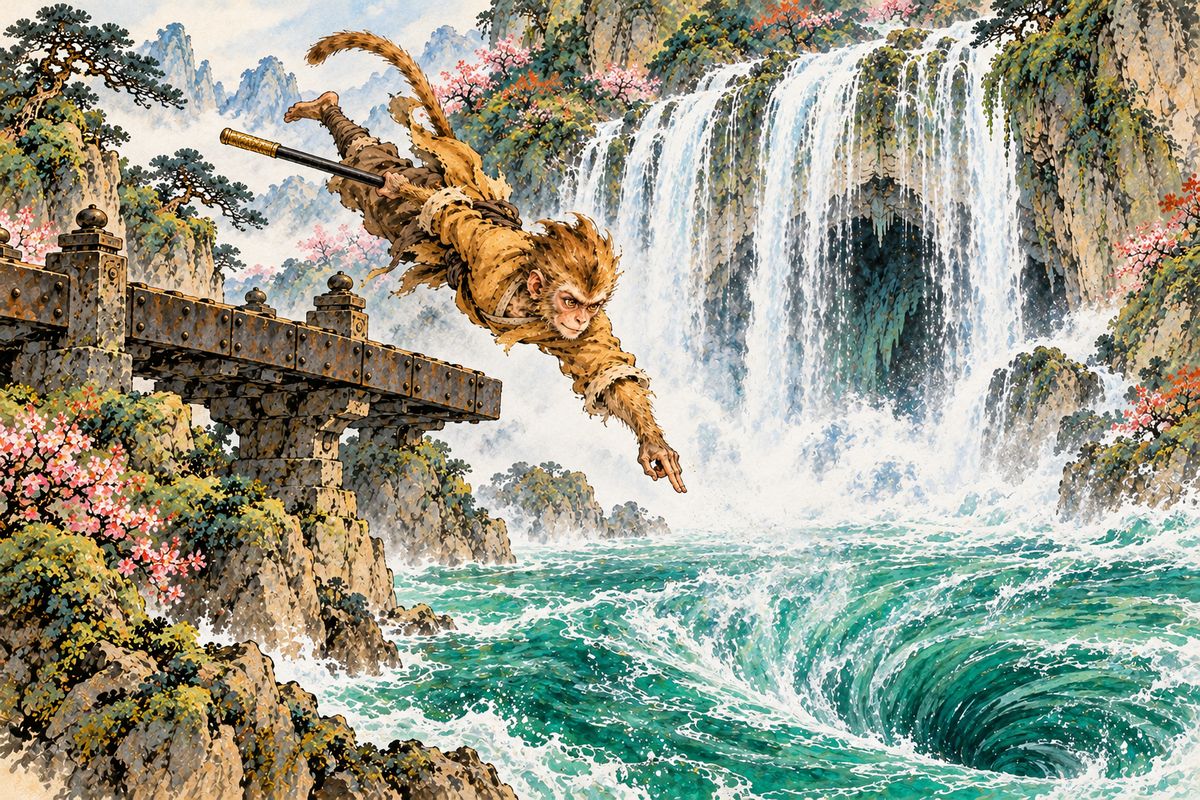
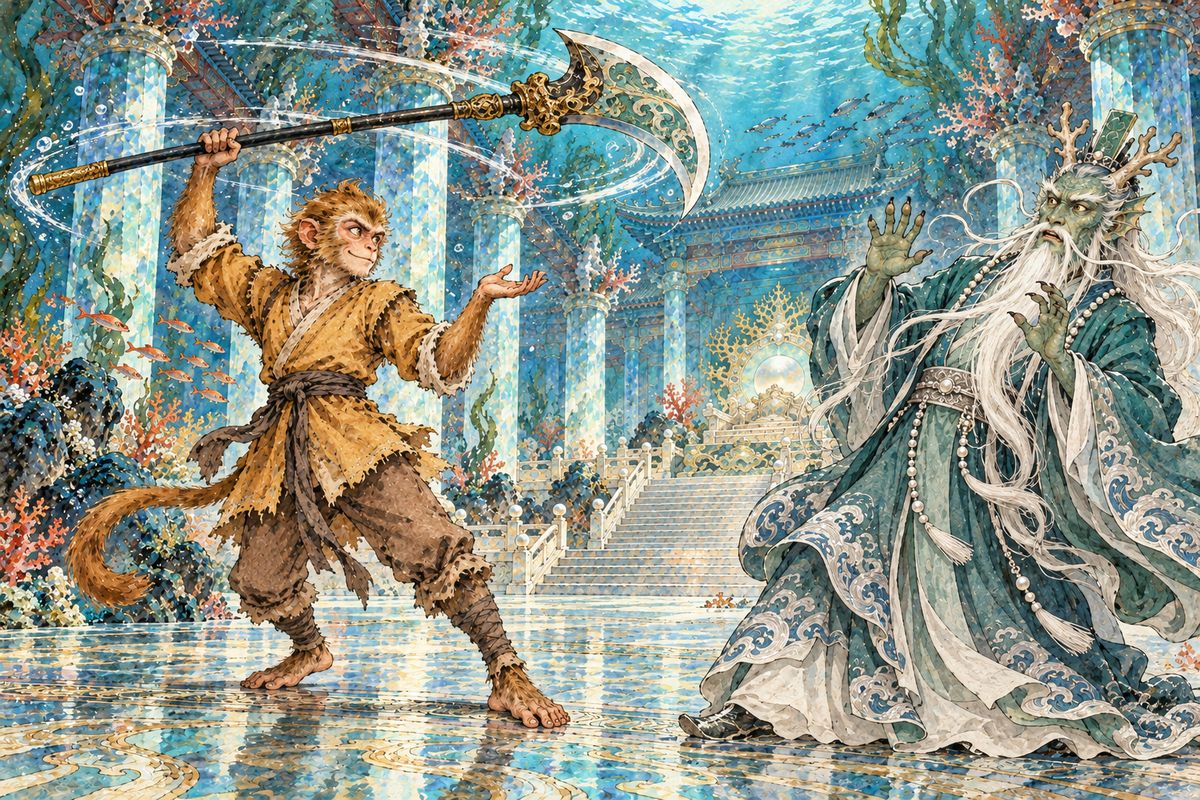
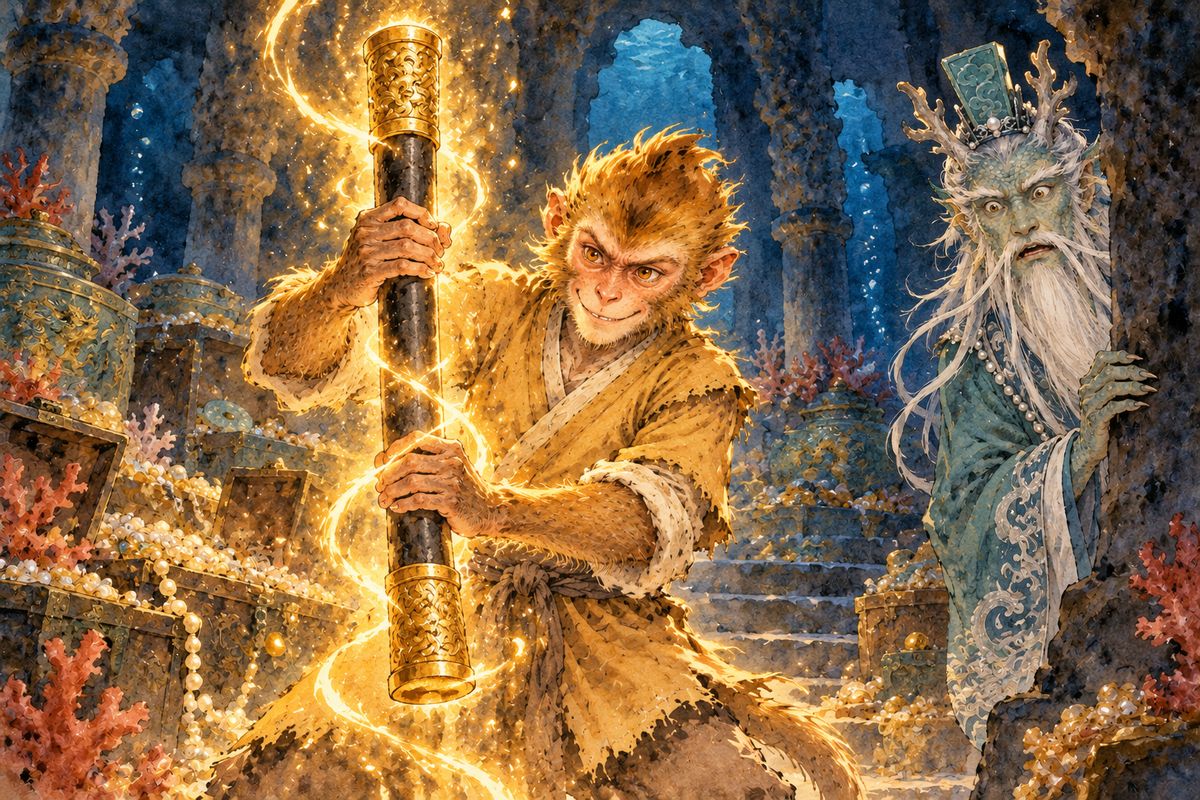
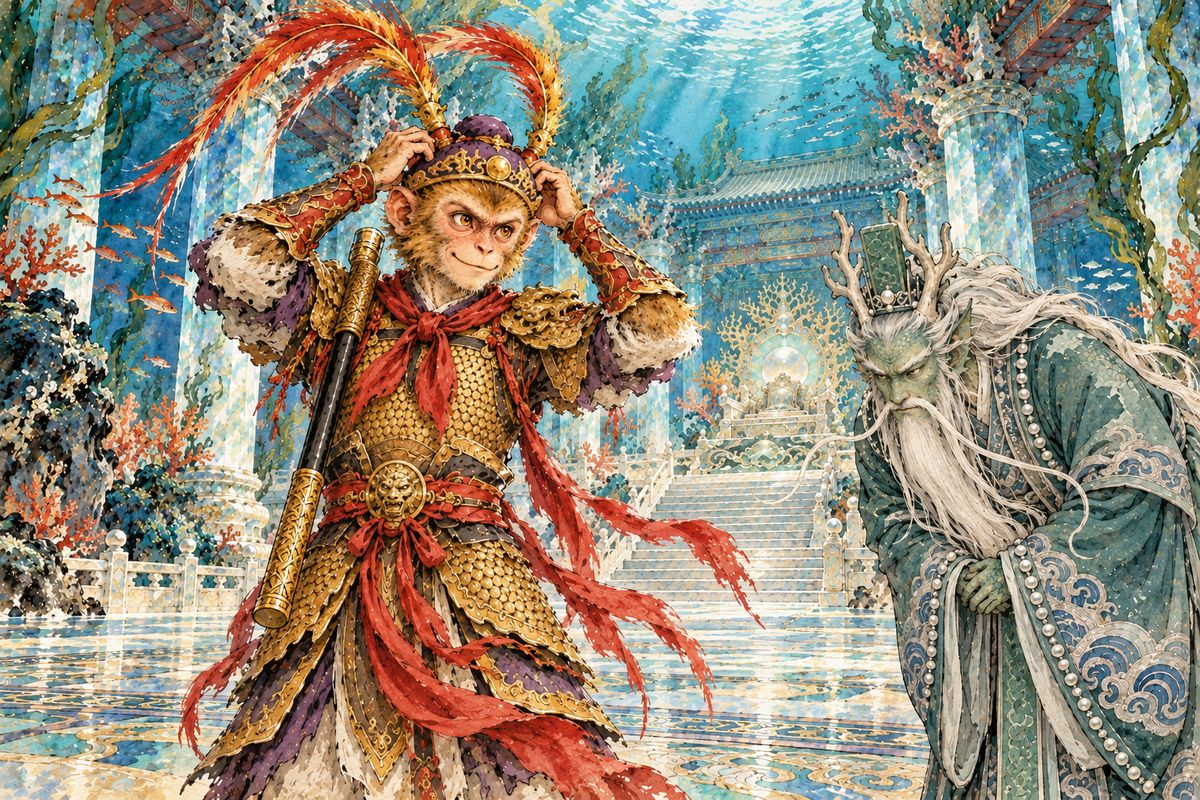
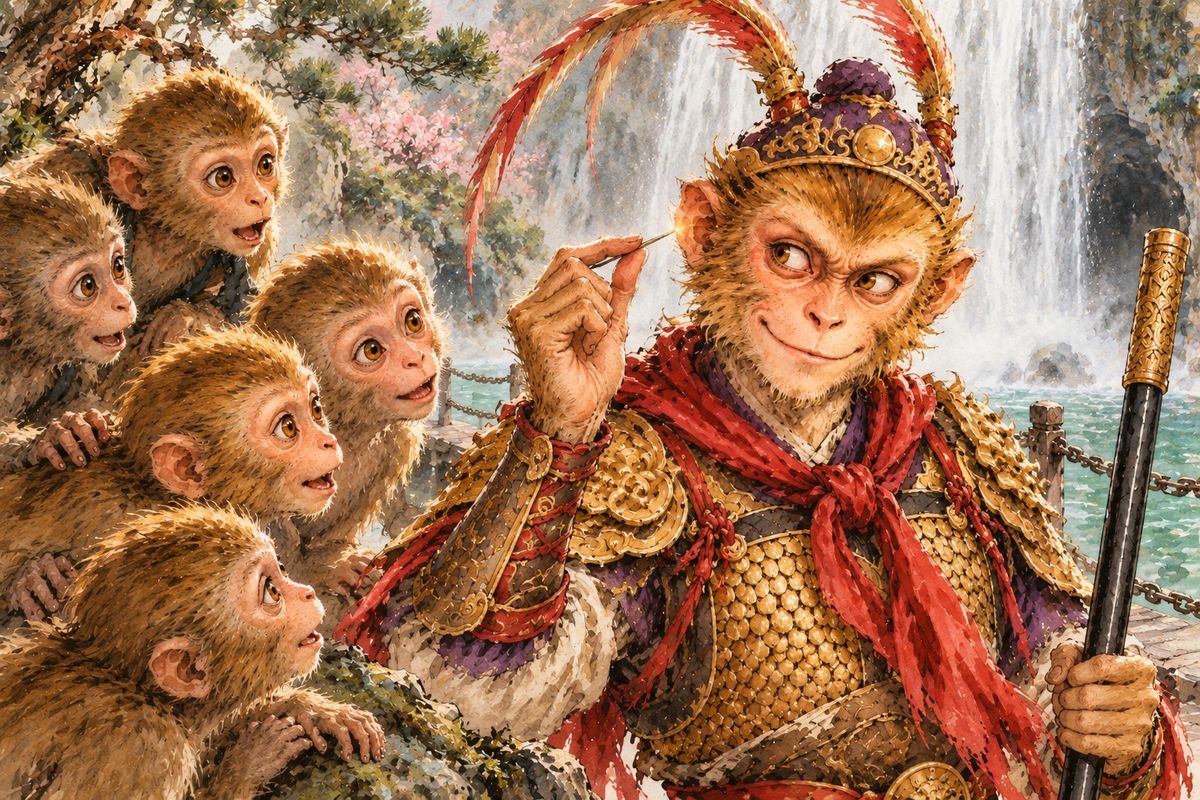
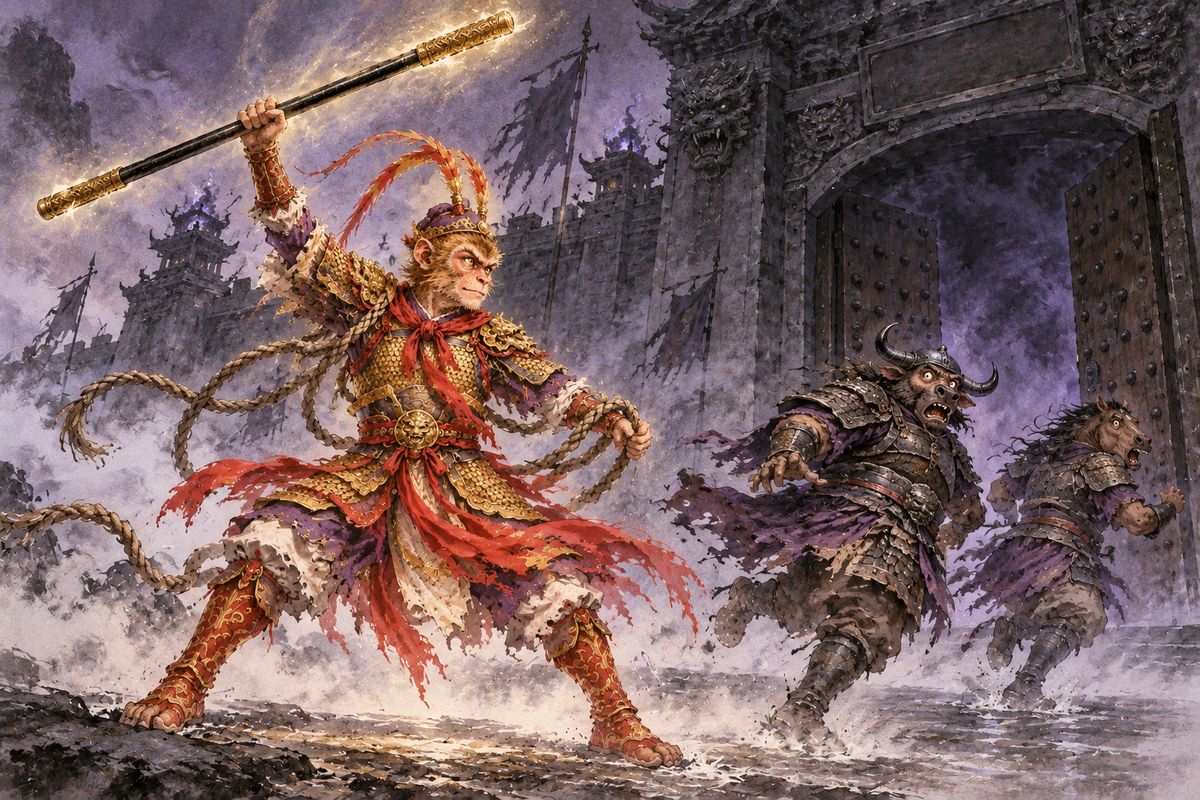
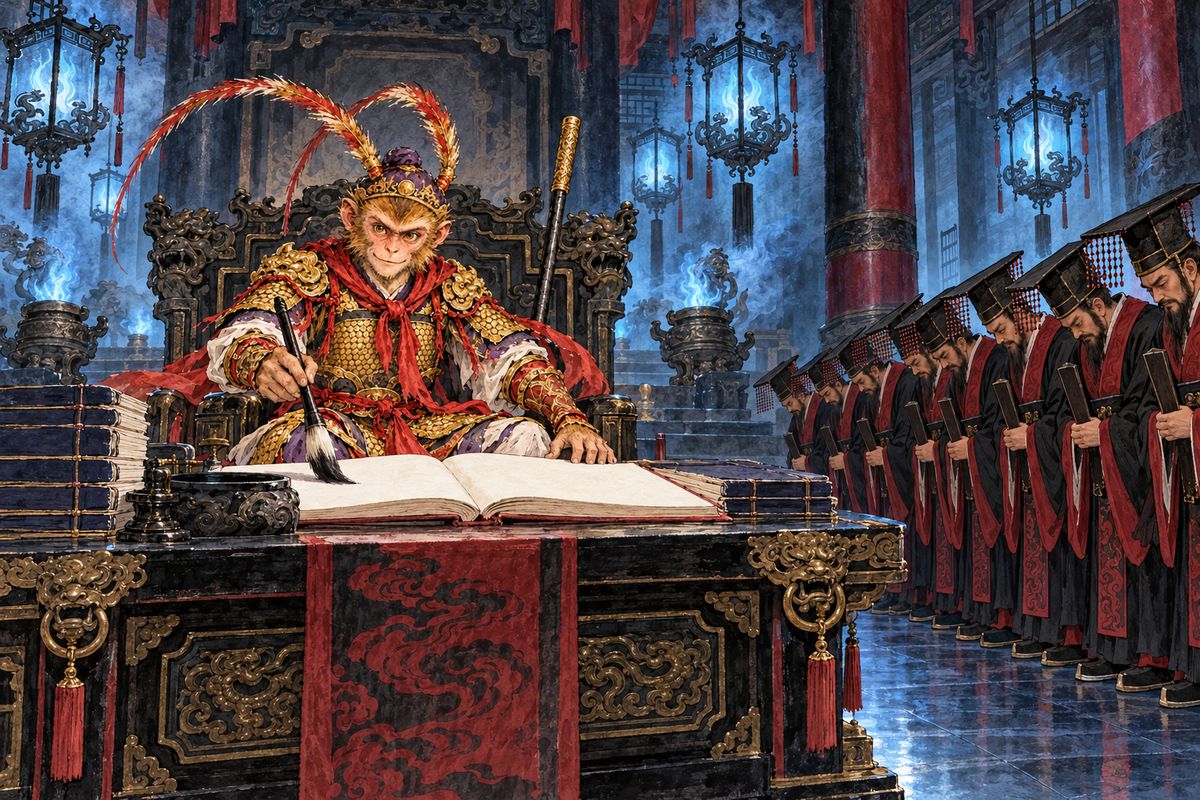
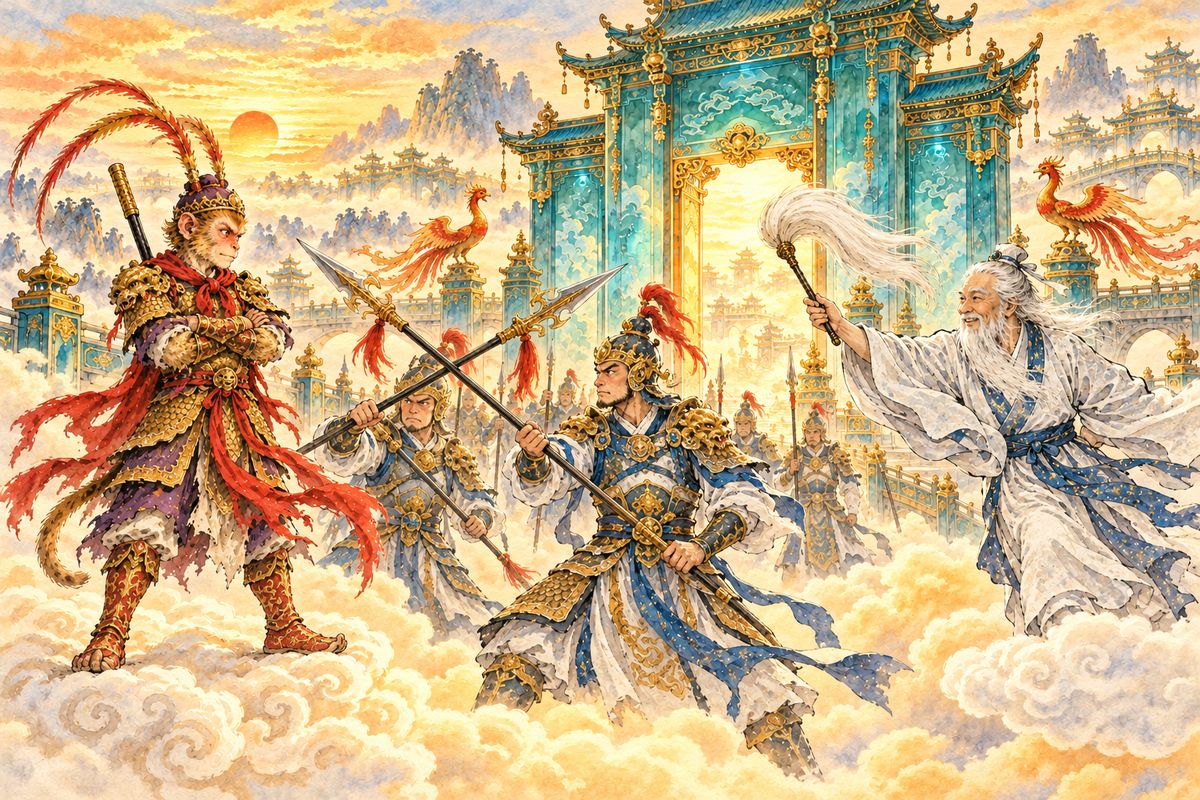
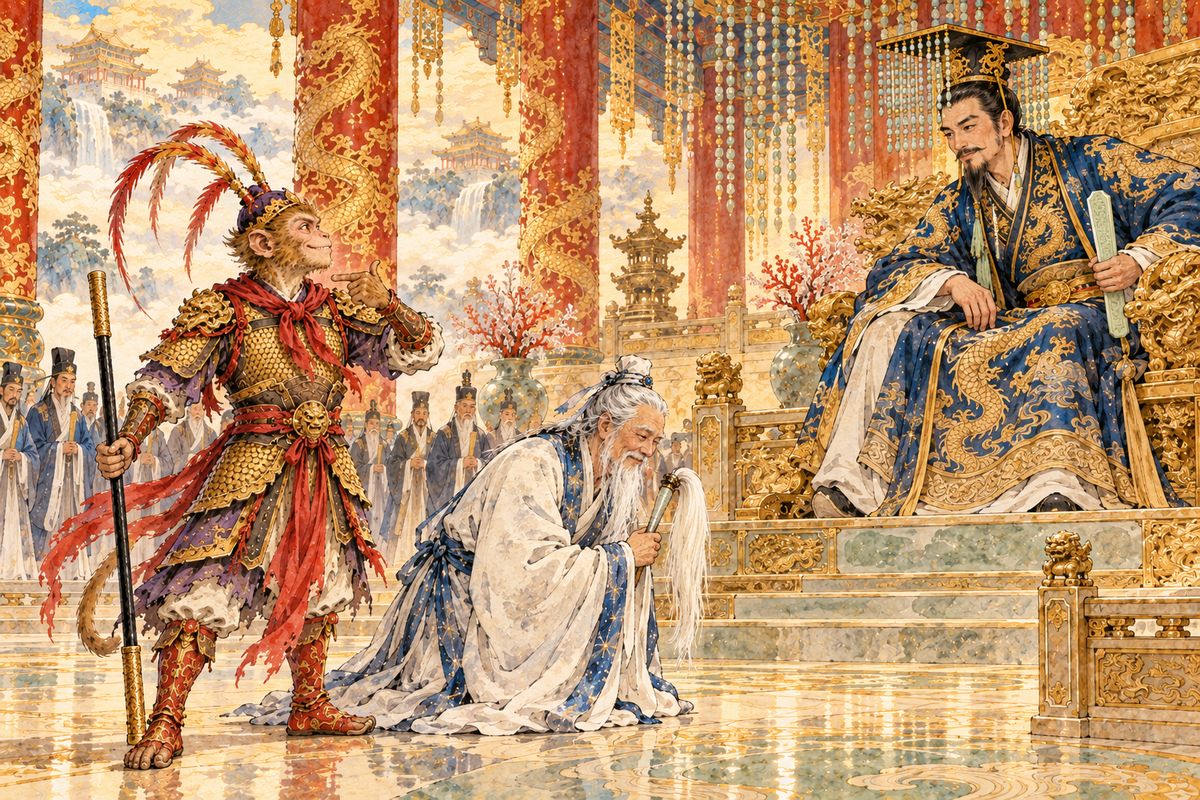
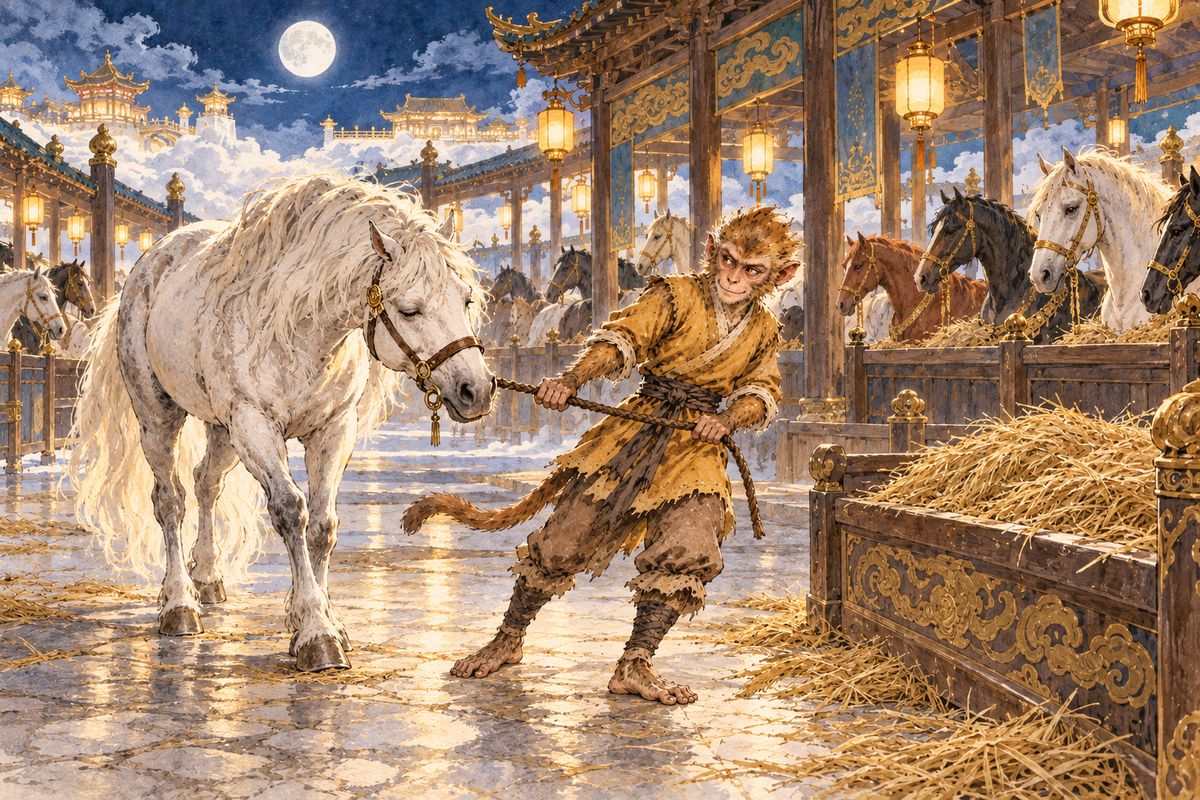
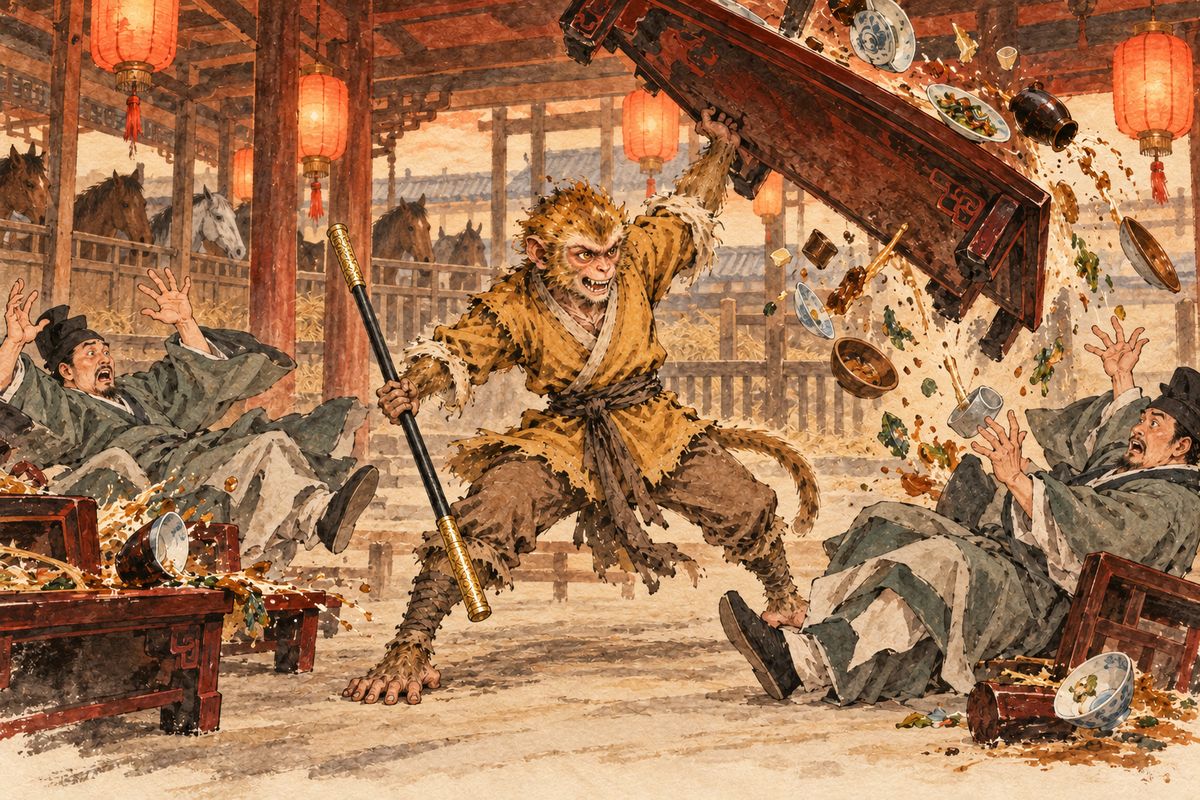
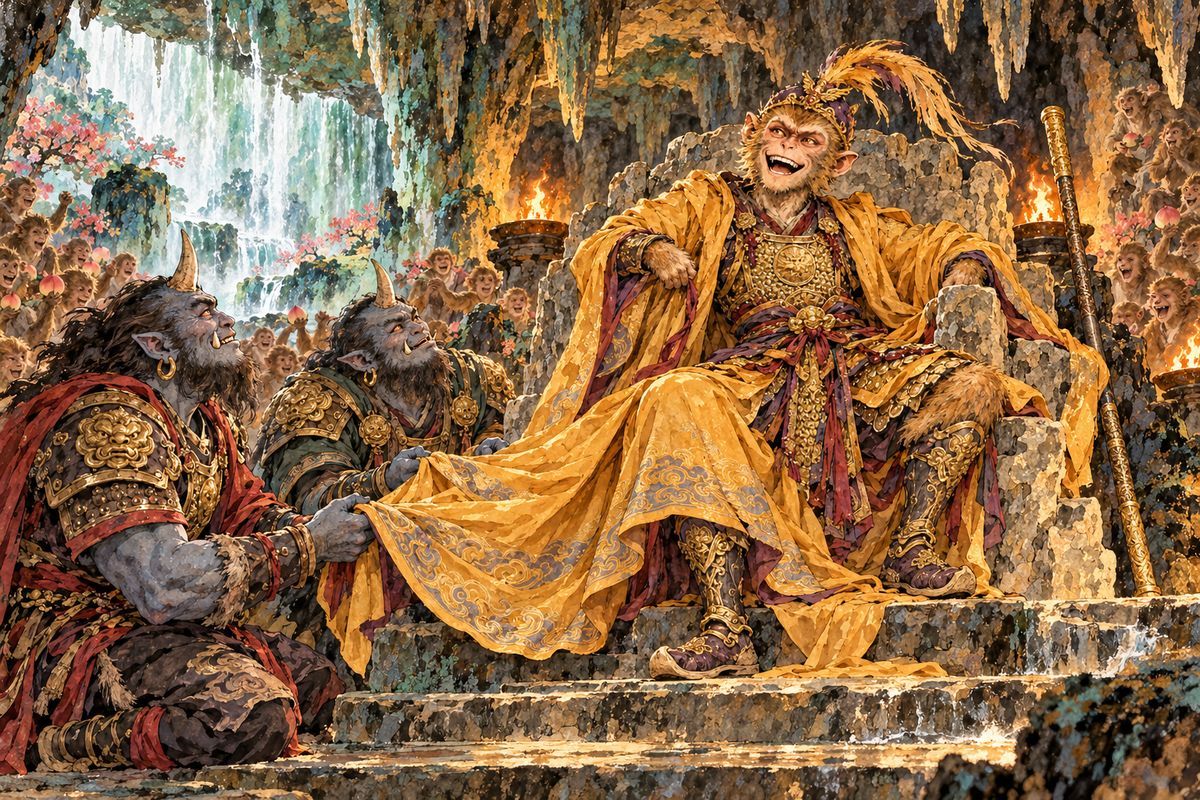
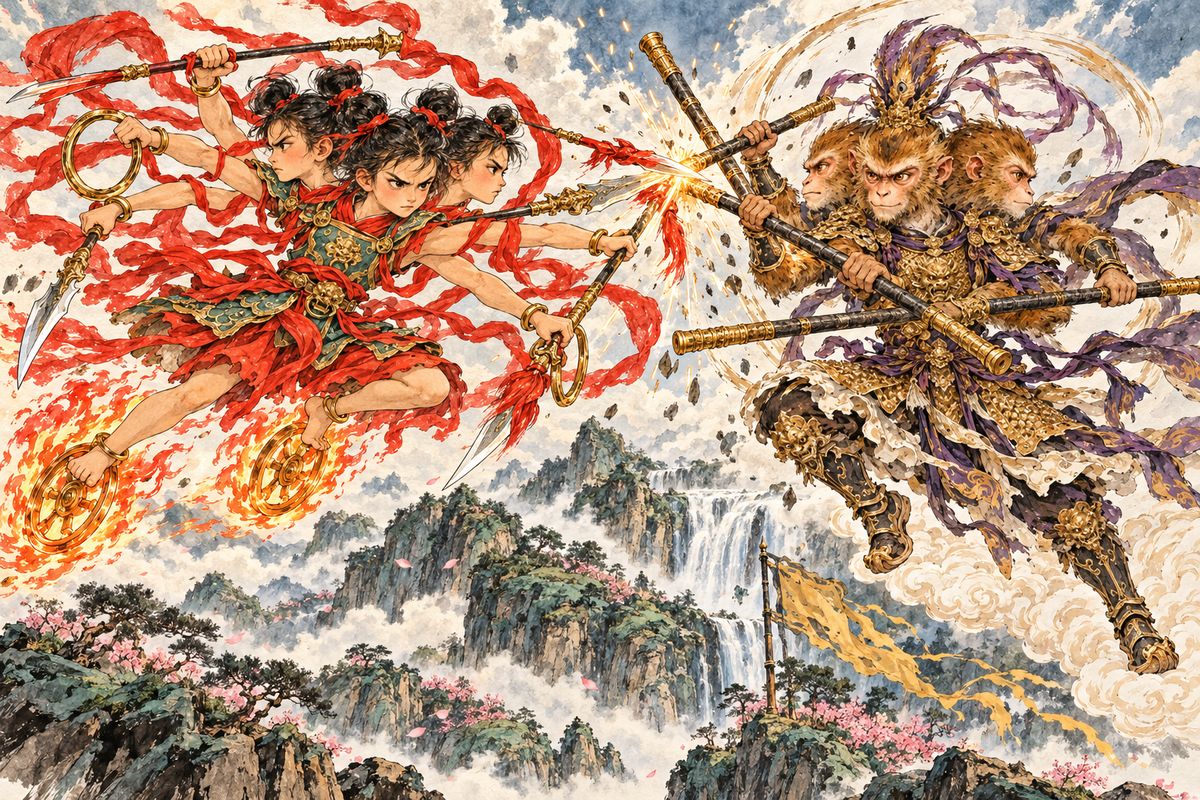
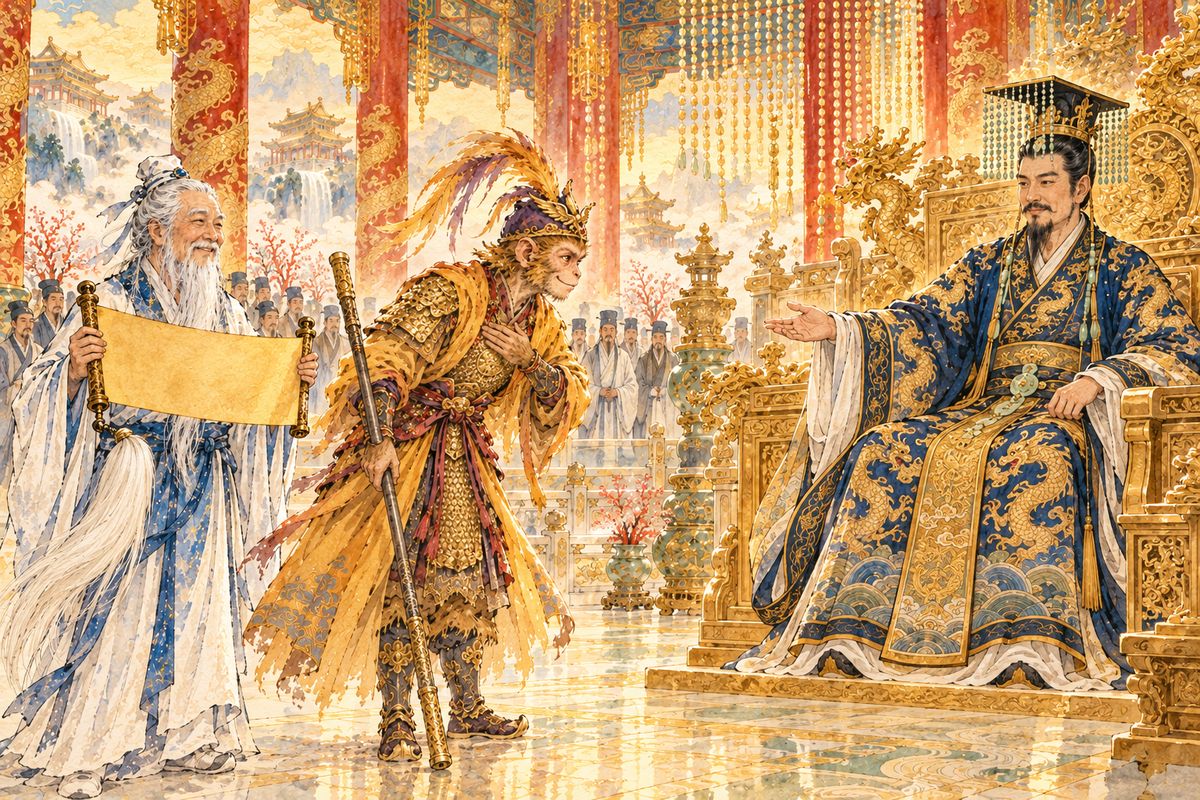
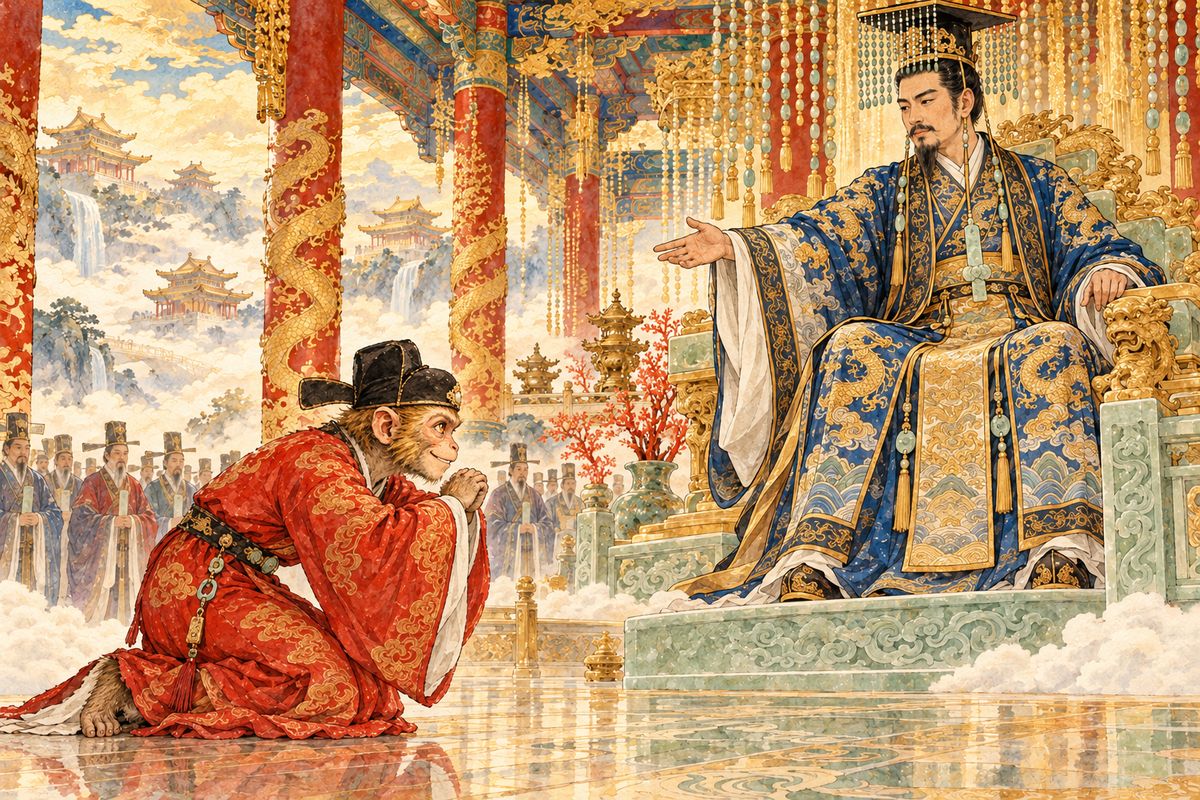
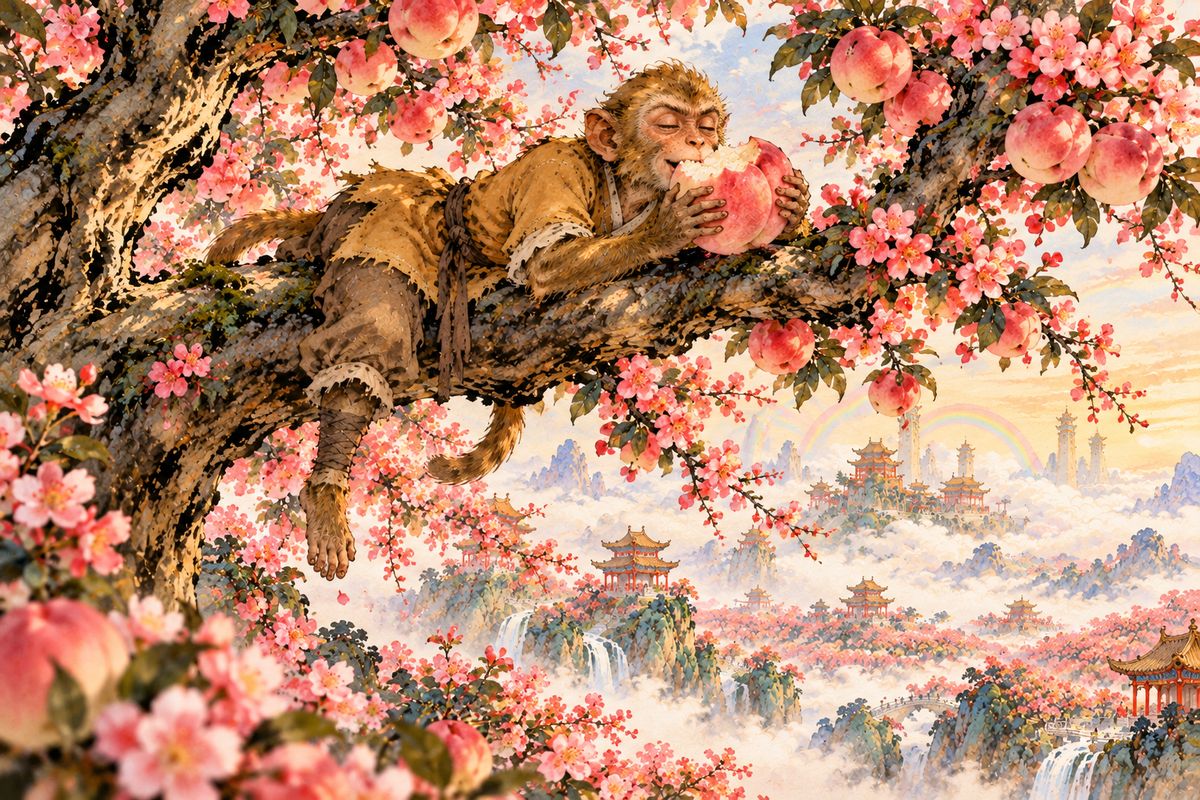
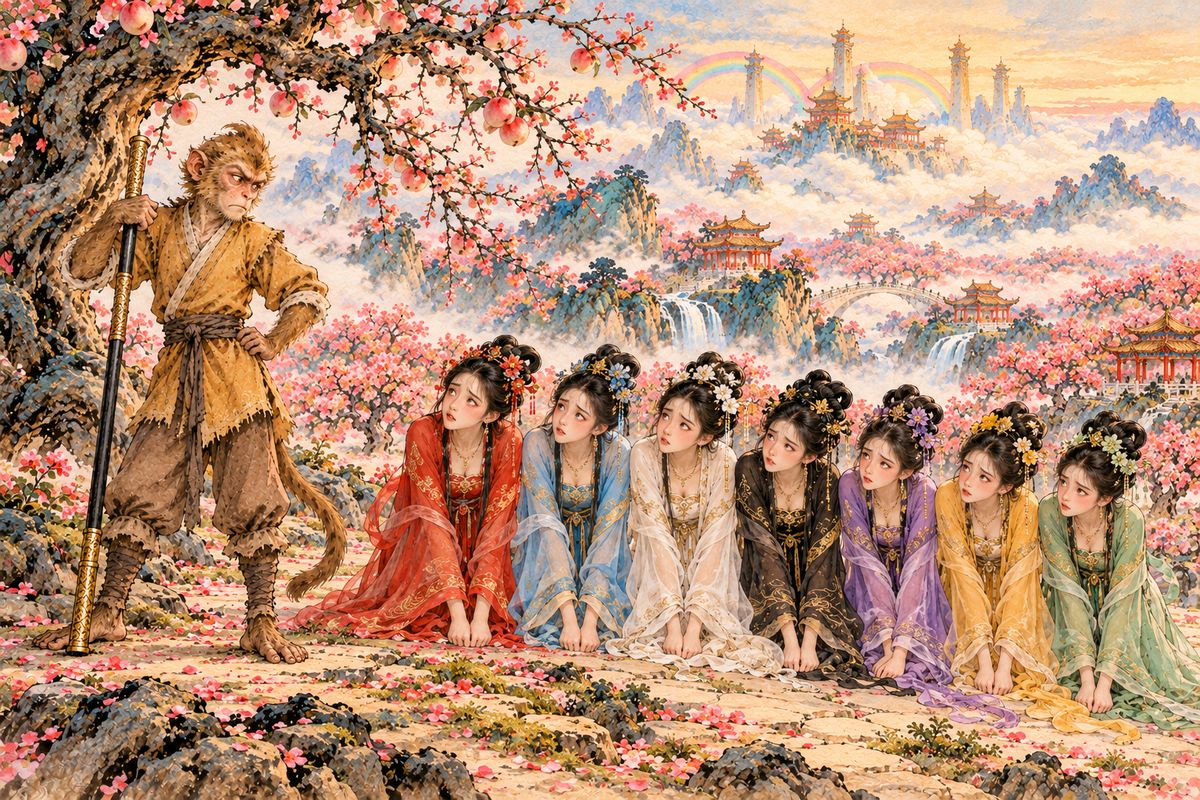
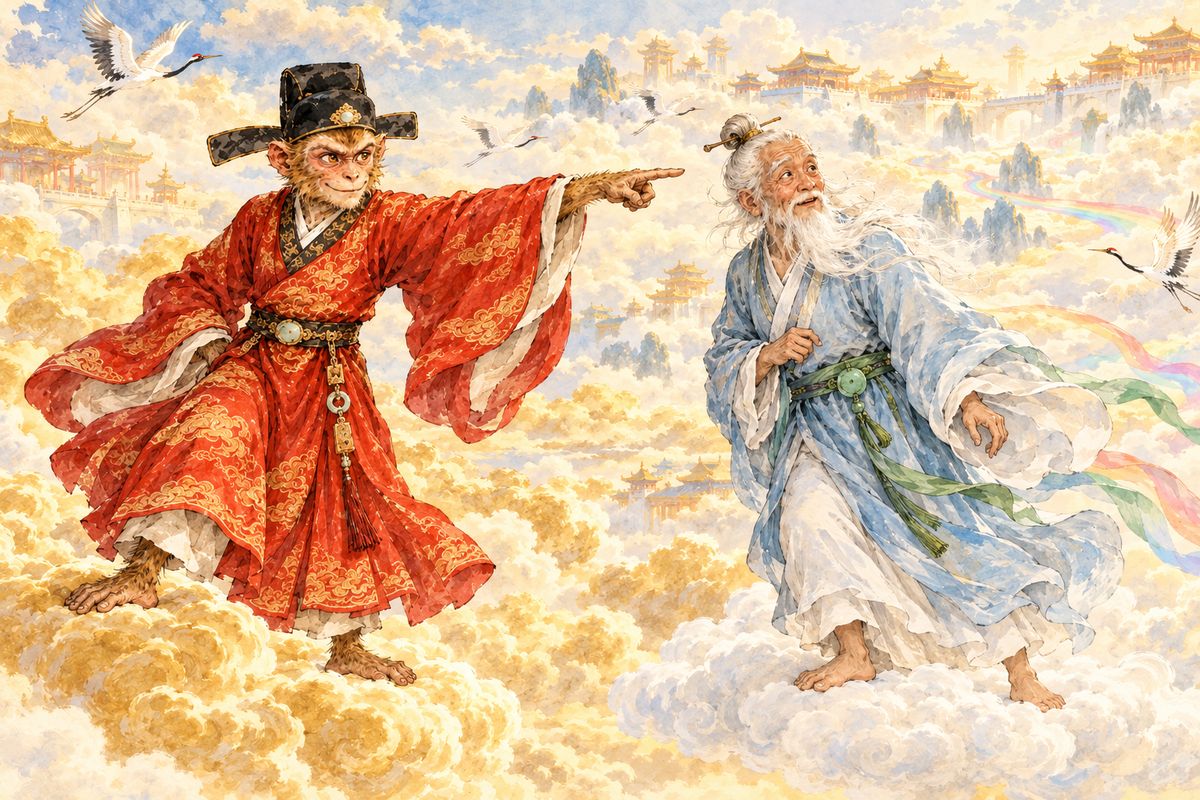
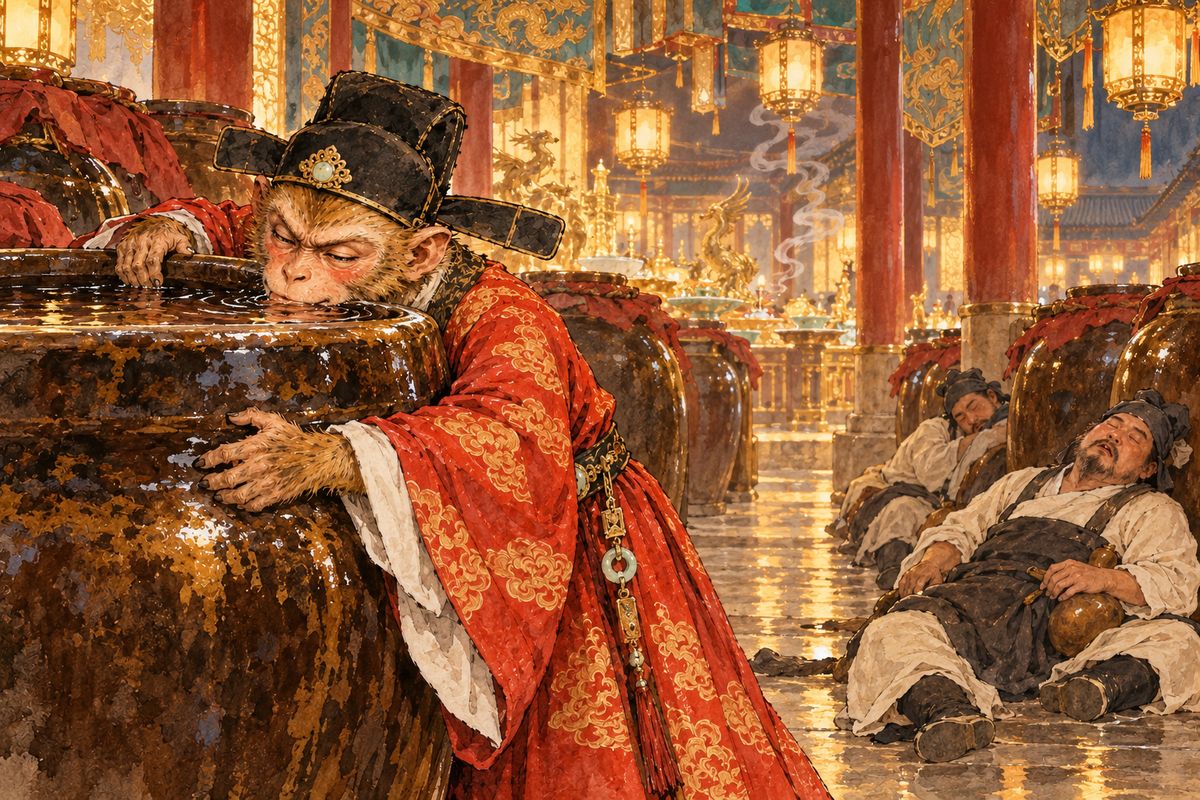
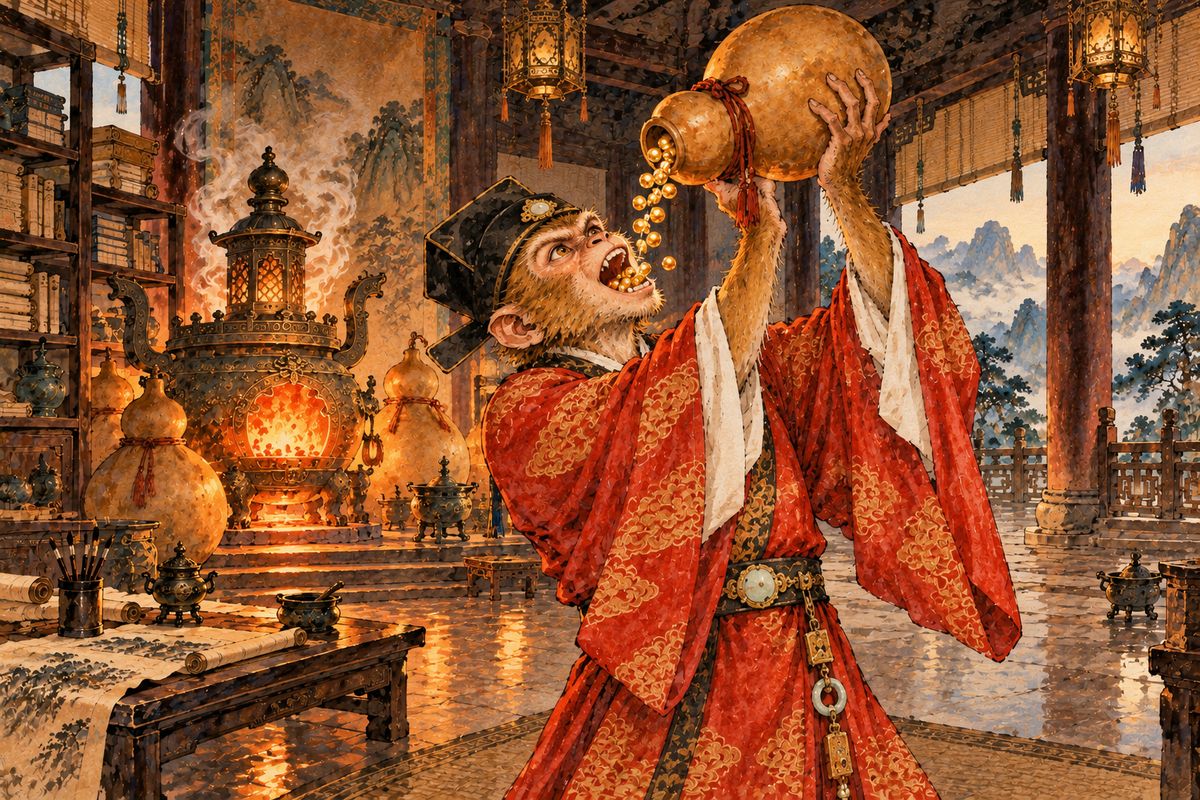
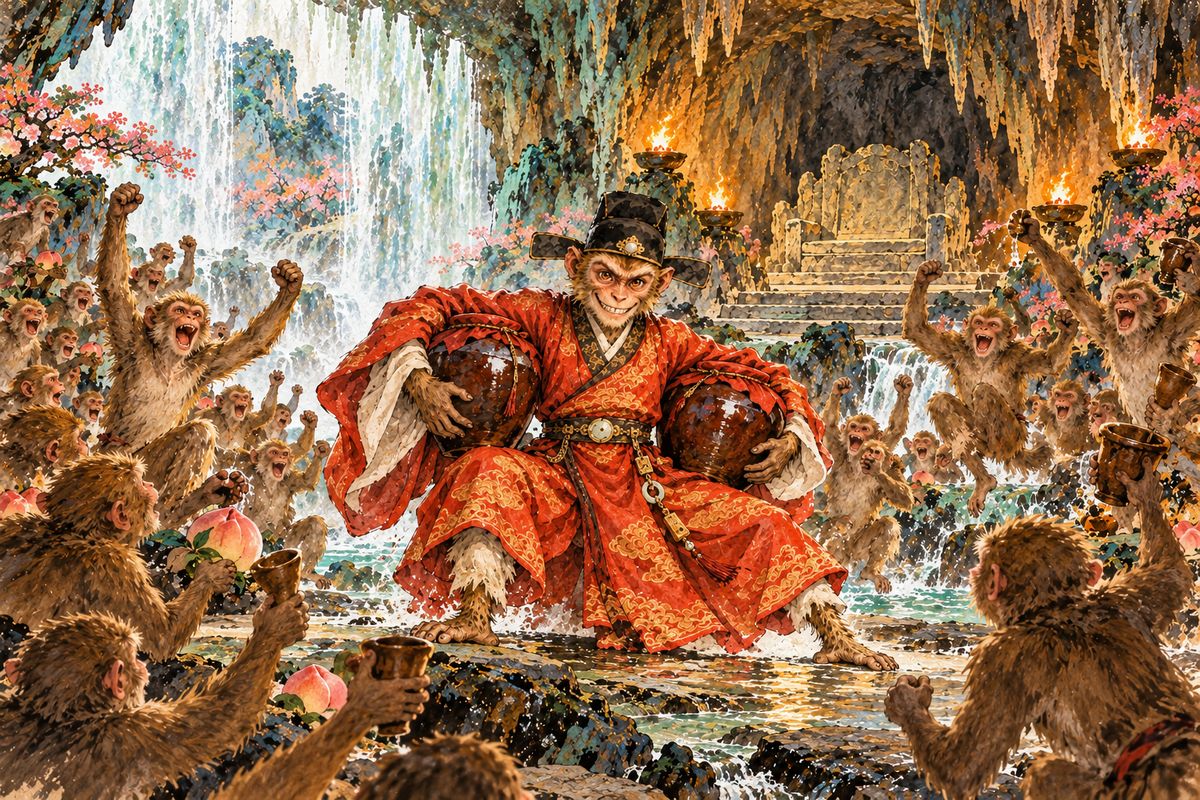
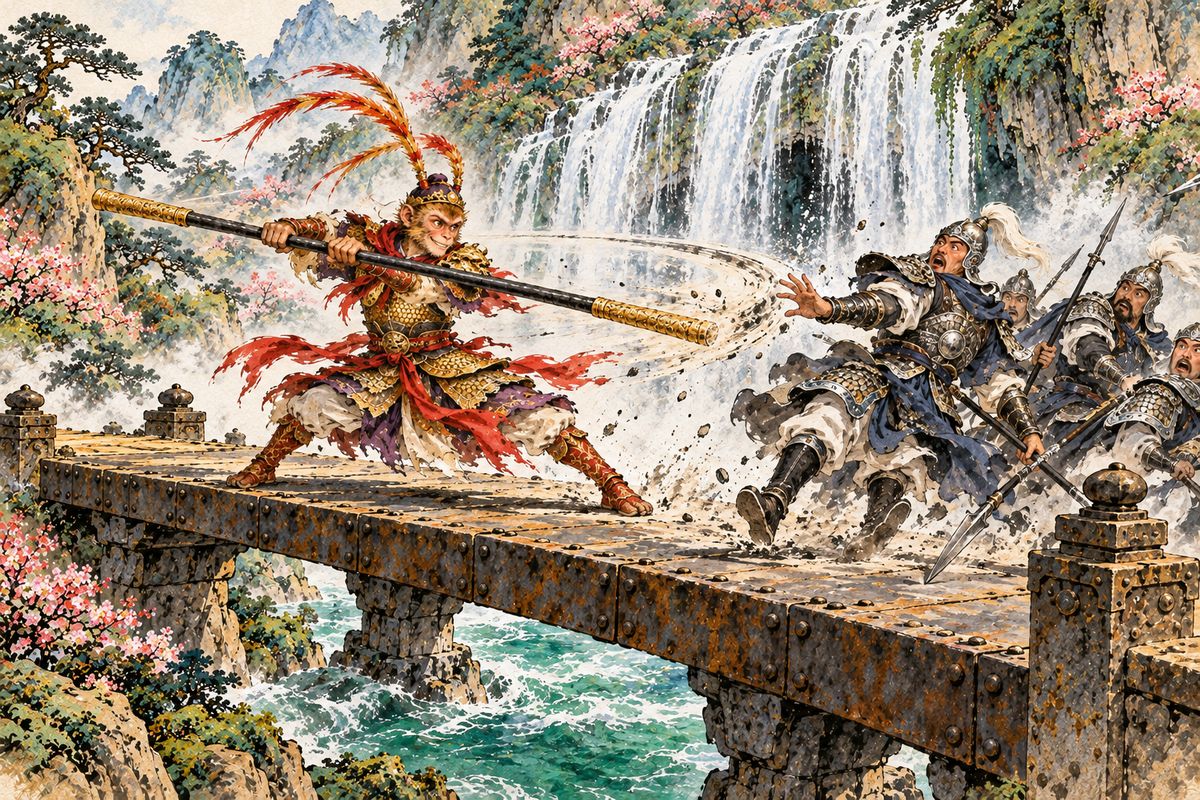
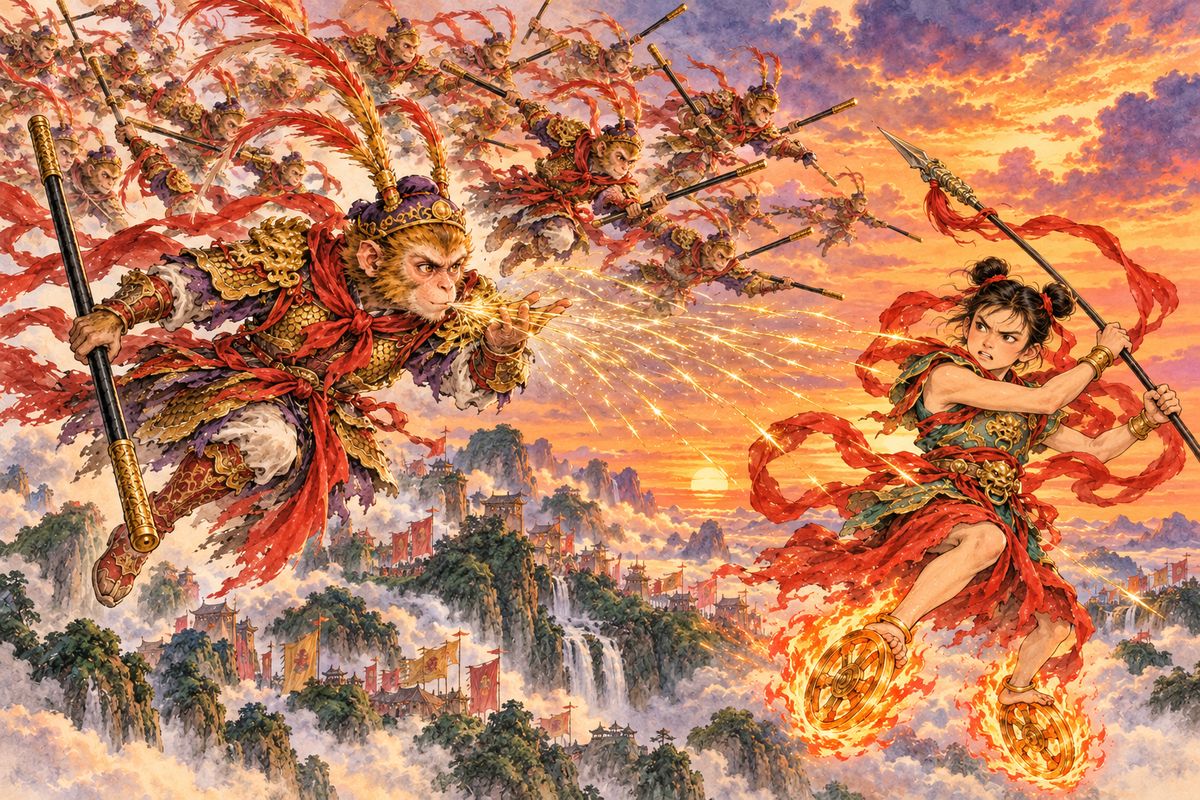
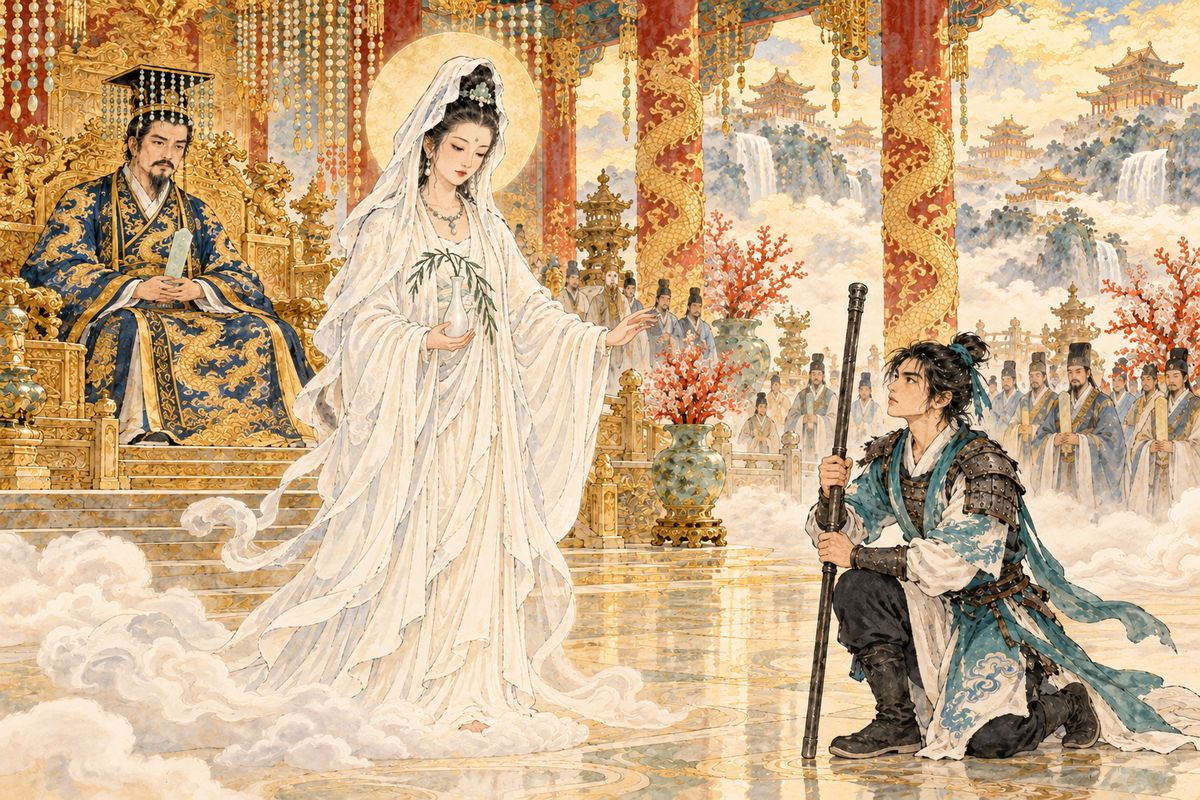
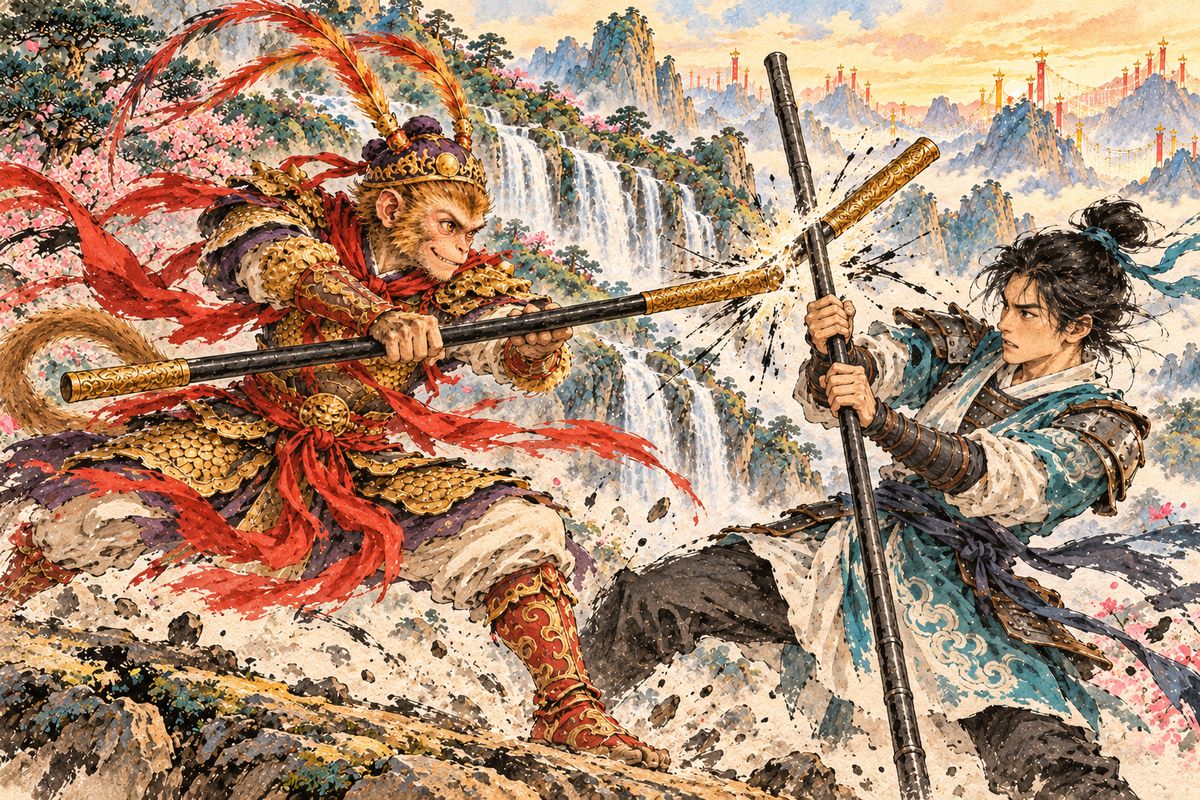
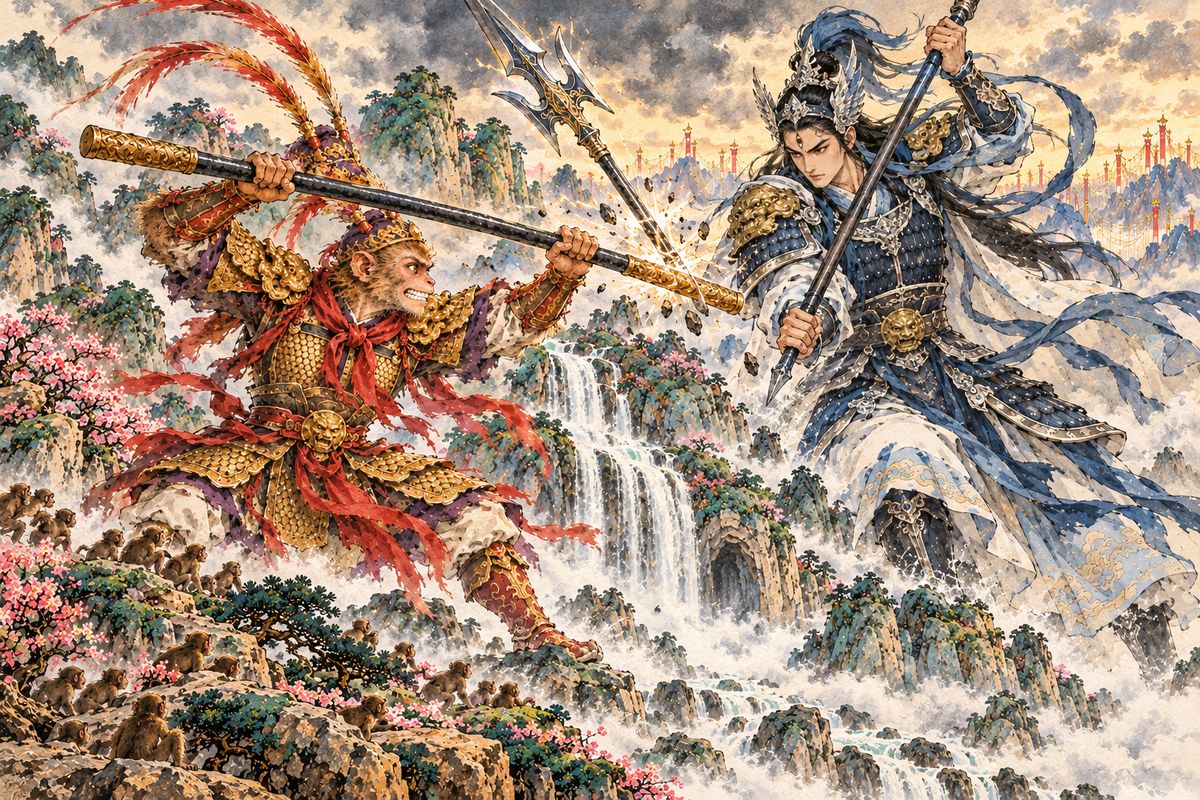
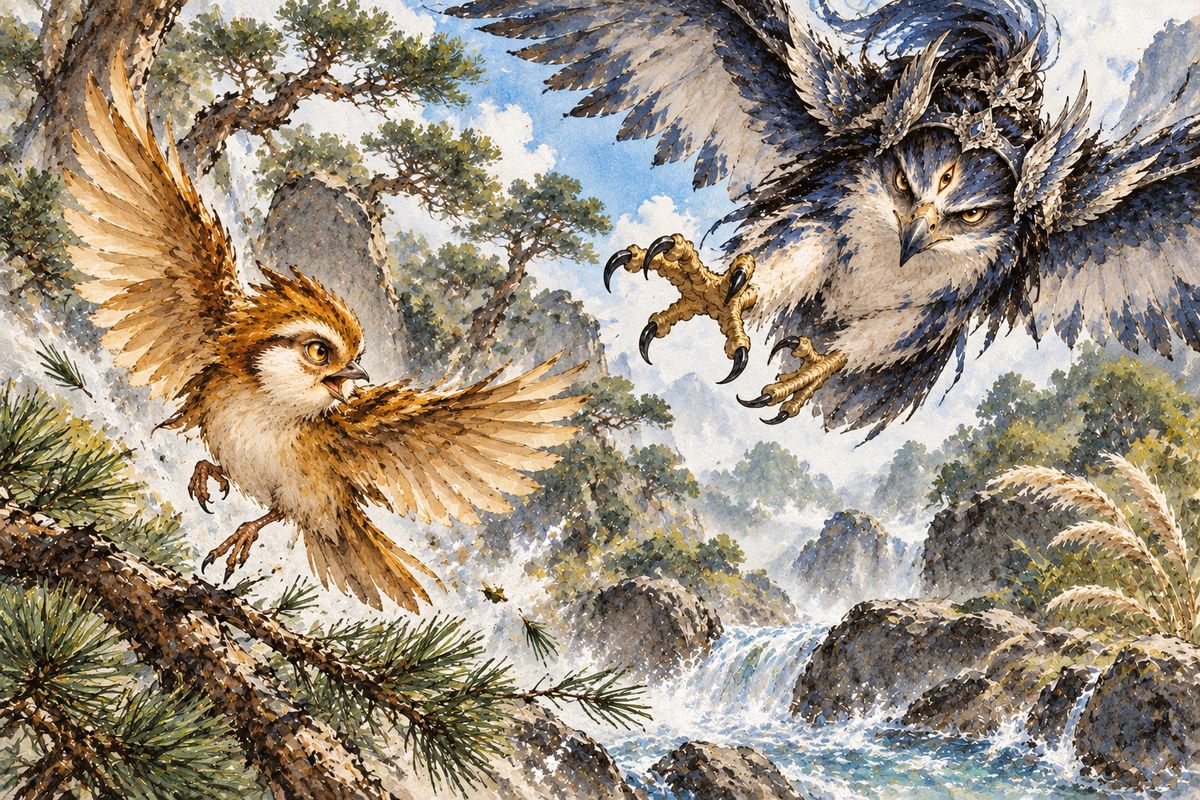
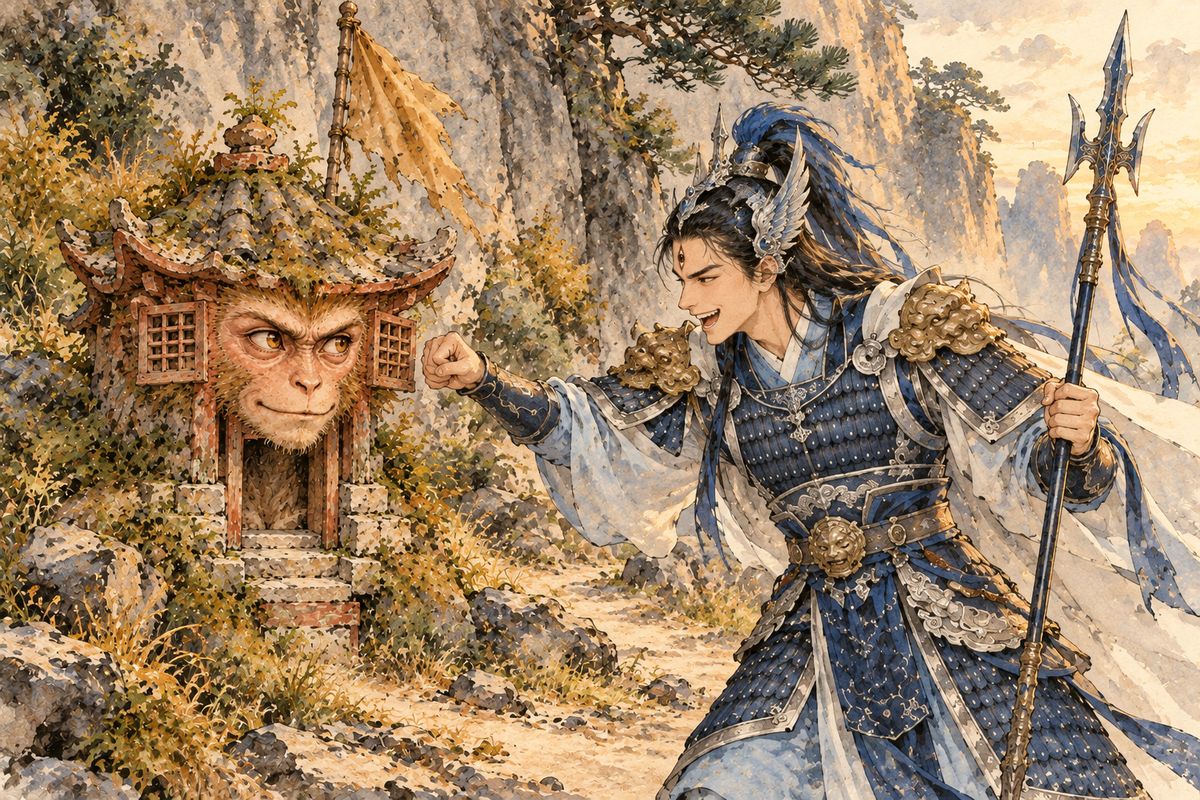
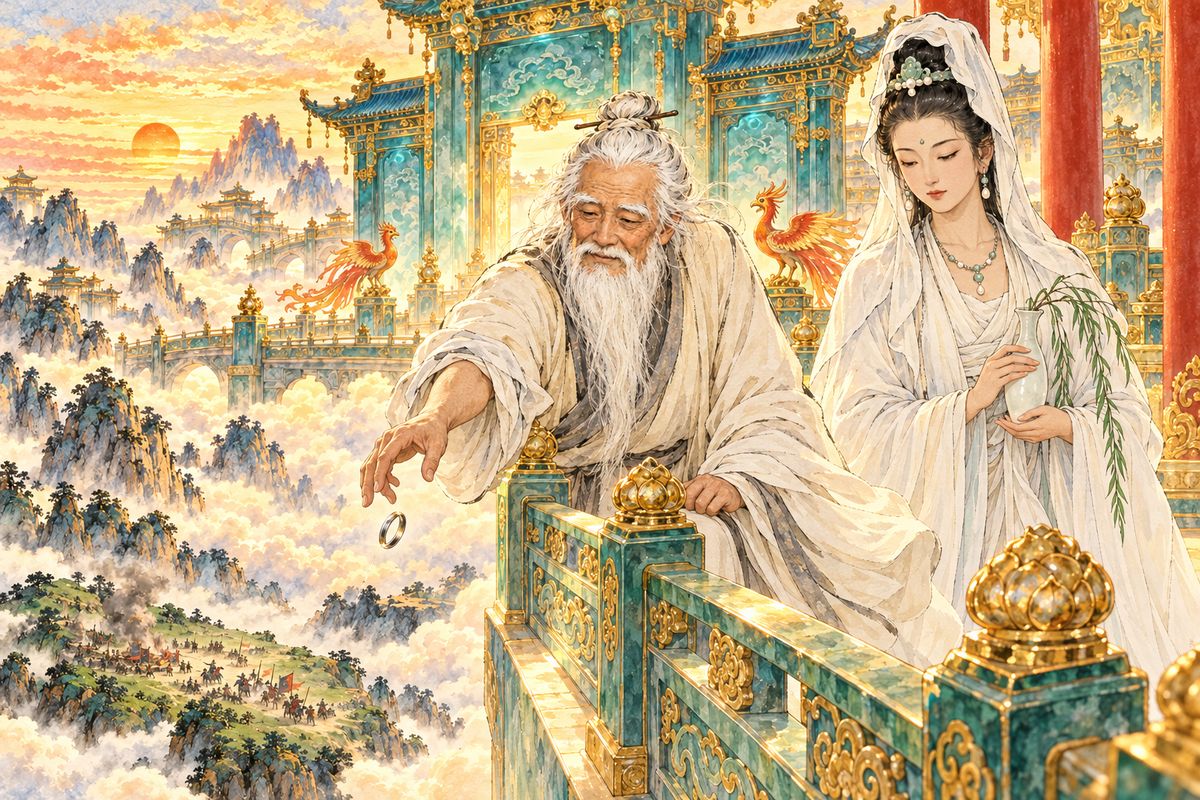
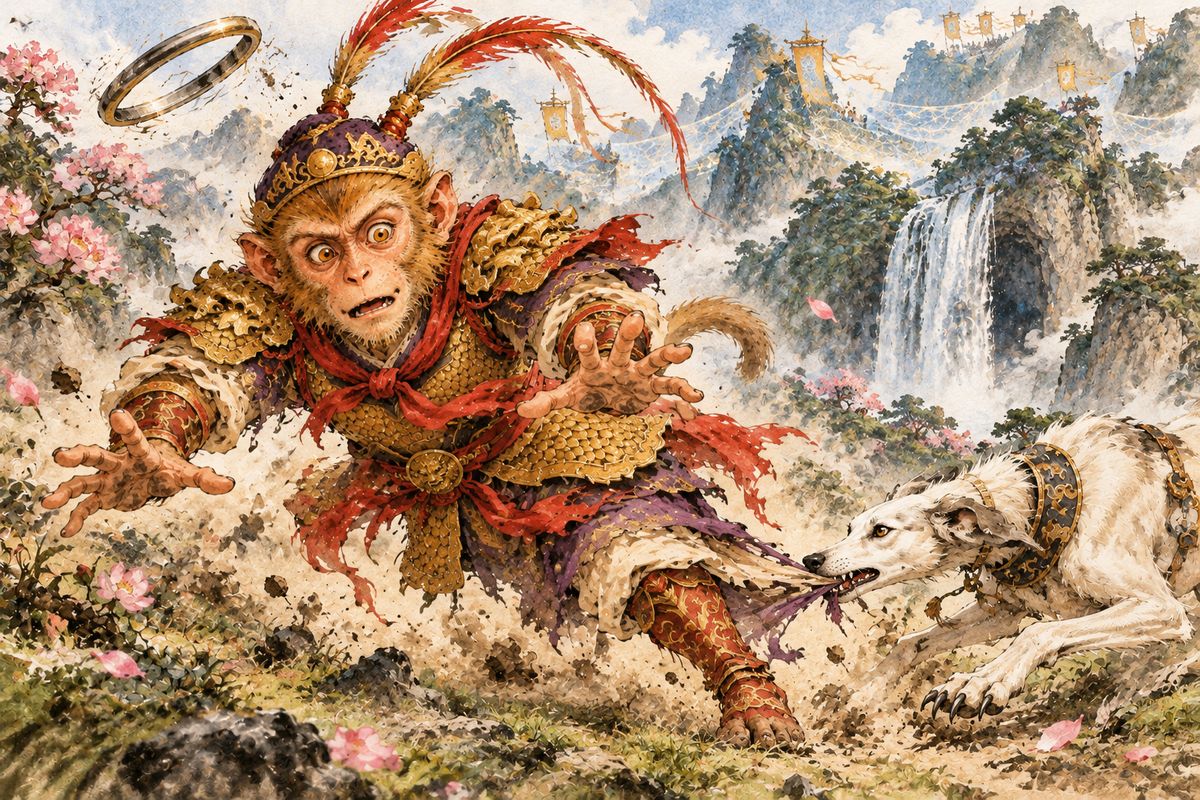
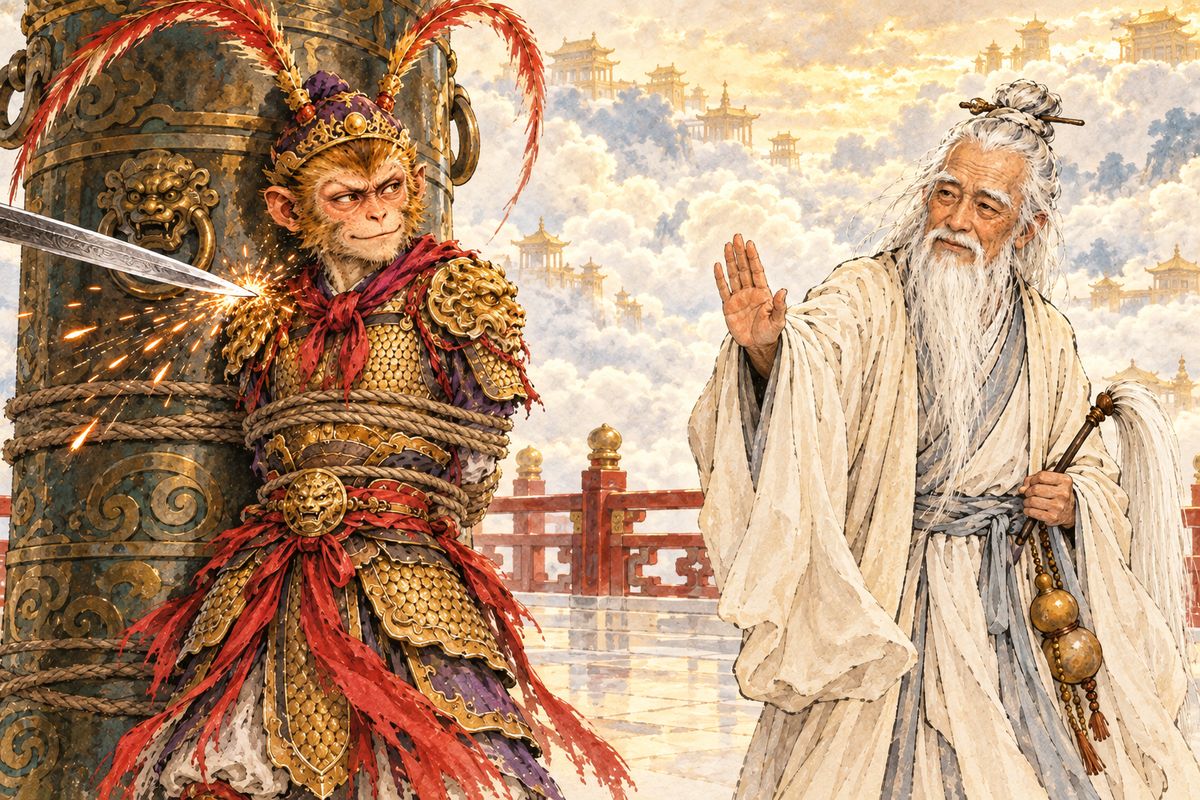
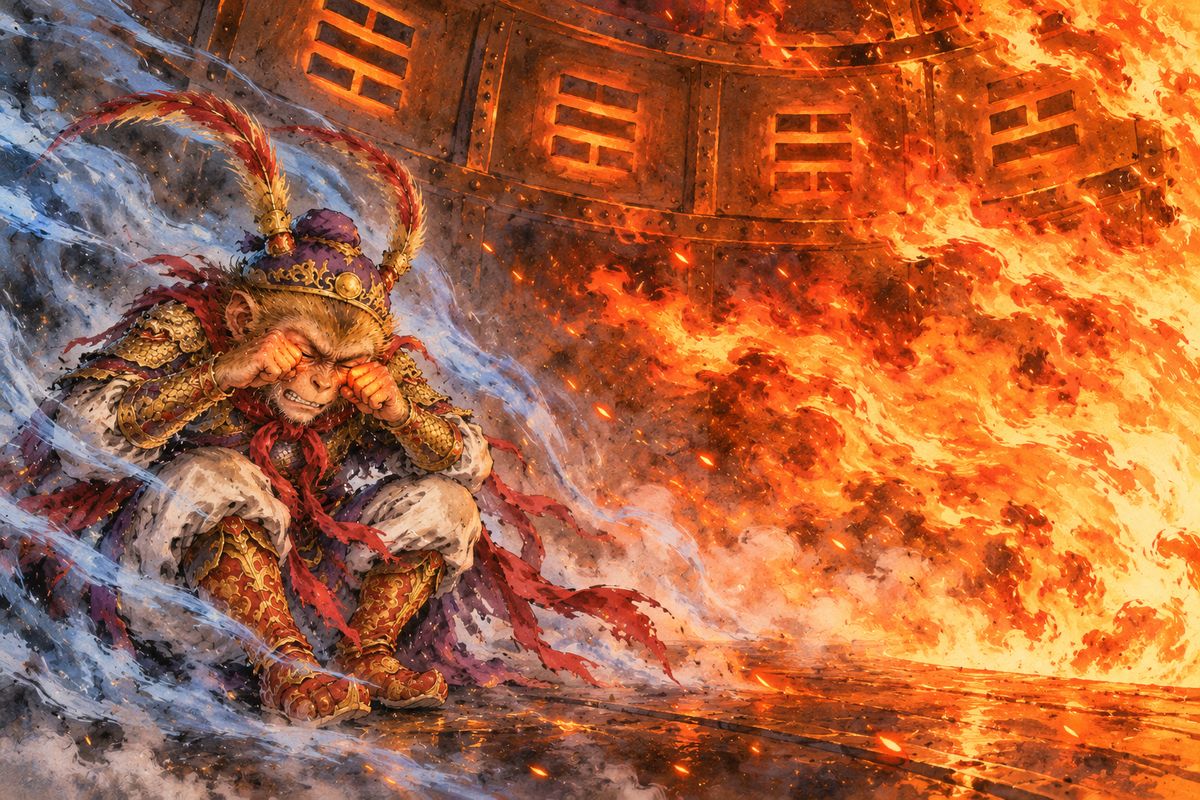
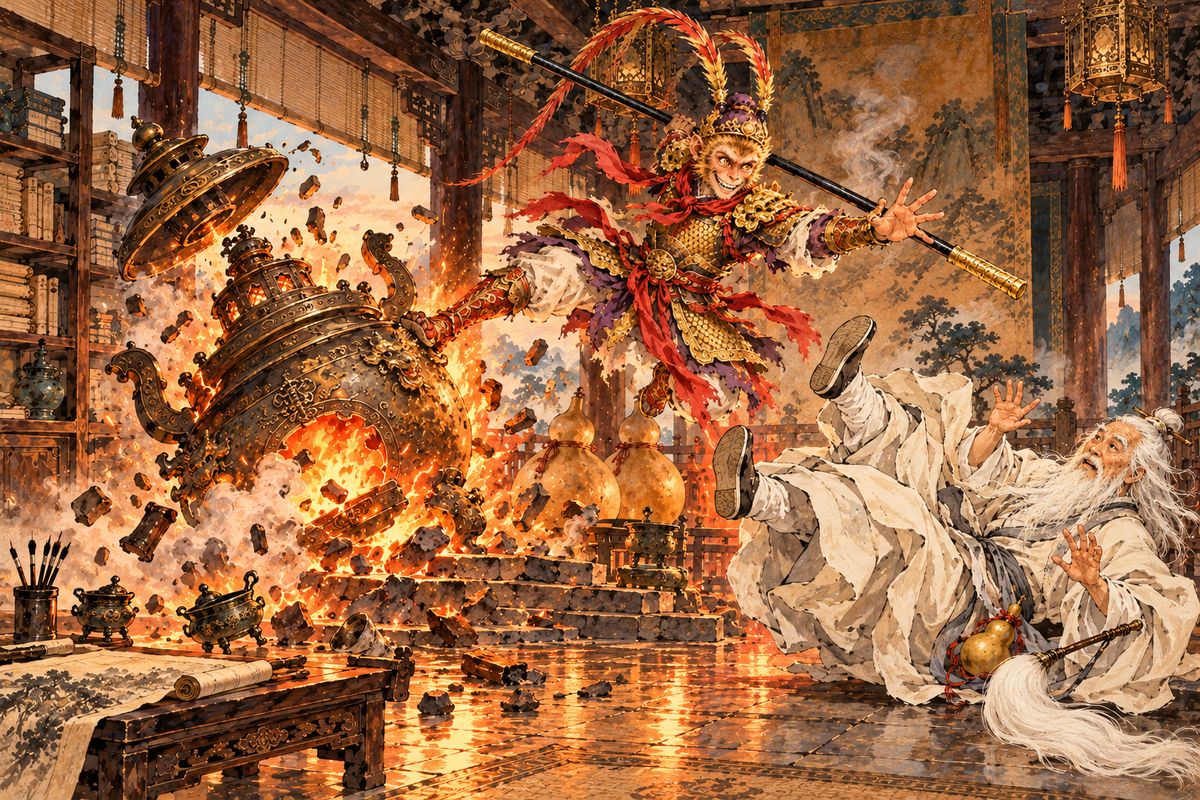
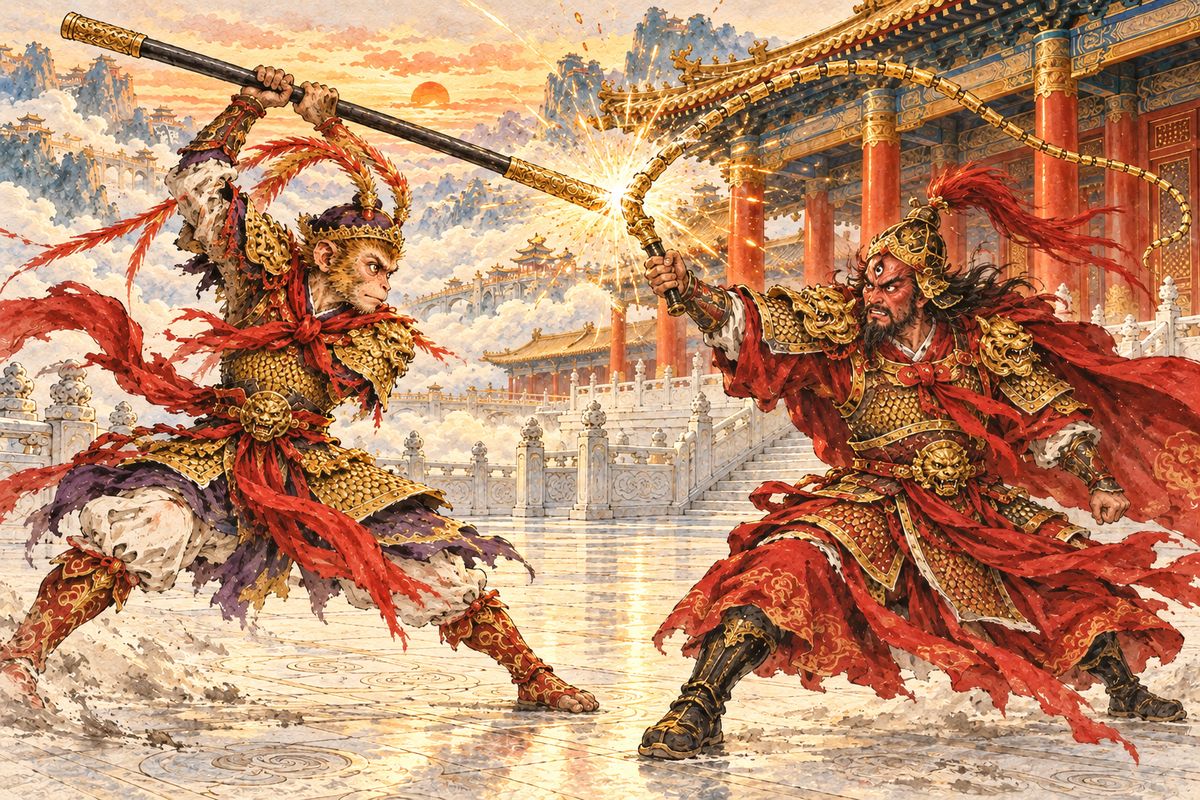
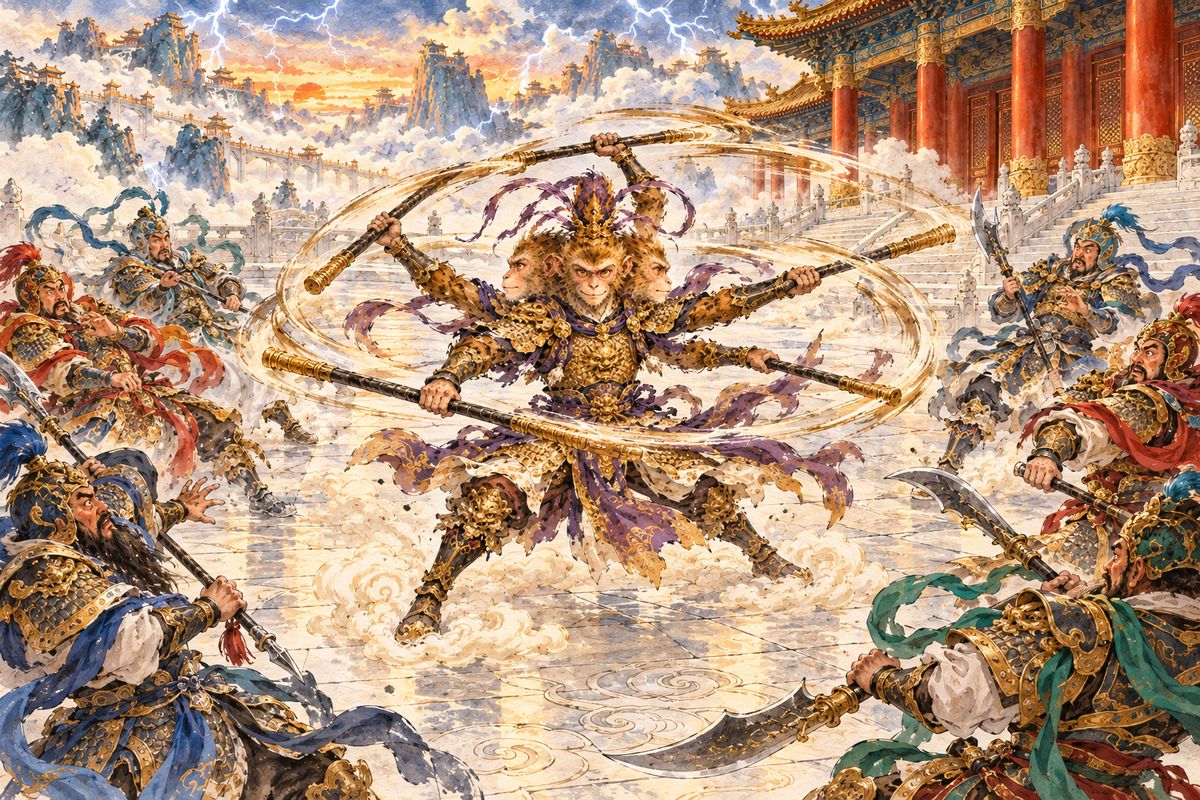
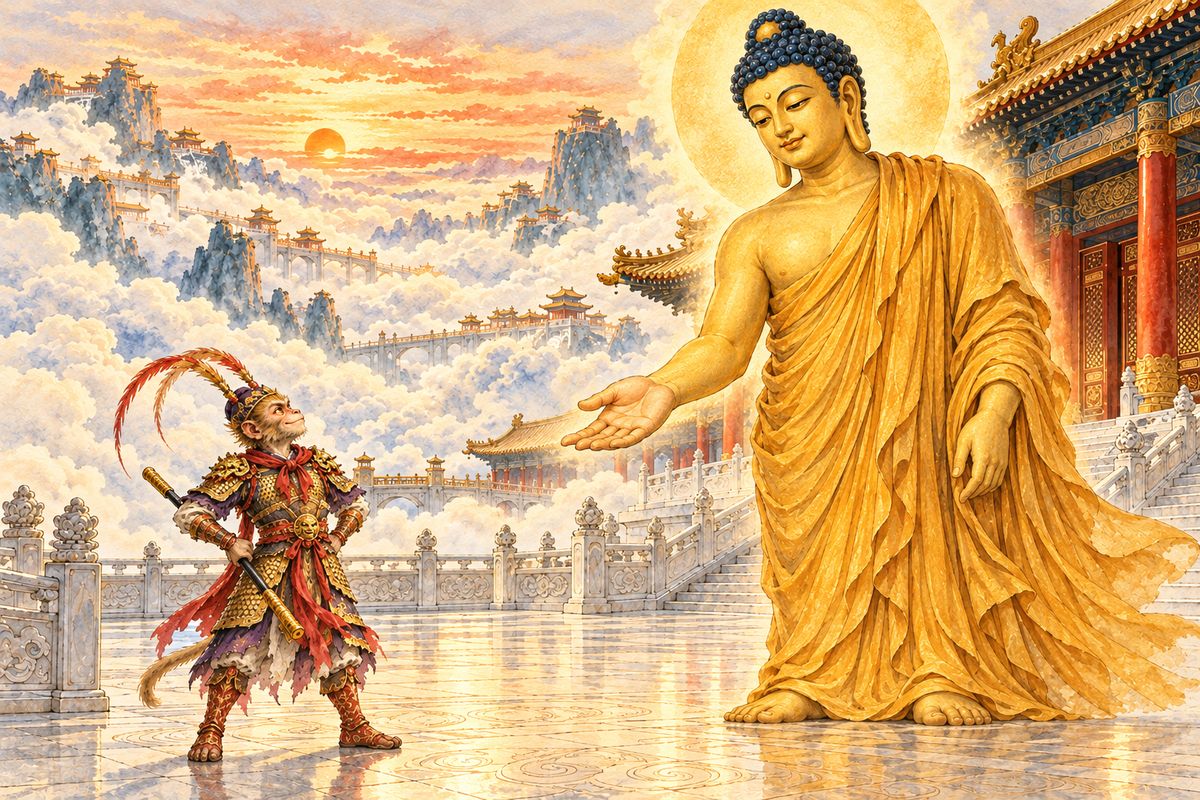
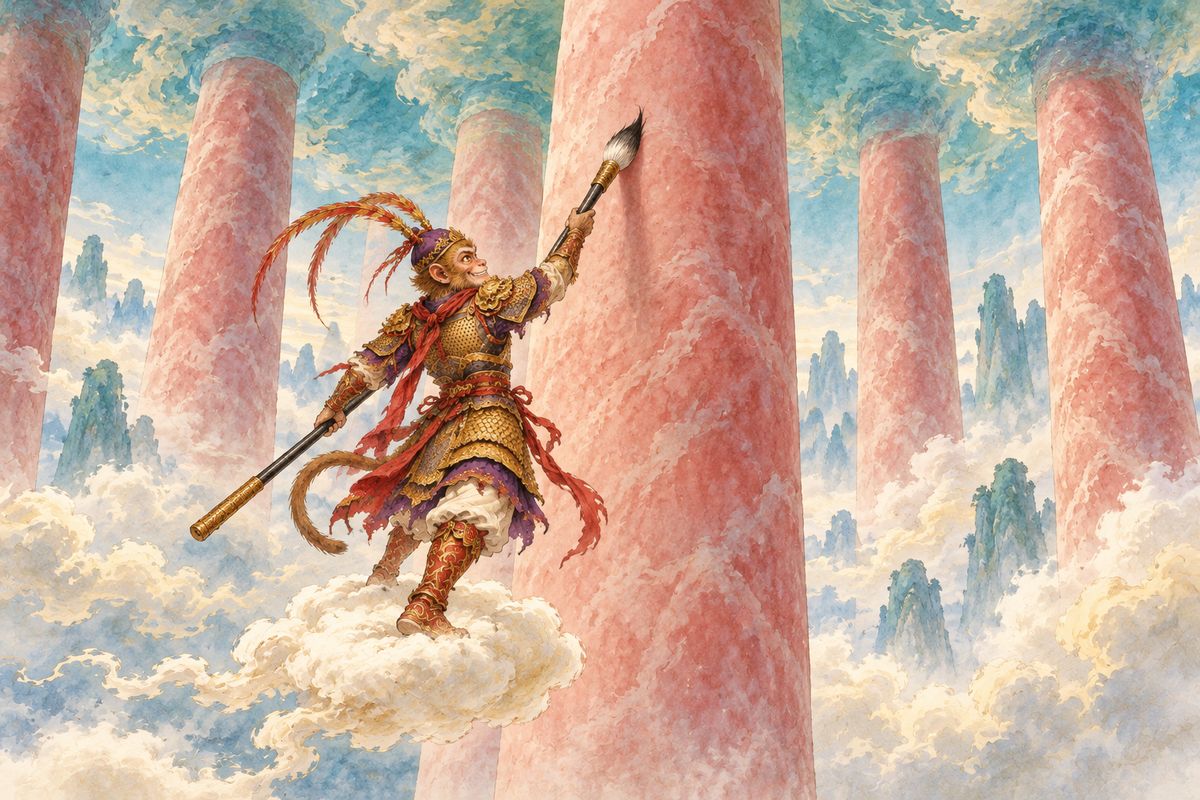
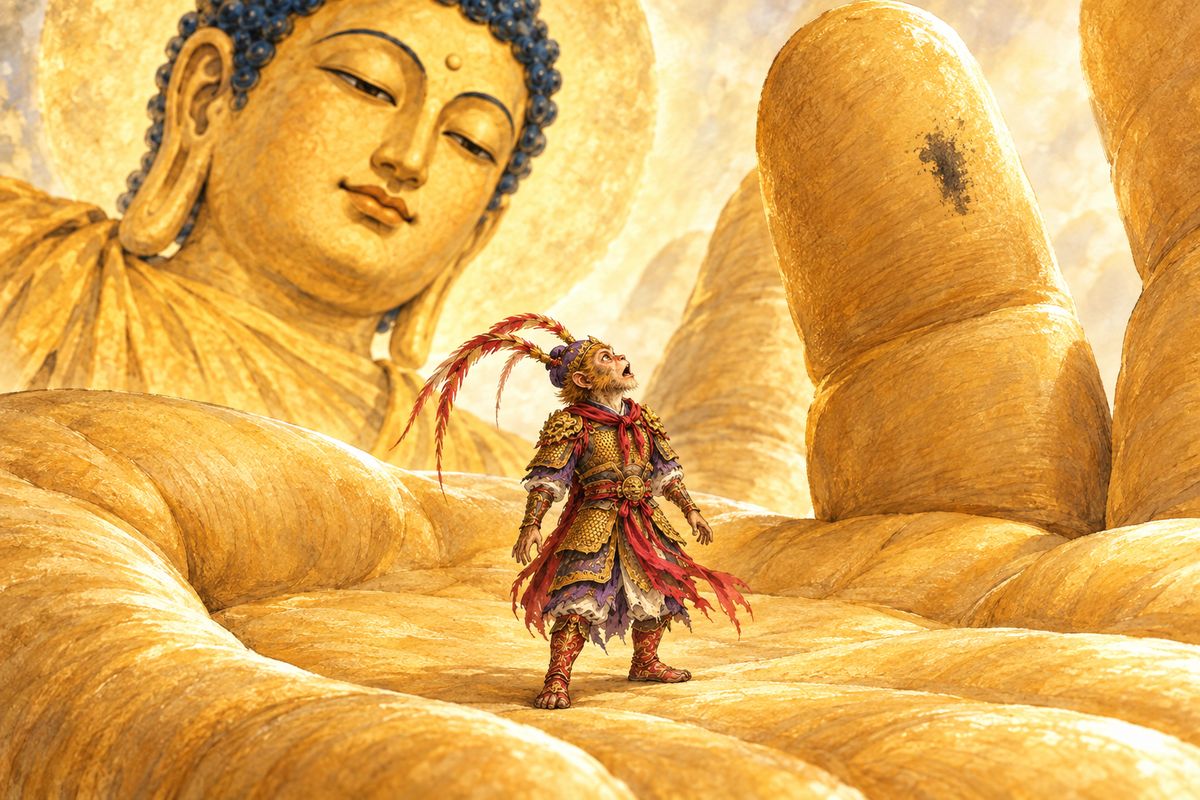
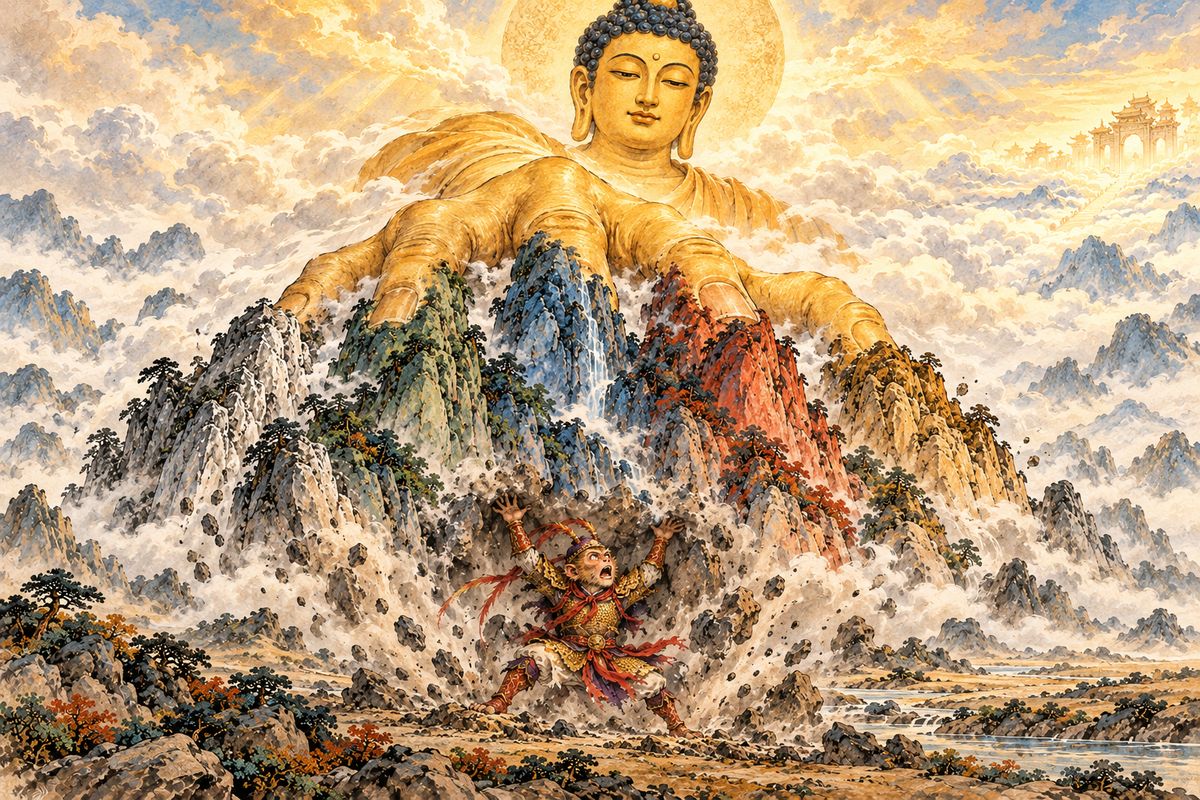
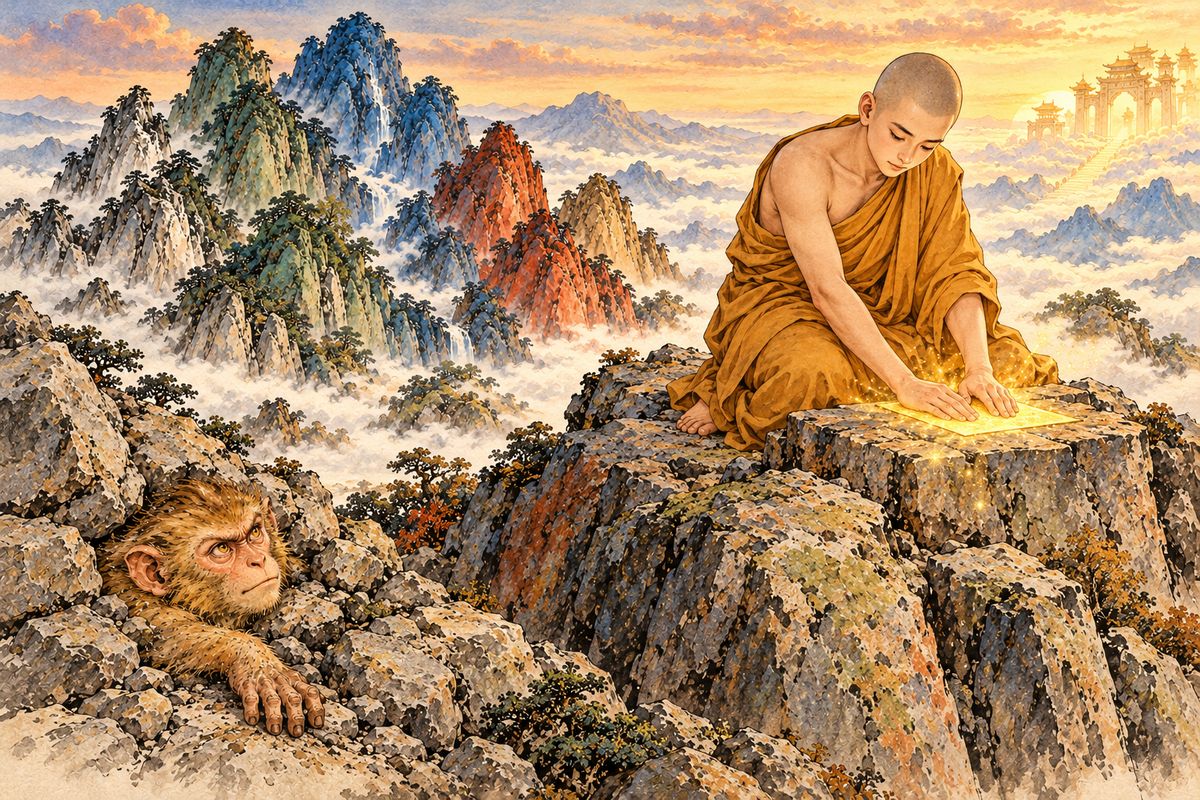
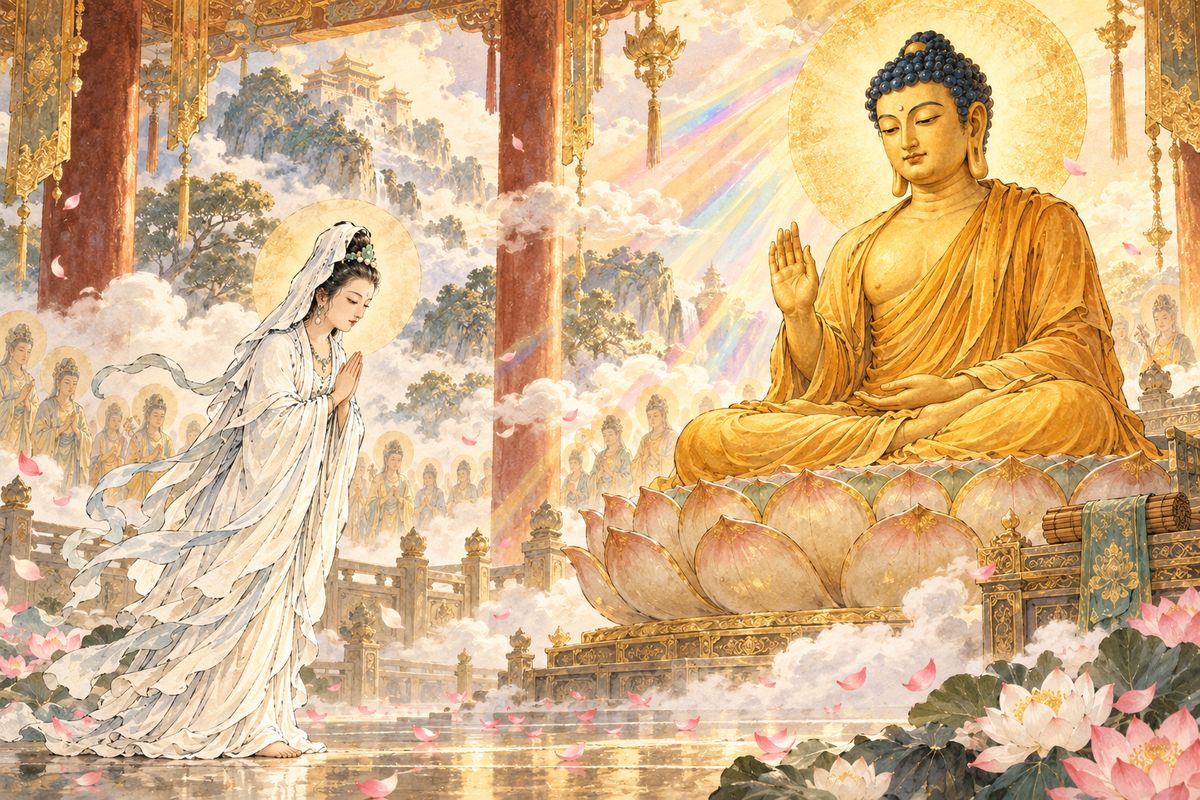
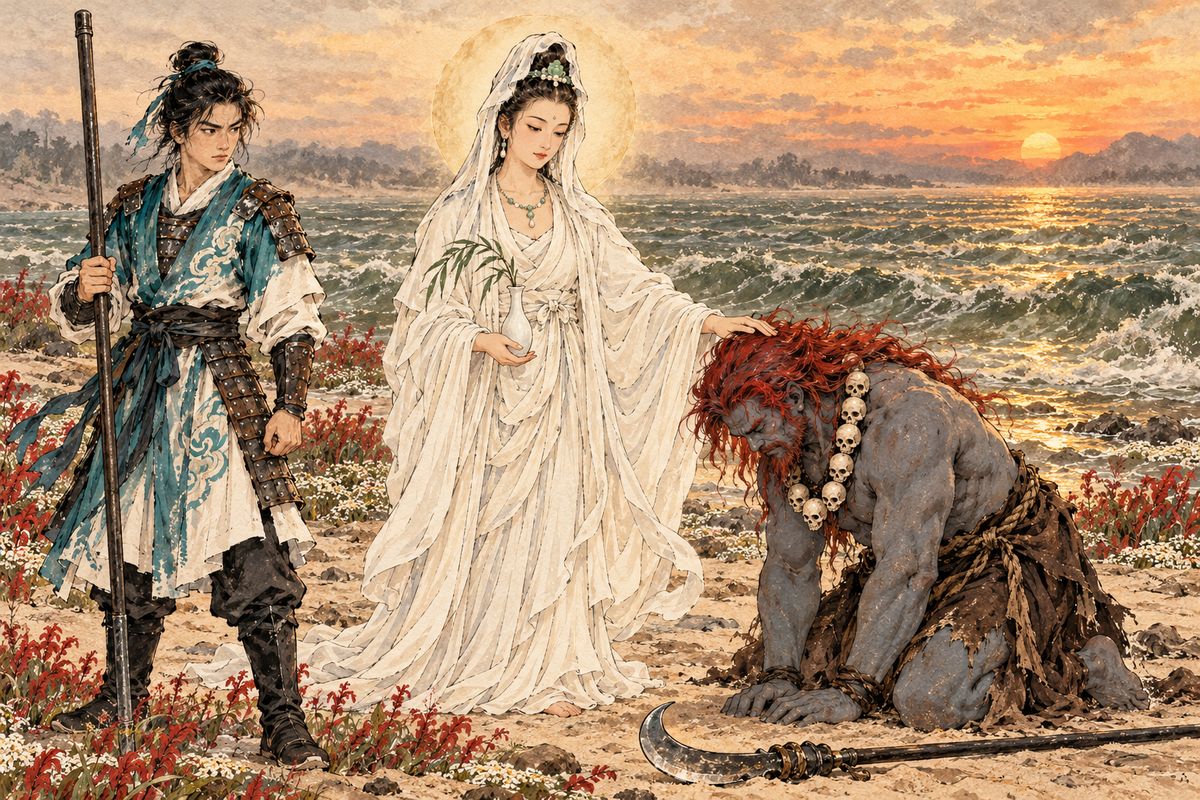
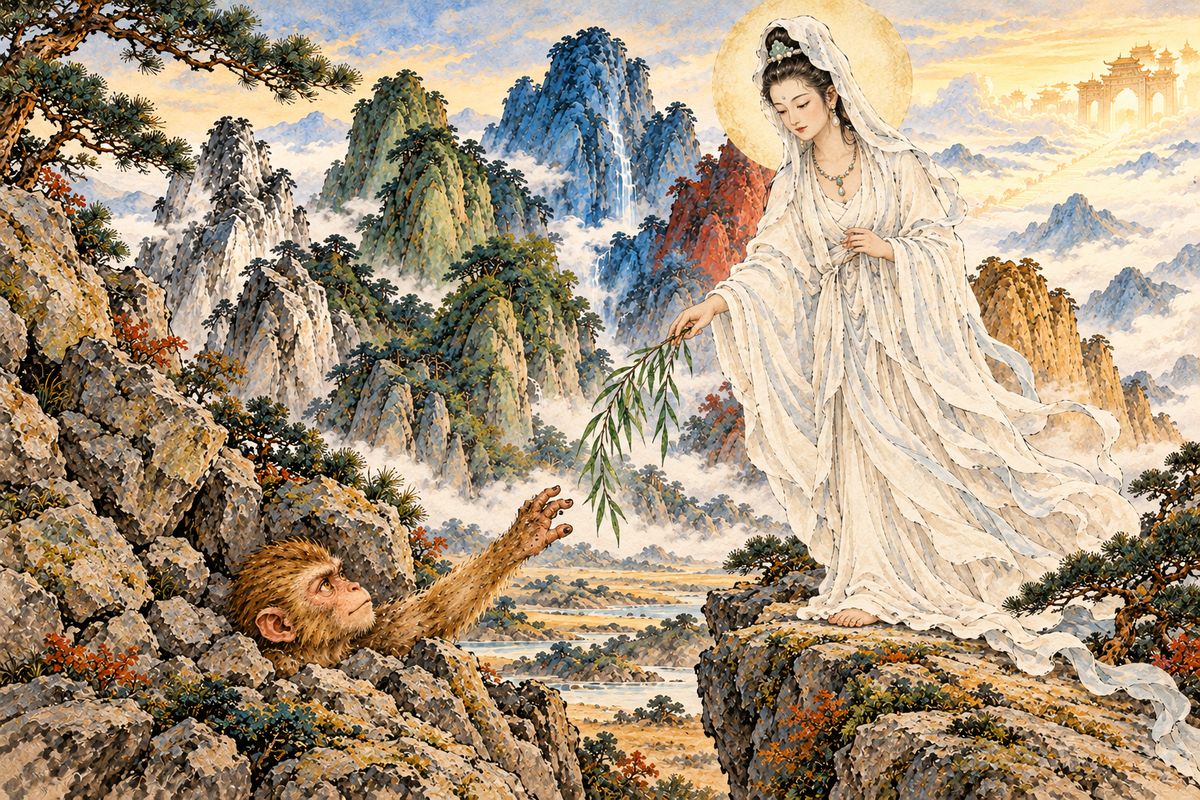
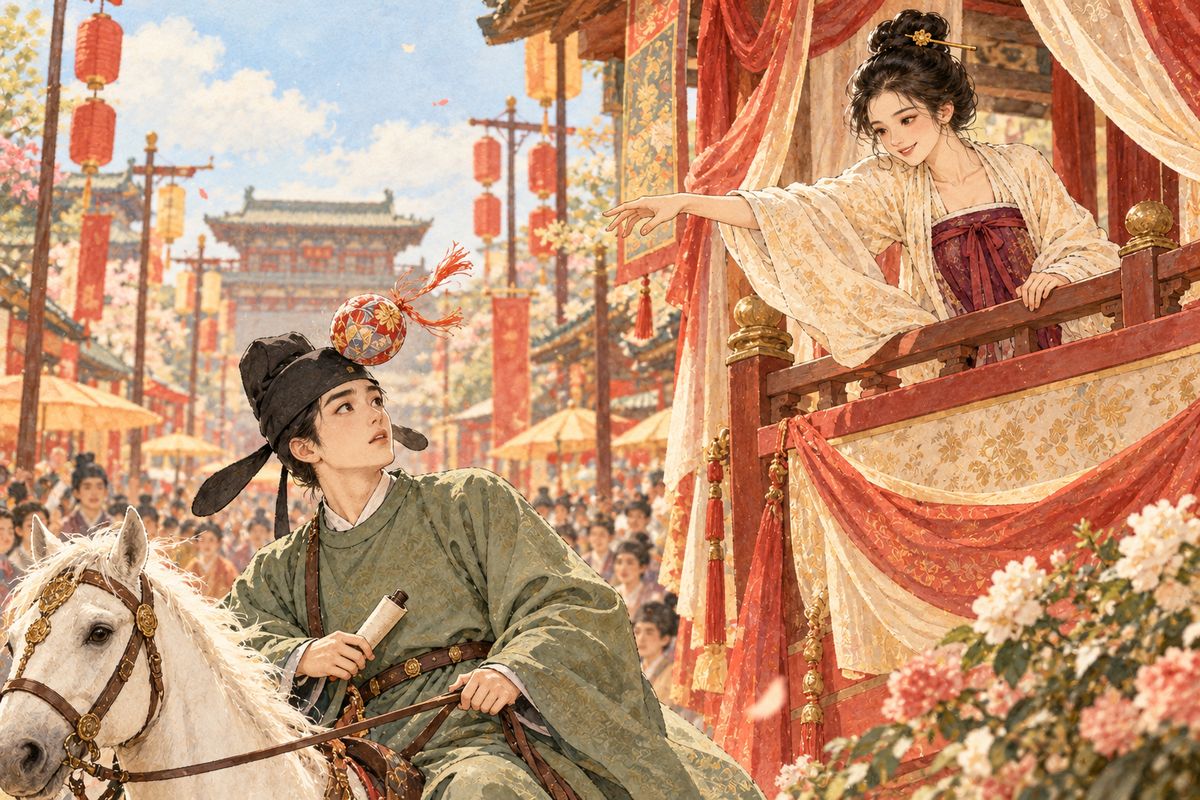
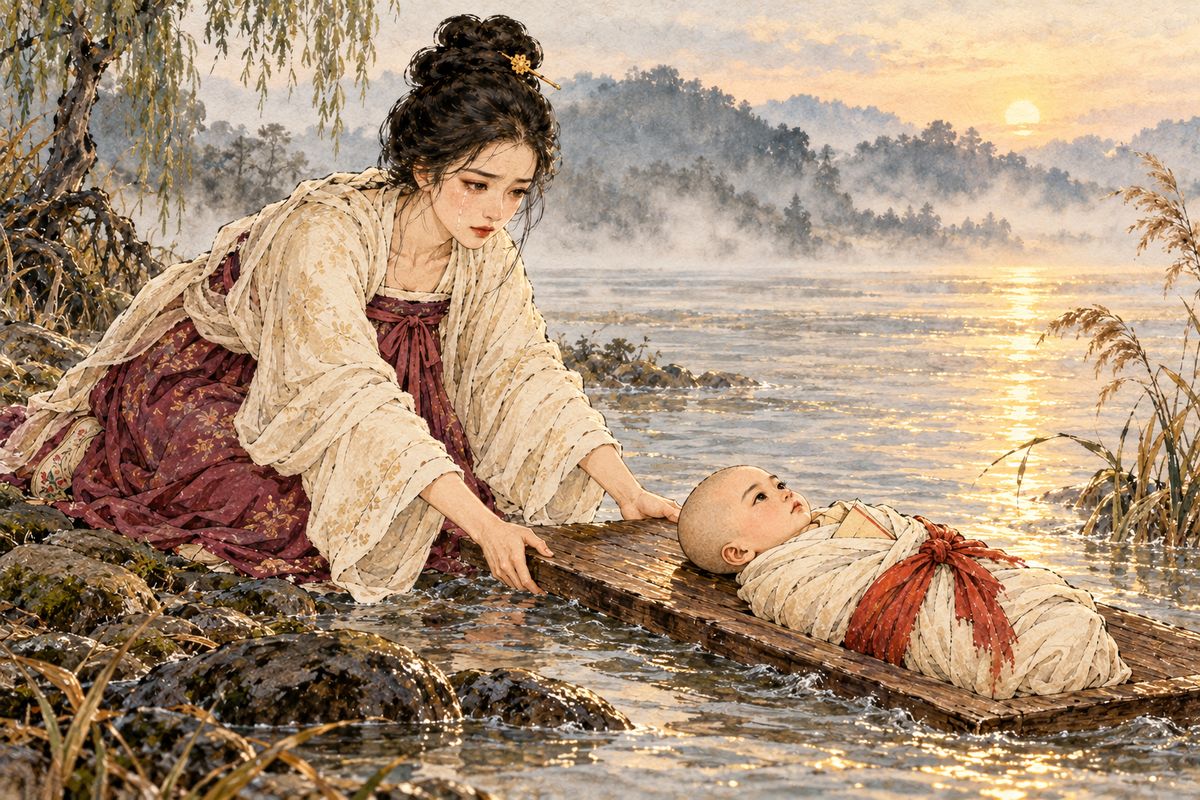
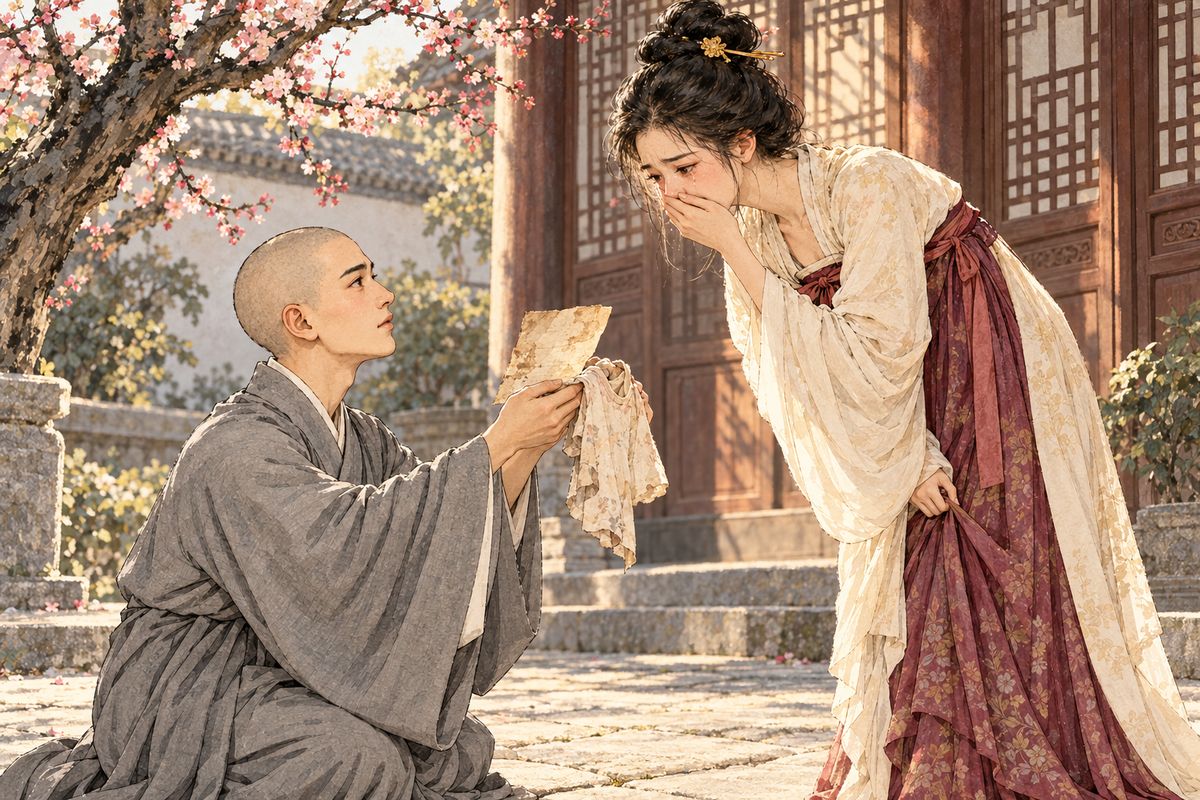
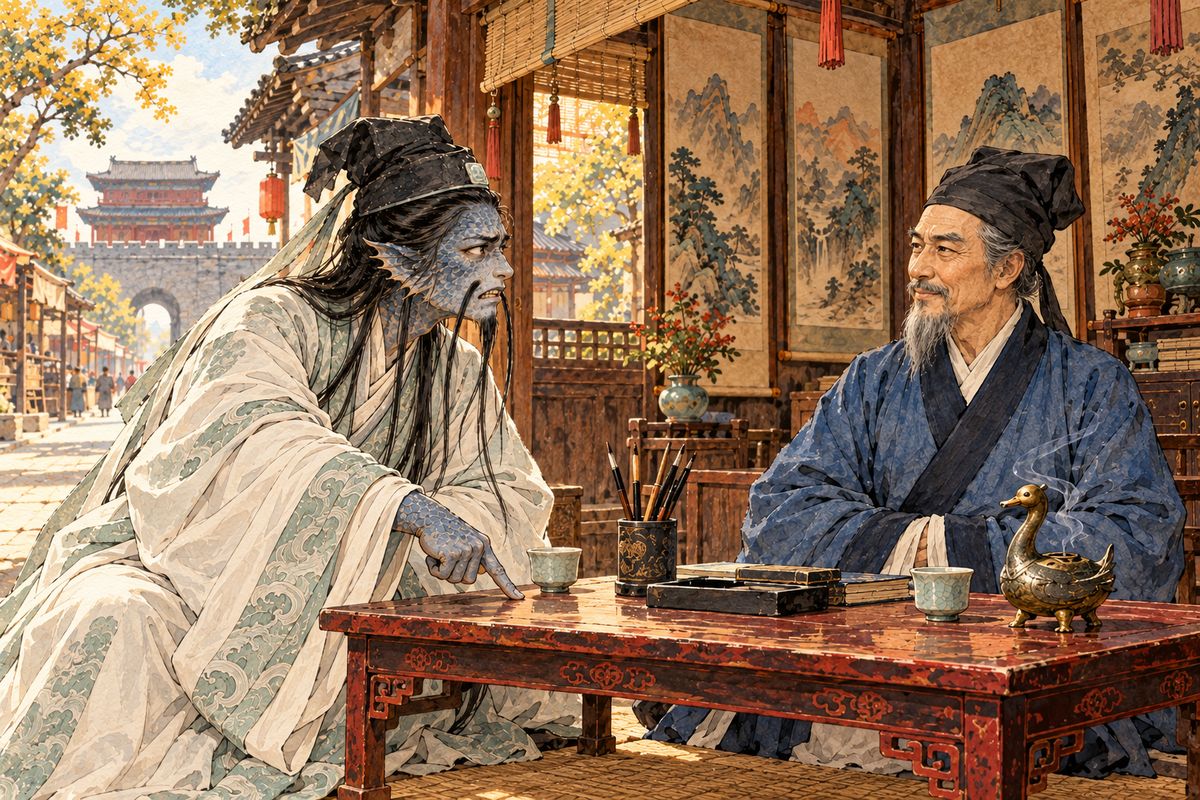
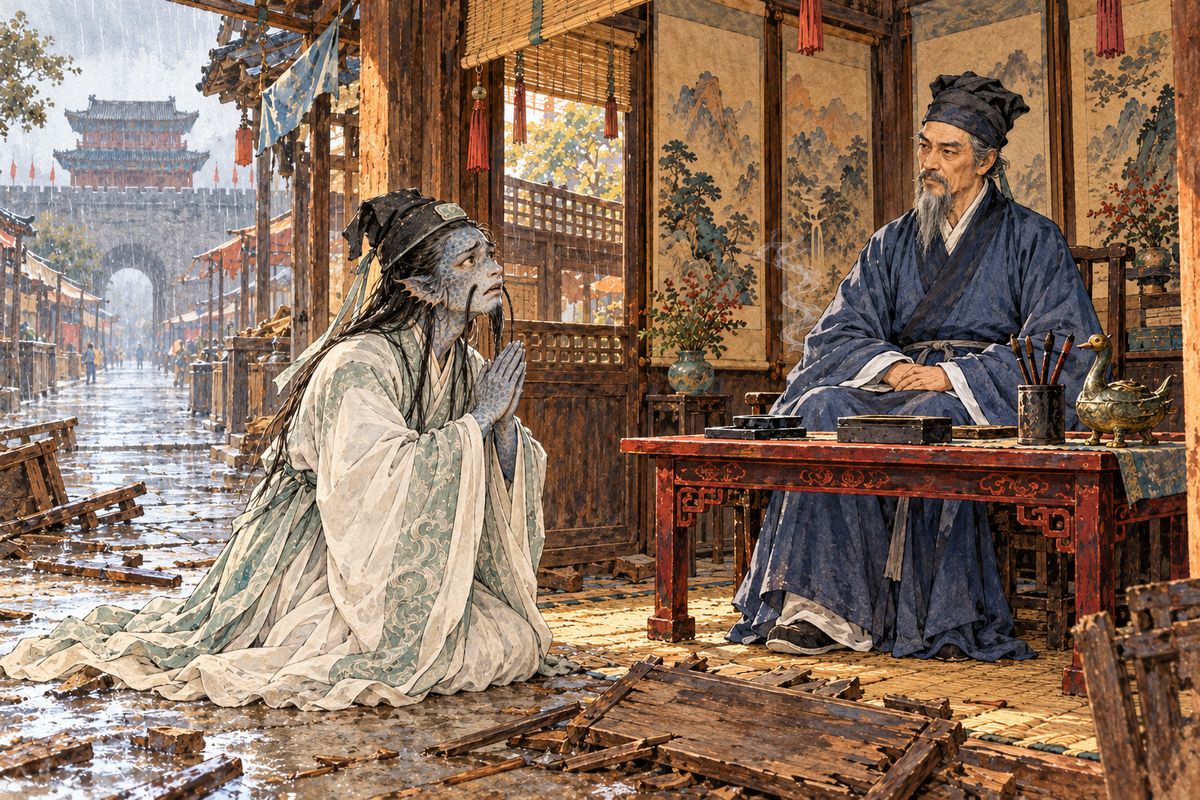
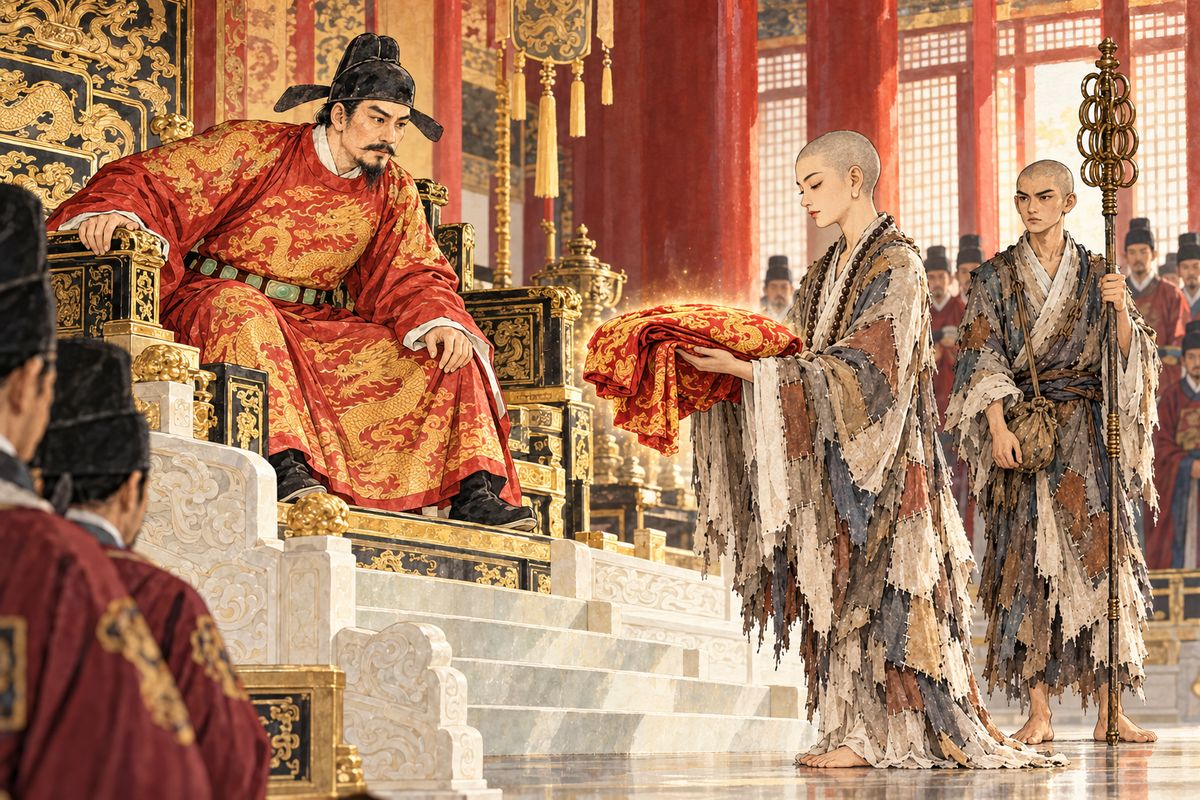
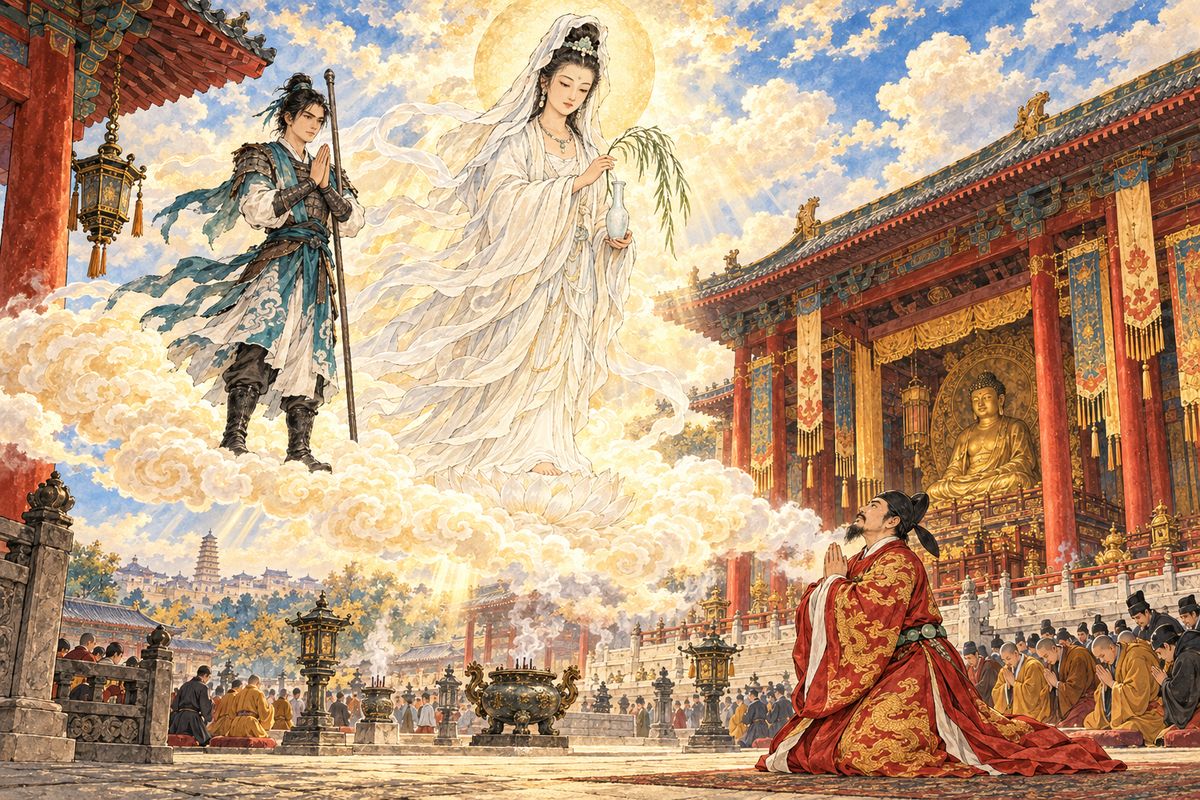
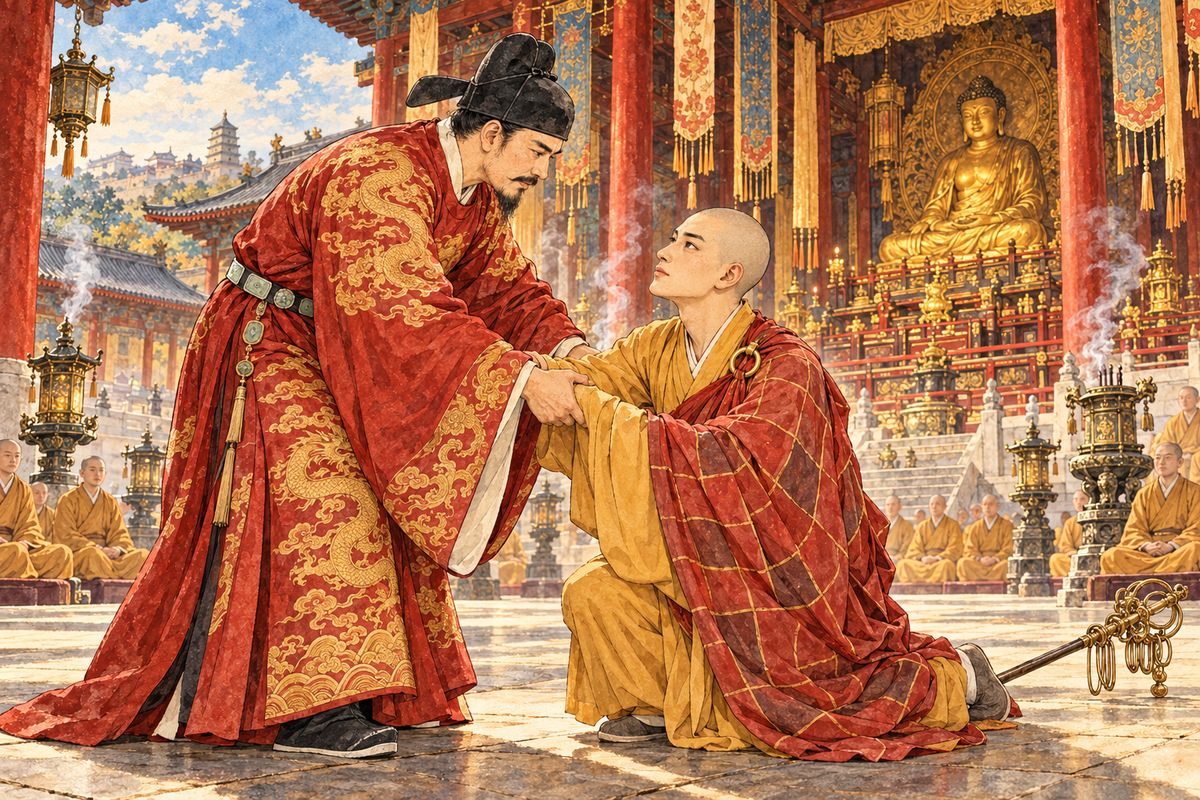
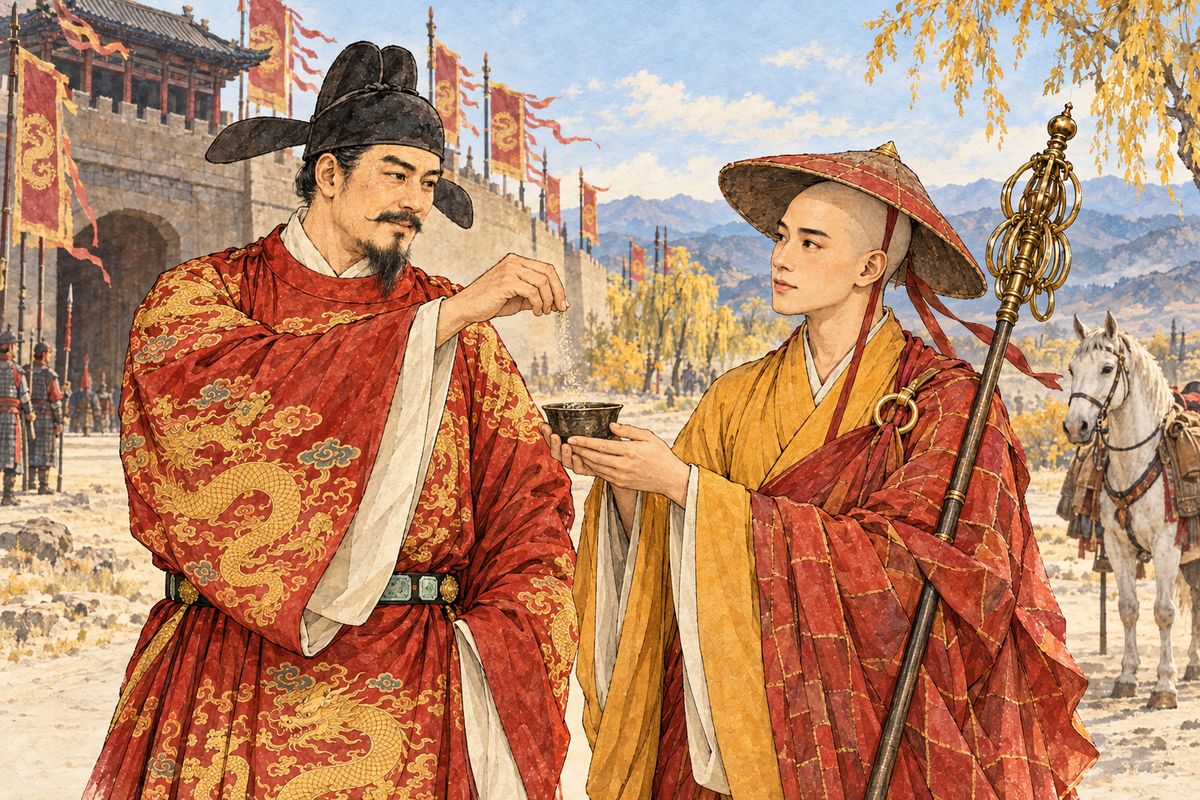
1On Flower-Fruit Mountain, a stone had gathered the sun and moon's essence for countless years. One day it split, and a small monkey stepped out, blinking at a world that seemed made for discovery.2He learned to leap through trees, drink from clear streams, and play with the mountain's monkeys. They knew nothing of calendars or kings; the mountain gave them food and the seasons passed unnoticed.3One hot day, the troop followed a stream to a waterfall. They promised to honor any monkey who could pass through its white curtain and return unharmed. The stone monkey called, 'I will go!'4He jumped through the torrent and found dry ground behind it. A stone bridge led into a broad cave, sheltered from wind and rain. The hidden place could be a home for all of them.5The others followed him through the water. They explored the cave, then remembered their promise: the brave jumper should be king. He accepted gladly, and the stone monkey became the Handsome Monkey King.6Years of feasting and play followed. Then, at a happy gathering, the king thought of a future he could not defeat: even monkeys died. He wept, and his companions fell quiet around him.7An elder monkey spoke of beings beyond death: Buddhas, immortals, and sages. The king resolved to find such a teacher. His people made him a little raft, and he pushed away from the shore alone.8He crossed seas, learned to move among humans, and searched for years. At last, in western mountains, a woodcutter's song led him toward the cave of Patriarch Subhuti. The journey had brought him to a door.9The Monkey King found the cave door shut and dared not knock, so he played in a pine tree, nibbling pine seeds. At last the door creaked open, and an immortal boy said his master expected a visitor.10Deep inside, the Monkey King bowed again and again before Patriarch Subhuti. The Patriarch doubted he could have crossed two oceans, but the monkey explained he had travelled for years and was born from a stone.11Pleased, Subhuti gave him the surname Sun and, following the school's naming order, the religious name Wukong, meaning 'Aware of Emptiness.' The delighted monkey cried, 'Good, good, good! From today I am Sun Wukong!'12After seven years of sweeping and chores, Wukong refused every path his teacher offered that could not grant eternal life. Subhuti tapped his head three times with a ruler, then walked inside and shut the middle door.13The other students scolded him, but Wukong had solved the riddle: come at the third watch, through the back door. At midnight he knelt by his teacher's bed and secretly received the formula for long life.14Three years later, Subhuti warned that heaven would send thunder, fire and wind to destroy anyone so long-lived. To escape them, Wukong chose the harder skill, and his teacher whispered the secret of seventy-two transformations.15When Wukong's first flight covered barely three li, Subhuti called it cloud-crawling. Building on the monkey's own leaping style, he taught him the somersault cloud, which carried him one hundred and eight thousand li in a single bound.16When classmates begged for a show, Wukong turned himself into a pine tree. Their cheering brought Subhuti out, angry at the boasting. He sent Wukong home and warned him never to say who had taught him.17Monkey King Sun Wukong found his big captured sword too clumsy. His four old monkey advisers said the water under the Iron Plank Bridge led to the East Sea Dragon Palace, so he used a water-parting spell and dived straight in.18Dragon King Ao Guang welcomed his new neighbor and offered weapons. Wukong refused a broadsword, swung a heavy nine-pronged fork, then tried an even heavier painted halberd. He called each one too light for his hand.19The Dragon Queen remembered a glowing iron pillar that Yu the Great had used to measure the seas. In the sea treasury, it shrank at Wukong's command into the As-You-Will Gold-Banded Staff, a weapon of astonishing weight.20Wukong then demanded armor. Fearing the staff, Ao Guang rang his bell and drum, and his three dragon brothers brought a phoenix-plumed golden cap, golden chain mail and cloud-walking boots. Wukong put them on and swung his way out.21Back home, his monkeys could not even shift the staff. Wukong cried, “Small! Small! Small!” and it shrank to an embroidery needle that he hid inside his ear, to their amazement.22After a great feast, Wukong fell asleep, and two summoners roped his soul and dragged him to the gates of the Underworld. Saying he was beyond death, he pulled out his staff, struck them down and fought his way inside.23The Ten Kings bowed and brought the registers of life and death. Wukong found his own entry, lifespan 342 years, took a brush and crossed out his name and every monkey's name. Then he woke beneath a pine tree.24Gold Star Taibai led Wukong up to Heaven, but Wukong's somersault cloud left the old envoy far behind. At the Southern Heaven Gate, armored guards blocked Wukong with spears until Taibai arrived and announced the Jade Emperor's summons.25In the Hall of Divine Mists, Wukong refused to kneel and simply answered, "Old Monkey is me!" The courtiers gasped, but the Jade Emperor forgave the newcomer and made him Bimawen, Keeper of the Heavenly Horses.26Wukong took up his post happily. He counted a thousand heavenly horses and tended them day and night, chasing sleepy ones up to eat and herding wanderers back to the troughs, until every horse grew sleek and strong.27After half a month, the stable officials held a welcome feast. Wukong asked his rank and learned his post was the lowest in Heaven, fit only for minding horses. Furious, he overturned the table and fought his way out.28Back home, the monkeys explained that each day in Heaven was a year below. Two one-horned demon kings brought Wukong an ochre robe and urged him to call himself Great Sage Equal to Heaven. Delighted, he raised a banner.29Heaven sent Heavenly King Li with an army. Wukong snapped the Mighty Spirit's axe handle, then matched Prince Nezha's three heads and six arms with his own, and a hair-clone trick let him strike Nezha's arm.30Gold Star Taibai persuaded the Jade Emperor to grant the title without salary or duties. Wukong returned to Heaven, gave only a brief bow, and was named Great Sage Equal to Heaven, with a new mansion beside the Peach Garden.31Worried that the idle Great Sage would make trouble, the Jade Emperor gave him a job: keeping the Peach Garden of Heaven. Wukong bowed his thanks and rushed off to inspect it at once.32The garden god explained that some peaches ripened once in nine thousand years and made the eater live as long as Heaven and Earth. One day Wukong sent his attendants away, climbed a tree, and feasted.33When the Queen Mother's seven fairies came to pick peaches for her banquet, they woke Wukong, asleep as a tiny figure in the leaves. He learned the guest list included every great immortal, but nobody had mentioned him.34Wukong froze the fairies with a spell and flew off. On the road he lied to the Barefoot Immortal, sending him to the wrong palace, then took his shape and walked into the empty banquet hall.35Smelling fine wine, Wukong turned hairs into sleep-insects that sent the brewers nodding. Then he gobbled the delicacies and drank straight from the jars until he was thoroughly drunk.36Staggering home, Wukong lost his way and wandered into Laozi's Tushita Palace. Laozi was away lecturing, so Wukong emptied five gourds of golden elixir pills and ate them all like roasted beans.37Sober and suddenly afraid, Wukong fled to Flower-Fruit Mountain. His monkeys' coconut wine now tasted awful, so he slipped back to Heaven and carried off four jars of immortal wine for a party.38Furious at the complaints, the Jade Emperor sent a hundred thousand heavenly soldiers to surround the mountain. Wukong cheerfully admitted every theft to the Nine Luminaries, then beat them back with his staff.39The battle raged until sunset, and Heaven captured the seventy-two demon kings. Then Wukong chewed a mouthful of hairs, spat out hundreds of fighting copies of himself, and routed Nezha and the Heavenly Kings.40Guanyin arrived for the Peach Banquet and found the tables wrecked. In the Hall of Divine Mists, the Jade Emperor told Guanyin of the monkey's crimes, and Guanyin sent the disciple Hui'an down to scout the battle.41Hui'an, also called Muzha, passed through Heaven's huge army surrounding Flower-Fruit Mountain. He challenged the Great Sage, but after fifty or sixty rounds his arms ached, and he fled back to camp to beg for help.42Guanyin advised the Jade Emperor to summon his nephew, Erlang Shen. Erlang marched to the mountain and fought Wukong for over three hundred rounds. Both grew as tall as mountains, while Erlang's sworn brothers scattered the monkey army.43Seeing his monkeys flee, Wukong shrank his staff into a needle and became a sparrow. Erlang became a hawk. The chase raced on: cormorant against crane, fish against fish hawk, water snake against grey crane.44Knocked down by Erlang's slingshot pellet, Wukong became a little roadside temple, but his tail stuck up behind as a flagpole. Erlang laughed at the giveaway and threatened to smash the windows, Wukong's eyes, so the monkey sprang away.45Wukong fled to Erlang's own temple disguised as Erlang, but the real Erlang chased him back to the mountain. Watching from the South Gate of Heaven, Laozi dropped his steel Diamond Snare toward the monkey's head.46The snare struck Wukong's head and knocked him over. Erlang's hound bit his leg, and the seven brothers pinned him and tied him up so he could no longer change shape. The Jade Emperor ordered the rebel executed.47Heaven's soldiers bound Wukong to the demon-slaying pillar, but blades, fire and thunderbolts could not harm him. Laozi explained that the stolen elixirs had made his body hard as diamond, and asked to refine him in his furnace.48Laozi pushed Wukong into the Eight Trigrams Furnace. Wukong hid under the Xun trigram, the place of wind, where no fire could reach. The smoke still reddened his eyes, giving him his famous fiery golden eyes.49After forty-nine days, Laozi opened the furnace. Wukong sprang out, kicked the great furnace over and knocked down every attendant who grabbed him. When Laozi seized him, Wukong flung the old sage headfirst and escaped.50Wukong pulled his staff from his ear and rampaged through Heaven until no god could stand against him. Outside the Hall of Divine Mists, Wang Lingguan blocked his way with a golden whip, and they fought without either winning.51Thirty-six thunder generals surrounded Wukong. He changed into a figure with three heads and six arms, spinning three staffs like a whirling wheel, and no one could get near. The worried Jade Emperor sent messengers to fetch the Buddha.52The Buddha halted the battle and asked why Wukong was so violent. Wukong boasted that the strongest should rule Heaven. The Buddha offered a wager: if Wukong could leap out of his right palm, Heaven would be his.53Wukong somersaulted away until he saw five pink pillars holding up a blue mist. Thinking he had reached the end of the world, he turned a hair into a brush and wrote 'The Great Sage Equal to Heaven was here' on the middle pillar.54Wukong returned to the palm and demanded Heaven. The Buddha told him to look down. There, on the Buddha's middle finger, was Wukong's own writing. He had never left the palm at all. Stunned, he refused to believe it.55Wukong tried to leap away again, but the Buddha turned his hand over and pushed him out of Heaven's western gate. His five fingers became five joined peaks, the Five Elements Mountain, pinning the monkey beneath.56Heaven held a Great Feast of Peace to thank the Buddha. When Wukong pushed his head out, Ananda sealed the summit with a golden charm. An earth god guarded him, feeding him iron pellets and molten copper until a rescuer should come.57Back on Vulture Peak, the Buddha declared that the people of the southern continent needed his three baskets of true scriptures. A pilgrim would have to walk all the way west to fetch them. Guanyin bowed and volunteered to find one.58Travelling east with her disciple Huian, Guanyin met a river ogre at Flowing Sands, a pig-faced fallen marshal, and a condemned dragon prince. Each repented and vowed to serve the future pilgrim. The ogre was named Sha Wujing, and the marshal Zhu Wuneng.59At Five Elements Mountain, Guanyin found Sun Wukong still trapped after five hundred years. He begged for help and promised to repent, so she told him to wait for a pilgrim from Tang China. Then she slipped into Chang'an in disguise.60In the Tang capital, the young scholar Chen Guangrui came first in the imperial exams. As he rode in the victory parade, Yin Wenjiao, a chancellor's daughter, tossed her embroidered ball from a pavilion and struck his hat, choosing him as husband.61On the way to his new post, the boatman Liu Hong killed Chen and seized his wife and office. Wenjiao later bore a son. To save him, she tied him to a plank with a blood-written letter and set him adrift.62Abbot Faming of Jinshan Temple rescued the baby and later ordained him as Xuanzang. At eighteen he found his mother; his grandfather's army punished Liu Hong, and a river Dragon King, once a carp Chen had freed, revived his father.63Hearing that a fortune-teller's forecasts never failed, the Jing River Dragon King disguised himself as a white-robed scholar and visited Yuan Shoucheng in Chang'an. Yuan predicted tomorrow's rain exactly, and the dragon wagered against him.64Heaven then ordered that very rain. To win, the dragon changed its hour and amount, then smashed Yuan's shop. Yuan calmly unmasked him: he had broken Heaven's law, would be executed by minister Wei Zheng, and should beg Emperor Taizong for help.65In a dream, Taizong promised to save the pleading dragon and kept Wei Zheng beside him at chess. But Wei Zheng dozed over the board, and in his dream carried out Heaven's sentence. The dragon's head fell from the clouds.66The headless dragon's ghost haunted Taizong, who sickened and died holding Wei Zheng's letter. In the underworld, Judge Cui Jue, Wei Zheng's old friend, read it and secretly turned the emperor's thirteen years into thirty-three.67Guided past the suffering souls, Taizong promised a great Mass for the lost dead. He returned to life inside his own coffin, then pardoned prisoners, freed palace women, and prepared to keep his promise.68Emperor Taizong held a great mass to free lost souls. His ministers chose the monk Xuanzang, son of Chen Guangrui, to lead it, and twelve hundred monks chanted at Huasheng Temple in Chang'an.69Guanyin, disguised as a scabby, barefoot monk, came to court with the disciple Muzha to sell a glowing kasaya and a nine-ringed staff. Learning they were meant for Xuanzang, Guanyin gave both as a gift and refused payment.70On the seventh day the disguised Guanyin challenged Xuanzang's teaching, then rose into the clouds in true form. A note drifted down saying the Mahayana scriptures waited in the far west, one hundred and eight thousand li away.71Taizong asked who would fetch these scriptures. Xuanzang stepped forward and vowed to reach the West or die trying. Delighted, the emperor bowed to him before the Buddha and named him his sworn brother.72At the farewell, Taizong named him Tripitaka after the three baskets of scripture and dropped a pinch of home soil into his wine. Tripitaka drank it, said goodbye, and set off west beyond the pass.
Adapted from Journey to the West by Wu Cheng'en, public domain. Pictures are AI illustrations drawn for this edition.
Add Stories to your Home Screen: tap
then Add to Home Screen.