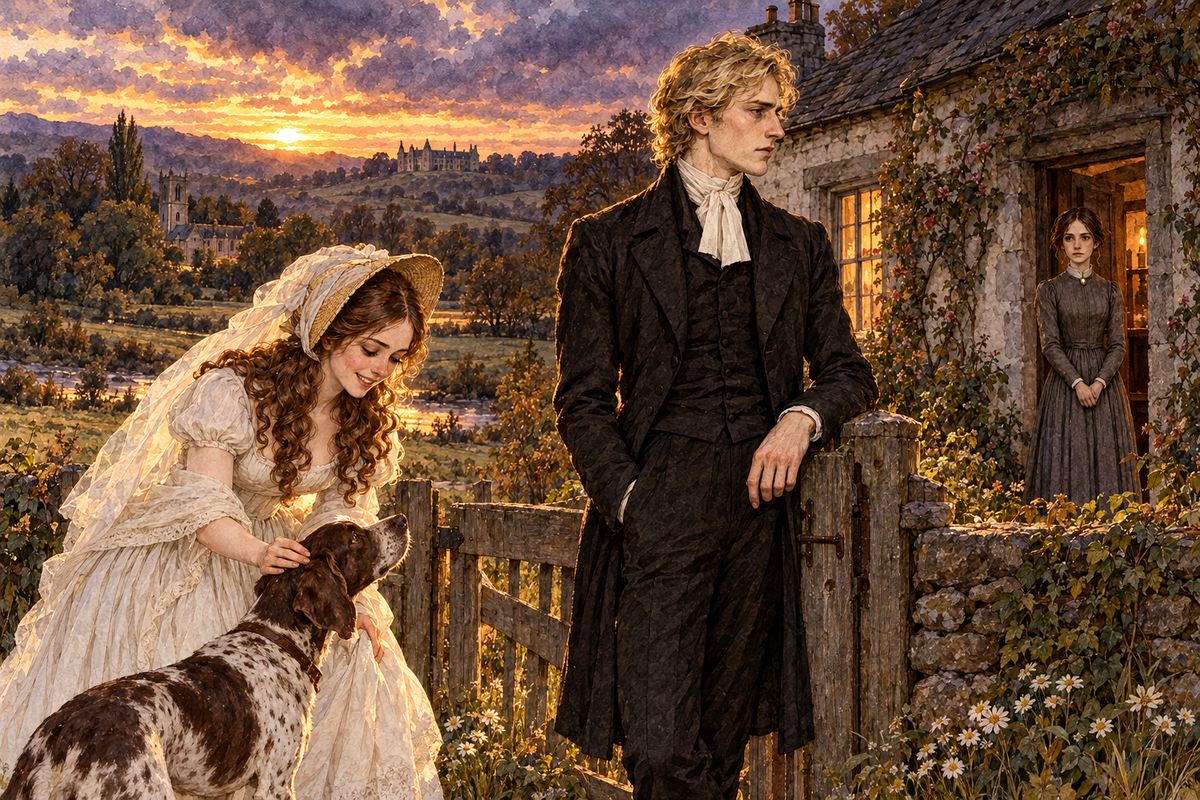
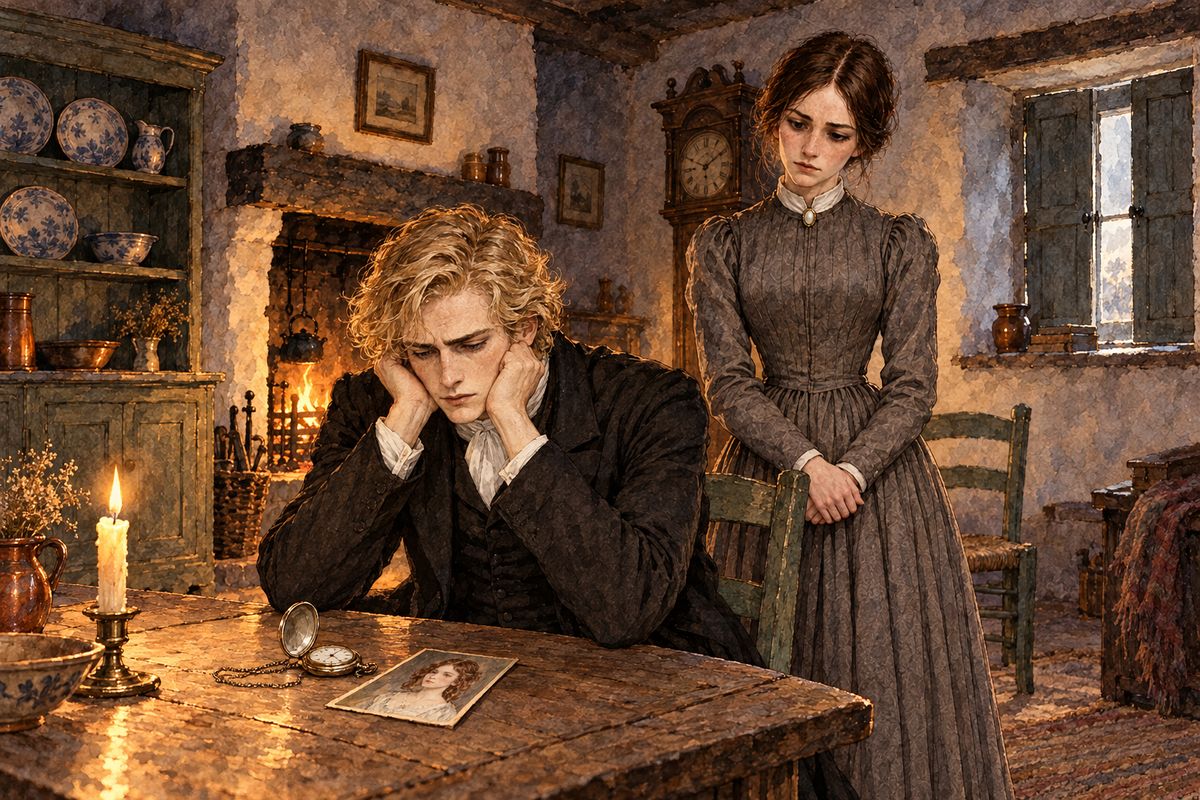
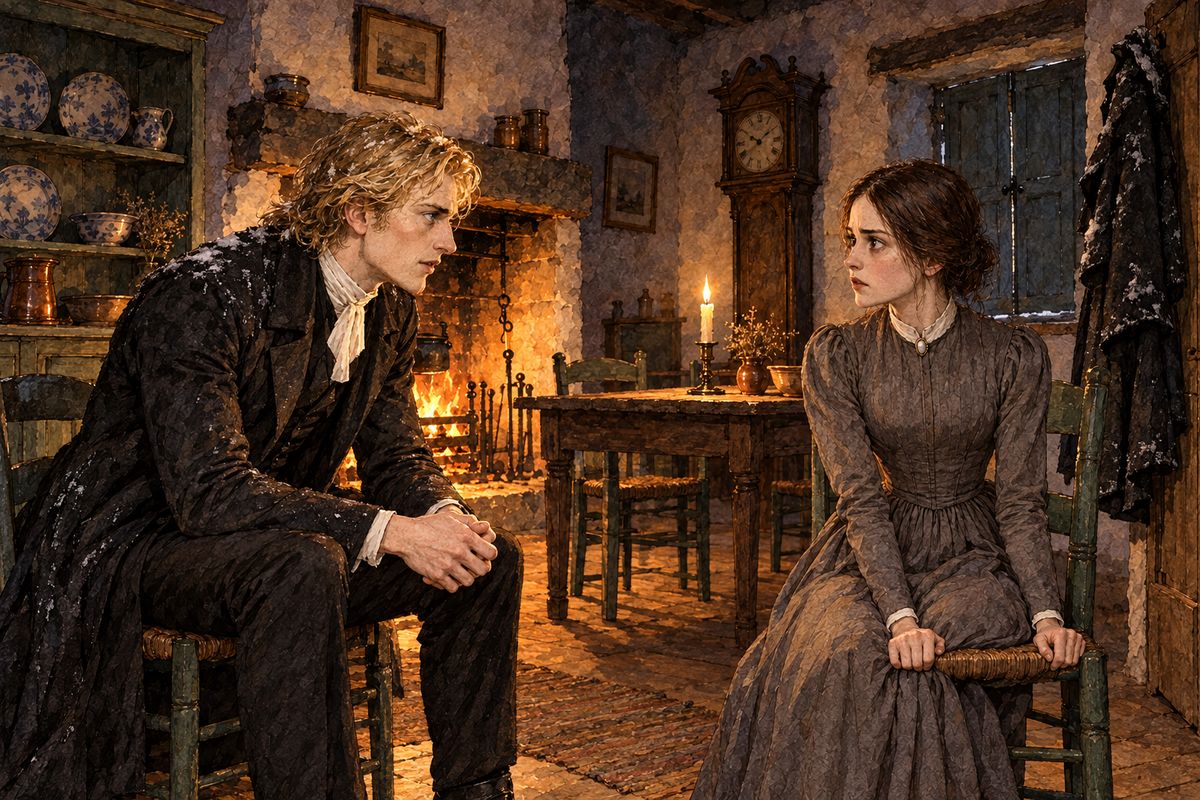
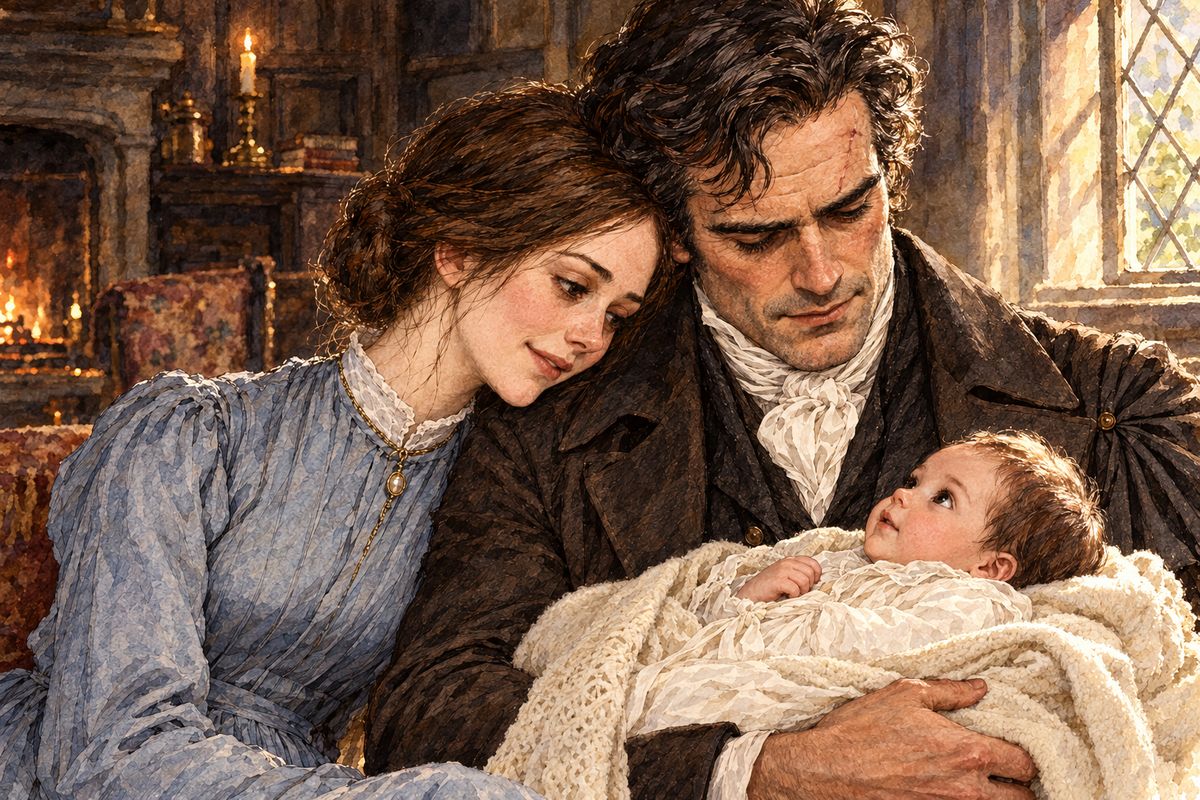
A picture-story retelling, after Charlotte Brontë (1847)
A gothic romance with cruelty to a child, a death from illness, a fire, a violent attack and a fatal fall. All are shown by the moment before or after, in shadow or at a distance, never in gruesome detail.
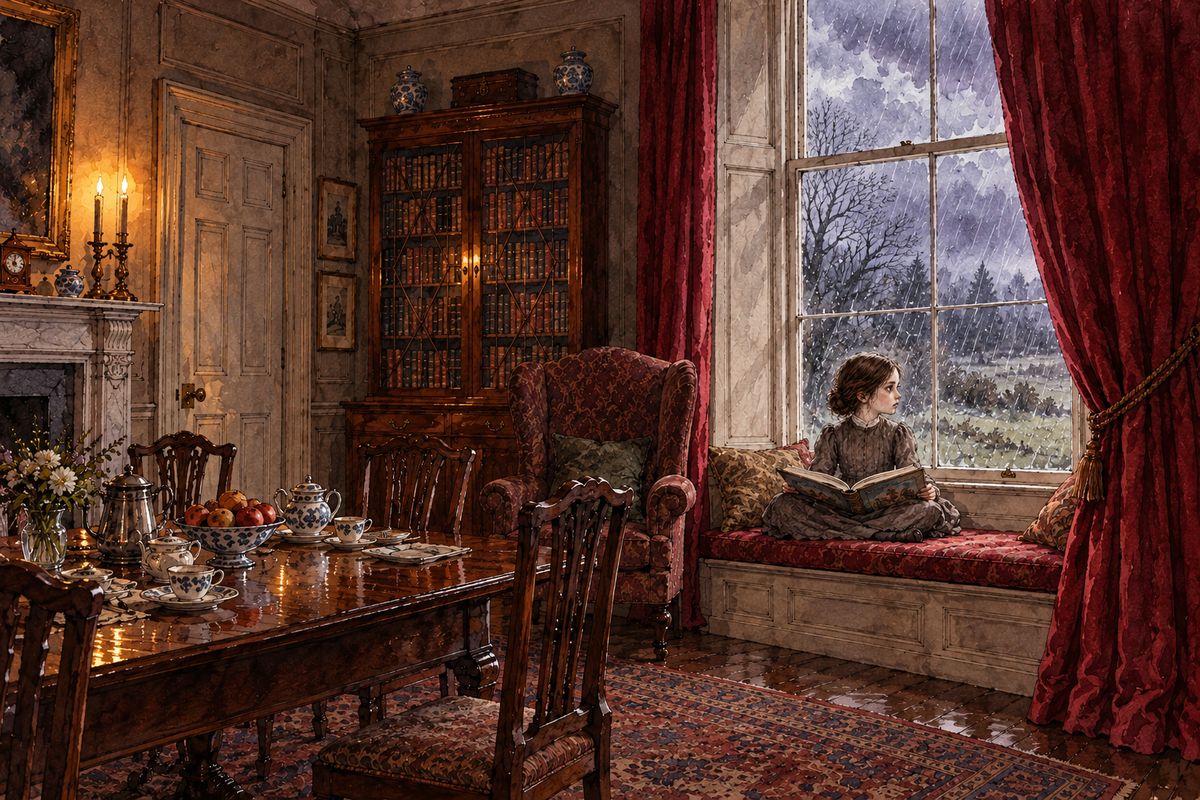
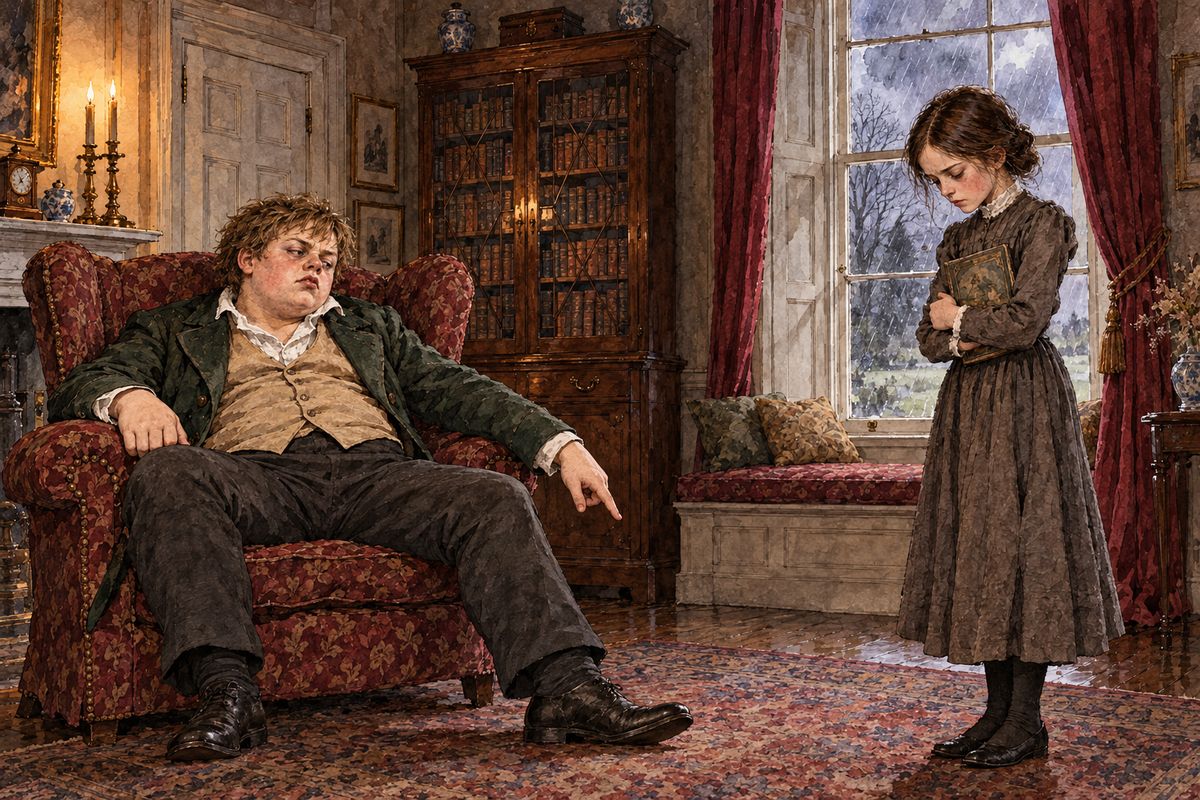
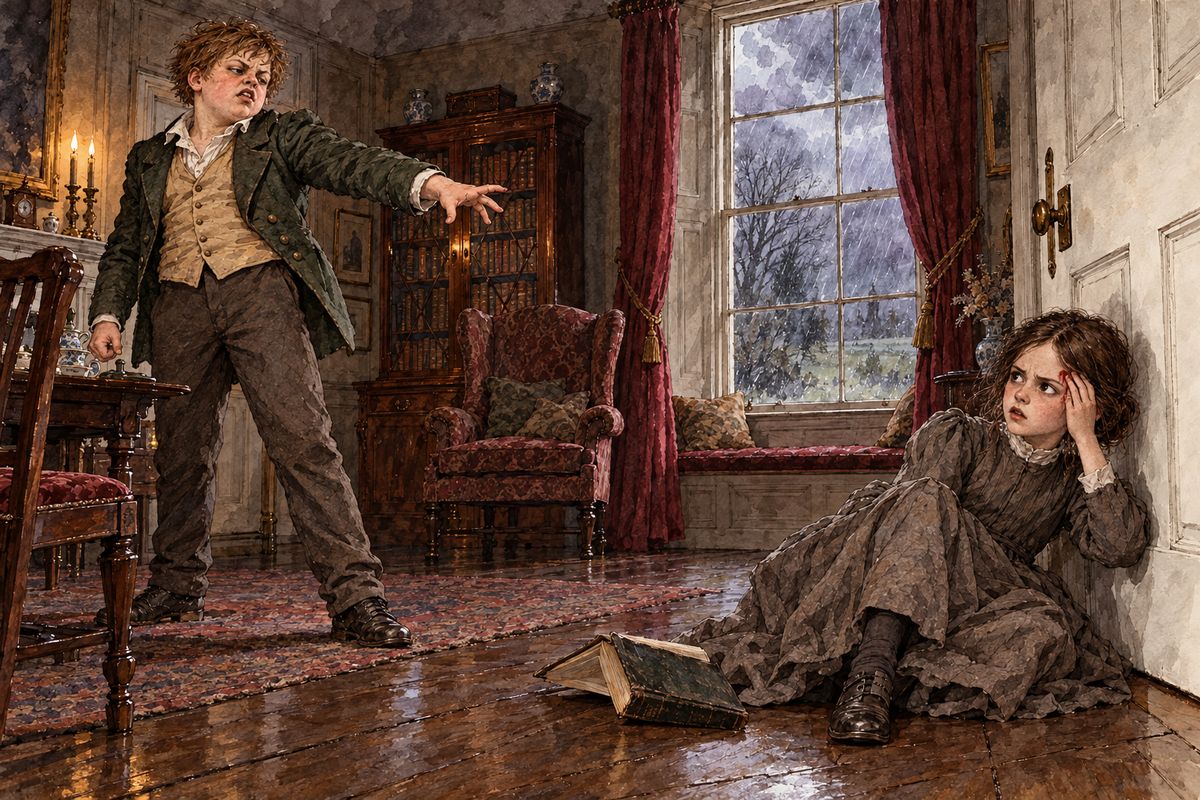
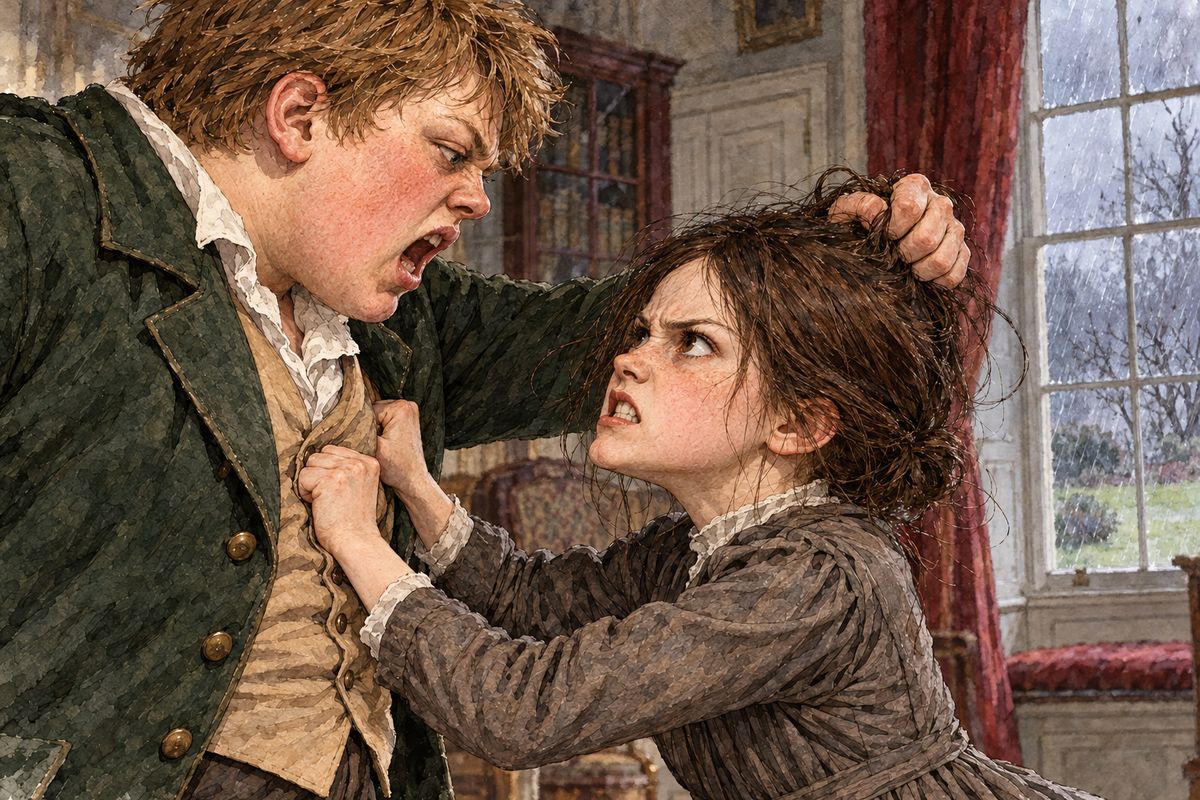
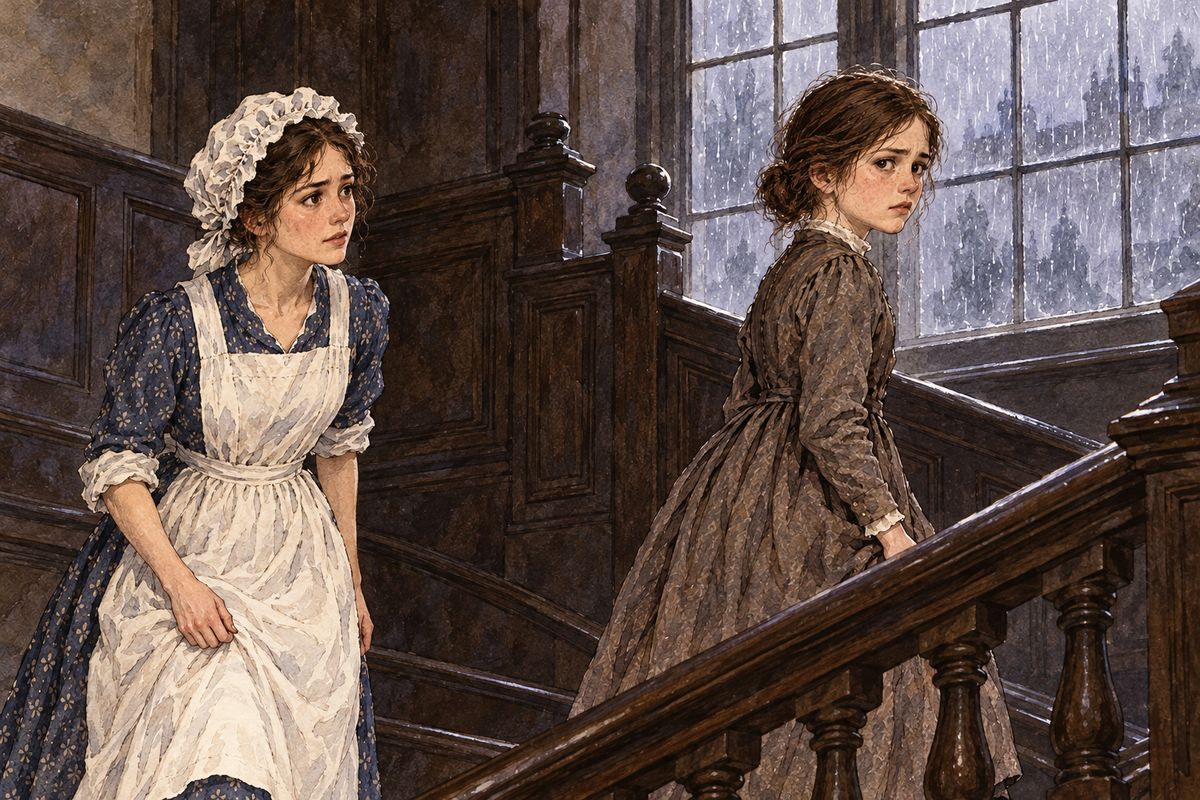
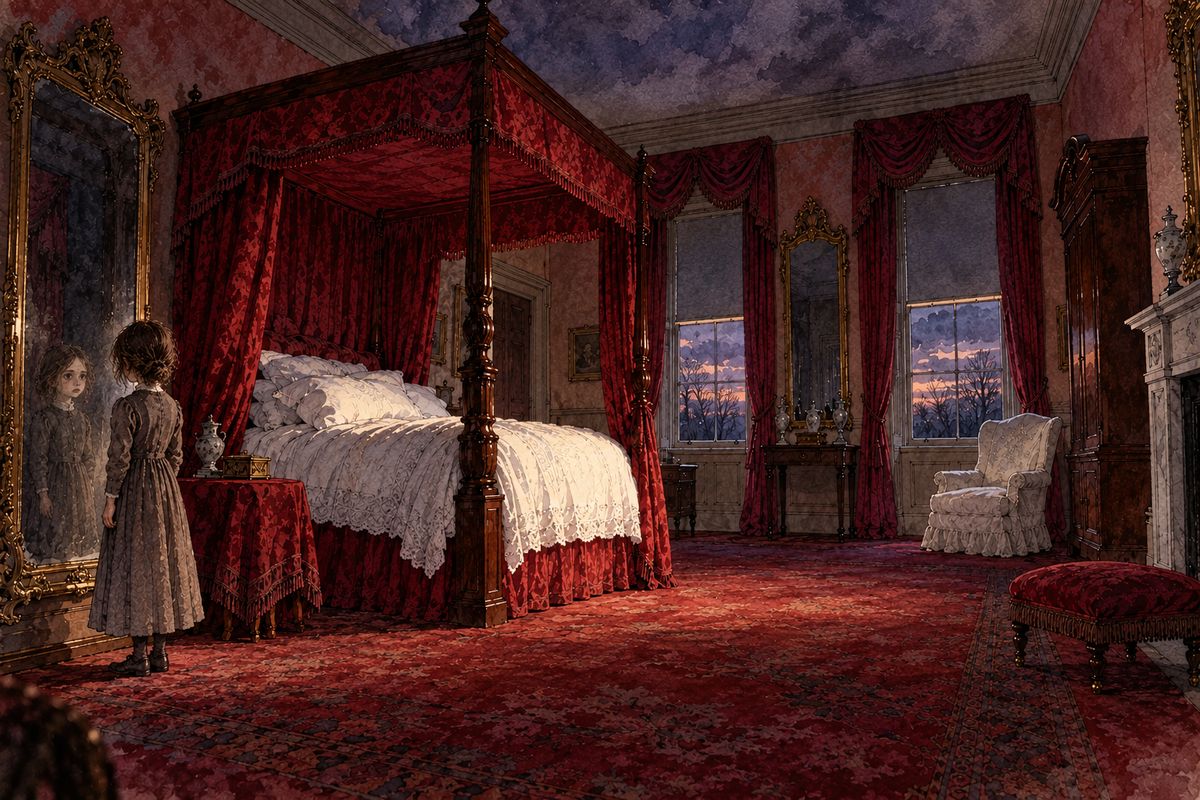
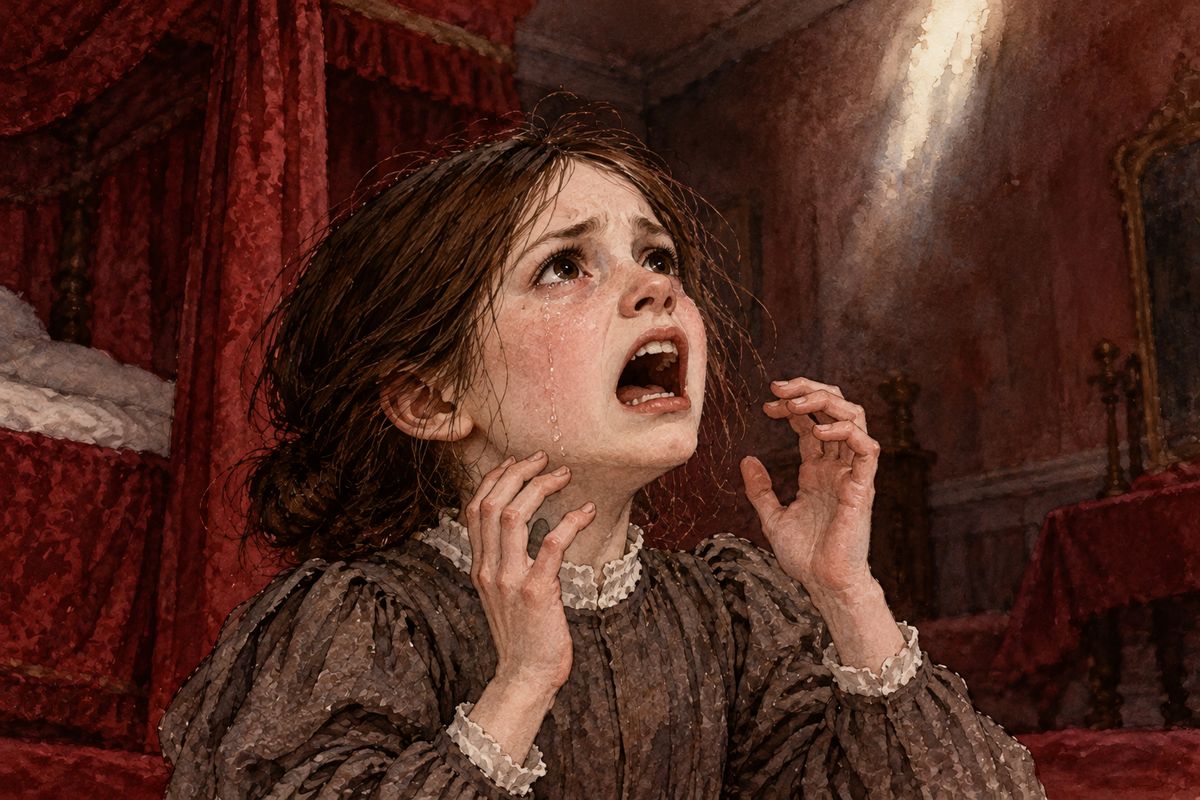
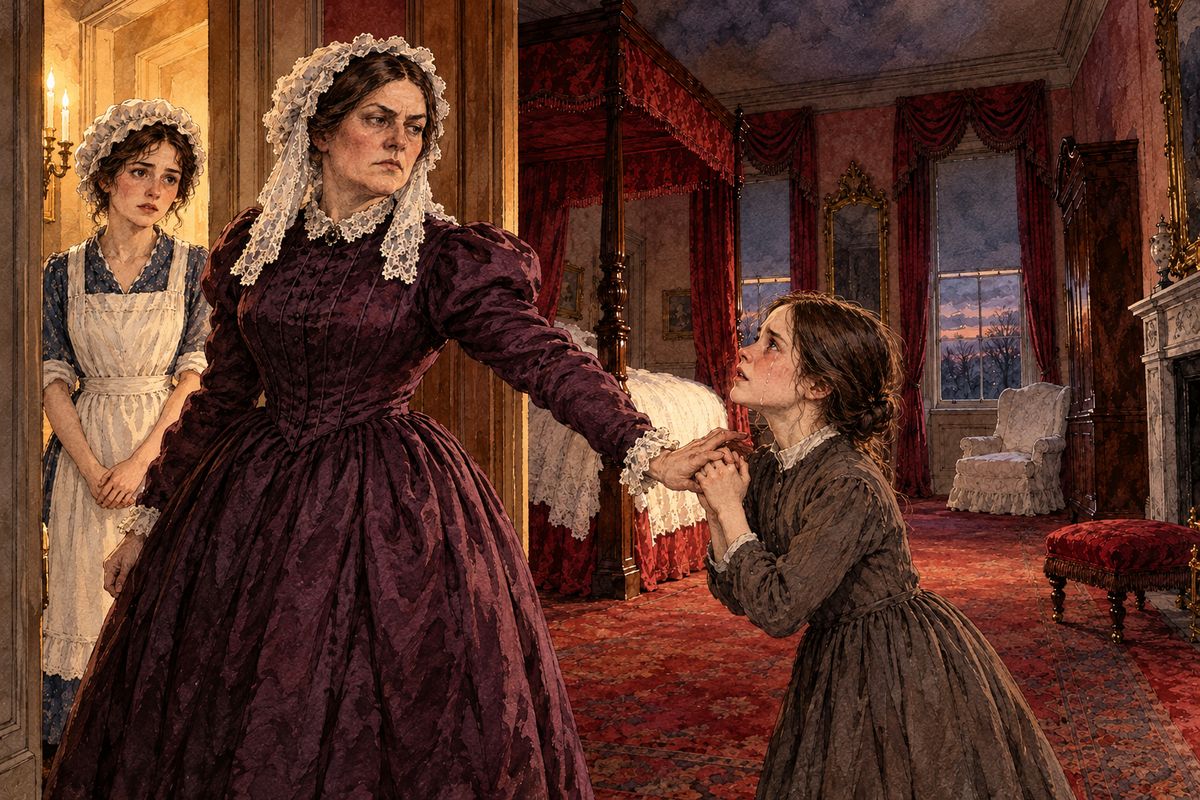
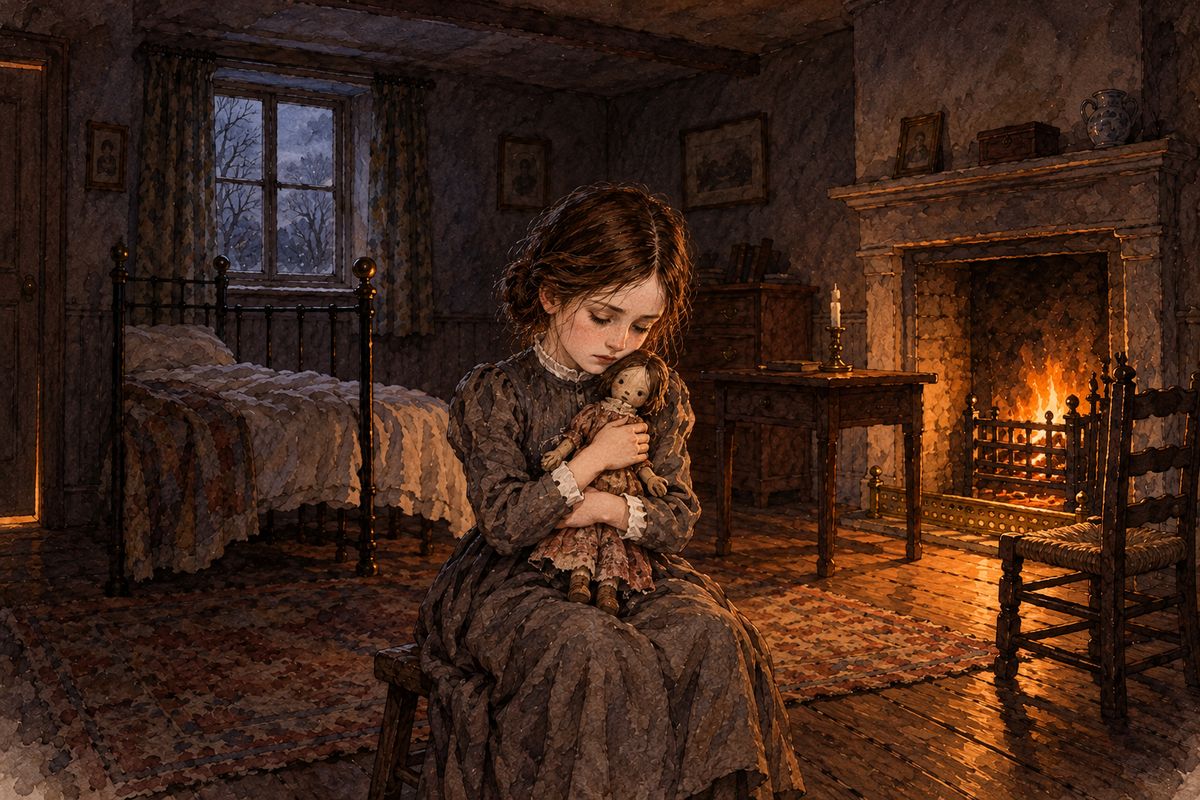
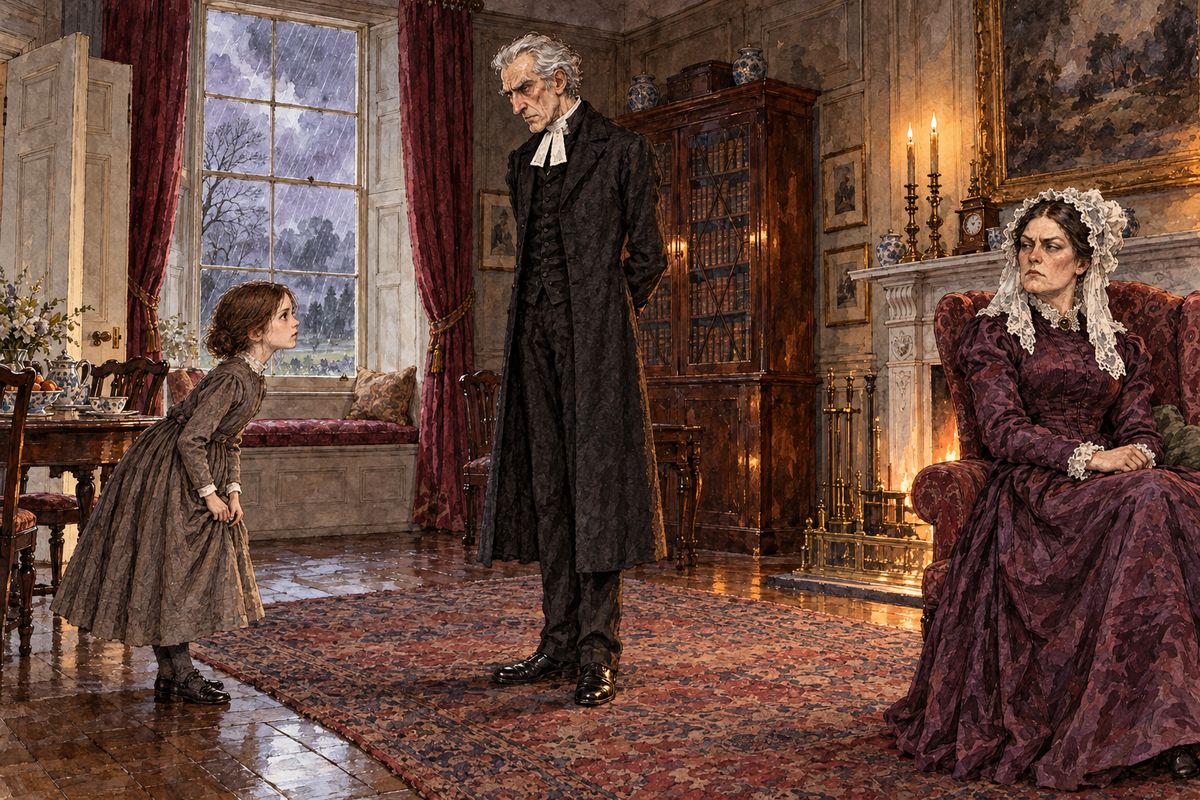
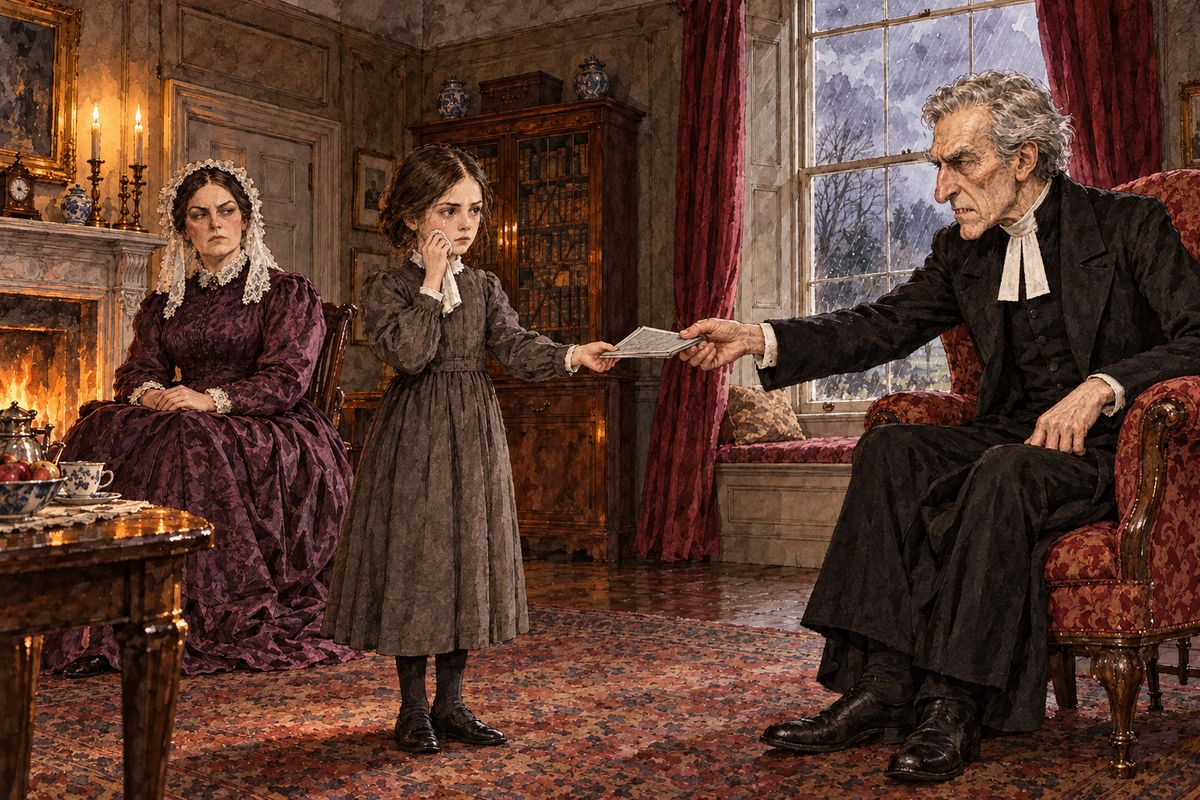
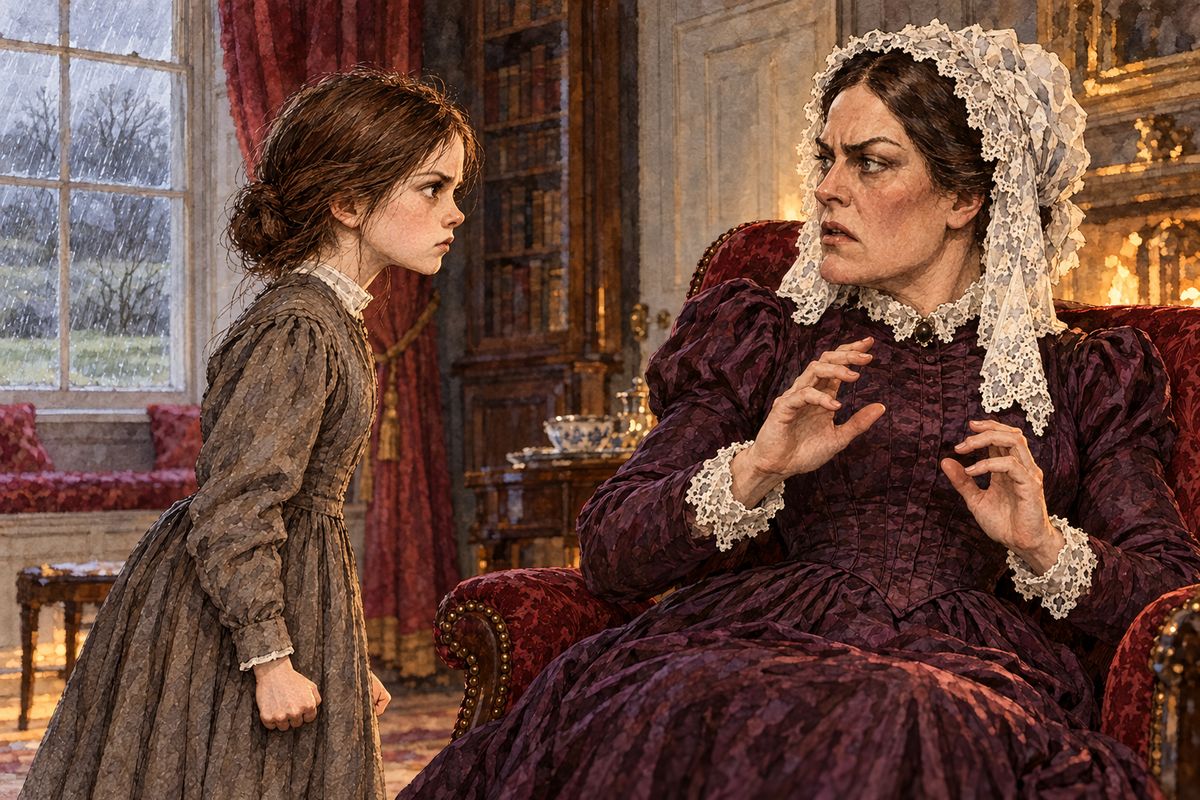
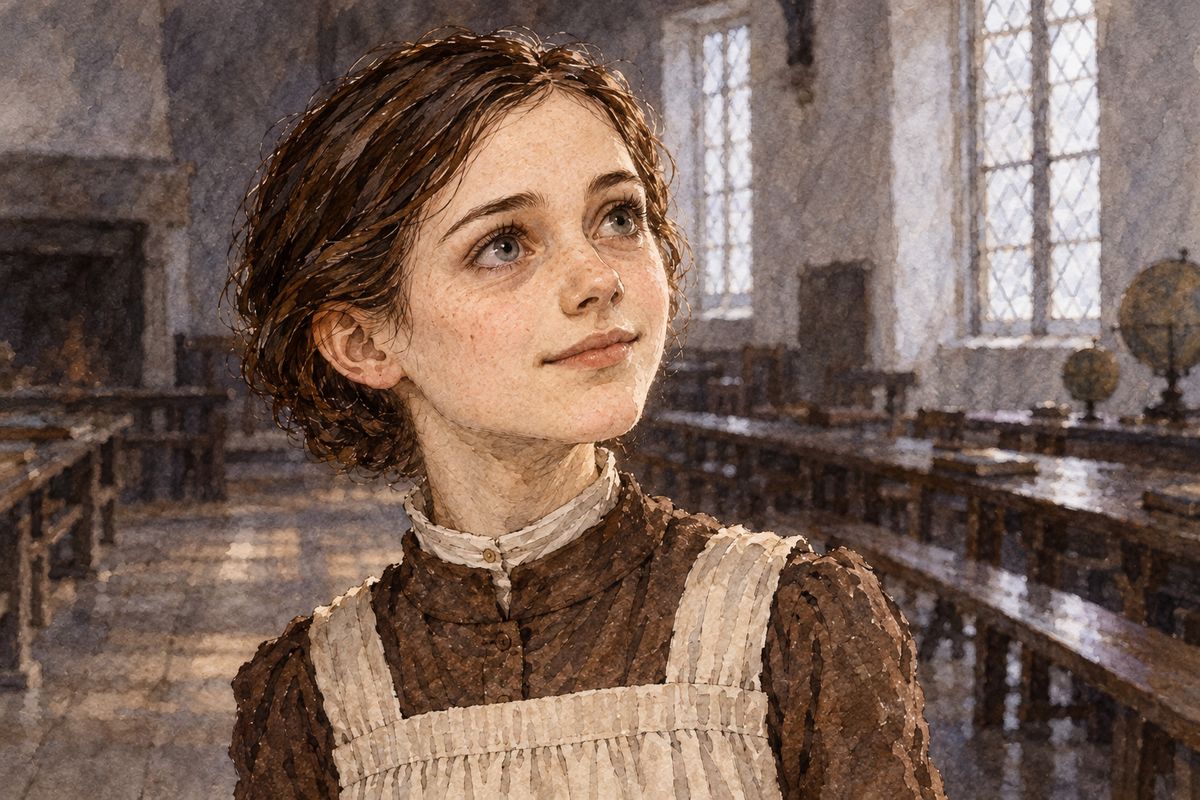
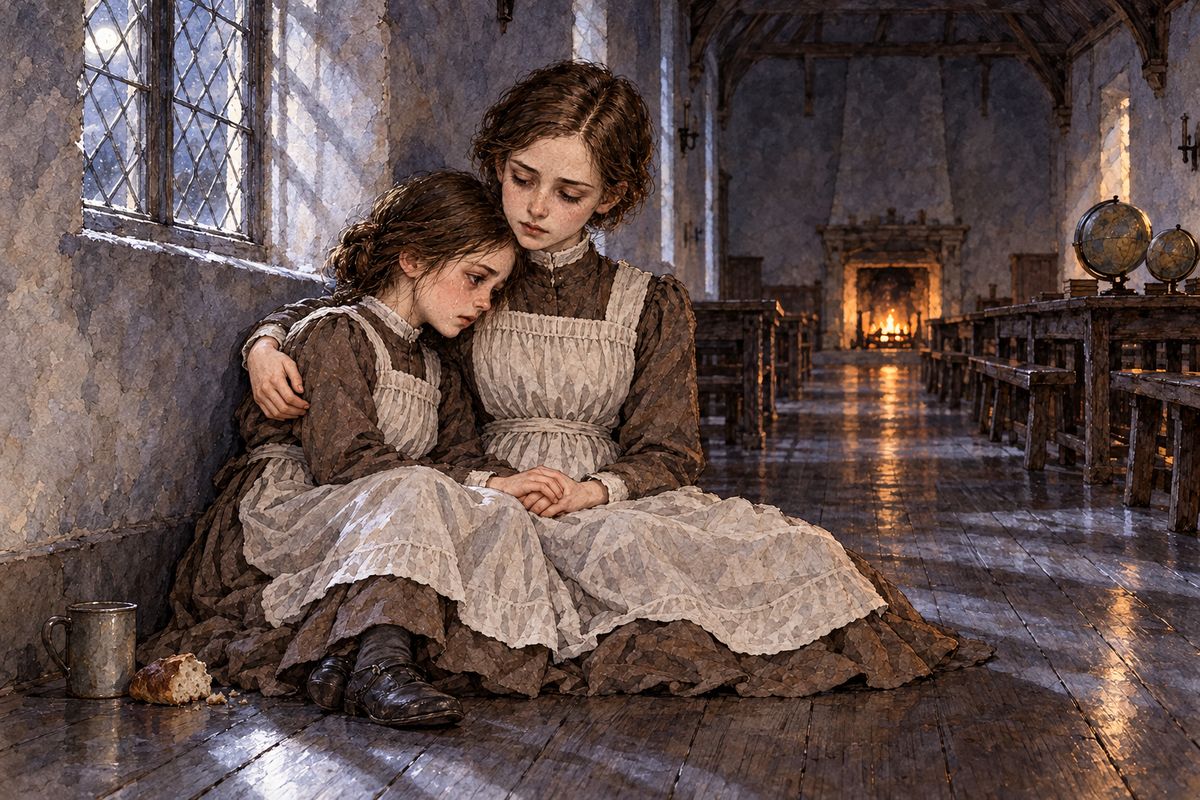
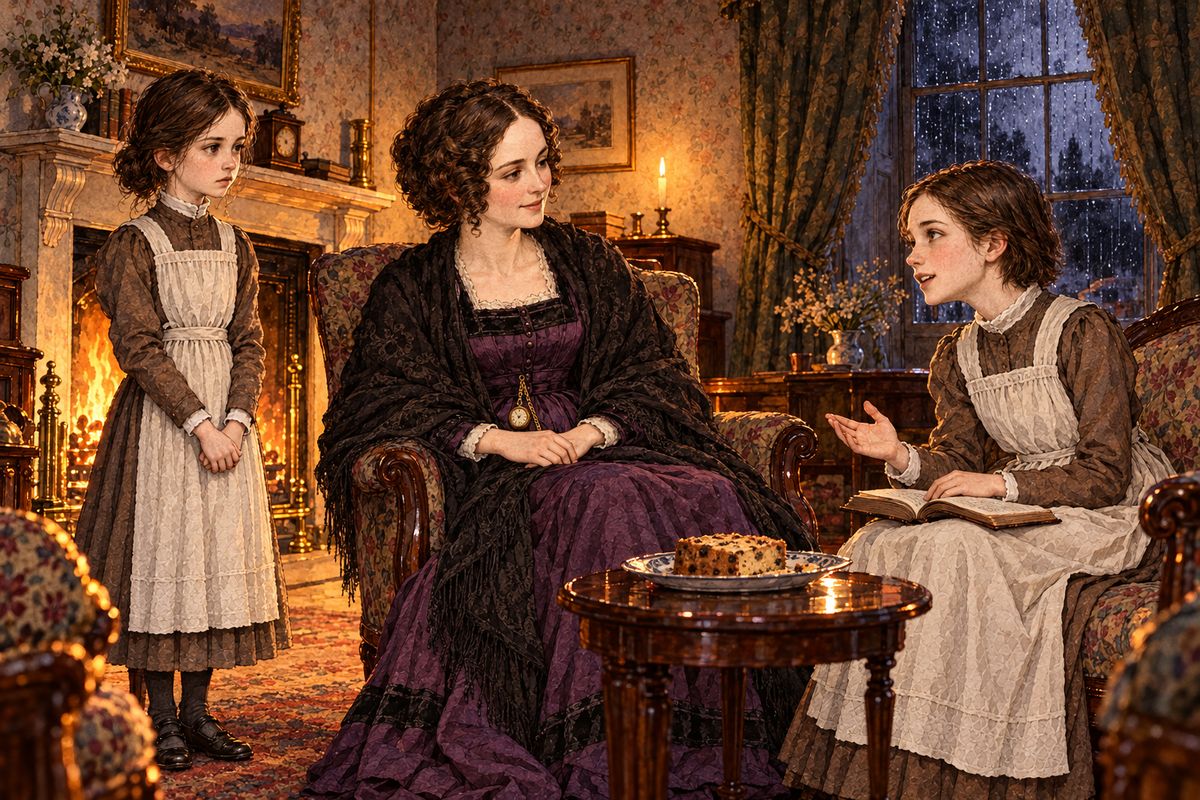
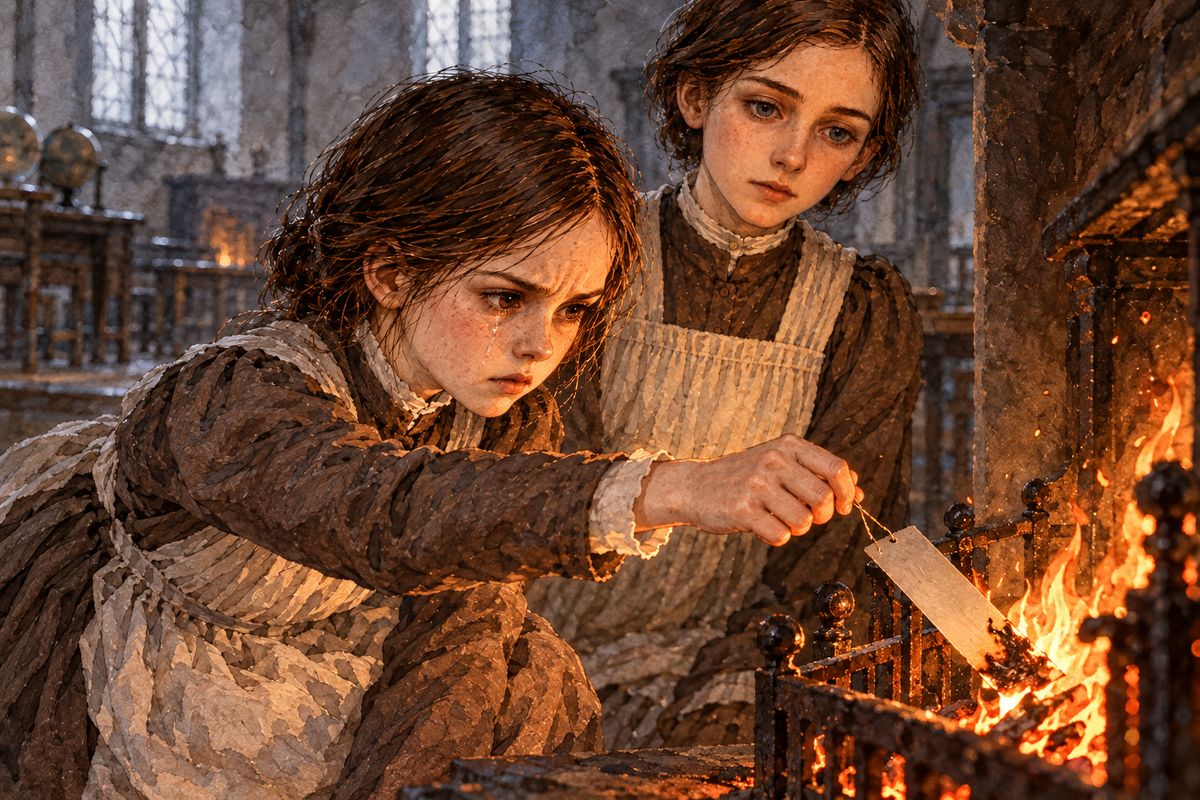
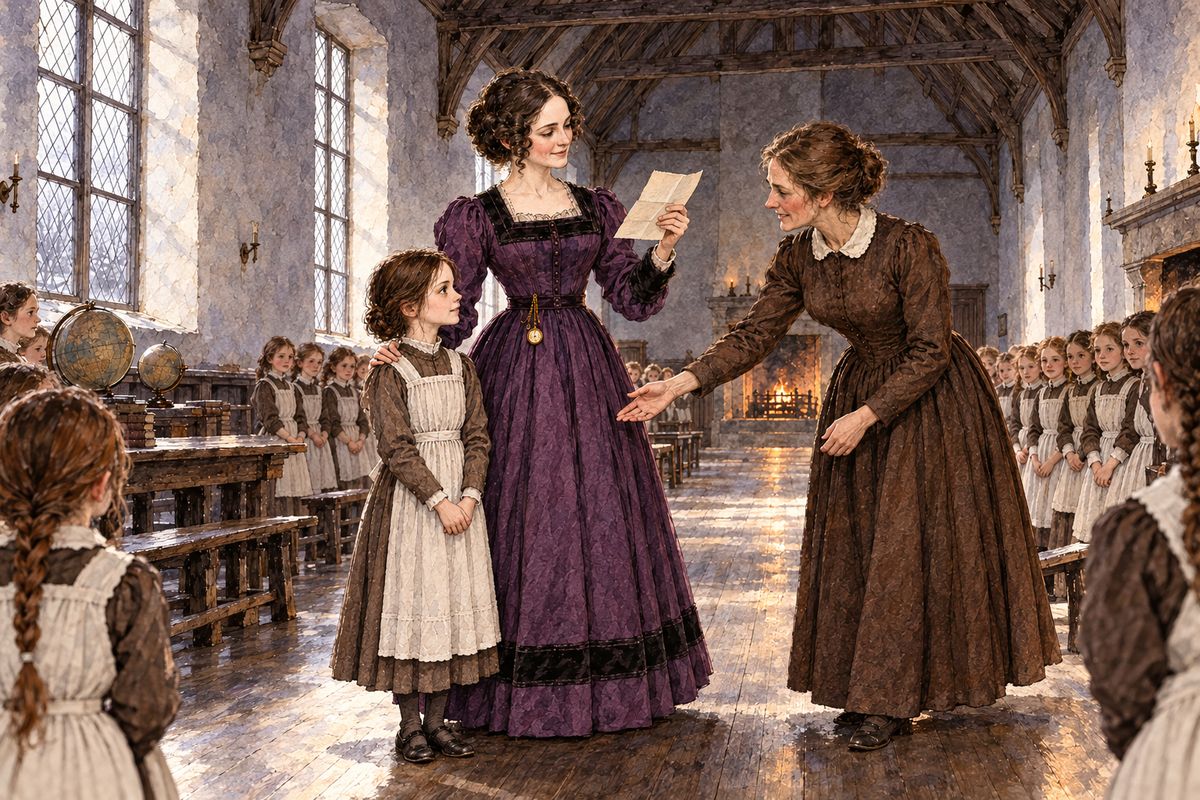
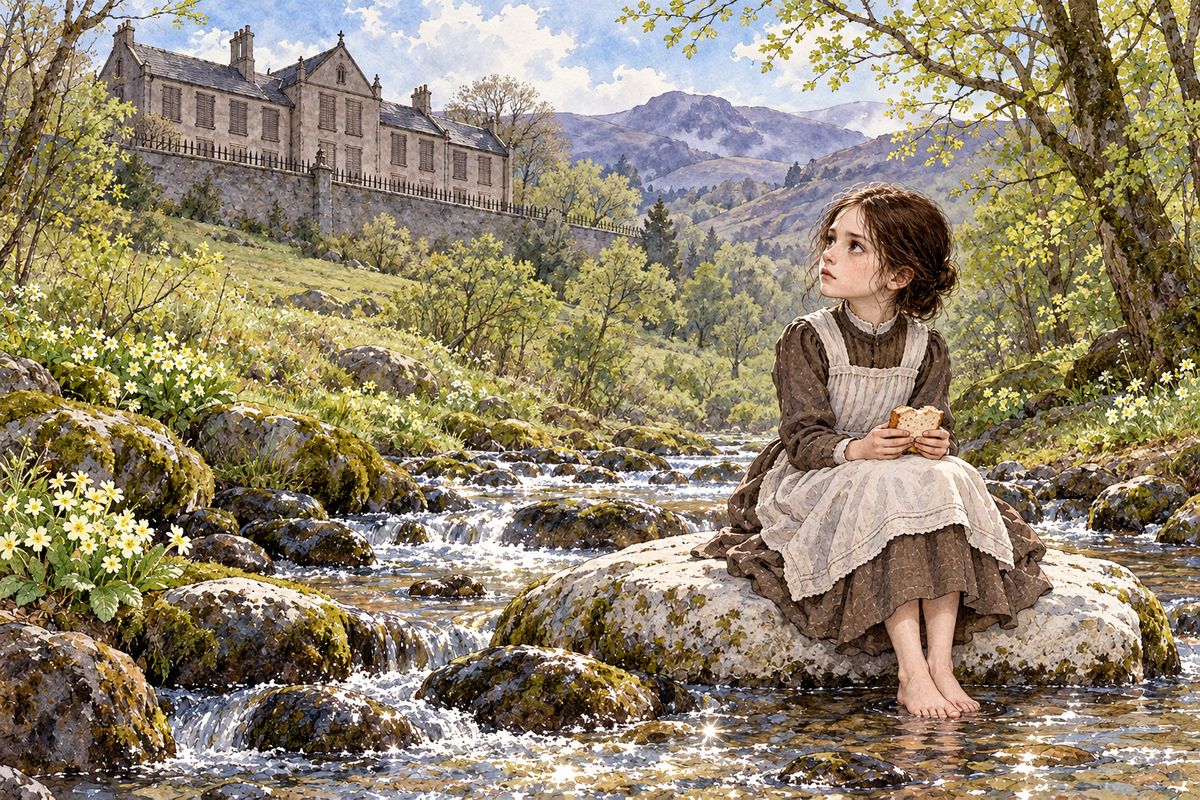
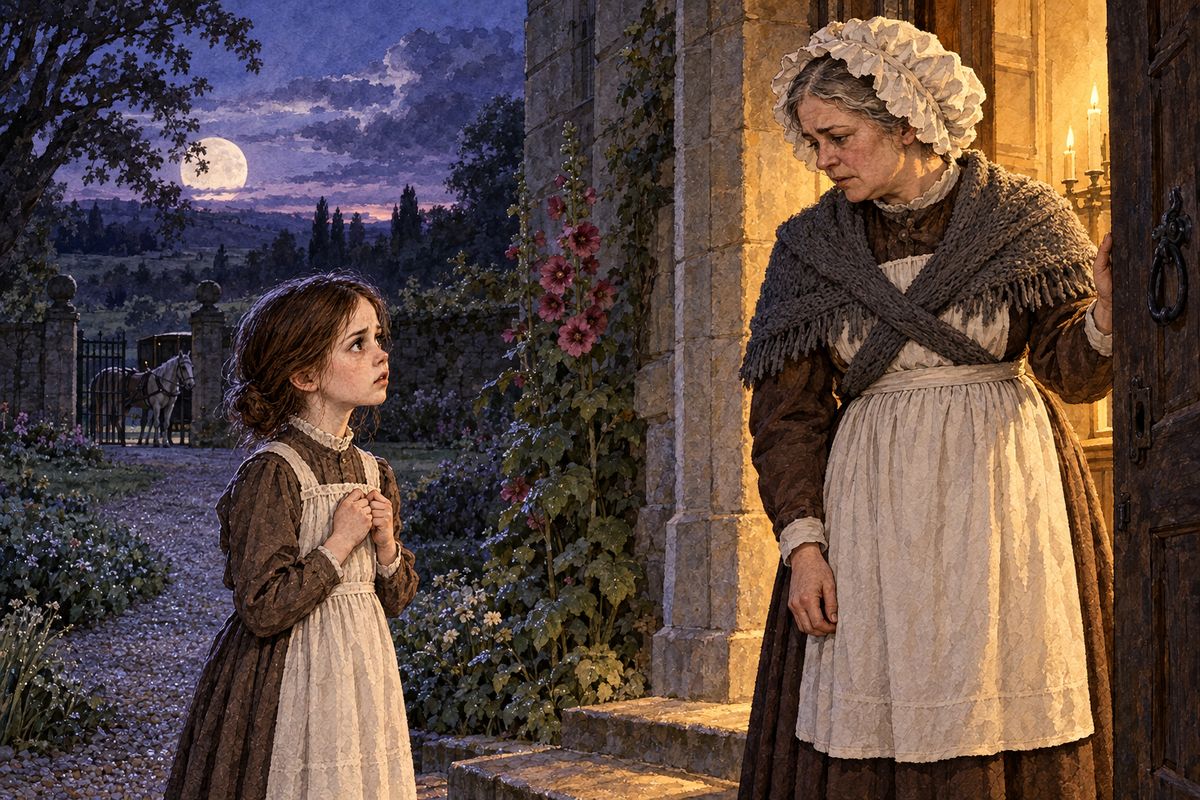
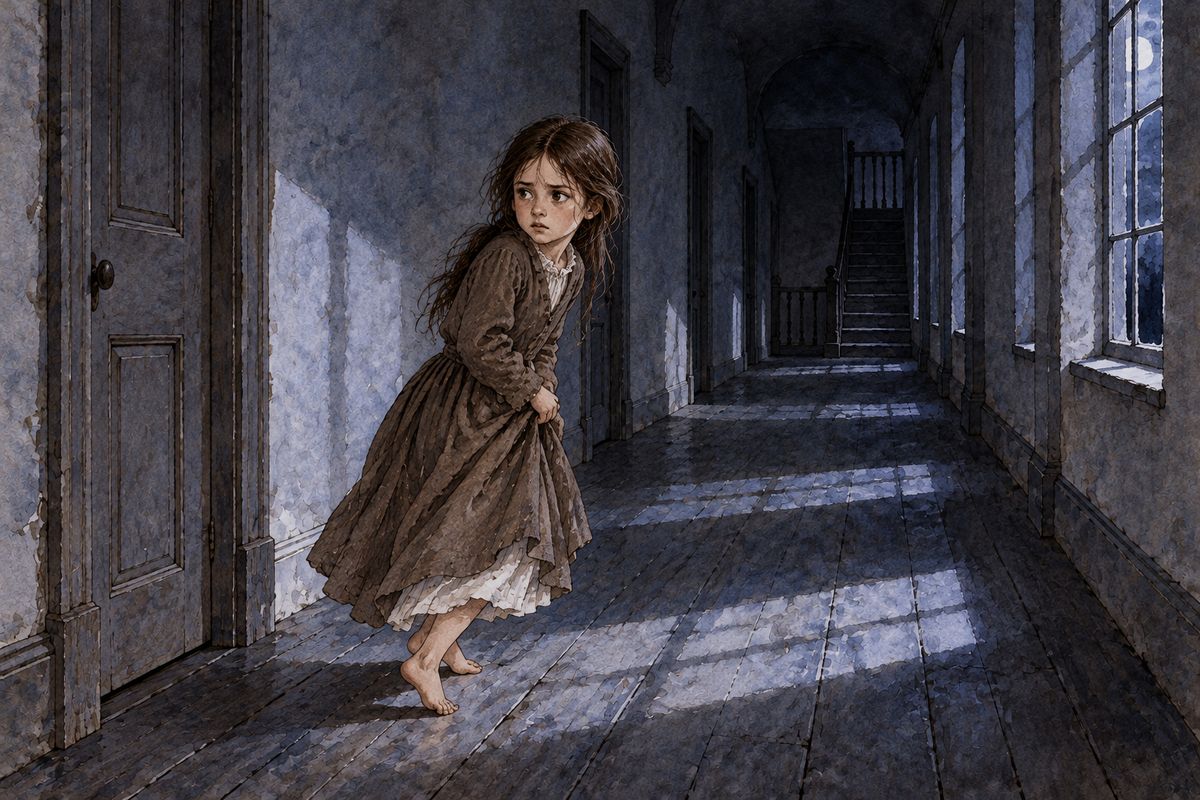
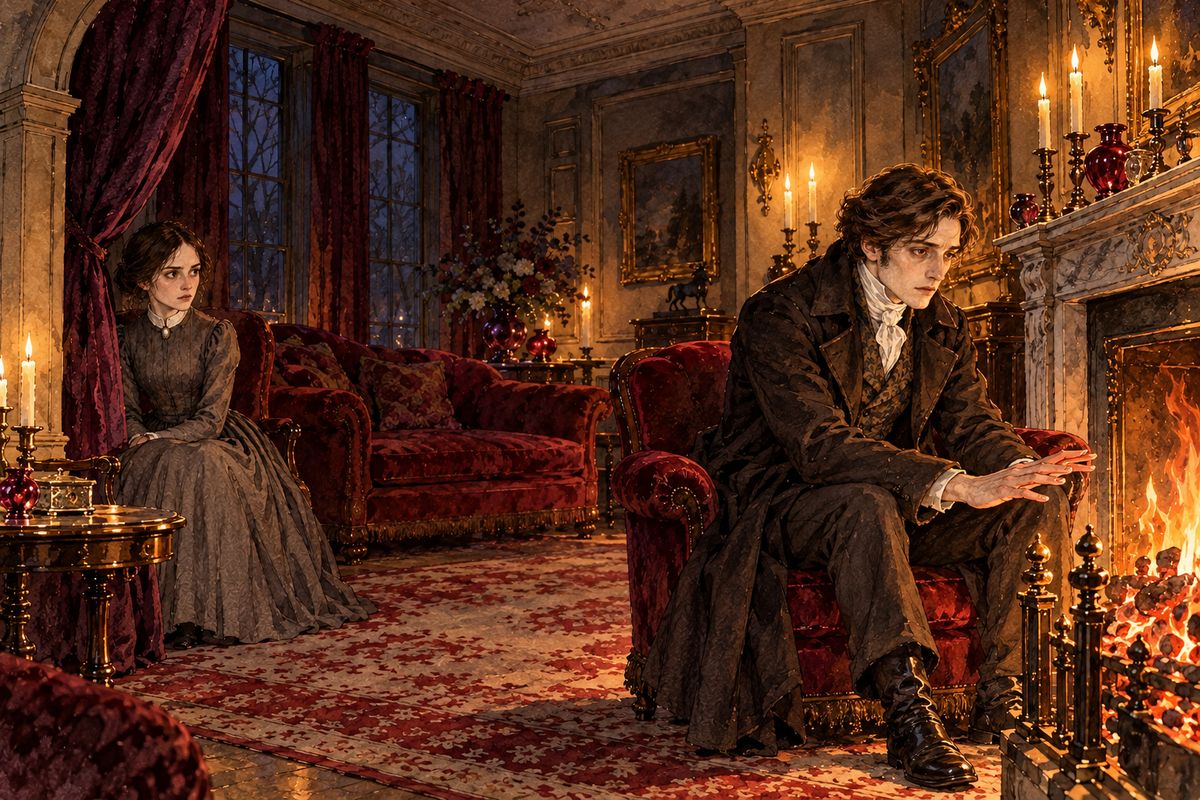
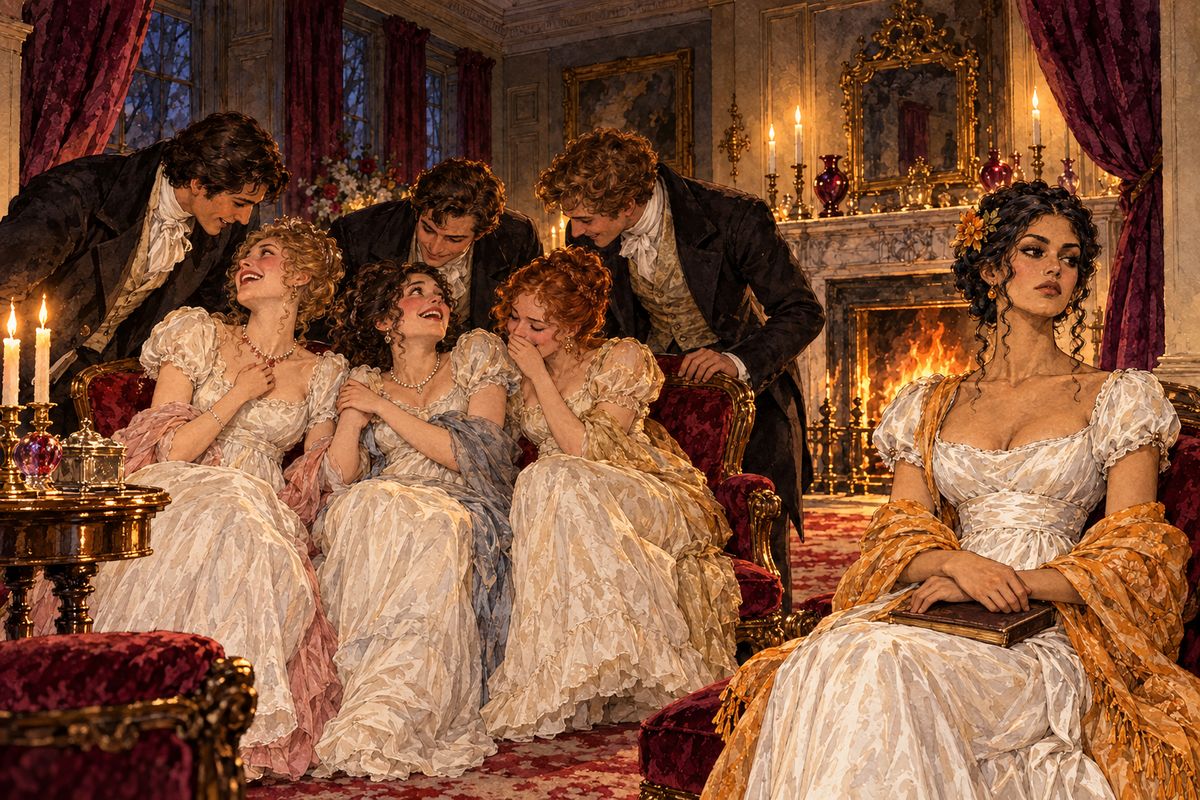
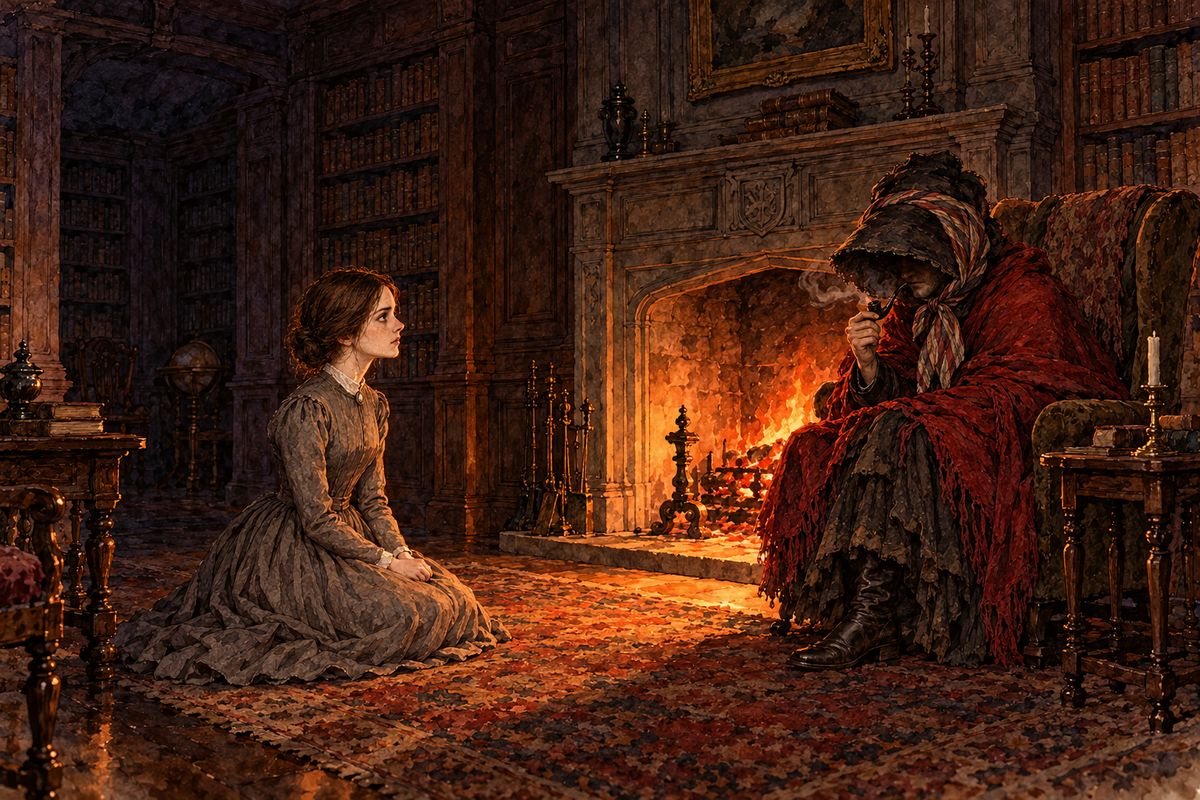
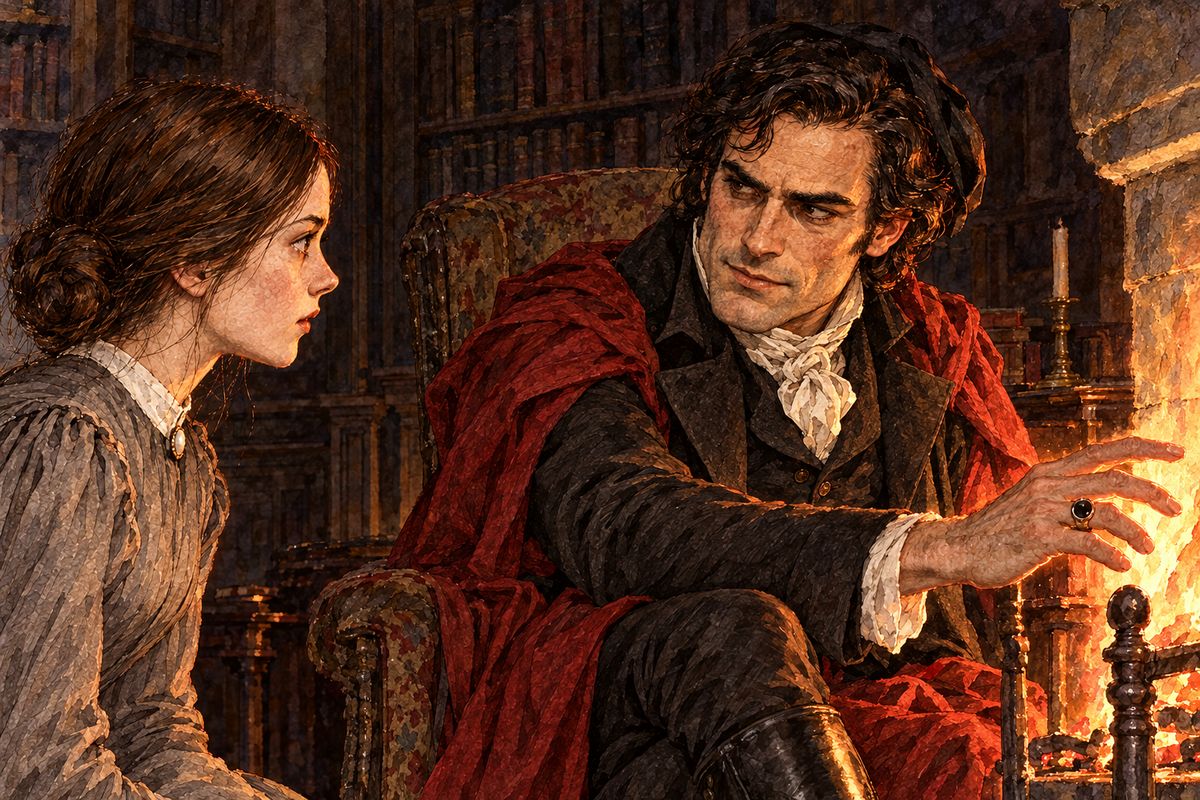
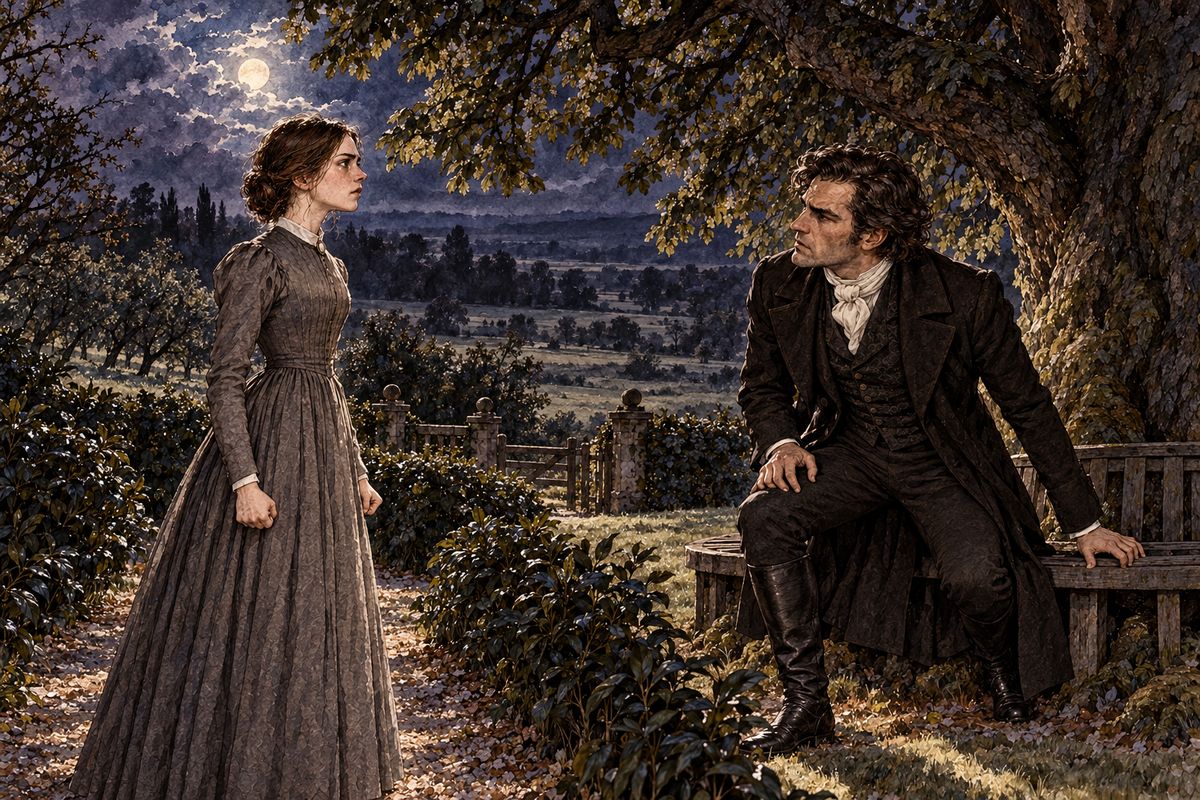
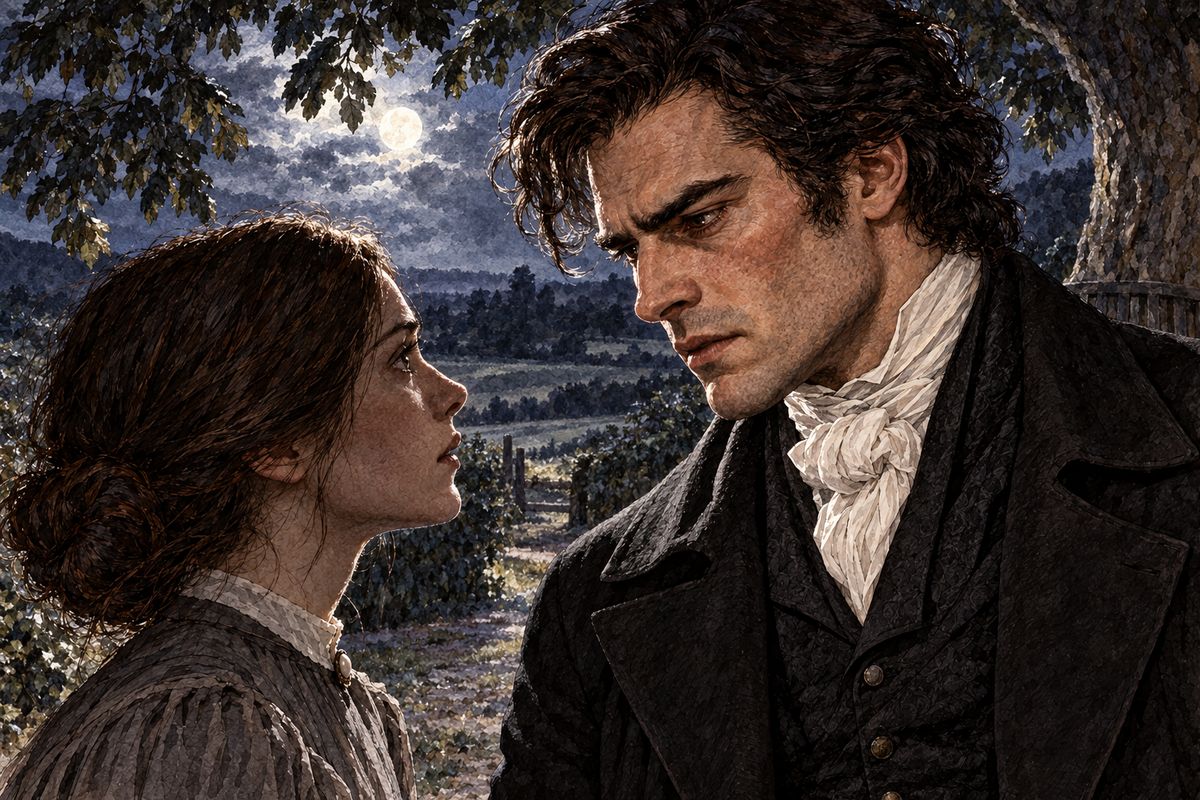
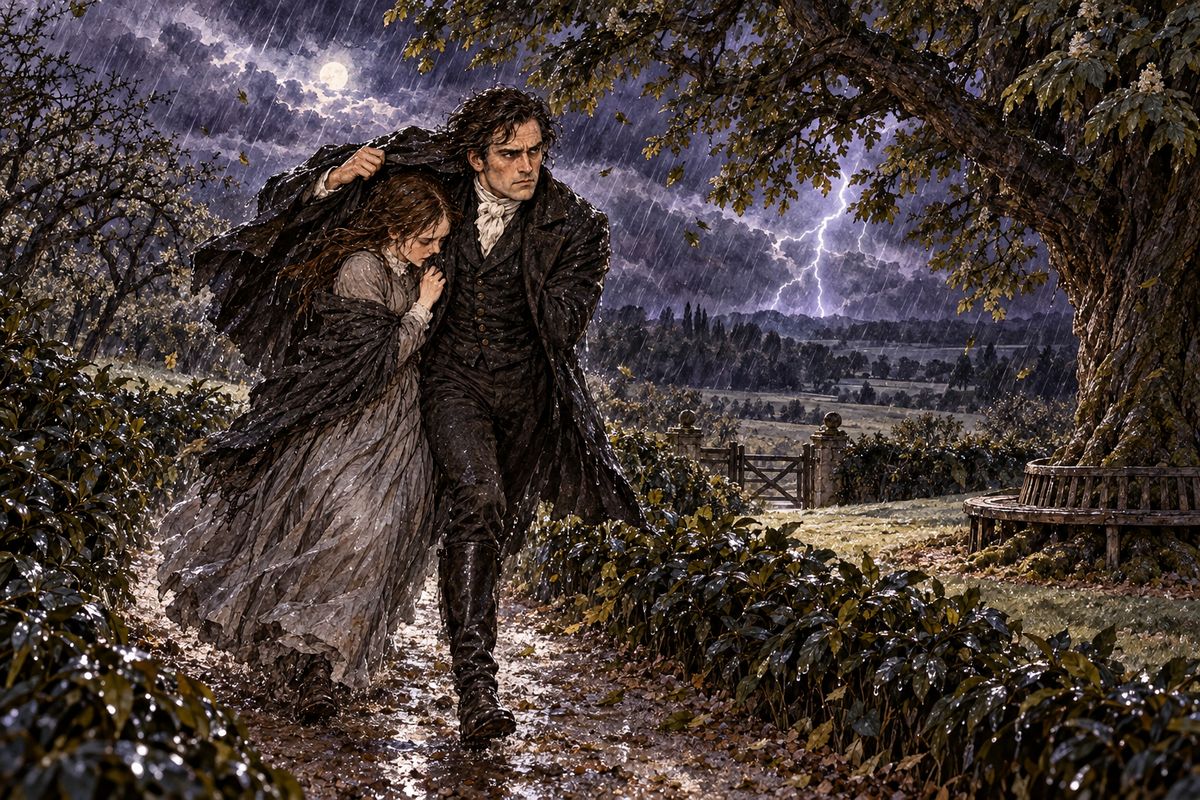
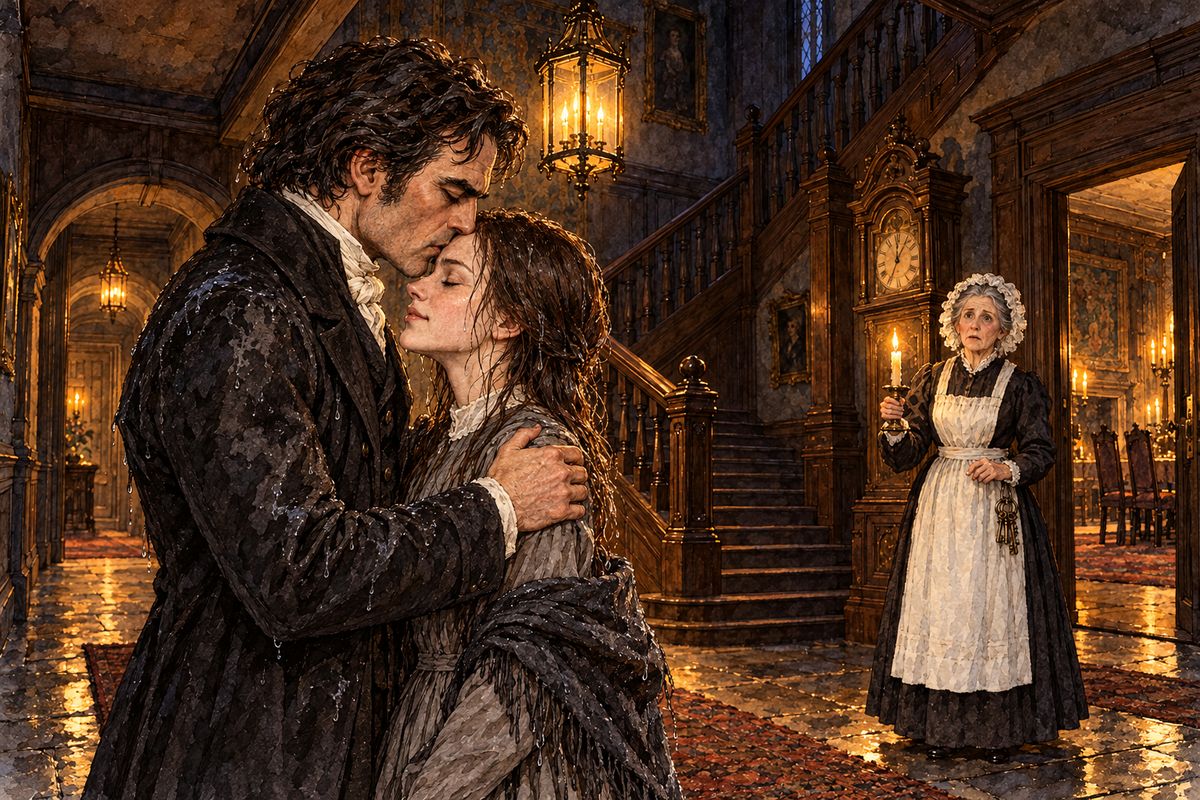
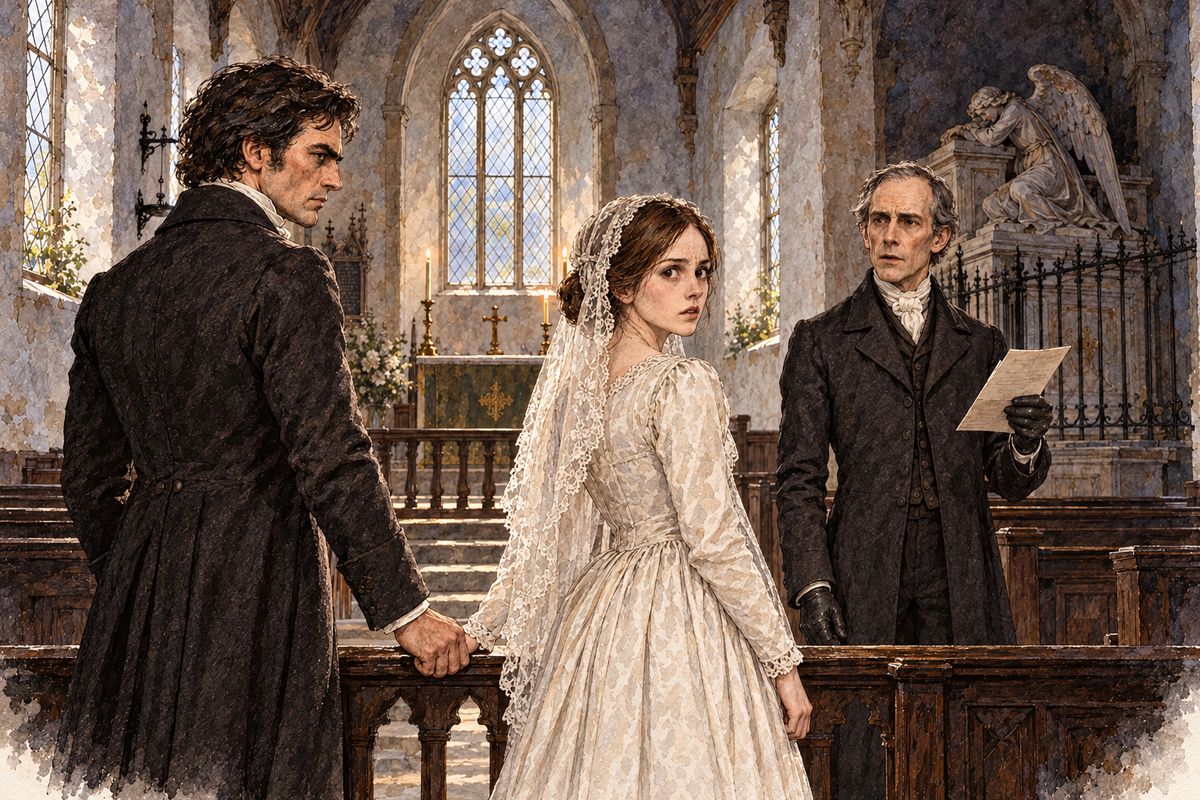
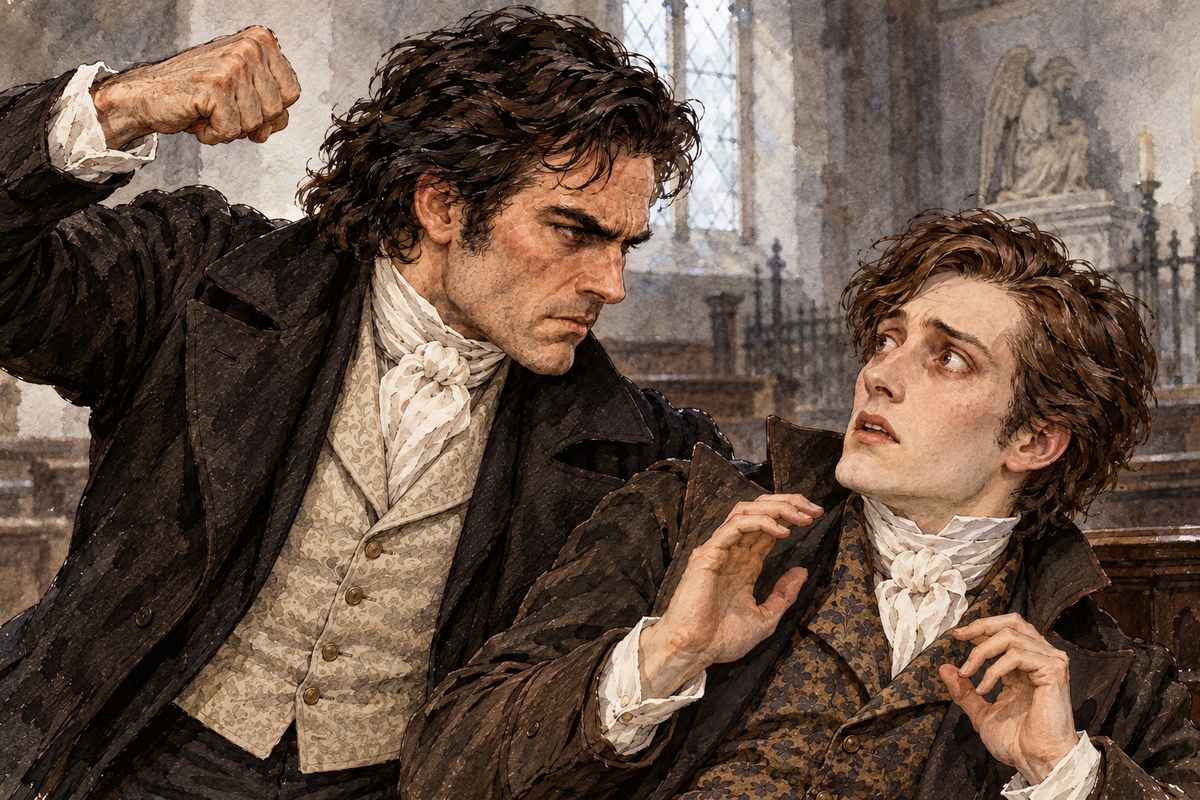
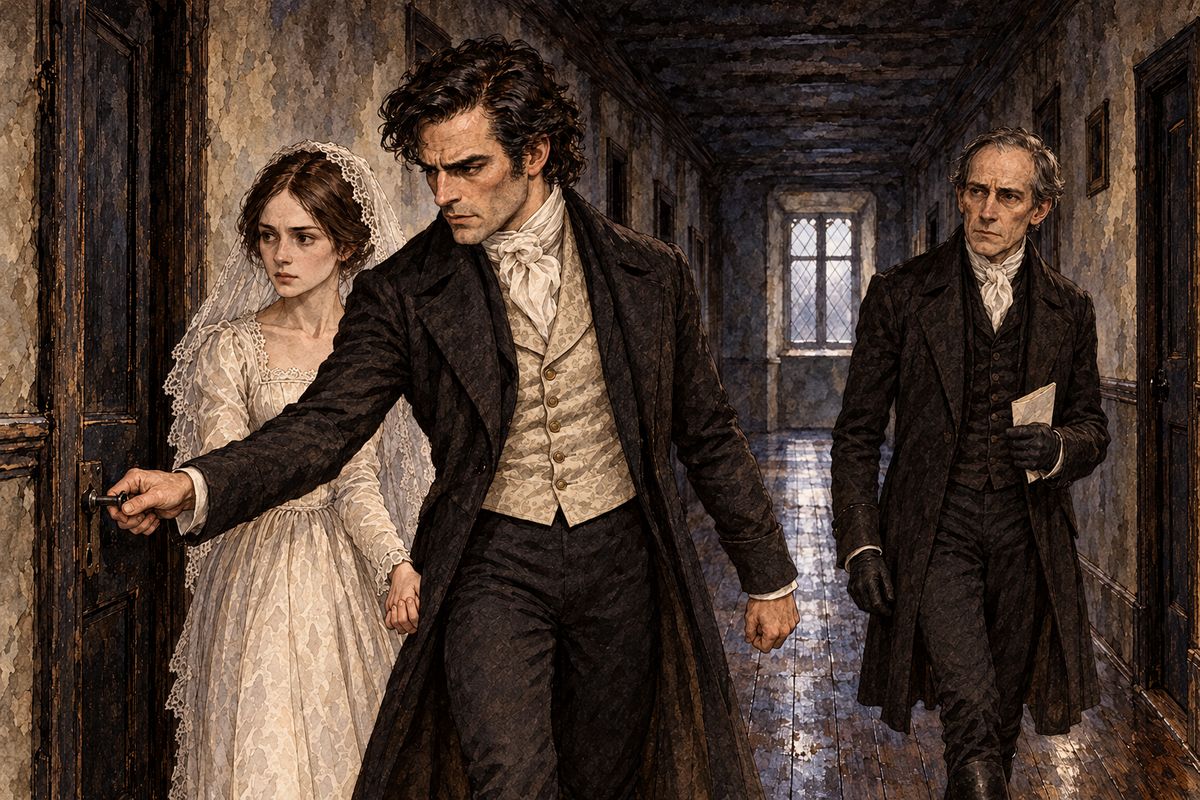
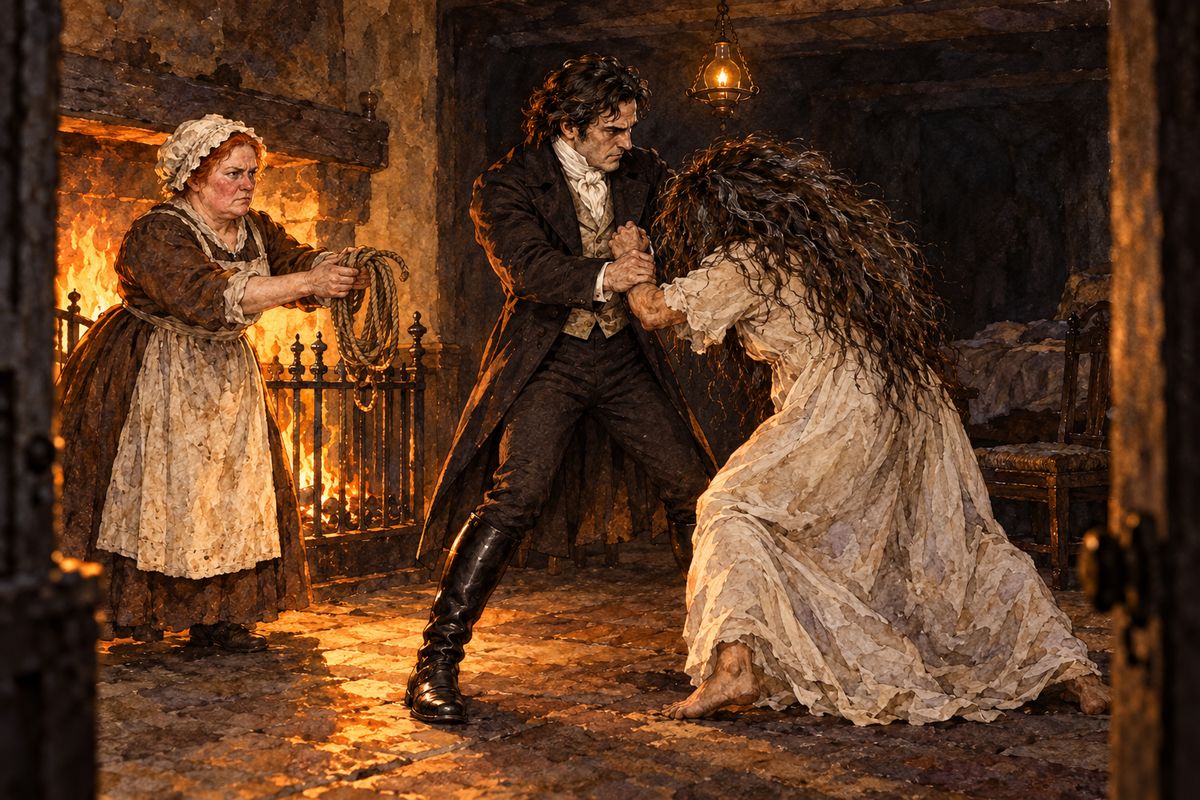
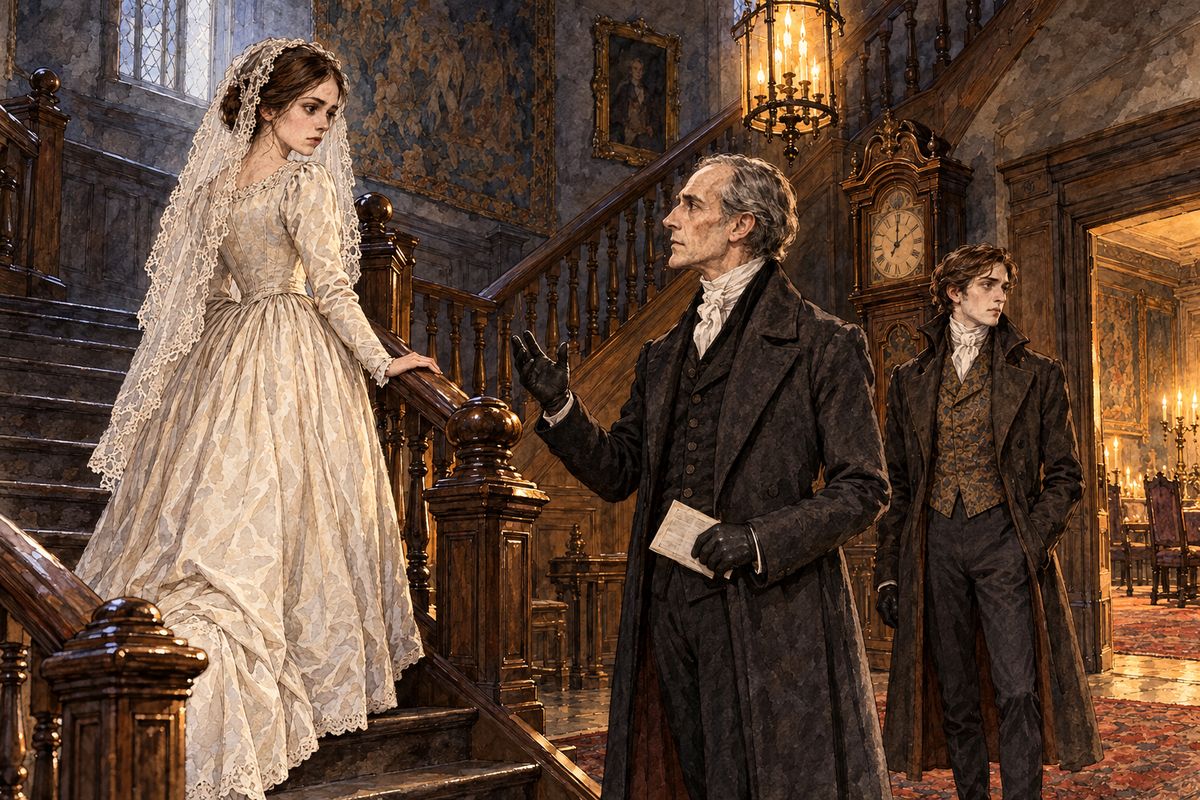
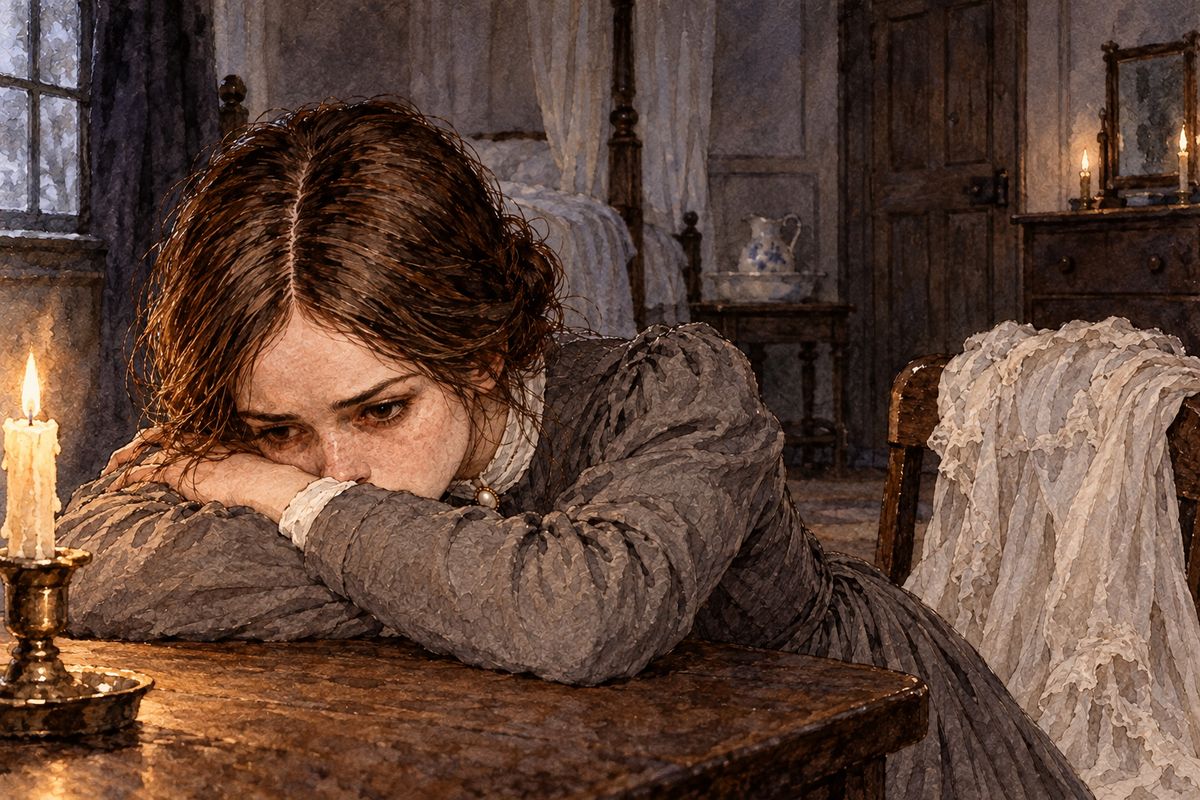
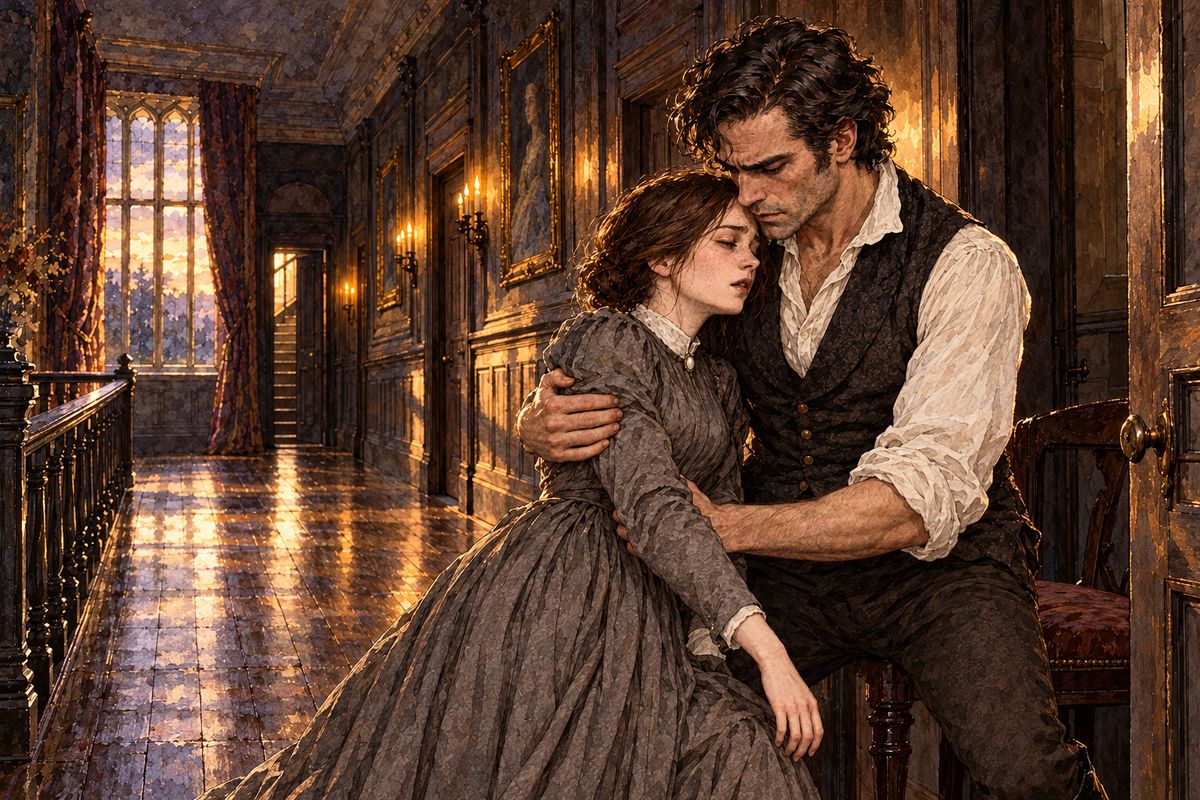
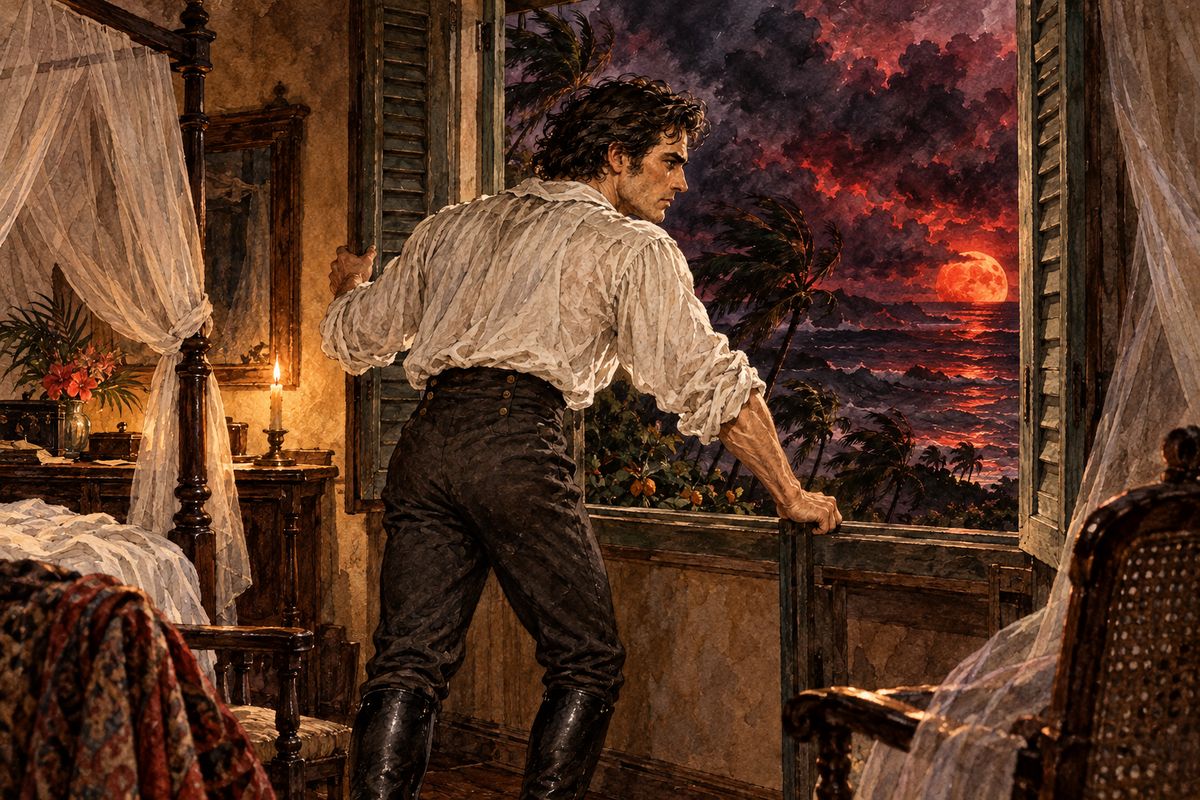
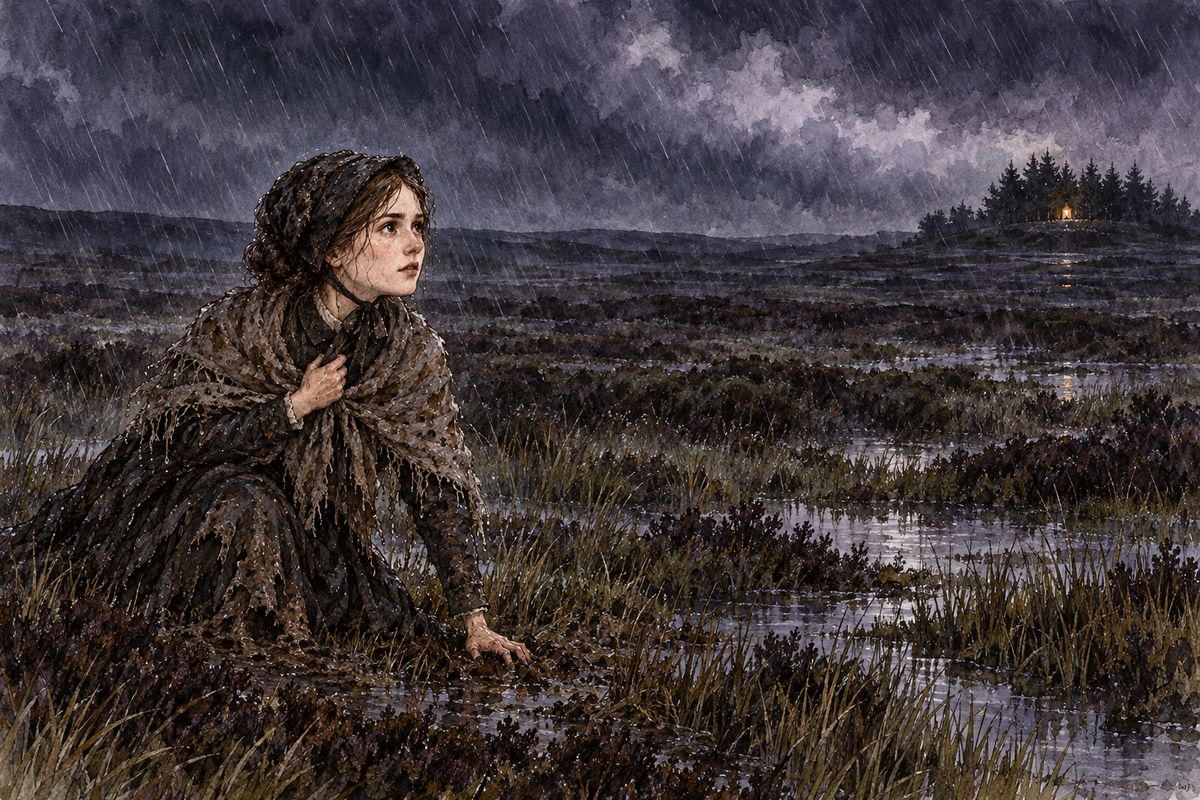
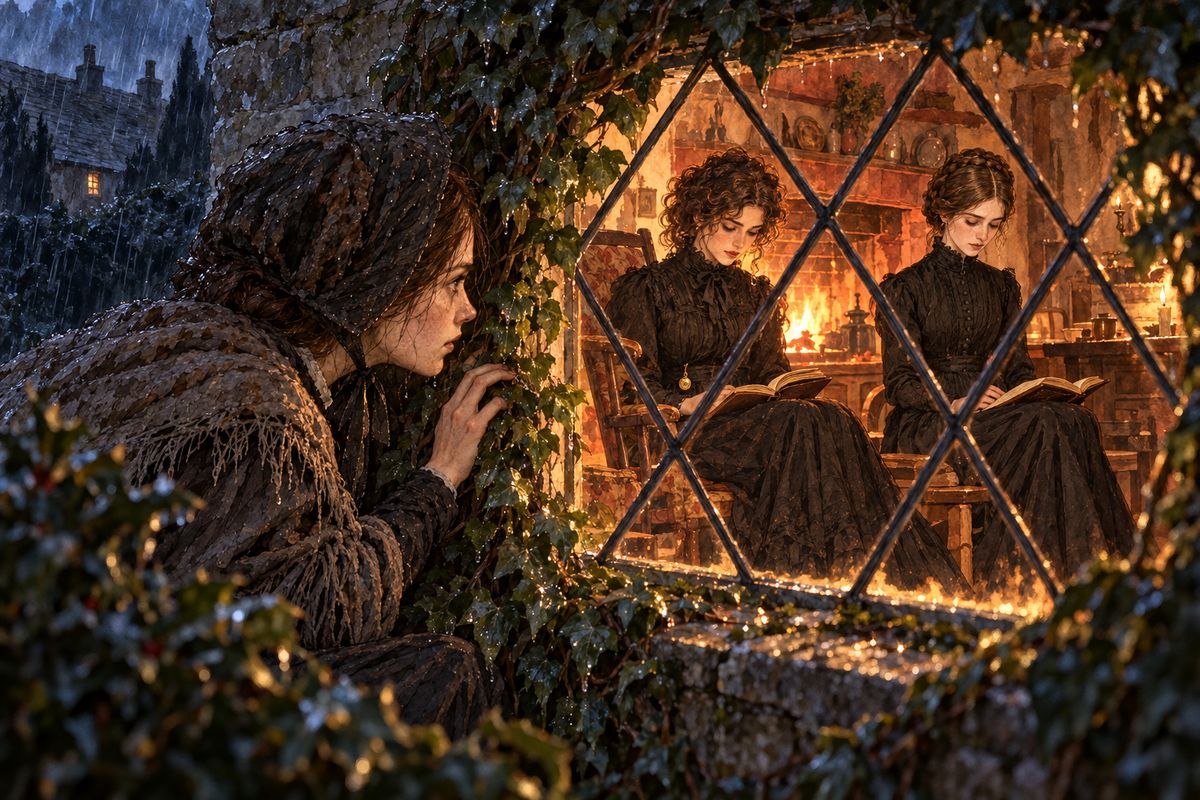
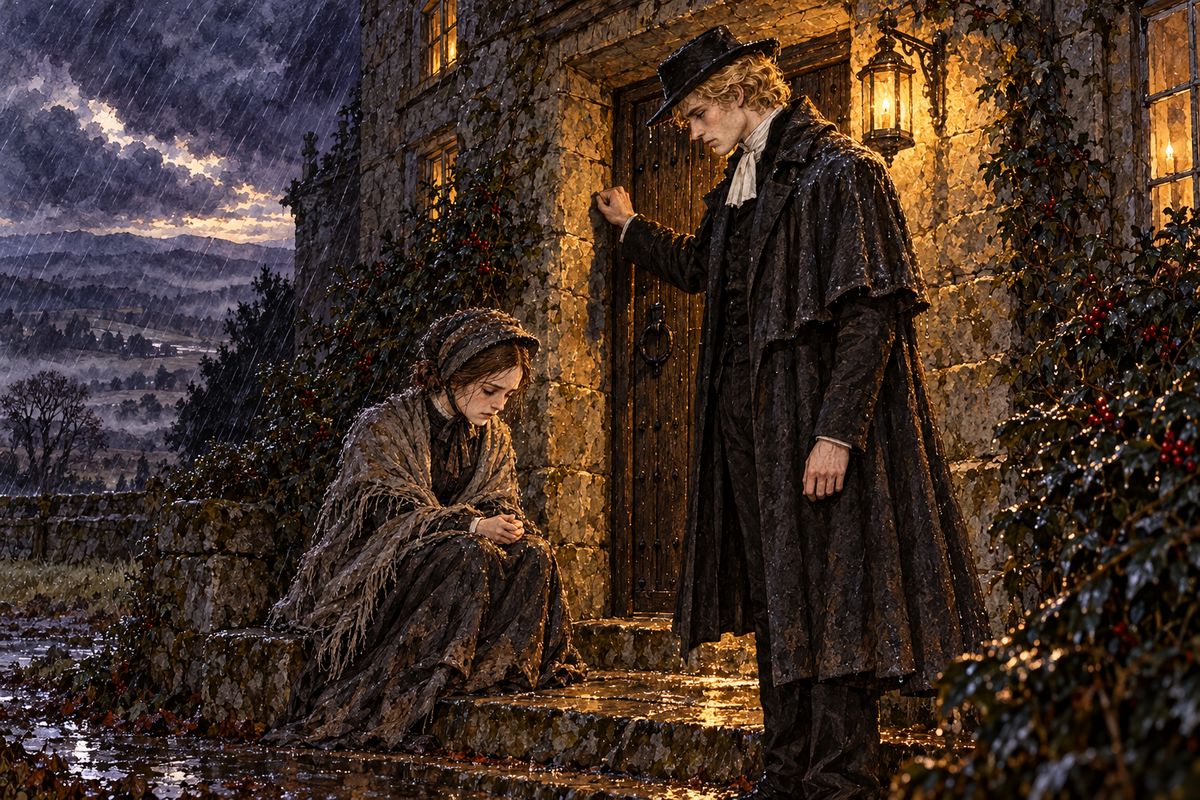
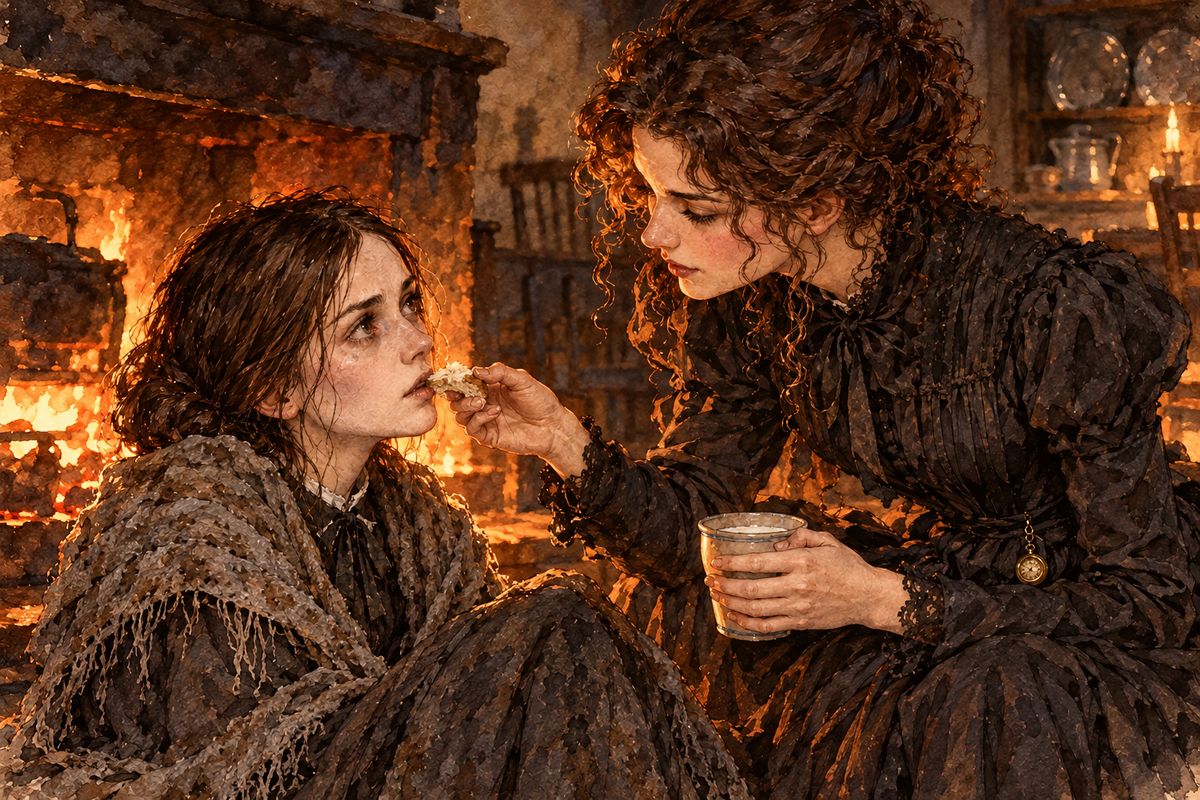
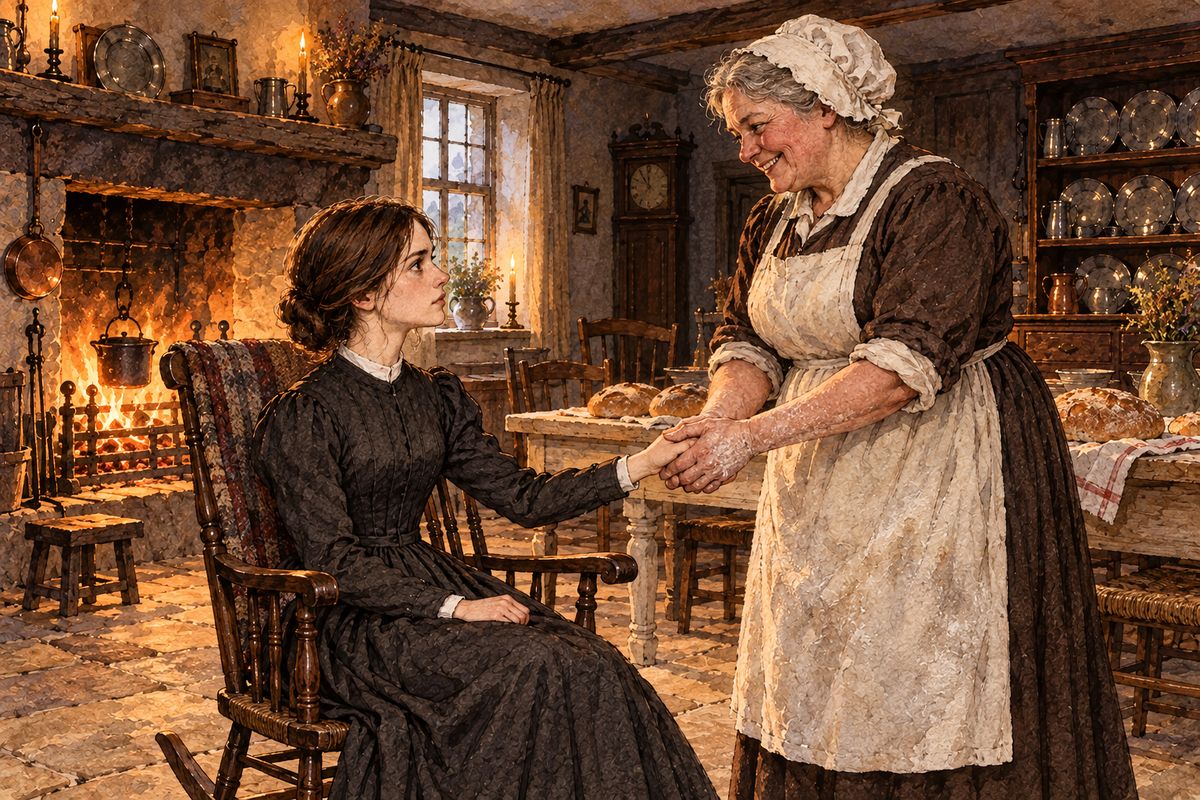
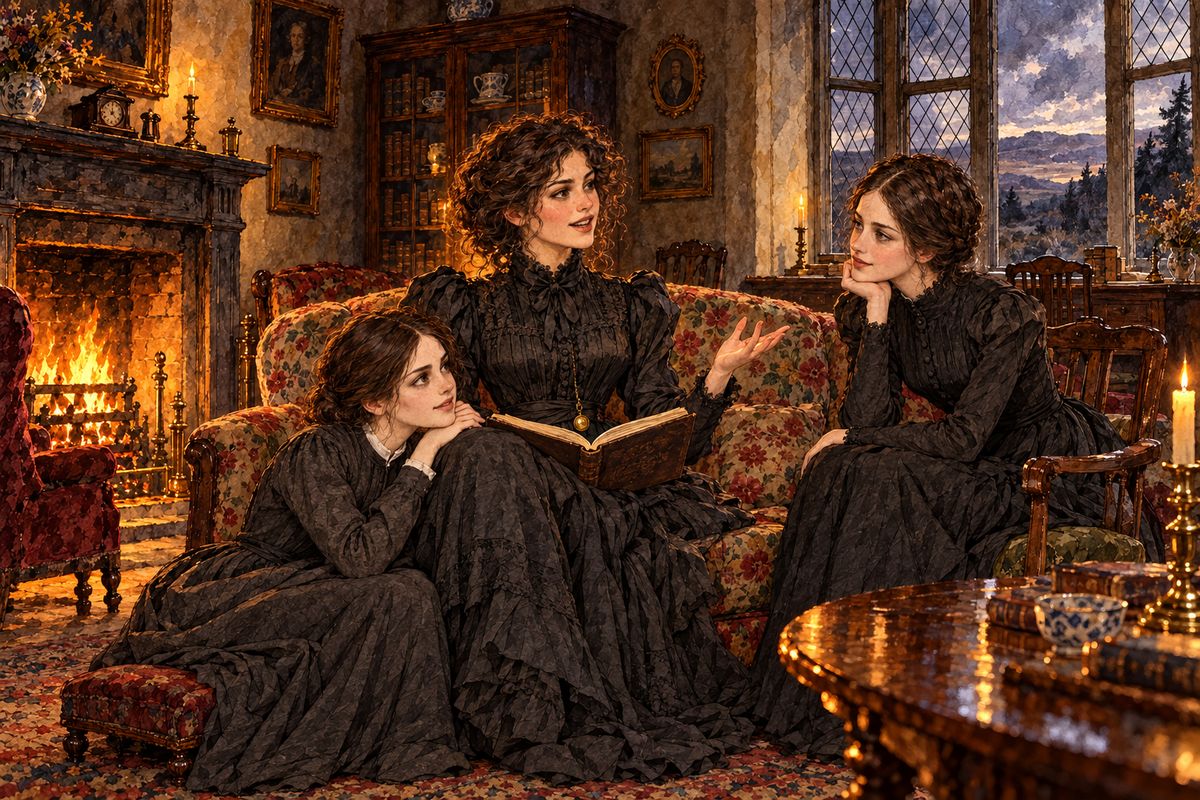
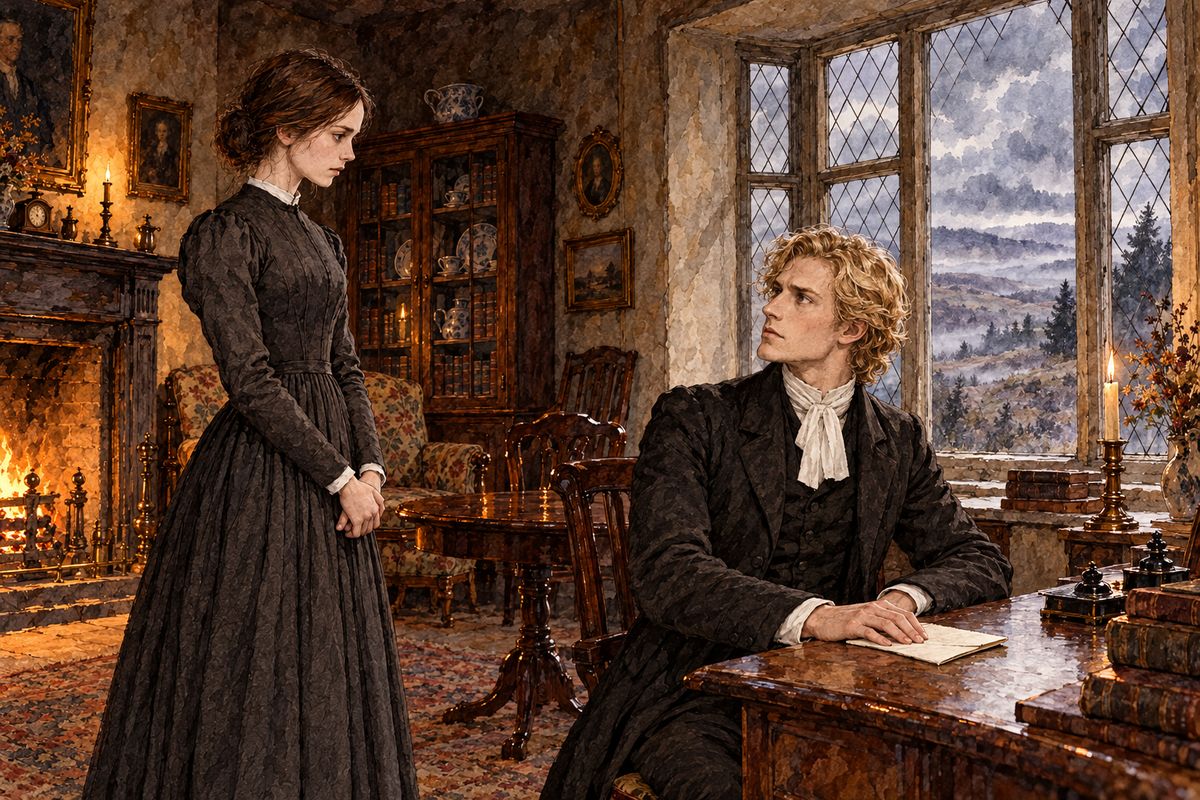
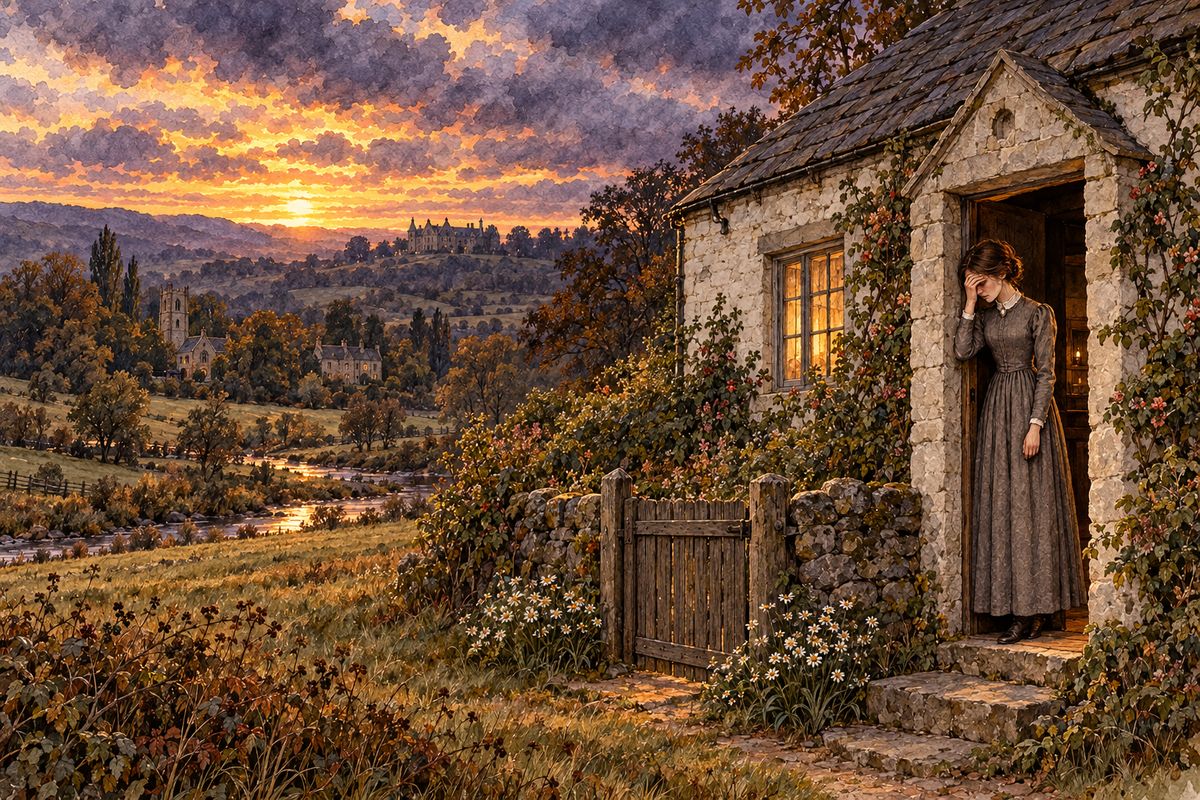
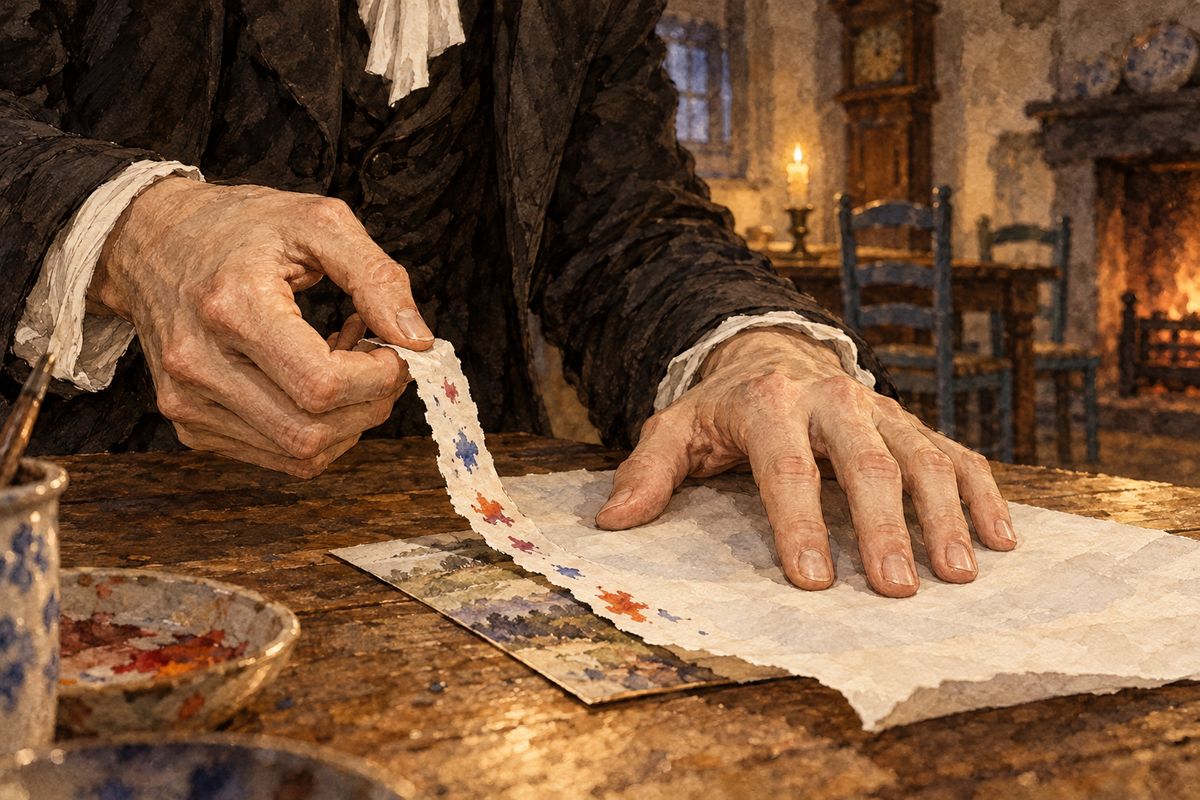
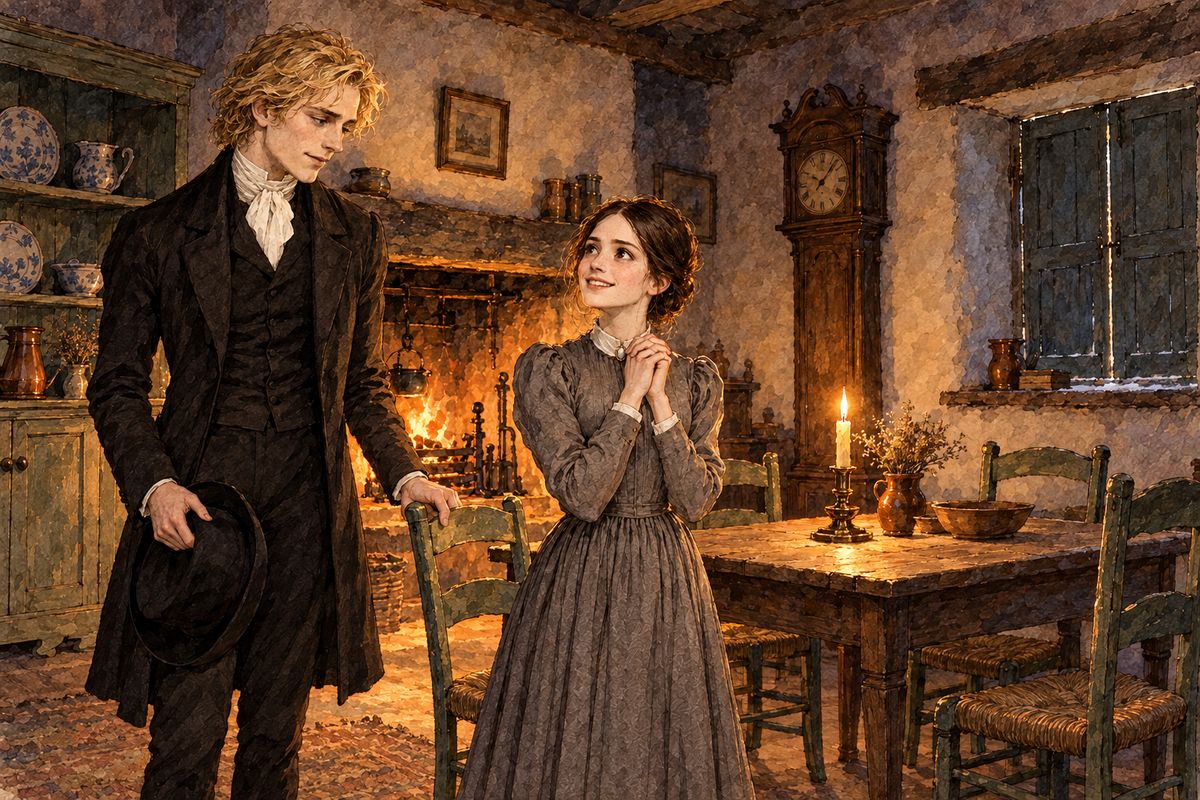
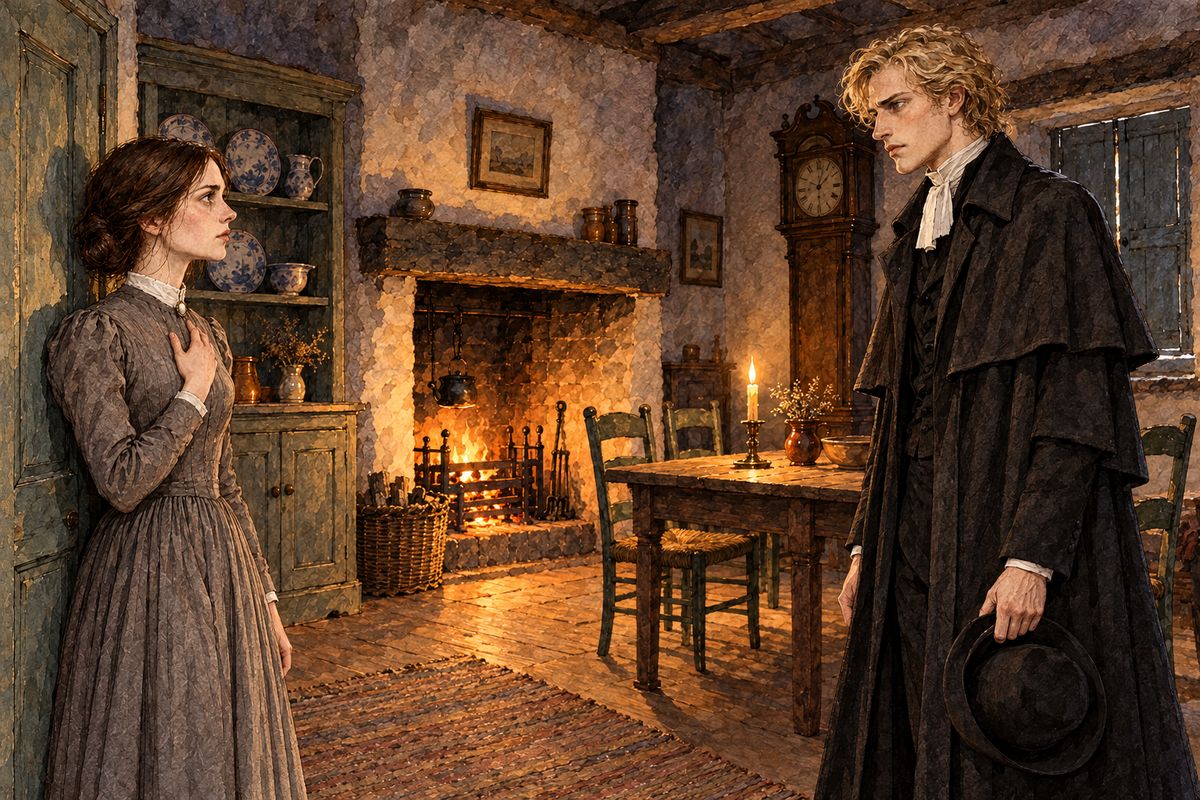
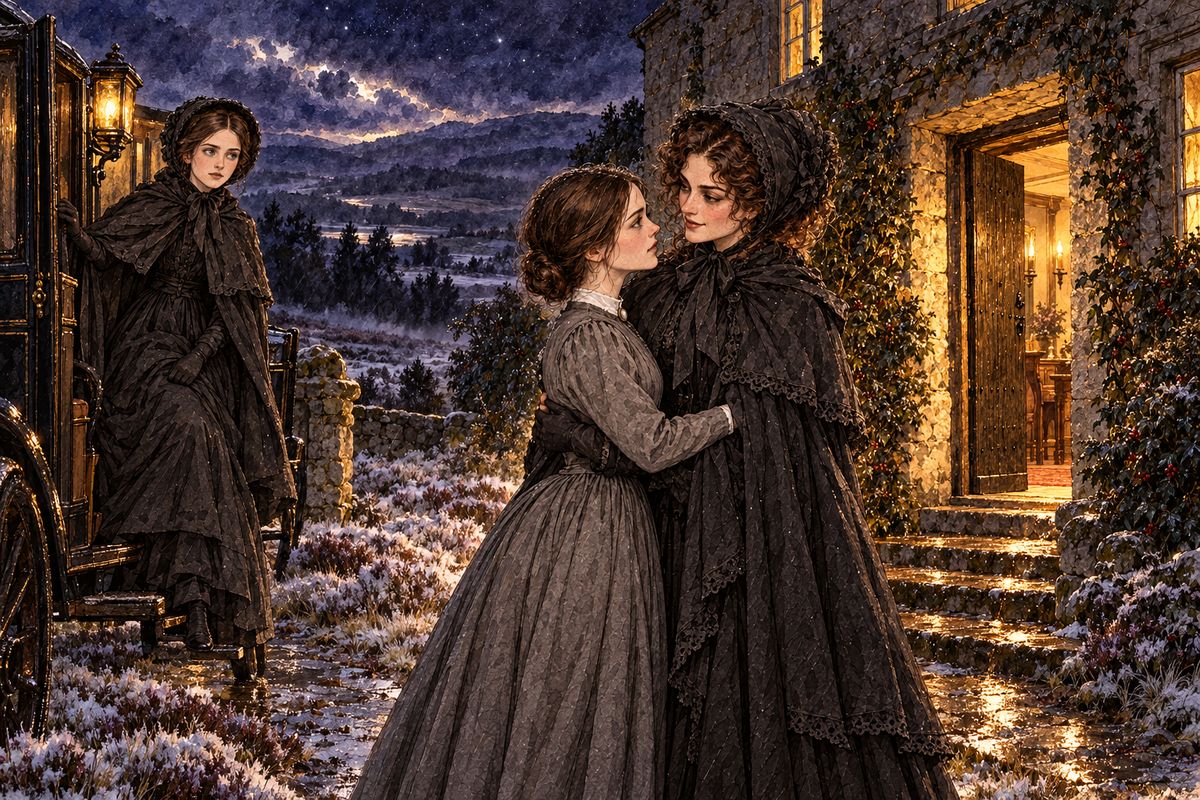
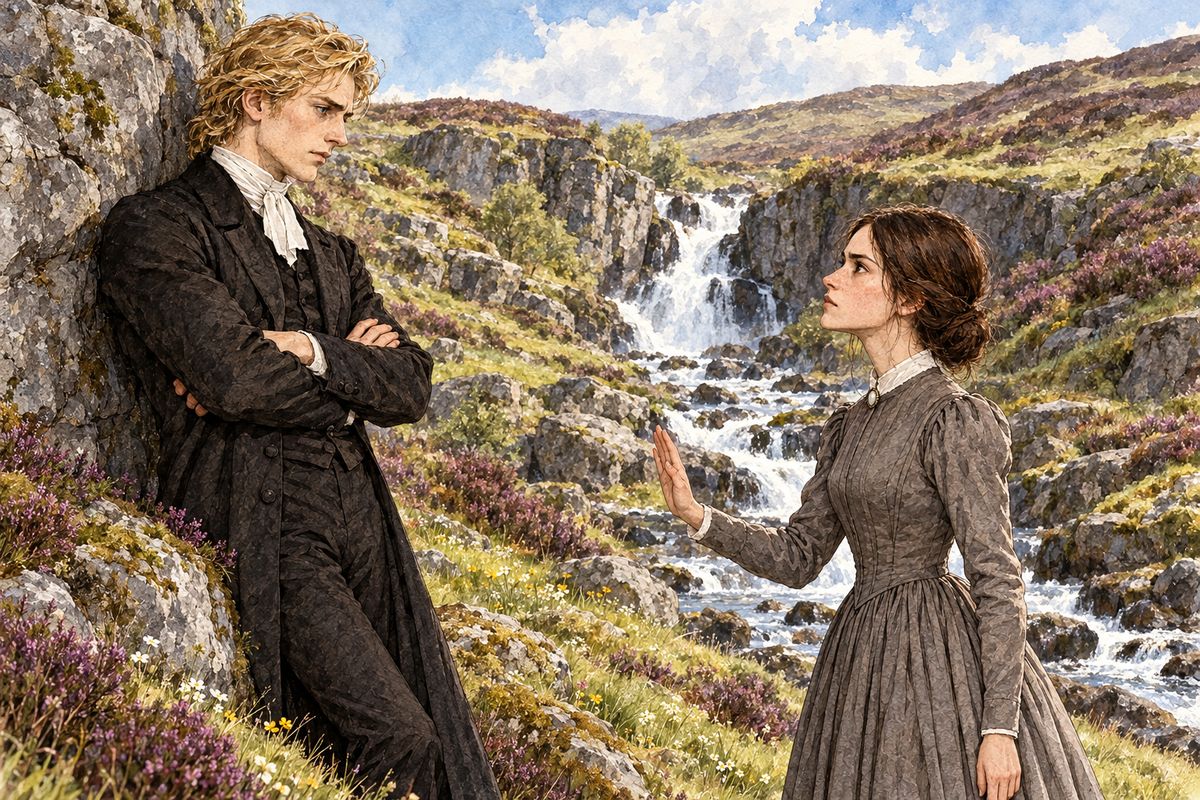
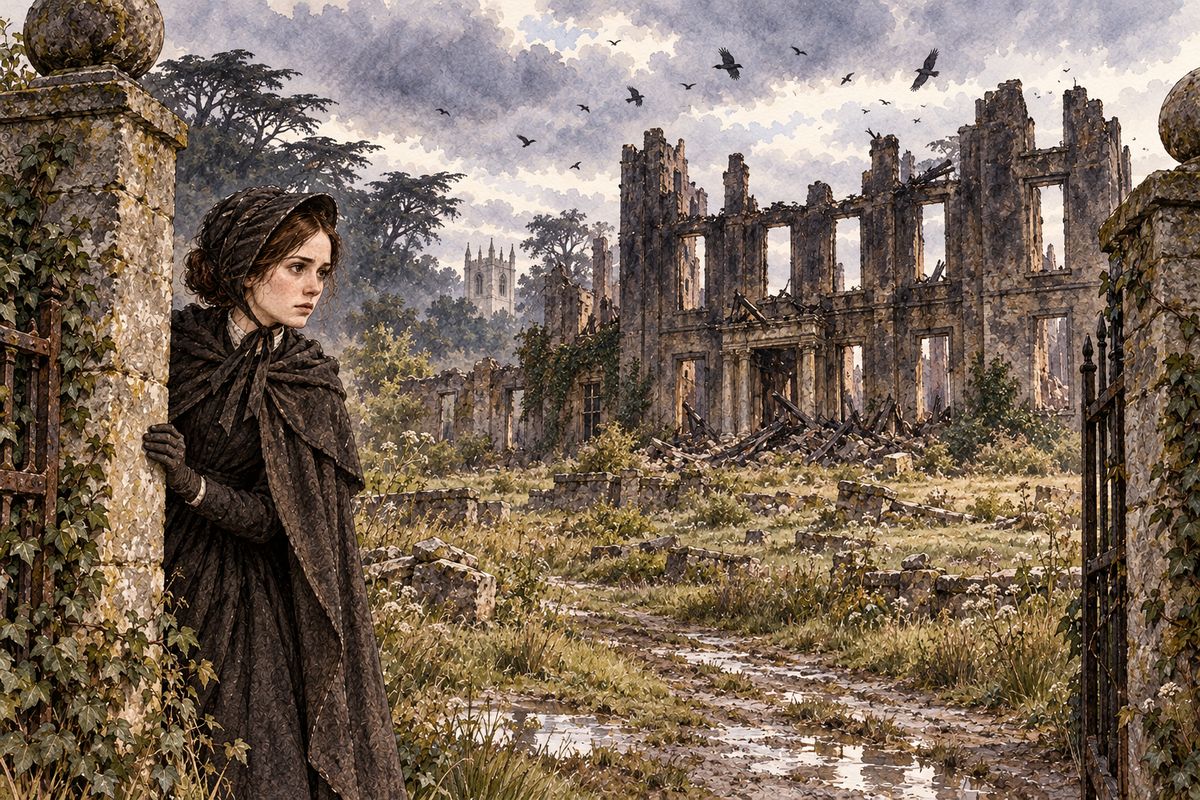
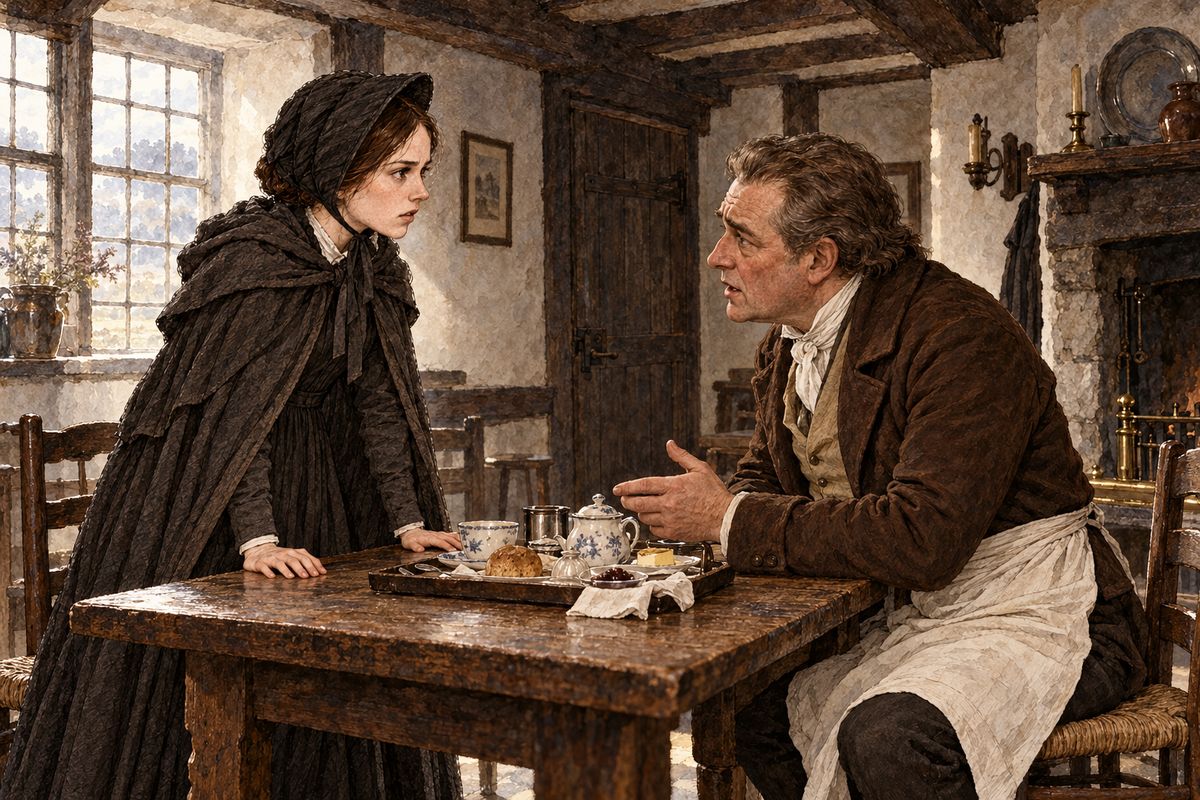
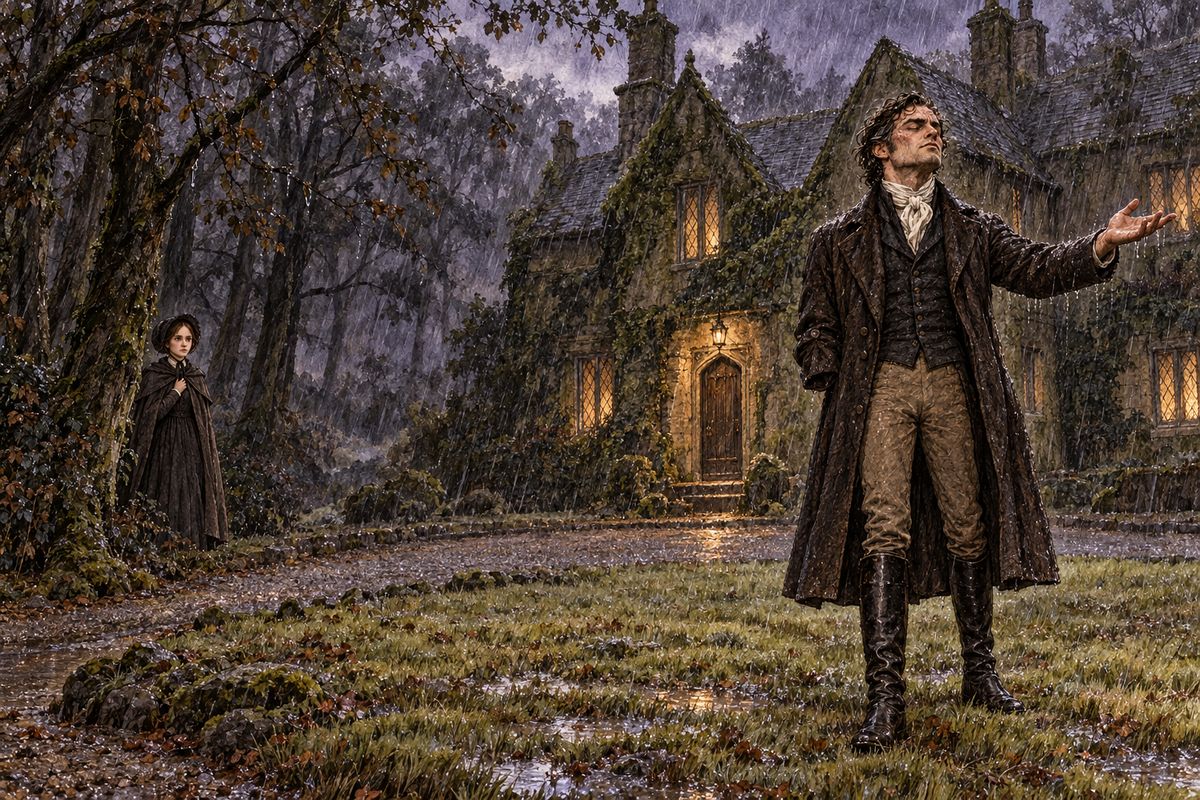
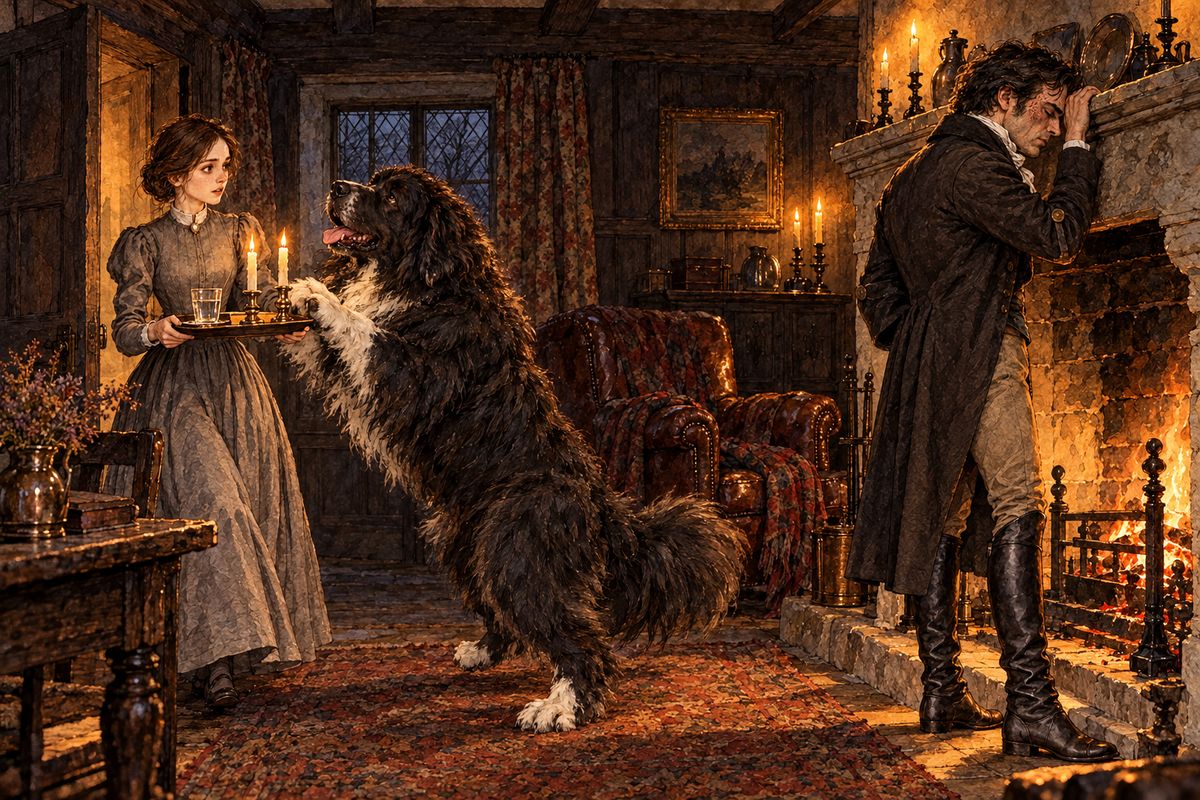
1No walk was possible that dreary November day. Shut out from her aunt's fireside circle, ten-year-old Jane Eyre slipped into the breakfast-room, climbed into the window-seat with Bewick's History of British Birds, and drew the red curtain close, while cold rain swept the leafless shrubbery outside.2Her peace ended when her cousin John Reed, a stout bully of fourteen, found her hiding. He struck her without warning, then sneered over the book: “You are a dependent, mama says; you ought to beg, and not to live here with gentlemen's children like us.”3He ordered her to stand by the door, then lifted the heavy volume and hurled it. It struck her; she fell against the door and cut her head, and as the blood came, her terror gave way to something fiercer.4“Wicked and cruel boy! You are like a murderer—you are like a slave-driver!” Jane cried. When John rushed at her and seized her hair, she fought back wildly, until his sisters' shouts brought Mrs Reed and the servants running.5“Take her away to the red-room, and lock her in there,” ordered Mrs Reed. Bessie the nurse and the maid Abbot hauled the struggling girl upstairs, Abbot scolding her for striking her young master: “You are less than a servant, for you do nothing for your keep.”6The red-room was the grandest, coldest chamber in Gateshead Hall, seldom entered because Jane's uncle, Mr Reed, had died there nine years before. Locked in alone, Jane crept past the great looking-glass and saw a strange white-faced little figure staring back, like a phantom from Bessie's stories.7As the dusk deepened she brooded on the injustice of it all, and on her dead uncle, who would surely have been kind. Then a pale light gleamed on the wall and glided up to the ceiling. Sure that a ghost was coming, Jane rushed to the door and screamed.8Bessie and Abbot came running, but Mrs Reed swept in behind them, sure the scream was a trick. Deaf to Jane's sobs—“O aunt! have pity! Forgive me!”—she thrust her back into the room and locked the door for another hour.9Alone in the dark again, Jane heard her aunt's footsteps sweep away. Her heart pounded, a rushing like wings filled her ears, and overcome by terror, she sank senseless onto the red carpet.10She woke in her own bed to a red glare that was only the nursery fire. Someone was holding her up more gently than anyone ever had: it was Mr Lloyd, the apothecary. “We shall do very well by-and-by,” he said, and Jane felt safe for the first time.11The next day she sat by the nursery hearth wrapped in a shawl, too wretched to be cheered. A tart on her favourite painted plate went untasted, the pictures in Gulliver's Travels seemed dreary, and Bessie's ballad of a poor orphan child only made her tears fall faster.12When Mr Lloyd returned, Jane told him the truth: “I cry because I am miserable,” and she longed to go to school. He spoke to Mrs Reed, who was glad to be rid of her. Overhearing the servants one night, Jane learned that her parents, a poor clergyman and his disowned wife, had died of typhus within a month of each other.13After the red-room, Mrs Reed shut Jane away from her cousins, in a closet to sleep and the nursery by day. At Christmas, while music and laughter rose from the drawing-room below, Jane sat alone by the dying fire with her shabby doll. Human beings must love something, and she loved that.14On a frosty January morning Jane was called down to the breakfast-room. On the hearth-rug stood a straight, narrow shape all in black, a grim face on top like a carved mask: a black pillar. It was Mr Brocklehurst, of Lowood school. 'Do you know where the wicked go after death?' he asked her.15Jane said she liked Revelations and Daniel, but 'Psalms are not interesting.' Mr Brocklehurst declared she had a wicked heart. Then Mrs Reed told him, in front of her, that Jane's worst fault was deceit and that the teachers must watch her. Jane fought back her tears as he pressed a little tract about a lying child into her hand.16When he had gone, Jane walked straight up to her aunt, shaking from head to foot. 'I am not deceitful: if I were, I should say I loved you; but I declare I do not love you.' She poured out the truth of the red-room. Mrs Reed's sewing slipped from her knee, and she looked frightened.17Her triumph soon turned cold and bitter. Jane wandered into the frozen garden, leaning on a gate as snow began to fall, whispering, 'What shall I do?' Then Bessie came looking for her. Jane put her arms round her, and the two made friends; Jane was to leave for school in a few days.18Before dawn on the nineteenth of January, Bessie walked Jane down to the lodge by lantern-light. Jane would not say goodbye to Mrs Reed. When the coach came, she was pulled weeping from Bessie's neck and driven away, fifty miles alone, through towns and wet grey hills, into the dark.19Long after nightfall, in wind and rain, Jane was lifted down at a wall door and led into a firelit parlour. A tall lady with dark hair came in carrying a candle. 'The child is very young to be sent alone,' she said, and touched Jane's cheek gently. She was Miss Temple, the superintendent of Lowood.20Breakfast next morning was burnt porridge that nobody could swallow. Eighty girls in brown frocks, every curl combed away, sat hungry through the lessons until noon. Then Miss Temple rose: 'You had this morning a breakfast which you could not eat; I have ordered that a lunch of bread and cheese shall be served to all.'21In the foggy, high-walled garden, the thin, pale girls huddled in the verandah, and Jane heard a hollow cough. A thin girl on a stone bench was reading a book called 'Rasselas'. Jane dared to speak to her and learned that Lowood was a school for orphans, and that all of them were charity-children.22The next morning the water in the pitchers was frozen solid. A north-east wind had whistled through the window cracks all night, and the girls dressed by rushlight without washing at all. After an hour and a half of prayers, Jane felt ready to perish with cold, and her little portion of porridge seemed smaller than ever.23That afternoon, sewing in a corner, Jane watched Miss Scatcherd scold Helen Burns for dirty nails, though no one could have washed in frozen water. Helen fetched a bundle of twigs, curtseyed, unloosed her pinafore without being told, and took a dozen strokes on the neck. Not a feature of her pensive face changed.24At the evening play-hour Jane found Helen reading by the embers and poured out her anger. "If she struck me with that rod, I should break it under her nose!" Helen answered gently that violence does not overcome hate. Life, she said, was too short to be spent nursing grudges or keeping a record of wrongs.25Through the first winter the girls had no boots or gloves. Chilblains swelled their feet, and the hungry older girls coaxed or bullied the little ones out of their bread. On Sundays they marched two miles through snow to Brocklebridge Church, and Miss Temple walked briskly along the drooping line, urging them on "like stalwart soldiers."26Three weeks after Jane's arrival, Mr Brocklehurst strode into the schoolroom. He scolded Miss Temple for giving the girls bread and cheese when their porridge was burnt, then stopped, horrified, and pointed his cane at Julia Severn's red curls. Miss Temple said quietly that they were natural, but he ordered them cut off, along with every top-knot in the first class.27In the middle of his sermon against braided hair and costly clothes, his wife and two daughters swept in from the carriage. They were dressed in velvet, silk and furs. The daughters' grey beaver hats nodded with ostrich plumes over elaborately curled hair, and Mrs Brocklehurst wore a false front of French curls.28Jane had hidden behind her slate, but it slipped and cracked in two. She was set on a high stool before the whole school, and Mr Brocklehurst warned everyone to shun her and watch her, because this child was "a liar!" His wife and daughters dabbed their eyes with their handkerchiefs.29Exposed on that pedestal of shame, Jane felt she would choke. Then Helen Burns passed by, lifted her eyes and smiled at her, like a martyr giving strength to a victim. Jane raised her head and stood firm, though Helen herself wore the untidy badge on her arm that day and had been sentenced to bread and water.30At five o'clock, in the deep dusk, Jane crept down and lay sobbing on the floor, wishing to die. Helen brought her coffee and bread and sat beside her. "There are only eighty people who have heard you called so, and the world contains hundreds of millions." She chafed Jane's cold fingers until Jane rested her head on her shoulder.31Miss Temple found them by moonlight and took them up to her warm room. She heard Jane's story and promised to write to Mr Lloyd, then served tea and unlocked a seed-cake. Helen's cheeks glowed and her eyes shone as she talked of books, far countries and French authors, and even read Virgil aloud, while Jane listened in wonder.32Next morning Miss Scatcherd tied a pasteboard sign reading 'Slattern' round Helen's forehead as punishment for her untidy drawer. Helen wore it all day, patient and unresentful. The moment the teacher left after afternoon school, Jane ran to her, tore it off and threw it into the fire, hot tears on her cheeks.33A week later Mr Lloyd's reply arrived, and it bore out Jane's account. Miss Temple gathered the whole school and declared Jane cleared of every charge, and the teachers shook her hand and kissed her. Jane set to work again, soon began French and drawing, and would not now have exchanged Lowood for all the luxuries of Gateshead.34Spring greened the Lowood valley, but fog-bred typhus crept into the school, and soon forty-five of the eighty girls lay ill. Coffins left quietly. The few healthy girls were turned loose in the woods from morning till night. Jane's favourite seat was a broad white stone in the middle of the beck, which she reached by wading barefoot.35One June evening Jane came back late from the woods and found the surgeon's pony at the gate. When the nurse saw Mr Bates off, Jane ran up and asked about Helen Burns, who had been kept upstairs for weeks. "He says she'll not be here long," the nurse said. Jane understood at once that this meant Helen was dying.36Near eleven, when the dormitory was silent, Jane pulled her frock over her night-dress and crept out barefoot. Moonlight from the passage windows showed her the way. She hurried past the fever-room, which smelled of camphor and burnt vinegar, and went on to the far end of the house, where Helen lay in Miss Temple's room.37Miss Temple had been called to the fever-room and the nurse was dozing. Helen, pale but calm, made Jane cover her bare feet under her quilt. "I am going to God," she whispered, and she promised that Jane would come to the same place of happiness one day. Jane held her close. "Don't leave me, Jane." "No one shall take me away."38Jane woke in daylight in the nurse's arms as she was carried back to bed. A day or two later she learned what had happened. At dawn Miss Temple had found her asleep in the little crib with her face against Helen's shoulder and her arms round her neck. Helen was dead.39Helen was buried in Brocklebridge churchyard. Fifteen years later a grey marble tablet would mark her grave, carved with her name and the word "Resurgam", which means "I shall rise again." After the epidemic, a public inquiry led to a new building and kinder rules. Jane stayed eight more years at Lowood, six as a pupil and two as a teacher.40Then Miss Temple married a clergyman and drove away over the hill, and she took Lowood's calm with her. Jane, now eighteen, opened her window and gazed at the far blue peaks, longing to follow the white road. She prayed for liberty, then for change, and at last, half desperate, she cried: "Grant me at least a new servitude!"41That night the answer came to her: she would advertise. She posted a notice in the Herald from Lowton, and a week later she found one reply waiting. In bed, by an inch of candle, while Miss Gryce snored, she read it. A Mrs Fairfax of Thornfield, near Millcote, offered thirty pounds a year to teach one little girl.42After the committee gave its consent, Jane's trunk was corded for Thornfield. On her last evening Bessie arrived, married now, with news of Gateshead. Seven years earlier, she said, a Mr Eyre, probably Jane's father's brother, had called to see her. He was sailing for an island where they made wine. "Madeira?" "That is the very word."43One raw October day, eighteen-year-old Jane Eyre left Lowood for her first post as a governess. After a long wait at the inn in Millcote, a silent driver took her the last six miles to Thornfield through the mist. It was nearly midnight when the gates clashed shut behind them, and a single candle glowed in the dark front of the house.44She had feared the coldness she knew at Gateshead. Instead, a neat little widow in a widow's cap got up from her knitting and hurried to meet her. "You must be cold, come to the fire," said Mrs Fairfax, untying Jane's bonnet herself and calling for hot negus. Jane's heart warmed to her at once.45Next morning Jane learned that Thornfield belonged not to Mrs Fairfax but to Mr Rochester, who was hardly ever there. Her pupil was his little French ward, Adèle Varens. After breakfast, Adèle climbed onto Jane's knee, folded her hands and sang an opera song about a lady abandoned by her lover. Then she recited a fable by La Fontaine, in French, with all the gestures.46Mrs Fairfax showed her through the house, from the grand dining-room to the dim third-storey rooms full of old furniture. At last they climbed a ladder and went out through a trap-door onto the leads. Below them the autumn lawn, the old thorn trees, the church and the quiet hills lay in the sun like a map.47On the way down, Jane waited alone in the third-storey corridor. It was narrow, low and dim, with two rows of small black doors all shut, like a passage in Bluebeard's castle. Then, in that silent place, she heard a laugh. It was strange, slow and mirthless, and it grew into a loud peal that echoed through the empty rooms.48"Perhaps Grace Poole," said Mrs Fairfax calmly. She called the name, and the nearest door opened. Out came a square-built, red-haired servant with a hard, plain face, about as unghostly as a person could be. "Too much noise, Grace. Remember directions!" Grace curtseyed without a word and went back inside.49Autumn turned to winter. Adèle learned well and Mrs Fairfax was kind, but Jane longed for more of life than Thornfield gave her. Women, she thought, feel just as men do and need a field for their efforts too. When she grew restless she paced the third-storey corridor, telling herself a tale that never ended, and now and then she heard Grace Poole's low laugh.50One still, frozen afternoon in January, Jane walked to Hay to post a letter. She rested on a stile in the lonely lane as the sun went down and the moon came up. Then came the clatter of hooves. A great black-and-white dog slid past under the hedge, just like the Gytrash, the ghostly creature from Bessie's old tales.51The horse slipped on the ice and fell with its rider. "Down, Pilot!" growled the dark stranger, who had sprained his ankle. He asked who she was, and when she said she was the governess, he gave her a long look. "Necessity compels me to make you useful," he said. Then he leaned on her shoulder, limped to his horse and galloped away.52When Jane got home, she found a great black-and-white dog sitting alone by Mrs Fairfax's fire. "Pilot," she said, and he came to her. "He came with master," said Leah, the maid. Mr Rochester had just arrived. His horse had slipped on the ice in Hay Lane, and he had sprained his ankle. The stranger was the master of Thornfield.53The day after his fall in Hay Lane, Thornfield had a master, and the house rang with callers. That evening Mr Rochester asked for Jane and Adèle at tea. Jane changed her plain stuff dress for her best black silk, and Mrs Fairfax fastened it while Jane pinned on the little pearl brooch Miss Temple had given her when they parted.54Mr Rochester lay half reclined on a couch, his sprained foot on a cushion and the firelight on his grim, square face. He watched Adèle and Pilot and did not even look up. "Let Miss Eyre be seated," was all he said. Jane sat down, oddly at ease: his rudeness asked for no grace in return.55He made her play the piano, then judged it no better than any schoolgirl's. Then he sent for her portfolio. He laid most of her watercolours aside but kept three: a cormorant on a drowning sea, the Evening Star, and a pale head against an iceberg. "Where did you get your copies?" "Out of my head." He called her thoughts elfish.56For days he passed her coldly in the halls. Then one wet night, mellow after dinner, he sent for her again and caught her studying his face. "You examine me, Miss Eyre: do you think me handsome?" The answer slipped out before she could soften it: "No, sir." He was not offended. He was intrigued.57He talked strangely that night, of a past he regretted and a cure he meant to take for it. Then Adèle burst in, wearing the rose-coloured satin frock from her long-awaited box, and danced up to him, curtseying just as her mother used to. "Precisely," he said bitterly: that was how the mother had charmed the gold from his pocket.58Some days later, walking the frozen beech avenue while Adèle played with her shuttlecock, he told Jane the truth. Adèle's mother was Céline Varens, a French opera-dancer he had once adored. One June night, waiting on her Paris balcony, he saw her step from the carriage he had given her, followed by a man in spurs.59In mid-sentence he stopped. He was speaking of how he had come to like Thornfield, and he glared up at its battlements with pain, shame and loathing in his face. Then he took up the story again. He had turned Céline out, wounded her vicomte in a duel in the Bois de Boulogne, and later rescued her abandoned child from Paris.60Jane told him Adèle was not to blame and she would only love her more. That night she lay awake thinking of him. At two o'clock something brushed her door, and then came a low, demonic laugh, as if right at her keyhole. Steps went off towards the third-storey stairs. Was it Grace Poole?61Opening her door, she found the gallery full of smoke pouring from Mr Rochester's room. His bed curtains were on fire, and he lay in a stupor in the middle of the blaze. Jane seized his basin and ewer, then her own jug, and drenched the bed and the sleeper until the flames hissed out.62Soaked and grave, he went up to the third storey alone and came back pale. "Grace Poole—you have guessed it," he said, and told her to keep silent. But when she tried to go, he held her hand warmly in both of his. "You have saved my life," he said. "I feel your benefits no burden, Jane."63The morning after the fire, Jane found Grace Poole calmly sewing rings onto new bed-curtains in Mr Rochester's room. Grace asked whether Jane had heard anything in the night, and whether she bolted her door. Jane said she would from now on. "It will be wise so to do," Grace answered, without a flicker.64All day Jane waited for Mr Rochester, but at tea Mrs Fairfax told her he had ridden off after breakfast to the Leas, ten miles beyond Millcote, and would likely stay a week or more. Among the guests was the Honourable Blanche Ingram, the beautiful belle he had once sung a duet with.65That night Jane told herself off for being a fool. She drew her own face in chalk without softening a single line and called it 'Portrait of a Governess, disconnected, poor, and plain'. Then she spent a fortnight painting a lovely imaginary Blanche on ivory, to look at whenever she began to hope.66After two silent weeks a letter came: the master would be back in three days with a houseful of guests. Thornfield was turned upside down with scrubbing, polishing and airing. Only Grace Poole went quietly on her way, and the servants whispered about her, then fell silent when Jane came near, as if there was a secret she must not know.67On Thursday evening Jane watched from the schoolroom window, hidden by the curtain, as the party came up the drive. Mr Rochester rode in front on his black horse Mesrour, with Pilot bounding ahead. Beside him rode a lady in a purple riding-habit, raven ringlets gleaming through her veil. "Miss Ingram!" cried Mrs Fairfax.68The next evening Mr Rochester insisted that Jane bring Adèle to the drawing-room. Jane sat in a window-seat as the ladies swept in like white birds. Adèle curtseyed gravely, and Blanche Ingram looked down at her and laughed, "Oh, what a little puppet!"69When the gentlemen came in, Mr Rochester never glanced at Jane. Blanche asked him why he kept a governess, and Lady Ingram declared she could read 'all the faults of her class' in Jane's face. "Half of them detestable and the rest ridiculous," Blanche laughed. Jane shrank further behind the curtain.70Blanche changed the subject, saying she liked a man with 'a spice of the devil in him', and she sat down at the piano and commanded Mr Rochester to sing. Jane meant to slip away, but his deep, powerful bass held her still until the last note died.71In the hall Mr Rochester caught her. He saw at once that she was paler, and that tears stood in her eyes. "So long as my visitors stay, I expect you in the drawing-room every evening," he said. "Now go. Good-night, my—" He stopped, bit his lip, and walked abruptly away.72On a wet spring evening the house party played charades, and the dining room became a theatre facing the drawing-room arch. Jane would not join in. When the curtain rose, Miss Ingram came forward in a white veil and a wreath of roses, with Mr Rochester at her side, and Adèle scattered flowers before them. "Bride!" the other side guessed.73In the second scene a marble basin from the conservatory stood in for a well. Mr Rochester sat beside it in shawls and a turban like an Eastern emir. Miss Ingram, dressed as Rebecca, gave him water from her pitcher, and he knelt and fastened gold bracelets on her bare arms.74On the third rising the candles were out. By the dim light of a horn lantern sat a grimy, scowling man in a torn coat, with his eyes on the floor. When he moved, a chain clanked at his wrists. "Bridewell!" cried Colonel Dent, and the word was solved. Jane knew it was Mr Rochester all the same.75Afterwards Jane watched the audience instead of the stage. Miss Ingram leaned so close that her curls brushed Mr Rochester's cheek, though she snubbed Adèle and never once looked at Jane. Jane admitted to herself that she loved him. What hurt most was seeing that he would marry Blanche for rank, and that Blanche could not make him love her.76One wet day, while Mr Rochester was away at Millcote, a stranger arrived by post-chaise and settled in to wait for him. He was Mr Mason, newly come from Jamaica. That evening he sat close to the fire, shivering in his surtout and asking for more coal. Jane thought him a sleek gander next to Mr Rochester's fierce falcon.77Then a footman reported that an old gipsy woman in the servants' hall insisted on telling the young ladies' fortunes, alone in the library. Blanche went first and came back sour and silent. The Eshton girls and Mary Ingram went in together and ran back shrieking: "She knows all about us!" Then the gipsy asked for Jane.78Jane was not afraid. In the firelit library an old woman in a red cloak and a black bonnet sat smoking a short black pipe. She told Jane she was cold, sick and silly: lonely, and too proud to reach for the happiness that waited for her. Then she had Jane kneel so the firelight fell on her face, and began to read it.79As the old voice spoke of reason holding the reins, it changed, and its tone grew familiar. The hand held out in the firelight was not withered. It was smooth and strong, with a ring Jane had seen a hundred times. "Well, Jane, do you know me?" Mr Rochester threw off the red cloak.80When Jane mentioned a stranger named Mason from the West Indies, Mr Rochester gripped her wrist and went whiter than ashes. "Jane, I've got a blow!" He sat with her hand held in both of his, then asked: if everyone turned against him, would she go with them? "I should have more pleasure in staying with you," she said.81Jane woke in the dead of night to a full moon at her window, and then to a savage, shrill cry that ran the length of Thornfield Hall. Directly above her ceiling came stamping, a deadly struggle, and a smothered voice: "Rochester! Rochester! for God's sake, come!"82Doors flew open and frightened guests crowded the moonlit gallery, crying of fire and robbers. Mr Rochester came down from the upper storey with a candle, Miss Ingram clutching his arm. A servant had had a nightmare, he told them, nothing more, and coaxed and commanded every one back to bed.83Jane did not believe the story; she dressed and waited. Near dawn Mr Rochester tapped at her door and led her softly up to the third storey, where she fetched her sponge and salts. At a small black door he asked if blood made her sick, and took her hand. "Warm and steady," he said, and turned the key.84Inside, Grace Poole's goblin laugh rang behind an inner door, and in a chair lay the stranger Mason, pale as death, his arm wounded. Mr Rochester went for a surgeon and locked Jane in, forbidding them to speak. Through the long night she sponged the wound and held water to his lips, while snarling sounds came from beyond the door.85At dawn Rochester returned with Carter the surgeon, who bandaged the shoulder and found it torn by teeth. They got Mason down to a post-chaise in the yard. Before it left, he wept: "Let her be taken care of; let her be treated as tenderly as may be." "I do my best," Rochester answered.86Then Rochester drew Jane into the dewy orchard and gave her the first rose. On the ivy bench he asked her to suppose a man, ruined by an early error, who found new life in a fresh, good stranger: might he defy the world's rules to keep her? He looked at her eagerly, then laughed bitterly and spoke of marrying Miss Ingram.87That afternoon Robert Leaven, Bessie's husband, came from Gateshead in mourning. John Reed was dead, perhaps by his own hand, and Mrs Reed, struck down by a stroke, kept asking for Jane. Rochester grumbled, but gave her leave and wages, and next morning she set off on the hundred-mile journey.88At Gateshead Bessie welcomed her warmly, but her cousins were cold: severe Eliza ignored her, and plump Georgiana eyed her plain bonnet. While her aunt lay delirious for ten days, Jane sat apart by the window drawing, and one morning found she had sketched Mr Rochester's face from memory.89One wet, windy afternoon, alone with her aunt, Jane heard her wake clear-minded. Mrs Reed had her take a letter from the dressing-case: three years before, Jane's uncle John Eyre of Madeira had asked to adopt her as his heir. Out of hatred, Mrs Reed had written back that Jane was dead.90"You have my full and free forgiveness," Jane told her. "Ask now for God's, and be at peace." But Mrs Reed turned from her kiss and drew her cold fingers away; dying, she must hate Jane still. She sank into stupor and died at midnight, and neither Jane nor her daughters shed a tear.91Mrs Reed was buried, yet Jane stayed a month at Gateshead, sewing and packing for the idle Georgiana and keeping house for Eliza, who burned her papers behind a bolted door. Georgiana later married a rich, worn-out man of fashion; Eliza took the veil in a French convent and in time became its head.92Jane did not send word of the day she would come back. At six o'clock on a June evening she slipped away from the George Inn at Millcote and walked the old road through the hayfields. The closer she came to Thornfield, the gladder she felt, though she told herself he was not thinking of her.93At the stone stile sat Mr Rochester, writing in a book, and Jane trembled so much she could hardly move. He teased her for creeping home like a ghost, then asked her to come and judge his new carriage: "Tell me if you don't think it will suit Mrs Rochester exactly."94Then he smiled his rare, true smile and moved aside: "Pass, Janet. Go up home." Jane climbed over without a word, but something turned her round, and the words came out on their own: "I am strangely glad to get back again to you: and wherever you are is my home—my only home." Then she hurried away.95Adèle was wild with delight and Mrs Fairfax welcomed her kindly. A strange, calm fortnight followed. No one spoke of the wedding, and Mr Rochester did not ride to Ingram Park once. He was kinder and more cheerful than Jane had ever seen him, and she had never loved him so well.96On Midsummer Eve, Jane went out into the orchard. She caught the smell of his cigar and tried to slip past Mr Rochester while he bent over a great moth. As she crossed his long moonlit shadow, he said quietly, without turning round: "Jane, come and look at this fellow."97He walked her down the laurel walk and gently said that he would soon marry, so she must leave. He had already found her a new post: teaching five daughters of a Mrs O'Gall in Ireland. "It is a long way off, sir," Jane said, and her tears came. "The sea is a barrier—from you."98On the bench under the great chestnut, the nightingale sang and Jane's grief burst out. "Do you think, because I am poor, obscure, plain, and little, I am soulless and heartless? I have as much soul as you,—and full as much heart!" She told him their spirits stood equal before God.99"My bride is here," he said, "because my equal is here. Jane, will you marry me?" She could not believe him until she made him turn his face to the moonlight and read it: flushed, agitated, his eyes strangely bright. "Do you truly love me?" "I do." "Then, sir, I will marry you."100While he held her and asked again and again if she was happy, the moon went behind cloud. The chestnut groaned and twisted in a sudden wind. Lightning split the sky with a crash, the rain poured down, and he hurried her up the walk to the house.101They were soaked through by the time they reached the hall, and the clock was striking twelve. He shook the rain from her loosened hair and kissed her goodnight, "my darling!" Looking up, Jane saw Mrs Fairfax standing there, pale, grave and amazed. Jane only smiled and ran upstairs, too happy to fear the storm.102Next morning, before Jane was up, Adèle came running in with the news. In the night the great horse-chestnut at the bottom of the orchard had been struck by lightning, and half of it had split away.103Jane woke wondering if the proposal had been a dream. A brilliant June morning had followed the storm, and her glass showed a face that no longer looked plain. She gave all her shillings to a ragged beggar-woman at the gate. Upstairs Mr Rochester greeted her with a kiss: "Soon to be Jane Rochester — in four weeks, Janet."104Mrs Fairfax, her Bible pushed aside, could hardly believe the news. There were twenty years between them, she said, and she feared something would prove different from what either of them expected. "Gentlemen in his station are not accustomed to marry their governesses." Jane, stung, felt tears rise to her eyes.105Jane begged for Adèle to come on the drive to Millcote. On the rain-washed road, Rochester told the child he would carry mademoiselle off to the moon. A fairy had given him a gold ring by a stile, he said, and mademoiselle was that fairy. Adèle called him "un vrai menteur".106At the silk warehouse he chose a blazing amethyst silk and a pink satin. Jane whispered him down to sober black satin and pearl-grey silk, and the jeweller's made her cheeks burn. She would write to her uncle in Madeira that very day, and stay Adèle's governess at thirty pounds a year. "I will not be your English Céline Varens."107Each evening at seven he sent for her, and each evening she kept him at arm's length with teasing and sharp words. When his song ended, all fire and tenderness, she asked whom he meant to marry now. Yet it was hard: he had become her whole world. "I could not, in those days, see God for His creature: of whom I had made an idol."108A month later, on the night before the wedding, Jane's trunks stood corded along the wall. In the closet hung the pearl-coloured dress and the veil, giving out a ghostly shimmer in the dark. Rochester was away on business, and something strange had happened the night before. "I will leave you by yourself, white dream."109She ran out into the howling south wind. At the bottom of the orchard stood the chestnut split by the lightning, black and riven, its two halves still joined at the root. "You did right to hold fast to each other," she told it. Through the cleft a blood-red moon glanced at her and vanished.110Ten o'clock struck and he had not come. She ran down to the gates, then out along the road as rain drove in. At last hoofbeats: Rochester on Mesrour, Pilot at his side. "You can't do without me, that is evident. Step on my boot-toe; mount!" He wrapped his cloak round her and rode home.111By the library fire past midnight she told him her dreams: a crying child in her arms, Thornfield a ruin, his horse galloping away. Then she woke to candlelight. A tall woman with wild dark hair put on the veil, stared into the mirror, tore it in two and trampled it, then blew out the candle by Jane's face.112Rochester shuddered, held her close, and said it must have been Grace Poole, half seen in a fever. He would explain in a year and a day. He sent her to sleep in Adèle's bed. Jane never slept; she held the child till sunrise, kissed her, and cried as she loosened the small hands from her neck.113On the wedding morning Mr Rochester gave Jane ten minutes for breakfast, then hurried her down the drive in a grip of iron, grimly set on his purpose. At the churchyard gate she stopped, out of breath. She noticed two strangers among the mossy graves, who slipped round to the side door of the church.114At the altar rails Mr Wood, the clergyman, asked whether anyone knew of an impediment to the marriage, and paused, as was the custom. Then a calm voice behind them broke the silence: “The marriage cannot go on: I declare the existence of an impediment.” A London solicitor named Briggs came forward and said that Mr Rochester had a wife now living.115Briggs read out the record of a marriage fifteen years earlier in Spanish Town, Jamaica, to one Bertha Mason. Then he called his witness, and pale Richard Mason crept forward. Rochester raised his arm as if to strike him, then let it fall in contempt. “She is now living at Thornfield Hall,” Mason faltered. “I am her brother.”116Rochester admitted the truth at once: he had married Bertha Mason, and she was mad. Still holding Jane's hand, he sent the carriage away and led the gentlemen up to the third storey and through the low black door. “You shall see what sort of a being I was cheated into espousing.”117In a windowless inner room Grace Poole was cooking at a guarded fire while a shaggy figure ran to and fro in the shadows. Suddenly it sprang at Rochester's throat. He would not strike her; he only wrestled. At last he pinned her arms, and with Grace's cord he tied her to a chair.118On the stairs Briggs told Jane she was cleared of all blame. Her uncle, Mr Eyre of Madeira, had heard of the wedding from her letter while Mason was staying with him, and had sent Mason to stop it. But he lay dying of decline. Soon the strangers were gone, and the clergyman after them.119Jane bolted her door. Without a tear she took off the wedding dress and put on yesterday's plain stuff gown, then sat with her head on her arms. Yesterday she had been almost a bride; now her hopes lay dead, as if a December storm had swept over June.120Late in the afternoon, faint with hunger, Jane opened her door, stumbled, and fell into Rochester's arms. He had sat in a chair across her threshold all day, listening. “Will you ever forgive me?” he asked. She forgave him in her heart but could not speak, and he carried her down to the library.121By the library fire Rochester begged her to come away with him to a villa in France. Then he told his story: a bride chosen for her fortune, a madness hidden from him, and a hot Jamaican night when he came close to despair, until a fresh wind from Europe broke the storm and gave him hope.122He had shut Bertha away at Thornfield and wandered Europe for ten years, until he found Jane. He begged her to say, “I will be yours.” “Mr Rochester, I will not be yours.” In fury he seized her, but her steady eyes defied him. He let her go and threw himself sobbing on the sofa.123That night Jane dreamed she lay in the red-room at Gateshead again. The ceiling melted into clouds, and where the moon should have been, a white human form leaned toward the earth and spoke to her heart: “My daughter, flee temptation.” “Mother, I will,” she answered as she woke.124Before dawn, still dressed, Jane made up a small parcel and pocketed her purse of twenty shillings. She left the pearl necklace behind: it belonged to a bride who had melted into air. At Rochester's door she heard him pacing, but she went on, slipped through the wicket gate, and was gone from Thornfield.125Two days after fleeing Thornfield, Jane was set down at Whitcross with no money left. As the coach rolled away, she realised she had left her only parcel in it. She was now completely destitute, alone at a stone signpost where four empty roads crossed the moors.126She lay down in the heather under a granite crag, with her shawl for a blanket. Her heart ached for Mr Rochester, and she knelt to pray for him. Beneath the great Milky Way she felt sure God would keep him safe, and that thought let her sleep.127In the village, the shop woman would not take her handkerchief or gloves for bread, and a neat white door was gently shut on her. After a cold night in a wood and a day of rain, a little girl was about to tip cold porridge into a pig trough. Jane asked for it, and ate it ravenously.128In the wet twilight, near the end of her strength, Jane climbed back onto the moor, thinking she would rather die there than in a street. Then, far off across the marshes, a light appeared. It burned steadily, so she dragged herself toward it through the bog, falling twice.129The light came from a low window at Moor House. Inside, two young ladies in deep mourning were studying German by the fire, while an old servant, Hannah, sat knitting. "Listen, Diana," said Mary, reading aloud from the book in her hands.130Hannah opened the door to her but would not let a "vagrant" in, and bolted it. Jane sank on the wet step and said, "I can but die, and I believe in God." A voice answered out of the dark: their brother, St John Rivers, had come home and heard everything. He brought her inside.131By the kitchen fire, Diana fed her bread dipped in milk, and Jane gave her name as "Jane Elliott." She lay half-conscious with fever for three days. She heard the sisters' kind whispers, and St John's cool remark that she would always be plain.132On the fourth day Jane came down and offered to pick gooseberries while Hannah baked. When Hannah hinted that she was a beggar, Jane told her firmly, "You ought not to consider poverty a crime." Hannah admitted she had been wrong and they shook hands. As they worked, Hannah told her about the old Rivers family.133Weeks passed happily. Jane read with Diana and Mary and talked with them every evening. Diana taught her German, and Mary learned drawing from her. St John stayed distant, and when Jane heard him preach at Morton, his sermon was so stern and restless that it left her sad.134With his sisters about to leave, St John offered Jane the new girls' school at Morton, paying thirty pounds a year, and she accepted gladly. Soon afterwards a letter came: their uncle John had died, leaving his fortune of twenty thousand pounds to another relation. "Amen! We can yet live," said Diana.135Jane's new home was a bare two-room cottage by the village school at Morton, where twenty rough farm girls had come to learn. That evening she told herself she had chosen rightly: better a free, honest schoolmistress than Mr Rochester's mistress in France. Yet as she watched the sunset from her door, she found herself weeping for him.136St John came by with a gift from his sisters and urged her never to look back. Then Rosamond Oliver, the heiress of Vale Hall, appeared at the gate all in white, lovely as a vision. St John went as pale as her gown and crushed the daisies underfoot. 'Not to-night, Miss Rosamond,' he said, and strode off without once turning round.137Through the autumn the school flourished and Rosamond visited often. Jane painted her portrait, and when St John saw it she urged him to marry the girl. He laid his watch on the table: 'Go on for another quarter of an hour.' For fifteen minutes he dreamed of Rosamond as his bride. Then he rose and called it delirium, since she could never be a missionary's wife.138As he was leaving, St John drew the thin cover sheet back over the portrait. Something on its margin caught his eye. He shot Jane a strange, piercing look, tore off a narrow strip and slipped it into his glove. 'Nothing in the world,' he said, and was gone, leaving her puzzled.139Snow fell all night and drifted the valley shut by the next evening. Yet St John waded through it, his cloak white as a glacier, sat by her fire and told a story: an orphan raised by Mrs Reed of Gateshead and schooled at Lowood became a governess at Thornfield, then fled on discovering that her master had a living wife. A lawyer, Mr Briggs, was searching for her.140Jane's first question was for Mr Rochester, but St John knew nothing of him. Then he held up the torn strip, stained with her paints: on it, in her own idle handwriting, were the words 'JANE EYRE'. Her uncle John Eyre of Madeira was dead and had left her everything: twenty thousand pounds.141Then the last secret came out. St John's mother had been an Eyre, so he, Diana and Mary were Jane's own cousins. The lonely orphan who had once begged at their door had found a family. She clapped her hands, too glad to sit still. 'Oh, I am glad! I am glad!'142Twenty thousand pounds shared four ways would be five thousand each, and Jane would hear of nothing else. 'I want my kindred,' she told St John, who protested that the fortune was hers by right. She would not yield, and after long arguments and an arbitration, each of the four cousins received an equal share.143By Christmas Jane had closed the school. With Hannah she scrubbed, polished and refurnished Moor House and baked cakes for days. On a frosty night the carriage rumbled up with Diana and Mary, who laughed and kissed her in the lantern light, though St John soon retreated from the happy noise to his books.144Months later Rosamond was engaged to another man, and St John had set Jane to learning Hindustani. One May morning in Marsh Glen he asked her to come to India as his wife, a helper fit for labour rather than love. She would go only as his sister. 'If you reject it,' he warned, 'it is not me you deny, but God.'145St John put off leaving for Cambridge for a week and turned to marble, always polite and never once warm. On his last evening Jane found him at the garden gate, watching the moon rise, and begged him to be friends. It only made things worse. 'If I were to marry you, you would kill me. You are killing me now.' He went white.146Guessing that she meant to look for Mr Rochester, St John said he would pray she did not become a castaway, and walked off down the glen. Indoors, Diana drew the whole story out of Jane and was appalled that her brother meant to take her to India. 'Madness! You would not live three months there.'147That night St John read from Revelation and prayed with all his strength. When the others had gone to bed he laid his hand on Jane's head and asked gently, 'Could you decide now?' His gentleness did what his anger never could. She was ready to give in, if only she could be sure it was God's will.148Then, in the moonlit hush, Jane heard a voice cry 'Jane! Jane! Jane!' It was Mr Rochester's voice, full of pain, and it seemed to come from nowhere. 'I am coming!' she cried. 'Wait for me!' She ran out into the garden, but it was empty. Only the hills beyond Marsh Glen called back her own words.149At dawn St John slipped a note under her door: he would expect her decision when he returned in a fortnight. That afternoon Jane stood once more at the Whitcross signpost, where she had once been set down penniless, and stopped the coach south. After thirty-six hours on the road she felt like a homing pigeon flying back.150At the Rochester Arms, two miles from Thornfield, she ran across the same fields she had fled through a year before, hoping to see her master at his window. She peeped round a gate pillar and stared. The Hall was a blackened, roofless shell, its windows empty and grass already growing in the rubble.151The innkeeper, once old Mr Rochester's butler, told her everything. Last autumn Bertha, the mad wife, had set the Hall on fire and leapt from the battlements as her husband reached her. Mr Rochester was pulled alive from the ruins, but he had lost one hand and his sight. 'He is stone-blind.' He lived now at Ferndean, thirty miles away, and Jane ordered a chaise at once.152Jane walked the last mile to Ferndean, an old manor buried in a dripping wood, and reached it just before dark. The narrow door opened and Mr Rochester came out bareheaded, blind, reaching out a hand to feel the rain. He groped across the grass, found only empty air, and stood still in the downpour. Jane watched from the trees, unseen.153Inside, Jane took the tray of water and candles from Mary and carried it in herself, her hands shaking so that the water spilled. Old Pilot, lying by the hearth, knew her at once and bounded to her with a yelp. Rochester, leaning at the mantelpiece, turned his blind face towards the noise. "Give me the water, Mary," he said.154"Who is this? Who speaks?" he demanded, groping for her. Jane caught his wandering hand in both of hers. "Her very fingers!" he cried, and his hand went to her arm, her shoulder, her face. "I am Jane Eyre," she told him. "I have found you out. I am come back to you."155Next morning the rain was gone, and Jane led him out into the bright fields. Sitting on his knee on an old tree-stump, she told him about her year away, and teased him with praise of her handsome cousin St John. Rochester grew fiercely jealous, until Jane admitted St John had only wanted a missionary's wife, and that her whole heart was his.156Then the gloom came back. He called himself a ruin, like the lightning-struck chestnut at Thornfield. Jane said he was green and strong, a tree that other plants would lean on. "Jane, will you marry me?" he asked at last. "A poor blind man, whom you will have to lead about by the hand?" "Yes, sir," she answered each time.157He told her that four nights before, near midnight, he had prayed at his open window and cried out "Jane! Jane! Jane!" A voice had answered from far away: "I am coming: wait for me." Jane knew it was the very night and hour she had heard him on the moor, but she kept that to herself.158He bared his head and thanked God, then held out his hand to be led. Jane let his arm rest round her shoulder, and she guided him home through the wood. Reader, I married him: a quiet wedding, with only the parson and clerk. John and Mary took the news calmly, and Diana and Mary Rivers sent their warm approval.159After two years Rochester's sight began to return in one eye. When their first-born son was put into his arms, he could see that the boy had his own eyes, large, bright and black. Adèle grew up happy at a gentler school; Diana and Mary married good men; St John worked on in India, unmarried, until the end of his life.
Adapted from Jane Eyre: An Autobiography by Charlotte Brontë, public domain. Pictures are AI illustrations drawn for this edition.
Add Stories to your Home Screen: tap
then Add to Home Screen.