A picture-story retelling, after Johanna Spyri, translated by Marion Edwards (1881)
A warm, gentle story with homesickness, an illness and a blind grandmother, all shown with tenderness; there is nothing frightening beyond a sleepwalking 'ghost' at night.
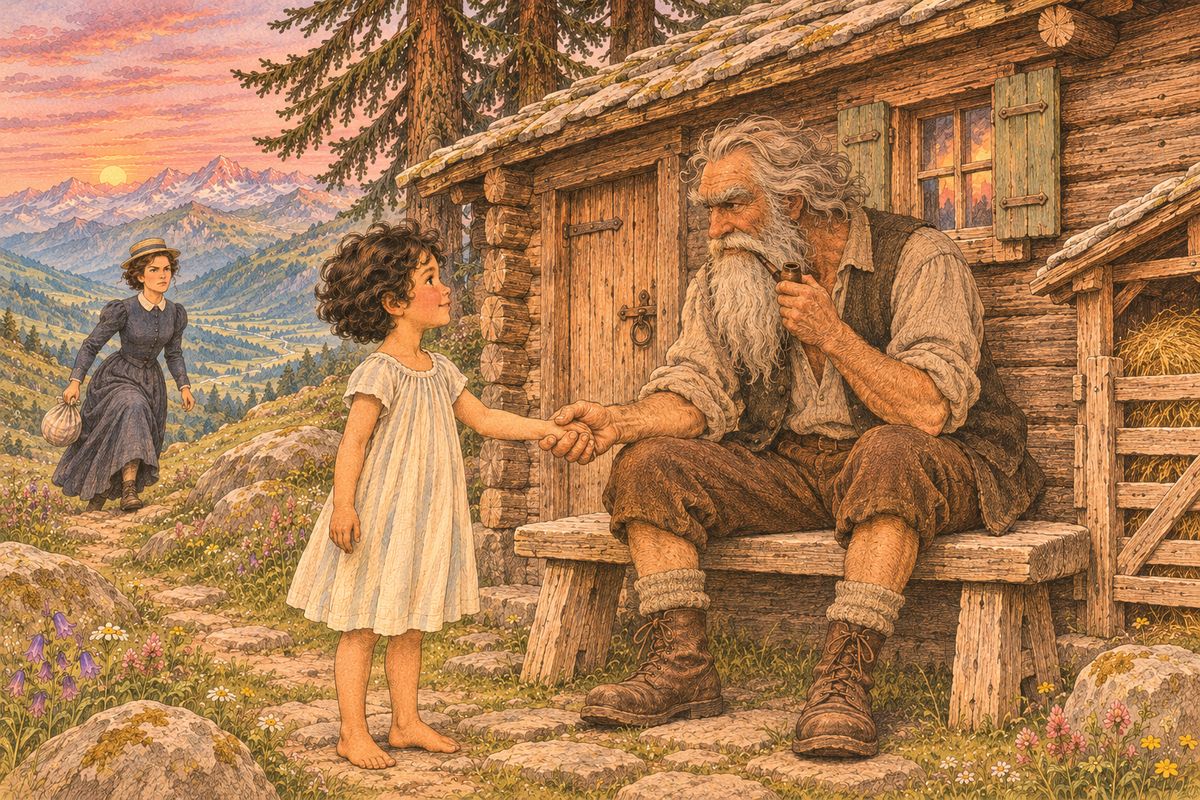
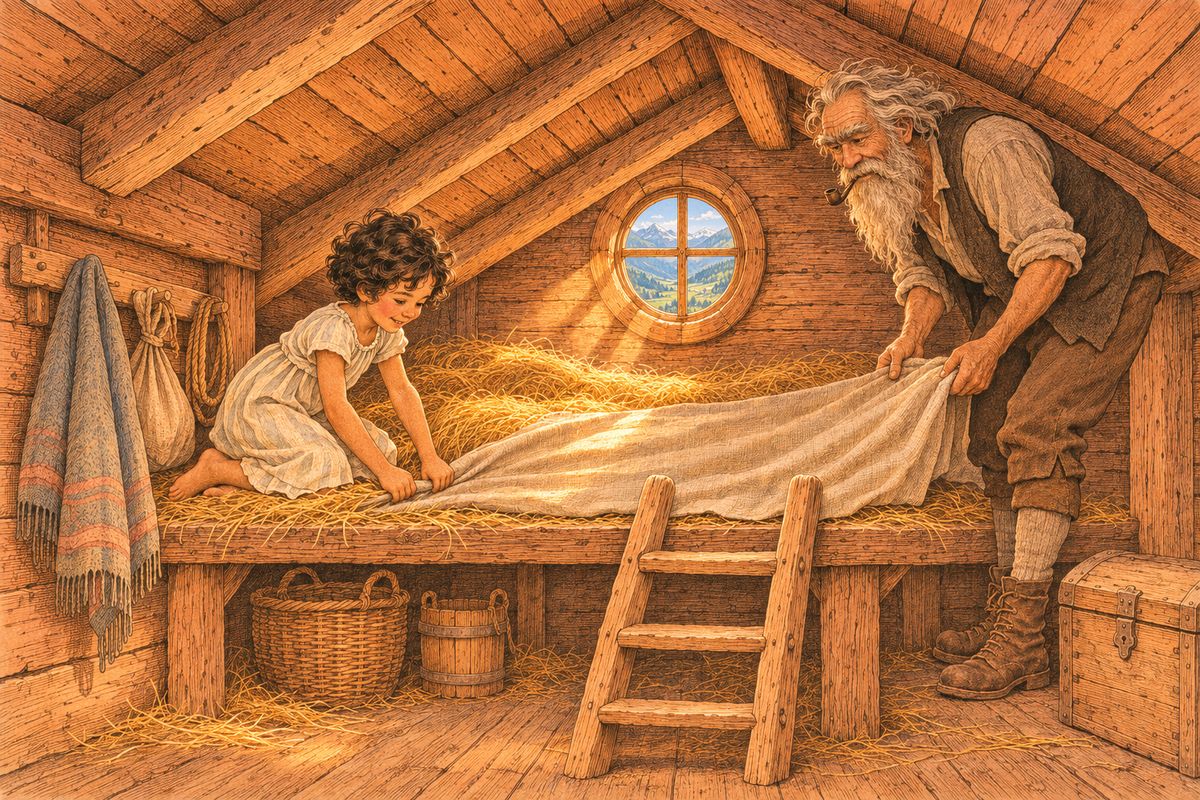
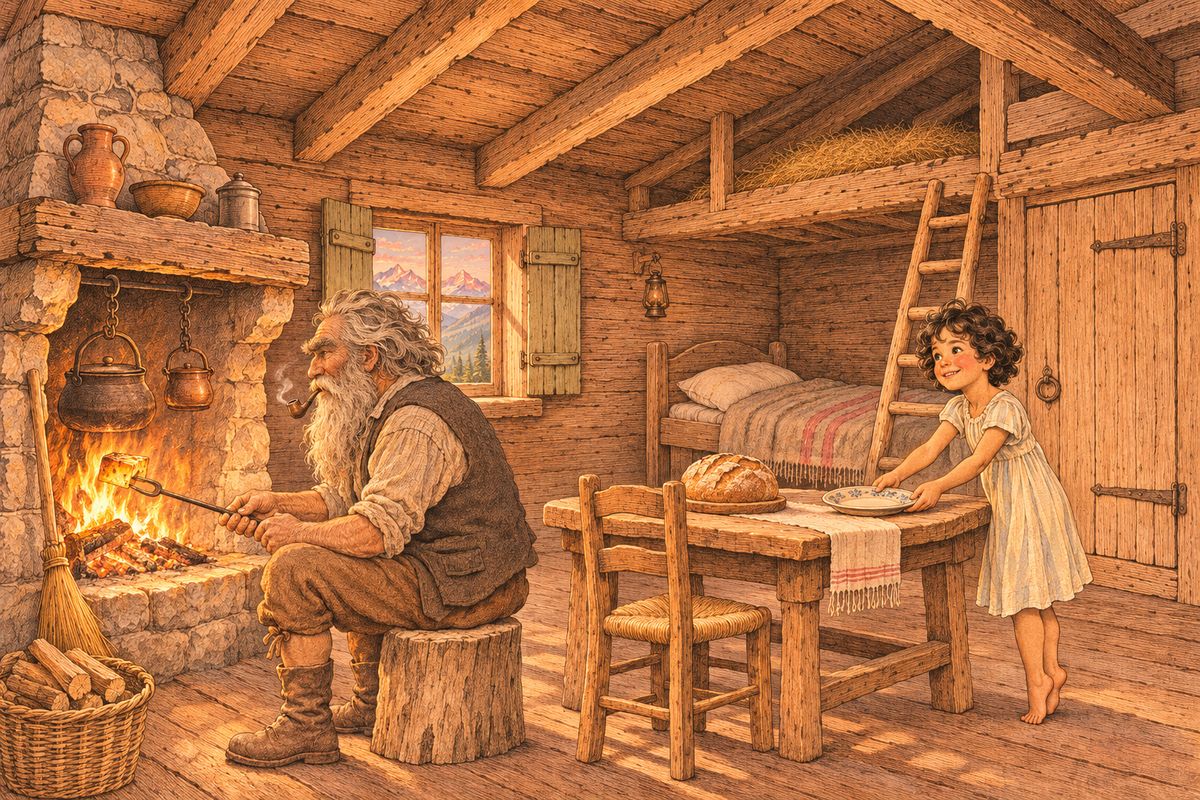
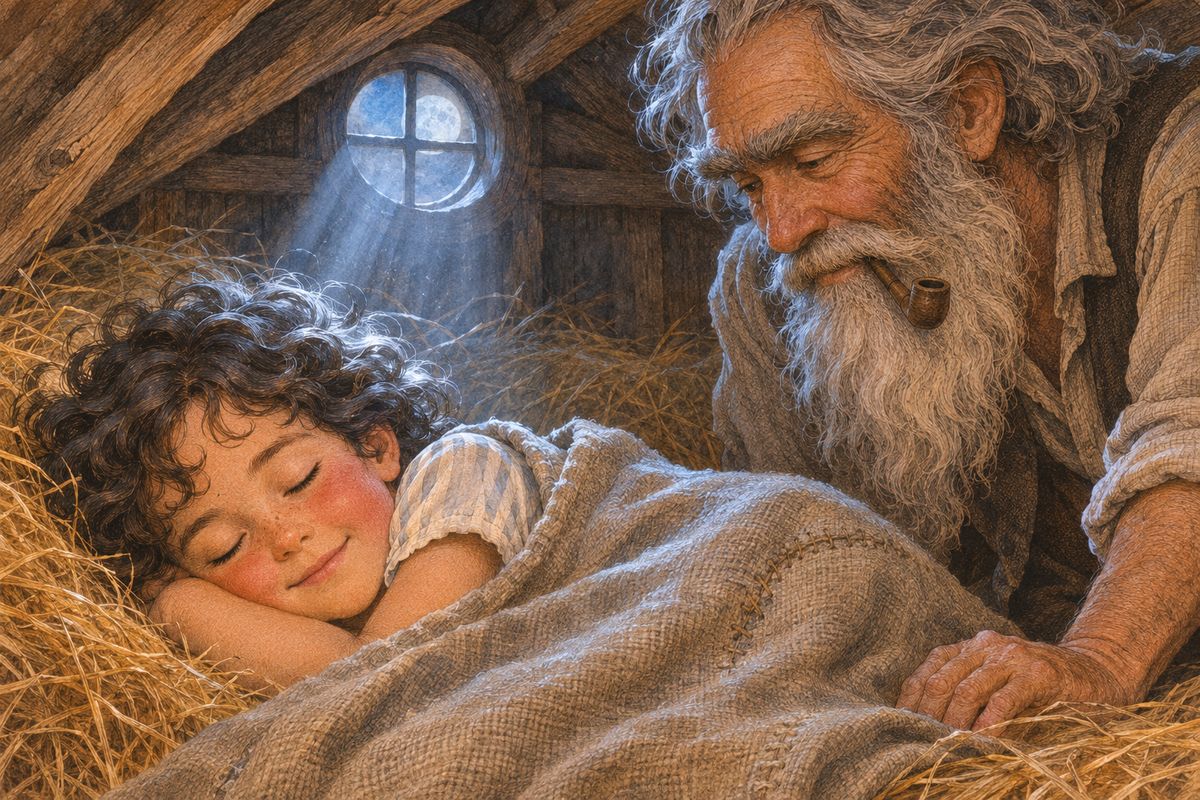
1On a hot June morning, Dete climbed up from Mayenfeld leading five-year-old Heidi, bundled in two frocks, a thick red shawl and nailed shoes. Past Dorfli, she told her friend Barbel the old man's story: Uncle had gambled away his farm, gone soldiering in Naples, and lost his son Tobias and Tobias's wife Adelaide, Heidi's parents.2While the women gossiped, Heidi slipped away after Peter the goatherd and his goats. Too hot to go on in her winter layers, she took off her thick shawl, outer frock, stockings and heavy shoes, folded them into a neat little heap, and ran uphill in her light summer dress. Peter looked back and grinned.3At the top of the Alm, the gruff old man sat smoking on his bench. Heidi reached him first, held out her hand and said calmly, "Good evening, Grandfather." He gave her hand a quick shake and stared at her from under his bushy brows, and she stared back just as steadily.4Dete said she had done her duty by the child for four years and now it was his turn. When she spoke too sharply, the old man rose and ordered her away, and she hurried off down the mountain. In Dorfli, the women called after her from every door and window, "The poor mite!"5Heidi explored her new home, stopping to listen to the wind roaring in the three old fir trees. When Grandfather said she could sleep wherever she liked, she chose the sweet-smelling hayloft and heaped up a pillow by the round window. Grandfather brought up a coarse sheet, and later a heavy sack to serve as a coverlid.6Downstairs, Grandfather toasted a big piece of cheese golden over the fire. Meanwhile Heidi, who had seen everything in the cupboard, laid the table with the round loaf, two plates and two knives. "I am glad to see that you have some ideas of your own," he said, and she drank the best milk she had ever tasted.7That evening, as the firs roared and Heidi danced for joy beneath them, Peter's whistle brought the goats bounding down. Two slender ones, one white and one brown, ran to Grandfather for salt. Heidi stroked them in delight and learned their names: Little Swan and Little Bear, who would always live with them.8That night a storm shook the hut and howled through the firs. "The child will be frightened," Grandfather murmured, and he climbed the ladder. But moonlight through the round window showed Heidi fast asleep under the heavy coverlid, her cheeks rosy and her face happy. He watched over her until clouds hid the moon.9Heidi woke next morning in the hay loft to golden sunlight and remembered with joy that she was no longer shut indoors with deaf old Ursula, but on the mountain. Grandfather let her go up with Peter and the goats, but first she must scrub in the tub before the door. "Will the sun laugh at me now, grandfather?" she asked, pink as a lobster.10Heidi ran ahead over slopes of red primroses, blue gentians and golden cistus, stuffing her apron with flowers to make her loft look like the meadows, while Peter whistled after his scattering goats. Only his talk of the old bird of prey on the topmost peak got her climbing, and at the high pasture a great bird came wheeling round and round, croaking above them.11At dinner Heidi drank her milk, then held out her big piece of bread and the whole slice of cheese: "You can have that, I have plenty." Peter could hardly believe it. While he ate, he taught her the goats' names: bullying Great Turk, brave little Greenfinch who faced him down, and little Snowflake, who bleated for her sold mother until Heidi promised to come every day.12Suddenly curious Greenfinch leapt to the very edge of the cliff, and Peter only just caught her hind leg; Heidi coaxed her back with sweet leaves. When Peter raised his stick to beat the goat, Heidi flung herself at him, eyes flashing. He let her off only for Heidi's cheese — and she promised it every day if he would never beat any of the goats.13As the sun sank, the rocks, the great snow-field and the sky began to glow. "Peter! Peter! everything is on fire!" cried Heidi, running back and forth, as the peaks turned rose and crimson and then faded to grey. Peter, peeling his stick, said calmly that it was always like that, and would come again to-morrow, for certain.14At home her apron of flowers spilled out withered like hay — they liked to stay out in the sun, said Grandfather — and over supper he named the peaks she described. Then she asked about the fire. "When he says good-night to the mountains," Grandfather said, "the sun throws his most beautiful colours over them, so that they may not forget him." She dreamed of rosy mountains and leaping Snowflake.15Day after day that summer Heidi climbed to the high pastures with Peter, until she was burnt brown by the sun and so strong that nothing ever ailed her. When the autumn winds blew too hard, Grandfather kept her at home, and she would run out again and again to stand beneath the three old fir trees, listening to them roar.16Then the snow came. It fell until it reached the windows and shut Heidi and Grandfather fast inside the hut, and once it stopped, Grandfather shovelled it into great heaps. A week had gone by without Heidi, so Peter would not be beaten. He fought his way up through the deep drifts, white all over with snow.17Peter brought word that his grandmother wanted Heidi to visit. Heidi said she must go five or six times a day until Grandfather gave in. He wrapped her in her thick sack, held her tight on his lap and pushed off on the hand-sleigh, and they shot down the mountain so fast that Heidi felt she was flying like a bird.18In the shabby, rattling cottage, the old grandmother at her spinning-wheel felt for Heidi's warm hand. Heidi asked why she could not see the shutter banging, and when she learned the grandmother could see nothing at all and never would again, she burst into bitter tears. "Who can make it light for you again? Can no one do it?"19That night Heidi begged Grandfather to mend the grandmother's house, and the next day he came down with his hammer and nails. All winter he made the cottage sound and tight. Every fine day Heidi sledged down to sit by the grandmother, who now cried, "God be thanked, she has come again!" and found the afternoons far too short.20Two winters and a bright summer passed, and Heidi, now nearly eight, was as happy as the birds. Uncle sent word to the schoolmaster that he would not send her to school. Then, one sunny March morning, as Heidi leapt over the water-trough, she nearly fell in with fright: an old gentleman in black stood gravely watching her.21It was the old pastor from Dorfli. He begged his old neighbour to send the child to school next winter and to come down and live among people again. Uncle spoke of storms, deep snow and the courts, then took the pastor's hand calmly and firmly: "I will not send the child to school nor come and live among you."22The next day Cousin Dete arrived in a feathered hat and a trailing skirt, all smiles. A rich family in Frankfurt wanted a companion for their invalid daughter, she said, and Heidi must go. When Uncle refused, she threatened him with the courts. "Go and be done with you!" he thundered, and he strode out of the hut.23Dete bundled up Heidi's clothes and hurried her down the mountain. As they passed Peter's cottage, the blind grandmother threw open her window and cried, "Dete, Dete, do not take the child away from us!" Heidi struggled to go to her, until Dete promised she could soon come back with a soft white roll for grandmother.24From that day Alm-Uncle looked grimmer than ever. He went no more to the grandmother's cottage, and when he strode through Dorfli with his cheeses, speaking to no one, mothers pulled their children out of his way. Only the blind grandmother spoke well of him, sighing, "Pray God I see Heidi again once more before I die!"25In a grand house in Frankfurt, pale Clara Sesemann lay waiting on her wheeled couch, watching the slow clock. At last, late in the day, Aunt Dete climbed the front steps with Heidi held tightly by the hand, and they were shown upstairs to Fraulein Rottenmeier, who kept the house.26Fraulein Rottenmeier looked the child over from beneath her towering headdress and decided the name must be Adelaide. Worse was to come. "Grandfather told me I was eight," said Heidi, and she had never learned to read. "Mercy upon us!" cried the housekeeper, horrified, while Dete hurried out of the house and left Heidi there.27When the grown-ups were gone, Clara beckoned the child to her couch. "Would you rather be called Heidi or Adelaide?" she asked. Heidi said she had never been called anything but Heidi. "Then I shall always call you by that name," Clara said, delighted with the curly-haired girl who said exactly what she thought.28At dinner Heidi told the footman Sebastian that he looked just like Peter, which shocked Fraulein Rottenmeier. Then she slipped the white roll by her plate into her pocket to take home to the blind grandmother. Sebastian, holding out the fish, shook so hard with silent laughter that the dish trembled in his hands.29Then Fraulein Rottenmeier began a long lecture on manners: how to behave at table, how to speak to servants, how to shut doors. Heidi had been up since before five, and her eyes slowly closed. When the lecture ended at last, Clara laughed: "Heidi has been asleep for ever so long!"30On her first morning in Frankfurt, Heidi woke in a high white bed and ran from window to window like a bird trying the bars of a new cage. The windows would not open, and above the sill she could see nothing but walls and windows, and again walls and windows.31During her first lesson Heidi heard a rushing sound like the wind in the fir trees and sprang up in joy, dragging the tablecloth with her. Books, inkstand and all crashed to the floor in a dark stream of ink, but she found only rattling carriages in the street. "She has not the smallest notion about anything!" cried Fraulein Rottenmeier.32When Sebastian told her that only a church tower would show her the whole valley, Heidi ran out alone. An organ-grinder boy led her to an old church for twopence, and the gruff tower-keeper scolded them for ringing. But Heidi clung to his coat and begged, "Let me go up, just once," and his face softened.33From the top of the tower Heidi saw only a sea of roofs, towers and chimney-pots. "It is not at all what I thought," she said sadly. But on the way down they passed a big basket of tumbling kittens, and the old man, glad to be rid of them, let her fill her pockets with two.34Heidi crept in late to dinner, and Fraulein Rottenmeier began a stern lecture. "Miau!" came the answer, then "Miau! miau!" while Sebastian fled to hide his laughter. "It isn't I, it's the kittens," Heidi explained at last, and Fraulein Rottenmeier shrieked and fled to lock herself in the study, leaving the girls to play with them happily.35Next morning a ragged boy rang the bell and asked Sebastian for the fourpence Clara owed him. Sebastian guessed who had really been out in the street. Grinning, he showed the boy into the study, and soon a hand-organ was blaring over the tutor's A B C. Fraulein Rottenmeier burst in, saw a tortoise crawling towards her feet, and leapt into the air shrieking, "Sebastian! Sebastian!"36Sebastian sent the boy and his tortoise away, but lessons had barely started again when a covered basket arrived for Clara. The loose lid slipped and out tumbled kittens, more and more of them. They scrambled over the tutor's boots, up Fraulein Rottenmeier's dress and onto Clara's couch. "Oh, the dear little things!" cried Clara, while Heidi laughed and chased them into every corner.37That evening the servants' story came out, and Rottenmeier learned that Heidi's outing was behind the whole commotion. Pale with anger, she said the little barbarian would be shut in a dark cellar with the rats and black beetles. Heidi only looked puzzled, because Grandfather's cellar was a pleasant place for cheese. Clara begged her to wait until Papa came home, and Rottenmeier had to give way.38For days Heidi talked of nothing but the mountain, and at every meal she secretly saved her white roll for Peter's grandmother, who could not chew hard black bread. One afternoon the longing grew too strong. Remembering that Dete had said she might go home whenever she liked, Heidi tied all her rolls into her red shawl and put on her straw hat.39At the front door Heidi ran into Fraulein Rottenmeier coming back from a walk. "Going home? Looking like a beggar?" Rottenmeier cried, and she ordered the bundle of stale, hard rolls thrown away. Heidi wept as if her heart would break. Later Clara comforted her and promised her a whole basket of fresh rolls for Grandmother, more than she had saved, when it was time to go home.40Herr Sesemann came home from his travels with parcels of pretty things and a kind handshake for Heidi. But at dinner Fraulein Rottenmeier sat opposite him looking like bad news itself. "Herr Sesemann," she said in a solemn voice, "we have been frightfully imposed upon."41When the tutor began his long, winding speeches, Herr Sesemann slipped away to the study and sent Heidi for a glass of fresh water. Meanwhile Clara begged him, "Please do not send her away!" Heidi came back from a far-off pump, bringing greetings from a white-haired gentleman with a gold chain: his old friend the doctor.42Herr Sesemann decided to keep Heidi and soon left again for Paris, but his mother came to stay. Heidi had been told never to say "grandmamma", so she greeted her as "Mrs. Madam". The old lady laughed and patted her cheek. "When I am with the children I am always grandmamma," she said.43Grandmamma gave Heidi beautiful picture books to look at. When she turned to a shepherd with his flock in a green pasture, glowing in the sunset, Heidi burst into sobs. Grandmamma comforted her and promised that as soon as Heidi could read, the book would be her very own.44Heidi grew paler but dared not say why. So Grandmamma told her she could tell God everything, and Heidi ran to her room to pray to go home. Later, when no answer came, she stopped praying, until Grandmamma gently explained that God answers in His own good time.45Then, to the tutor's astonishment, Heidi learned to read almost overnight. That evening she found the big picture book lying on her plate. "Yes, it's yours now," Grandmamma said. Her favourite tale was the Prodigal Son, whose father ran with open arms to welcome him home.46When Grandmamma drove away, the house felt empty. Fraulein Rottenmeier warned that if Heidi cried again over her reading, she would lose the book. So Heidi hid her tears. She grew pale, silent and thin, and at night she wept quietly into her pillow so that no one would hear.47Something strange was happening in Herr Sesemann's house. Every morning the servants came down to find the front door standing wide open, though it had been barred and doubly locked the night before, and nothing was ever taken. Soon nobody dared go anywhere in the house alone, and Tinette always called Sebastian to come with her.48At last Sebastian and John agreed to sit up and watch. At one o'clock John stepped boldly into the hall with his candle, but a gust of air from the open front door blew it out. He stumbled back white and trembling. "A white figure standing at the top of the steps," he gasped, "and then all in a minute it disappeared."49Next morning Fraulein Rottenmeier wrote to Herr Sesemann with fingers stiff with fear, begging him to come home. When he would not, she frightened Clara with the tale and wrote again that his daughter's health was in danger. That letter worked, and two days later the master rang at his own front door.50Herr Sesemann laughed at the ghost, but he sent for his old friend the doctor. That night the two men sat up in the watch room with tall candles burning, listening as midnight passed and then one o'clock. The house lay perfectly still until a faint sound came from the hall.51They heard the bar slide back and the key turn. Carrying candles, the two men stepped into the hall and saw a white figure standing in the moonlit doorway. "Who is there?" thundered the doctor. The figure turned with a low cry, and there stood Heidi, barefoot in her little white nightgown, trembling from head to foot. She had been walking in her sleep.52The doctor carried Heidi up to bed and asked her gently what she dreamed. Every night, she said, she was back with her grandfather, hearing the fir trees and seeing the stars, but when she woke she was still in Frankfurt; then at last she cried. Downstairs, the doctor gave his verdict: she was dreadfully homesick and must be sent home to the mountain at once.53Early one morning Herr Sesemann rang every bell in the house, and frightened servants came running, sure the ghost had struck. Fraulein Rottenmeier came down last, her cap on back to front. But the master was cheerful. The doctor had decided Heidi must go home that very day, so the trunk was to be packed at once.54Upstairs, Clara had filled a huge trunk with dresses and aprons for her friend. "And look here," she cried, and held up a basket. Inside were twelve beautiful round white rolls, all for the grandmother. The two girls were so happy about it that they forgot to be sad, until someone called that the carriage was waiting.55Heidi had wrapped her old red shawl round a secret bundle, but on the stairs Fraulein Rottenmeier snatched it away and threw it down. "No, no," said Herr Sesemann firmly. "The child shall take home with her whatever she likes, kittens and tortoises, if it pleases her." Heidi picked up her treasure and looked at him gratefully.56For two long days Heidi sat on the train with Sebastian, the basket on her knees, peeping in at the rolls and asking, "Are you sure grandmother is not dead?" At Mayenfeld the Dorfli miller took her and her trunk up in his cart, and in Dorfli she broke away from the curious villagers and climbed the mountain alone.57Breathless, Heidi burst into the little cottage and threw herself down at the grandmother's knees. "It's I, grandmother!" The blind old woman stroked her curls and wept for joy as Heidi piled all twelve rolls in her lap. Then Heidi took out her old battered hat, put her red shawl on, and hurried on up to Grandfather.58Higher up, the peaks blazed like flames and the snowfield turned crimson, and Heidi thanked God aloud with happy tears. Then she ran, and flung her arms round Grandfather's neck. For the first time in years his eyes were wet. Soon the goats came leaping down to her, and Peter's whole face lit up: "I am glad you are back."59The next day Heidi's money was set aside for a fresh roll for the grandmother every day, and Heidi read her a hymn that brought light to her heart. That evening she read Grandfather the Prodigal Son. Later, when she was asleep, he stood over her with his lamp. "Father, I have sinned against heaven," he whispered, and two tears rolled down his cheeks.60On Sunday Grandfather put on his coat with the silver buttons and took Heidi down to church in Dorfli, while the astonished villagers whispered, "Alm-Uncle is in church!" Afterwards he asked the pastor to forgive him, and the pastor welcomed him warmly as a neighbour. The whole village crowded round to shake his hand, and that day a letter came from Clara: she and Grandmamma would visit in the autumn.61In Frankfurt the kind doctor, grey with grief for his lost daughter, agreed to visit Heidi alone, for Clara was too weak to travel. As he left, a gust sent Fraulein Rottenmeier sailing almost into his arms, her white shawl billowing like a sail. Soon she was packing Clara's gifts into one enormous parcel.62On the Alm, Heidi ran down the path to greet her friend, but he had come alone. Seeing the sorrow in his eyes, she forgot her own disappointment and comforted him: "It won't be very long to wait for spring." Outside the hut, Grandfather served steaming milk and golden toasted cheese, and the doctor ate better than he had all year.63When the porter brought up the huge parcel, Heidi unpacked her treasures. That evening she carried Clara's gifts into Peter's cottage. The blind grandmother kept stroking her warm new shawl: "I never thought I should ever have such a splendid thing." Brigitta stared at the monster sausage in awe, and Peter, tumbling in, stopped short at the sight of it.64Next day on the high pasture the doctor asked how a sad heart could be healed. Heidi folded her hands and recited the grandmother's hymn, "Let not your heart be troubled" — the very verses his own mother had once said to him. He sat long with his hand over his eyes, comforted. Behind him, jealous Peter shook his fists at the man keeping Heidi from him.65After a sunny month of mountain days the doctor had to return to Frankfurt. Heidi ran sobbing after him, offering to come at once, but he gently said she must stay under the fir trees. "If I am ever ill and alone, will you come then?" he asked. "Yes, yes, I will come the very day you send for me," she promised.66When the first snow fell, Grandfather shut up the hut and took Heidi and the goats down to a half-ruined old house by the church in Dorfli, patched up all autumn. In its one sound room stood a huge stove painted with blue pictures, and behind it Heidi found her own hay bed. "O grandfather, this is my room, how nice!"67On the Alm, Peter had to crawl out of the snowed-in hut and dig a path every morning. Then the snow froze hard as iron, and his sledge flew so fast that he shot straight past the school. "She's got it now: the frost," he told Heidi, and that afternoon she rode up with him to find the grandmother ill in bed.68To cheer the grandmother every day, Heidi decided Peter must learn to read. Each evening she drilled him from Clara's rhyming ABC book. The playful verses warned him what might happen if he neglected his lessons, while Grandfather smoked his pipe by the stove and hid a smile. Peter bent over the letters and tried again.69By the end of the winter Peter could really read, and every evening he read one hymn to his grandmother. But he skipped every word that looked too long or too hard, so the old woman lay puzzling over the gaps and longing for spring, when Heidi would come and read the hymns whole again.70In May, Grandfather was building new chairs for the visitors from Frankfurt. Peter brought a letter he had forgotten at the bottom of his lunch bag. Clara wrote that they were coming soon, but Fraulein Rottenmeier would not come, because Sebastian had scared her with stories of steep cliffs and deep crevasses. Peter ran off in a fury.71Heidi was afraid the visitors meant to take her away, and so was Peter's blind grandmother, who found comfort in the hymn 'All things will work for good.' Then one bright day in late June, Heidi cried out: a strange procession was winding up the mountain towards the hut.72Grandfather lifted Clara out of the hard sedan as gently as if he had nursed the sick all his life. Grandmamma was astonished. After a happy dinner of toasted cheese in the open air, he suggested that Clara stay a month to grow strong, and he made her a soft bed of Grandmamma's shawls in the hayloft.73That night Clara lay in her soft bed of shawls and looked straight out through the round window at the shining stars, which she had hardly ever seen. "It's just as if we were in a high carriage and were going to drive straight into heaven," she whispered, while Heidi fell asleep beside her.74Every morning Clara drank a foaming bowl of Little Swan's milk and asked for more, while Peter shook his fists at her couch and stamped away. After three weeks, Grandfather began to coax her: "Won't the little daughter try if she can stand for a minute or two?" It hurt, and she clung to him, but each day he let her try a little longer.75At dawn a jealous Peter found Clara's chair standing alone outside the shed. He shoved it down the slope and watched from behind a blackberry bush as it tumbled and smashed. Heidi was sure the wind had done it, so Grandfather carried Clara up the mountain and laid her on shawls.76Clara loved the sunny pasture and soon knew every goat by name. When Heidi longed to run off and see the flowers, she left little Snowflake behind as company. Clara fed the kid leaves from her hand and felt a new wish to help others. "O Snowflake, how delightful it is up here!"77Heidi ran back calling that the flowers were glorious and ordered Peter to help. Afraid she knew his secret, he came meekly. Together they lifted Clara, and she set one foot down firmly, then another. "I can do it, Heidi! Look! I can make proper steps!"78They spent a blissful afternoon among the blue bellflowers and golden cistus. Clara sat silent with happiness while Peter slept. But that evening in Dorfli, Peter saw the broken chair and heard the baker say whoever had done it would be punished. He ran home sure that a constable would come from Frankfurt for him.79A week later Grandmamma rode up on her white horse. She was shocked to find Clara out of her chair, but then the two girls got up and walked over to her. Laughing and crying, she hugged them both and sent Peter down with a telegram calling her son from Paris.80Herr Sesemann had already set out to surprise them. On the path he asked Peter the way, and the terrified boy fled, tumbling head over heels and losing the telegram. At the hut, Clara walked to meet her father. He stopped short with tears in his eyes. "Are you my little Clara, really my little Clara?"81Peter, sure the stranger was the constable, confessed about the chair. Grandmamma kindly told him about the little watchman inside us who gives the wrongdoer no peace. Then she granted his wish, a penny every week for life. Heidi's own wish was her Frankfurt bed, so blind Grandmother could sleep warm.82Clara wept as she rode away on the white horse, promising to come back next summer. The bed arrived for Grandmother, and the doctor came to Dorfli to rebuild the old winter house, where he would watch over Heidi with Grandfather. In the cottage Grandmother said, "Heidi, read me one of the hymns!"
Adapted from Heidi by Johanna Spyri, public domain. Pictures are AI illustrations drawn for this edition.
Add Stories to your Home Screen: tap
then Add to Home Screen.