A picture-story retelling, after Mary Wollstonecraft Shelley (1818)
A gothic tragedy with several murders, an execution and deaths from grief and exhaustion. Each one is shown by the moment before or after, through shadow and distance, never in gruesome detail.
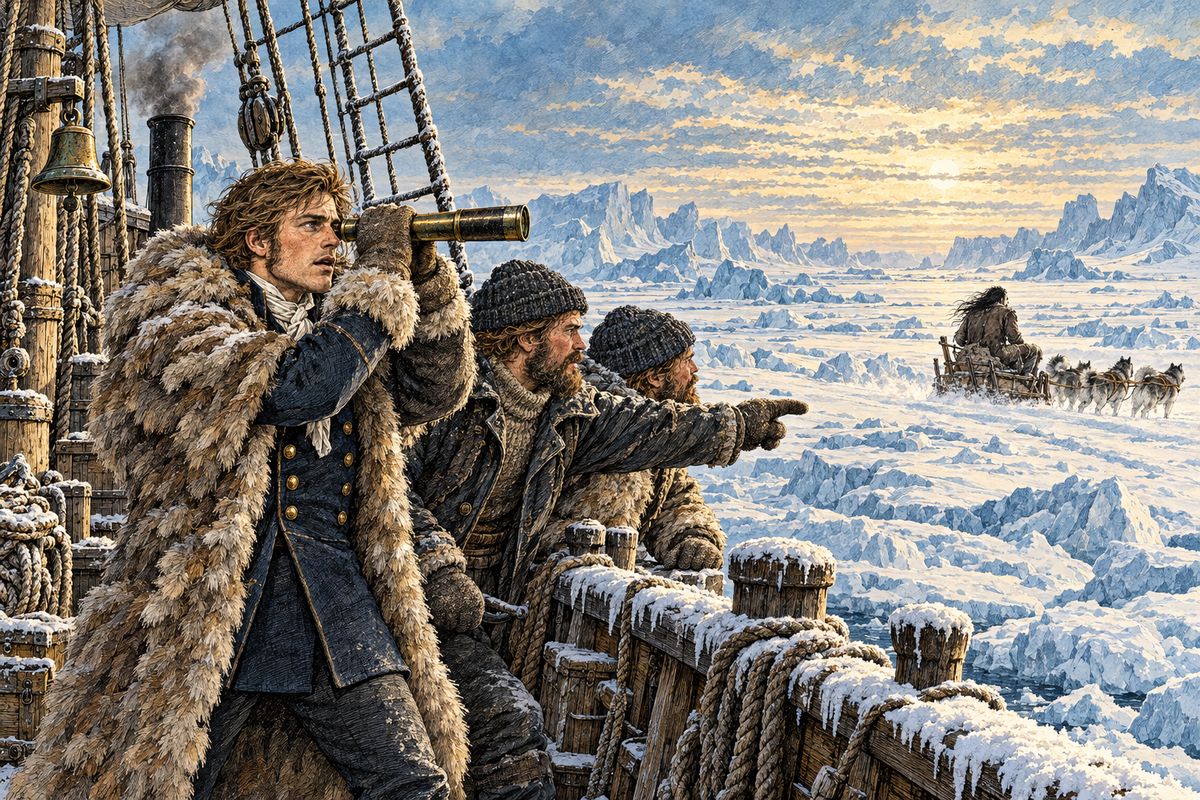
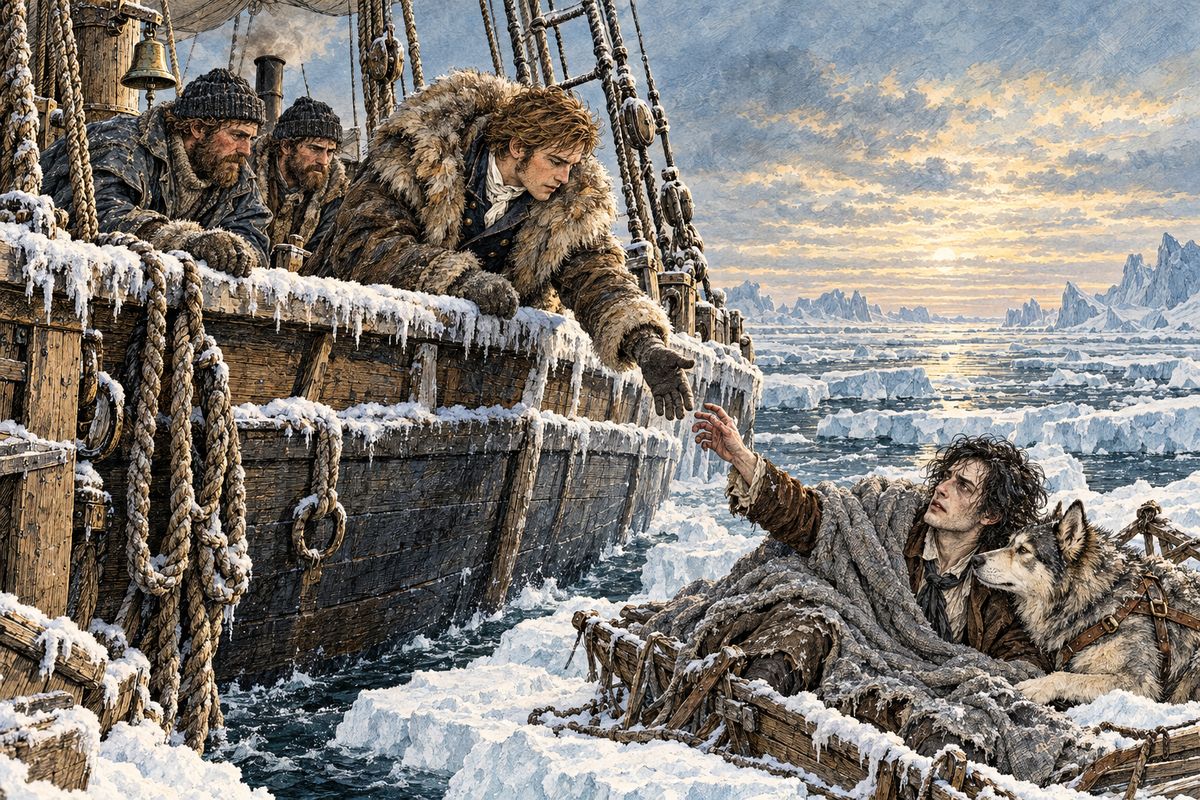
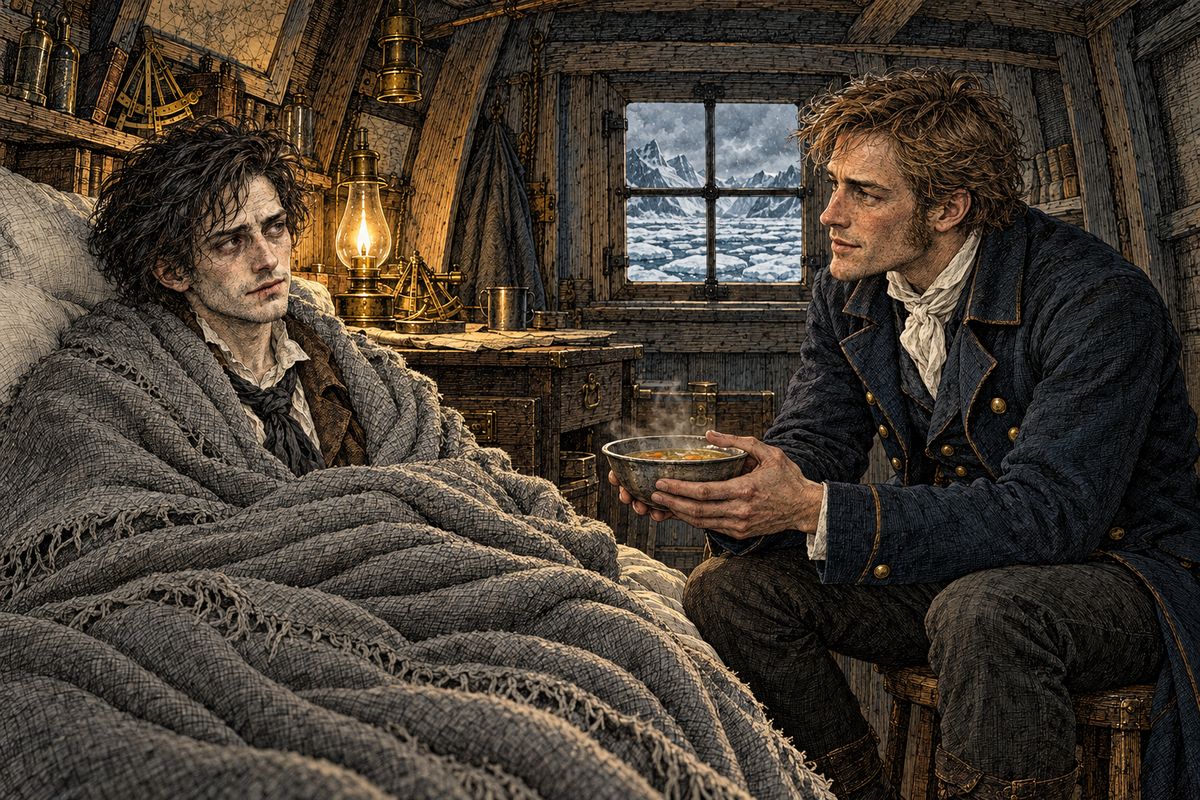
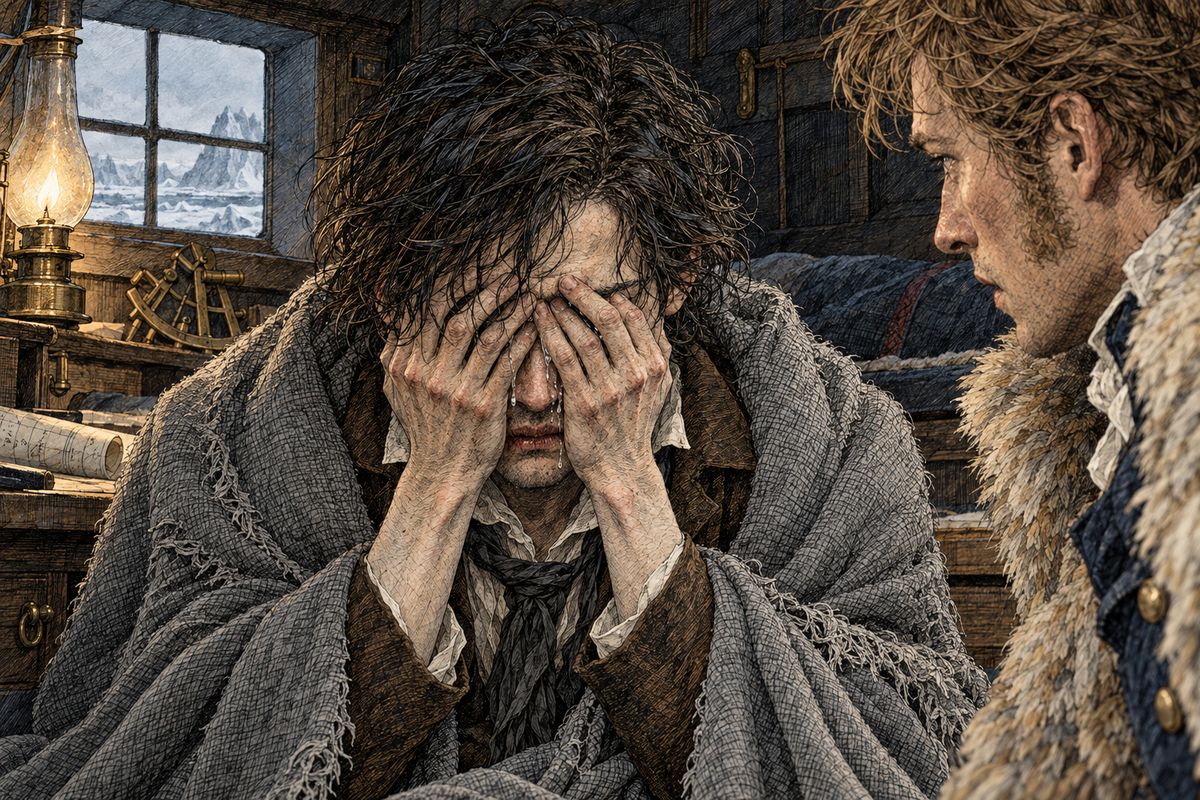
1In the spring of 17—, Robert Walton, a young English captain, hired a ship at Archangel and signed on a crew of hardy whalers. He dreamed of finding a passage past the North Pole and of setting foot on land no one had ever seen. Still, he wrote to his sister Margaret that he had no friend to share his hopes.2By late July the ship was far to the north when the pack ice closed in on every side and a thick fog swallowed the world. The crew lay to and waited. When the mist cleared they saw endless, broken plains of ice stretching in every direction. Some of the men groaned, and Walton's own thoughts grew anxious.3Then a strange sight caught every eye. Half a mile away, a sledge drawn by dogs sped north across the ice, driven by a being shaped like a man but of gigantic size. The sailors watched him through their telescopes until he vanished among the ridges. They had believed they were hundreds of miles from any land.4That night the ice broke up. At dawn the sailors found a second sledge beside the ship, drifting on a floe, with one dog still alive and a starving, half-frozen European inside. Before he would come aboard he asked, "Will you have the kindness to inform me whither you are bound?" When Walton told him they were heading for the Pole, he agreed.5Walton nursed the stranger in his own cabin. He recovered slowly, though a wild grief often filled his eyes, and he would say only that he was hunting "one who fled from me." Walton found him gentle, wise and eloquent. He came to love him as a brother: the friend he had believed he would never find at sea.6One evening Walton declared that he would gladly give his fortune, even his life, for the knowledge he sought. The stranger covered his face and wept. "Unhappy man! Do you share my madness?" A few days later he agreed to tell Walton his own story, hoping it would serve as a warning, and promised to begin the next day.7Victor's father, Alphonse Frankenstein, searched for ten months for his ruined friend Beaufort. When he found him in Lucerne, he was too late. Beaufort's daughter Caroline was kneeling by her father's coffin, weeping. Alphonse took her home to Geneva under his protection, married her two years later and took her travelling. Their first child, Victor, was born in Naples.8By Lake Como, Caroline came across a poor cottage full of hungry children. One of them was different: a fair, golden-haired orphan of noble birth named Elizabeth. Caroline adopted her. 'I have a pretty present for my Victor,' she said, and five-year-old Victor took the gift seriously. He believed Elizabeth was his to protect and love.9The family settled at Belrive with Victor's school friend Henry Clerval, and no childhood could have been happier. Elizabeth loved poetry, while Victor longed to discover nature's secrets. At thirteen, kept indoors by rain at an inn in Thonon, he found a book by Cornelius Agrippa. 'My dear Victor,' his father said, 'it is sad trash.' Victor kept reading.10When Victor was fifteen, a violent storm rolled in from the Jura. From the doorway he saw a stream of fire burst from the old oak, and by morning only thin ribbons of wood were left. A visiting scientist explained electricity and galvanism to him. Victor's old masters suddenly seemed worthless to him, and for a time he gave up the study of nature altogether.11When Victor was seventeen, just before he was to leave for university, Elizabeth caught scarlet fever. His mother nursed her back to health, but then she caught the fever herself. On her deathbed she joined their hands. 'My children,' she said, 'my firmest hopes of future happiness were placed on the prospect of your union.' Then she died calmly.12After weeks of mourning, Victor could put off leaving no longer. The family sat up late, unable to say goodbye. At dawn they were all waiting by the carriage. His father blessed him, Clerval, whose father would not let him study, pressed his hand, and Elizabeth begged him to write often. Then the chaise carried him away to Ingolstadt.13In Ingolstadt, the squat professor Krempe sneered at Victor's alchemists as 'nonsense'. Then kind Professor Waldman lectured on modern chemistry, whose masters 'command the thunders of heaven'. As Victor listened, his mind caught fire with a single purpose: he would explore unknown powers and reveal the deepest mysteries of creation. That day, he later said, decided his destiny.14At Ingolstadt, chemistry became Victor's whole life. Kind Professor Waldman smoothed every path for him, and Victor worked so eagerly that the stars often faded into morning while he was still bent over his instruments. Two years passed this way, and he never once went home to Geneva.15Asking where life itself came from, Victor turned to death. He spent days and nights in vaults and charnel-houses and watched how the body wasted and decayed. Then, out of that darkness, a sudden brilliant light broke in on him: he had found the cause of life, and could give it to lifeless matter.16He decided to make a being like himself, but gigantic, about eight feet tall. For months he went out by night to collect what he needed from charnel-houses, disturbing "with profane fingers" the secrets of the human frame, and often loathing his own work.17In a lonely attic cell at the top of the house he toiled through winter, spring and summer, blind to the fine harvest outside. His father's letters went unanswered. By the time the leaves had withered, Victor was pale and thin, shaken every night by a slow fever, and startled by the fall of a leaf.18On a dreary night of November, at one in the morning, Victor gathered the instruments of life about him. Rain pattered on the panes and his candle was nearly burnt out. Then, by its dying glimmer, he saw the dull yellow eye of the creature open; it breathed hard, and its limbs twitched.19The dream of two years vanished, and Victor fled the room in horror. Asleep at last, he dreamed that he kissed Elizabeth and she turned into his dead mother's shrouded corpse. He woke shaking to find the creature holding up the bed curtain, grinning and reaching out a hand. Victor escaped downstairs into the courtyard.20At a wet dawn he walked the streets without daring to look behind him, until the Swiss coach stopped beside him and Henry Clerval sprang out. "My dear Frankenstein, how glad I am to see you!" For a moment home came back to Victor, though Henry soon saw how thin and ill he looked.21To Victor's wild relief, his rooms were empty. But his frantic laughter turned to terror, and he collapsed in a fit, the start of a nervous fever. All winter Henry was his only nurse and kept the worst from Victor's family. When spring buds appeared at the window, Victor was well again.22All through that long spring Clerval nursed Victor back to health, and at last he gave him a letter from Elizabeth. She begged for a single line in his own hand. She also wrote that gentle Justine Moritz, the servant girl his mother had loved and educated, had come home to live with them. "Dear, dear Elizabeth!" Victor cried, and he wrote back at once.23Once he was well, though, Victor could not bear even the name of natural philosophy. Clerval had hidden all his apparatus, but when they called on the professors, M. Waldman's kind praise of his progress felt like torture, and M. Krempe's blunt boasting was worse. Seeing his pain, Clerval quietly turned the talk elsewhere. He never tried to draw out Victor's secret.24Winter snows put off his journey home until spring. In May, Clerval proposed a fortnight's walking tour around Ingolstadt, and among blossoming hedges and cheerful faces Victor learned to be happy again. They came back on a Sunday afternoon while the peasants were dancing on the village green, and Victor bounded along in high spirits.25A letter from his father was waiting for him. Little William was dead, found strangled on the meadow of Plainpalais with the print of the murderer's finger on his neck. That evening the boy had begged Elizabeth to let him wear a miniature of their mother, and the picture was gone. "Come, Victor," his father wrote; "you alone can console Elizabeth."26Dread slowed his journey, and by nightfall the gates of Geneva were shut. He crossed the lake by boat to Plainpalais as a great storm broke over the Alps and lightning turned the lake into a sheet of fire. "William, dear angel! this is thy funeral!" he cried. Then a flash showed him a gigantic figure, the creature, climbing the sheer rocks of Mont Salêve.27Victor was sure the creature was the murderer, but who would believe a story that sounded like the ravings of fever? He said nothing. At dawn his brother Ernest found him in the library, weeping, with terrible news: the murderer had been found. Justine Moritz was arrested after the missing miniature turned up in her pocket. "Justine is innocent," Victor insisted.28At Justine's trial, Victor sat in silent torture, sure that his creature was the true killer. The lost picture of his mother had been found in her pocket. Elizabeth rose bravely to defend her: "If she had earnestly desired it, I should have willingly given it to her." But the ballots were all black, and Justine was condemned.29Justine had confessed, but in her gloomy cell she told Elizabeth the truth: her confessor had threatened her with hell fire until, with no one to support her, she signed a lie. Now she was calm and full of faith. "I do not now fear to die," she said, while Victor hid his anguish in a corner, unable to speak.30On the morrow Justine died on the scaffold as a murderess; neither Elizabeth's tears nor Victor's pleas could move the judges. Watching those he loved weep for William and Justine, Victor knew who was to blame: "I, the true murderer, felt the never-dying worm alive in my bosom."31Back at Belrive, Victor took the boat out alone at night and drifted on the silent lake, tempted to plunge in and let the waters close over him. Only the thought of Elizabeth, his father and Ernest held him back. Later Elizabeth took his hand and begged him to banish his dark passions, but even her love could not lift his gloom.32In mid-August, two months after Justine's death, Victor fled to the Alps, riding up the roaring ravine of the Arve toward Chamounix. Glaciers crept down to the road, avalanches thundered, and Mont Blanc's great dome towered over all. That night he watched pale lightning flicker above the mountain until sleep, at last, crept over him.33Victor wandered a day among the glaciers at the source of the Arveiron, and their grandeur calmed him a little. But he woke to pouring rain and mist over every summit. Still he rode his mule up Montanvert alone, along a path scarred by winter avalanches, where even a loud word could bring the stones down.34At noon the mist lifted, and Victor crossed the heaving ice to gaze up at Mont Blanc. "Wandering spirits," he cried, "allow me this faint happiness, or take me as your companion." Then he saw a figure far off coming towards him at superhuman speed, bounding over crevasses he had crept around. It was the wretch he had made.35Victor called him a devil and sprang at him, but the creature stepped easily aside. "I was benevolent and good; misery made me a fiend," he said. "Make me happy, and I shall again be virtuous." If Victor would do his duty to him, he promised to leave mankind in peace. If not, he would glut death with the blood of Victor's remaining friends.36"Hear my tale," the creature begged, "and then decide." Victor did not answer, but he followed him across the ice and up the rock, half from curiosity and half from a first stirring of what a creator owes his creature. As rain began again, the creature lit a fire in the mountain hut, and Victor sat to listen as he began.37Fleeing Victor's room, the newborn creature wandered into the forest near Ingolstadt, where light, sound and smell crashed over him all at once. He drank at a brook, ate fallen berries and wept from cold, until a huge cloak under a tree and the rising moon gave him his first pleasure. In the weeks after, he learned the birds' sweet songs.38One cold day he found a fire left by wandering beggars and, in his delight, thrust his hand into the live embers. How strange that the same thing could warm and burn! Slowly he learned to dry wood, fan the flames and roast nuts and roots. When food ran short he had to leave the fire behind and set off west.39In the snowy open country an old shepherd took one look at him and fled his hut shrieking. At sunset the creature reached a village and stepped into a cottage. Children screamed and a woman fainted, and the whole village rose against him with stones and sticks until, badly bruised, he ran for the fields.40He hid in a low hovel built against the back of a neat cottage. Through a tiny chink in a boarded window he watched a blind, silver-haired old man play a sad, sweet air for a gentle girl, Agatha, until she wept and knelt at his feet. Her sorrowful brother Felix came home later carrying wood. The sight filled the creature with a strange mix of pain and joy.41In time he understood why they were sad: they were very poor, and Felix and Agatha often went hungry so their father could eat. Ashamed, he stopped stealing their food. Instead, at night, he cut firewood with Felix's tools and stacked it by the door. 'Good spirit,' they whispered, amazed, though he did not yet know the words.42Over many months he worked out that their sounds carried meaning. One by one he learned 'fire', 'milk', 'bread' and 'wood', and then their names: father, Agatha, Felix. Each evening Felix read aloud to the others, and in the dark of his hovel the creature mouthed the words after him, longing to speak well enough to make them overlook his face.43After admiring how lovely the cottagers were, he looked into a clear pool and recoiled. Was that monster really himself? Yet as the snow melted, the cottagers had enough to eat again and birds sang among the budding trees. 'Happy, happy earth!' His sorrow faded, and he dreamed that by gentleness he might one day win their love.44As spring bloomed, a lady on horseback came to the cottage door, wrapped in a thick black veil. When Agatha asked her a question, she answered with one word, spoken in a sweet, foreign voice: "Felix." He rushed out, and she threw back her veil. All the sorrow went from his face, and he kissed her hand and called her his sweet Arabian.45Safie brought joy to the cottage. She played the old man's guitar, and Felix began teaching her French from Volney's 'Ruins of Empires'. Unseen behind the wall, the creature listened to every lesson. Within two months he understood almost every word, and he was learning far faster than the Arabian, who still spoke in broken phrases.46From these lessons he learned how people divided themselves into rich and poor, high birth and low, families and strangers. Then he turned to look at himself. He had no money, no family, no friend, and no one else like him. "Was I then a monster, a blot upon the earth, from which all men fled?" The more he knew, the deeper his sorrow grew.47In time he learned their history. In Paris, Felix had freed a Turkish merchant who had been unjustly condemned, and the merchant promised him his daughter Safie. The escape was discovered. The De Laceys lost everything and were sent into exile, and the Turk broke his word. But Safie defied her father and travelled alone across Europe to find the man she loved.48One August night, in the wood, the creature found a leather case holding Paradise Lost, Plutarch's Lives and The Sorrows of Werter. Reading them, he felt as alone as Adam and as bitter as Satan. Then he made out Victor's journal from the pocket of the stolen coat, and every word of loathing about his making sickened him. 'Accursed creator!' he cried.49Through autumn he planned, and on a bright winter day, when the young people had gone walking, he knocked at the cottage door. 'Come in,' said blind old De Lacey, and welcomed the traveller to his fire. When the creature spoke of beloved friends who were set against him, the old man answered gently that he believed him sincere and would gladly help.50Hearing steps outside, the creature fell sobbing at the old man's knees: 'Save and protect me!' Then the door opened. Agatha fainted, Safie ran from the cottage, and Felix tore him away and struck him again and again with a stick. The creature could have torn him limb from limb, but he held back, and fled to his hovel.51That night he raged through the wood and declared war on all mankind, and most of all on his maker. Next day he heard Felix tell the landlord that the family could never live there again. The De Laceys were gone for good. Once the moon had set, he piled straw around the empty cottage and set it alight in a howling wind.52Guided by Victor's papers, he travelled south-west towards Geneva through a winter of snow and frozen rivers, moving only by night. One spring morning in Switzerland he pulled a drowning girl from a rushing river, but the man with her snatched her away and shot him. 'This was then the reward of my benevolence!' He swore hatred against all mankind.53He reached the fields outside Geneva at dusk, and a little boy came running into his hiding place. Hoping for a friend too young to fear him, the creature caught hold of the child. But William screamed 'Monster!' and cried that his papa was M. Frankenstein. 'You shall be my first victim,' said the creature, and strangled him. From the child's breast he took a portrait of a lovely woman.54In a barn he found a young woman, Justine, asleep on the straw. Afraid she would wake and name him as the murderer, he tucked the portrait into a fold of her dress and fled. At last he came into these mountains to find his maker and make one demand: a companion as hideous as himself. 'This being you must create.'55"I do refuse it," Victor cried; no torture would ever make him create a second such being. The creature's face twisted with rage, and he swore undying hatred against his maker. Then, calmer, he asked only for a companion as hideous as himself. Together, he said, they would live harmlessly in the wilds of South America, eating acorns and berries.56Shaken, and moved by his story, Victor at last agreed, on the creature's solemn oath to leave Europe forever. "I swear by the sun, and by the blue sky of Heaven," the creature cried, and rushed down over the sea of ice faster than an eagle flies. That night, alone beneath the stars, Victor wept bitterly.57Back in Geneva, Victor put off the hated work for weeks. When his father hoped for an early wedding to Elizabeth, Victor asked first to travel to England, where he could do the task far from those he loved. On the September morning he left, Elizabeth could not find any words. She bade him a tearful, silent farewell.58Henry Clerval joined him at Strasburgh, and the two friends sailed down the Rhine past willowy islands, vineyards and ruined castles on their crags. Clerval was overjoyed by every view. "This is what it is to live!" he cried. But Victor sat brooding in the boat, haunted by the work that waited for him at the end of the journey.59Victor and Clerval spent the winter in London, where Victor secretly gathered the materials for his dreadful new task, each step 'like the torture of single drops of water' on his head. In spring they travelled north, and among the Cumberland lakes Victor could almost fancy himself back among the Swiss mountains, while Clerval cried, 'I could pass my life here.'60At Perth Victor could bear company no longer. He told Clerval he would tour Scotland alone for a month or two. Henry begged him to write often: 'Hasten then, my dear friend, to return.' Victor rode away to the far north, sure the creature was following him and would show himself once the work was done.61On one of the remotest Orkneys, a bare rock beaten by waves and home to five half-starved people, he hired a broken hut and patched it. There he worked in cold blood, no longer blinded by the frenzy of his first creation, and his heart often sickened at what his hands were doing. He dared not raise his eyes, afraid of seeing his persecutor.62One moonlit evening Victor sat idle at his bench and thought it through: she might be worse than her mate, might hate him, might give the world a race of devils. Then he looked up and saw the creature grinning at the window. Shaking with rage, Victor tore the half-finished thing apart. With a howl of despair and revenge, the creature withdrew.63Hours later the creature rowed back and came into Victor's room. 'You are my creator, but I am your master—obey!' Victor refused to make him a mate. The creature gnashed his teeth and swore revenge, and at the door he turned: 'I go; but remember, I shall be with you on your wedding-night.' Then his boat shot away into the dark.64Two nights later Victor packed the remains into a basket weighted with stones and sank it four miles out under a clouded moon. He fell asleep in the skiff, and the wind drove him far across a stormy sea. When he finally reached a small Irish harbour, a frowning crowd closed around him: he was to answer to Mr Kirwin, the magistrate, for a gentleman found murdered there the night before.65Seized on landing in Ireland, Victor was brought before the magistrate, kindly old Mr. Kirwin. A fisherman told how he had tripped in the dark over a young man's body, still warm and dry, strangled, with the black mark of fingers on his neck. Remembering William, Victor trembled and gripped a chair, and the magistrate watched him keenly.66Mr. Kirwin had him taken to the inn to view the body. In the coffin lay Henry Clerval. Victor threw himself upon his friend: "Have my murderous machinations deprived you also, my dearest Henry, of life?" He was carried out in convulsions, and for two months he raved in fever that he had murdered William, Justine and Clerval.67He woke in a barred prison room. Mr. Kirwin, who had found his father's letter among his papers, had sent to Geneva, and Alphonse came to his bedside. At the assizes the grand jury freed him on proof that he had been on the Orkneys that night, and father and son sailed from Ireland at midnight, Victor still haunted by Clerval and the monster.68After resting a while in Paris with his father, Victor got a letter from Elizabeth. Gently, she offered to release him if he loved someone else. But it only reminded him of the creature's vow, "I will be with you on your wedding night!" Victor took it as a threat to his own life, and he decided to marry her anyway and face his fate.69Ten days later they were married in Geneva and sailed away across the lake toward Evian. Mont Blanc shone in the distance. "What a divine day!" Elizabeth said, pointing out the fish in the clear water. Even so, her joy kept giving way to a quiet dread, while Victor knew these were his last happy hours.70They landed at Evian at sunset, and that night a violent storm swept the lake. Victor, gripping a pistol hidden inside his coat, begged Elizabeth to go to bed. Then he crept through the inn's passages, searching every corner for his enemy. He had begun to hope the fiend would not come, when a shrill, dreadful scream rang out from her room.71He rushed in and found Elizabeth lifeless, thrown across the bed. When he looked up, the shutters stood open, and at the window the monster grinned and pointed a jeering finger at her body. Victor drew his pistol and fired, but the creature sprang away and plunged into the lake. The boats and nets that searched for him found nothing.72Victor hurried back to Geneva. His father could not bear the news, and within a few days he died in Victor's arms. For months afterwards Victor was locked in a madman's cell. Once he was released, he told a Genevan magistrate the whole story. The magistrate did not believe it, so Victor swore to hunt the creature down himself.73With Elizabeth and his father dead, Victor left Geneva for ever. At dusk he knelt at the family grave and swore by the Night and the spirits of the dead to hunt the dæmon until one of them died. A loud, fiendish laugh answered him. "I am satisfied," whispered a hated voice. "You have determined to live."74For months Victor followed him down the Rhone, onto a ship bound for the Black Sea, and through the wilds of Tartary and Russia. The creature kept him going with messages cut into bark and stone, and sometimes left food: "Follow me; I seek the everlasting ices of the north. Come on, my enemy; we have yet to wrestle for our lives."75With a dog-sledge he gained on his enemy, and followed him out onto the frozen sea. After three weeks he saw the creature's sledge less than a mile ahead. Then a ground sea thundered beneath the ice, and it split with a roar like an earthquake. Black water rolled between them, and Victor was left drifting on a shrinking floe.76Rescued by Walton's ship, Victor told his whole tale, then weakened day by day while the ice closed around them. When the sailors came to demand that Walton turn south if the ice freed them, the dying man rose from his blankets. "Be steady to your purposes, and firm as a rock," he urged them. "This ice is not made of such stuff as your hearts may be."77Walton gave in, and when the ice broke the ship turned for England while the crew cheered. Victor tried to rise and pursue his enemy but fell back, dying. "Seek happiness in tranquillity, and avoid ambition," he told Walton, "even if it be only the apparently innocent one of distinguishing yourself in science and discoveries." Then he pressed his friend's hand, and closed his eyes for ever.78At midnight Walton found the creature weeping over the coffin. "That is also my victim!" he cried, hating himself more than any man could hate him. He swore to build his own funeral pyre at the Pole, so that no one could ever make another like him. Then he sprang from the cabin window onto his ice raft, and was carried away into darkness and distance.
Adapted from Frankenstein; Or, The Modern Prometheus by Mary Wollstonecraft Shelley, public domain. Pictures are AI illustrations drawn for this edition.
Add Stories to your Home Screen: tap
then Add to Home Screen.