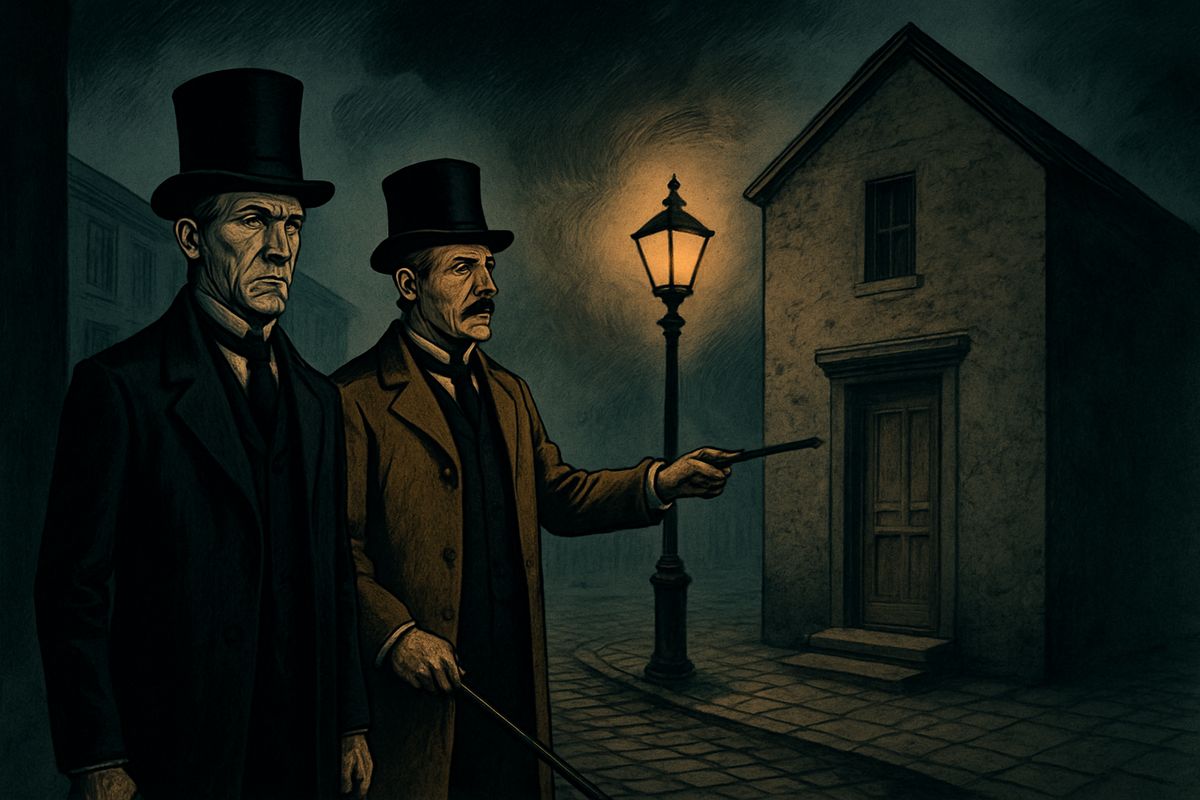
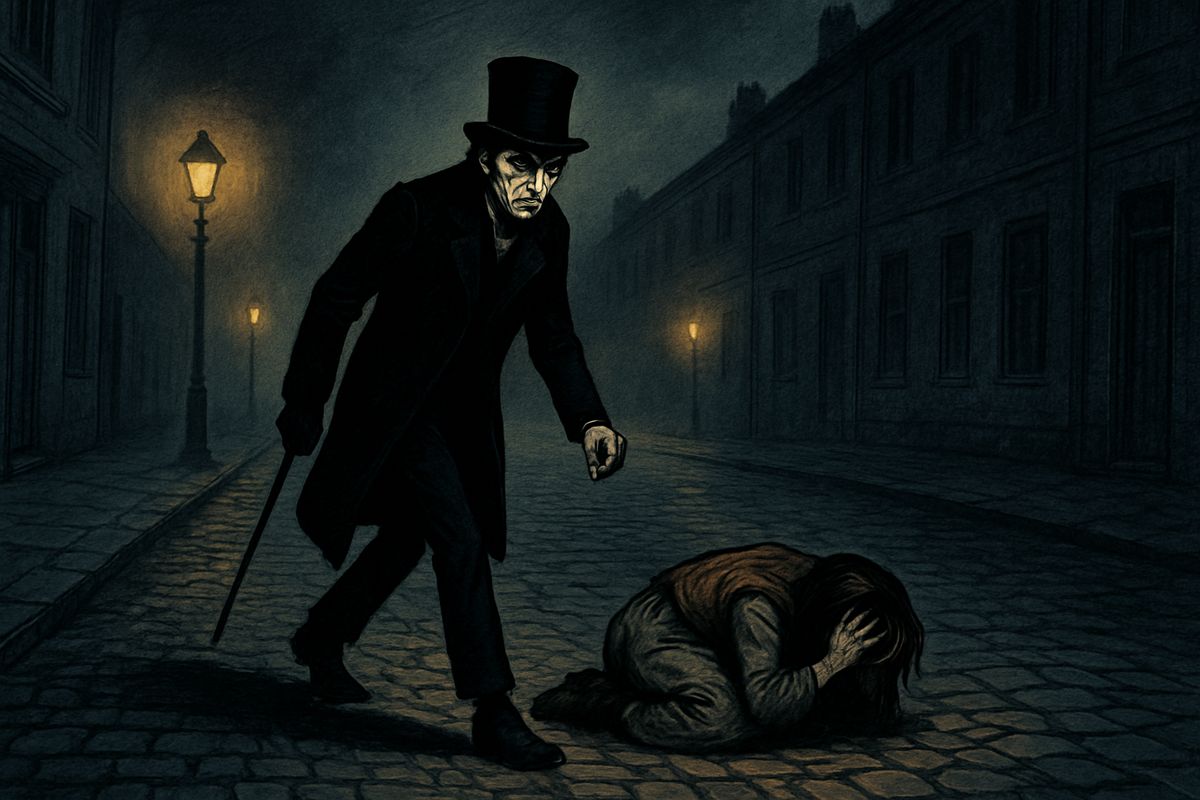
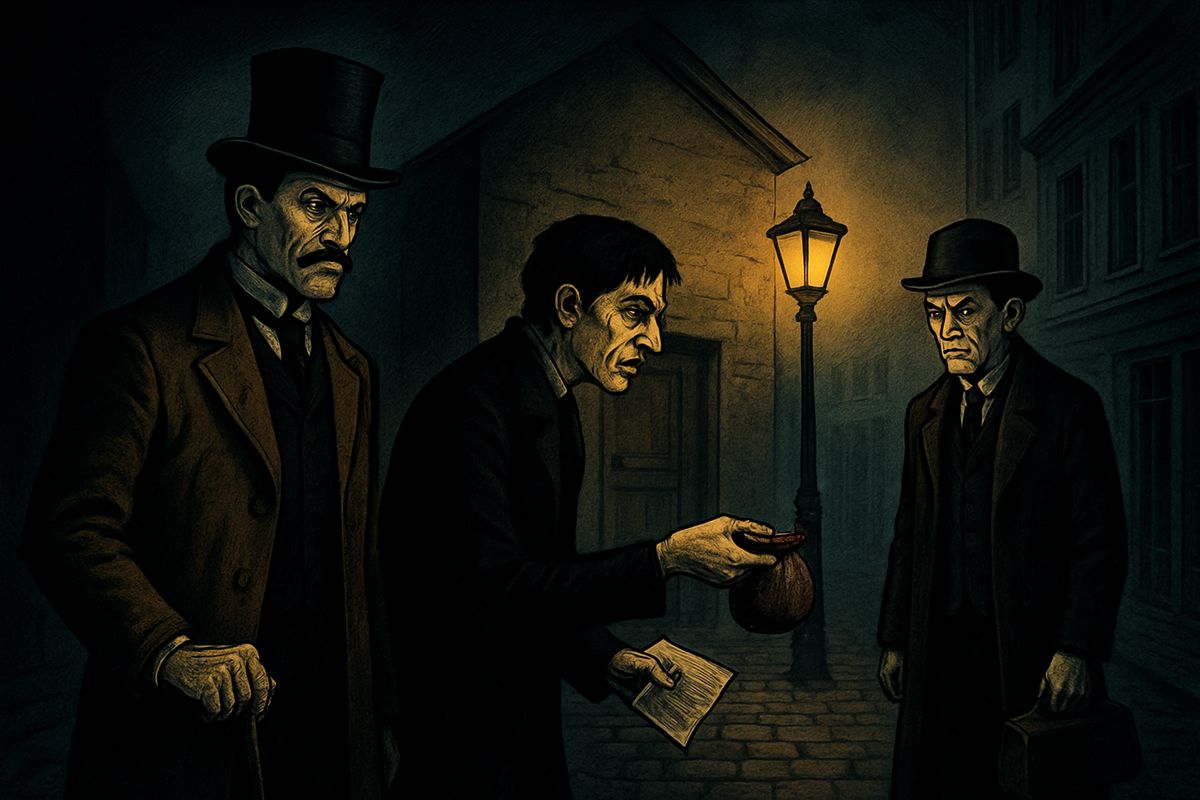
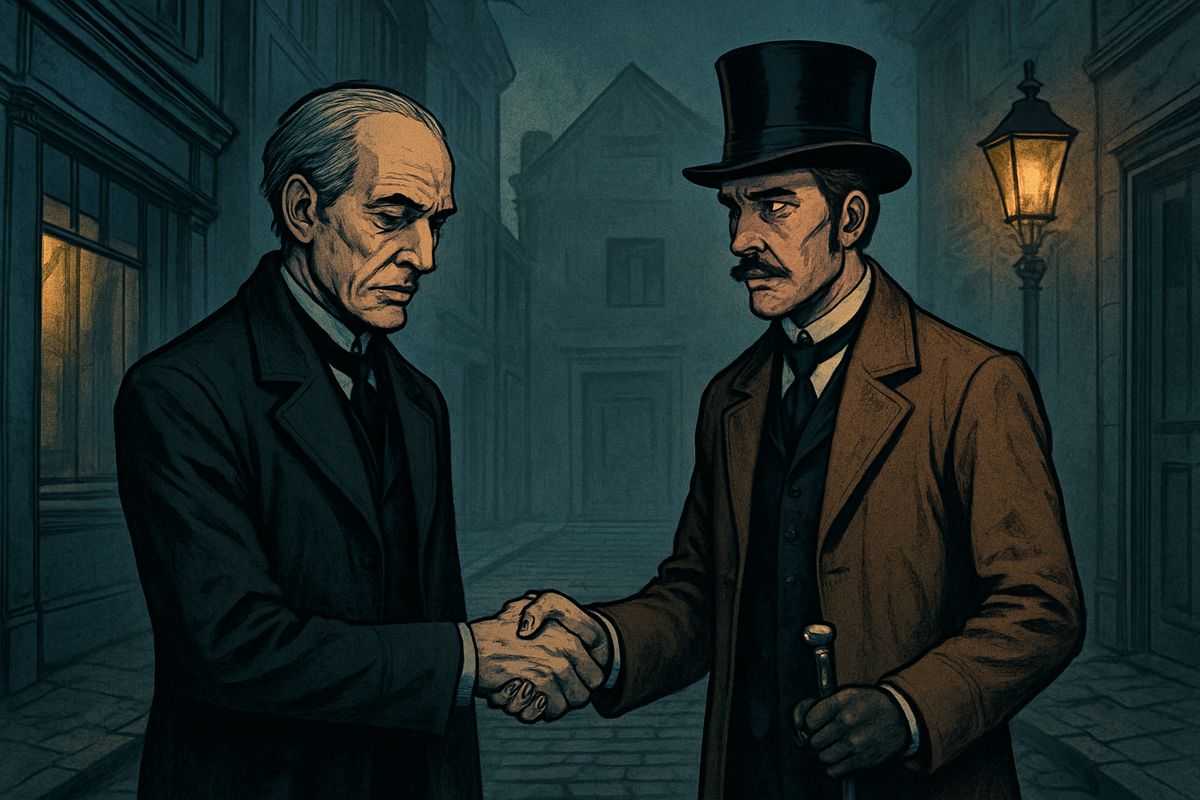
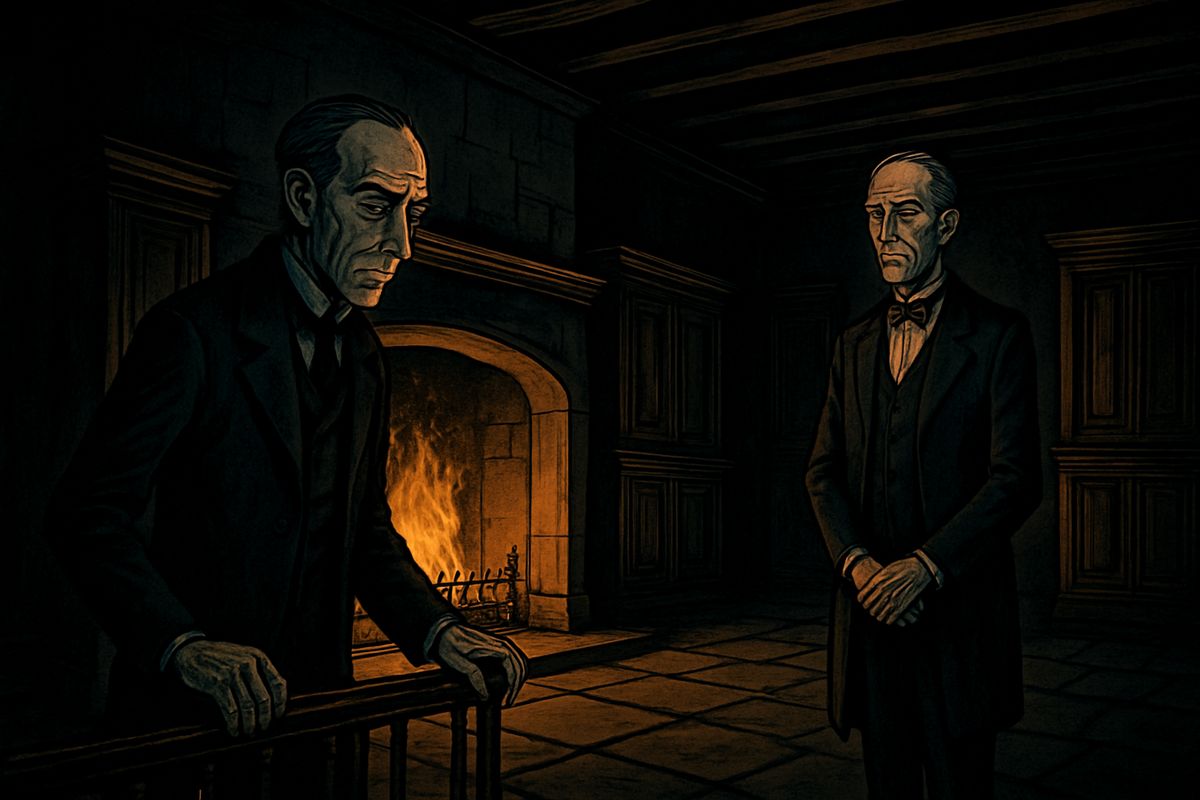
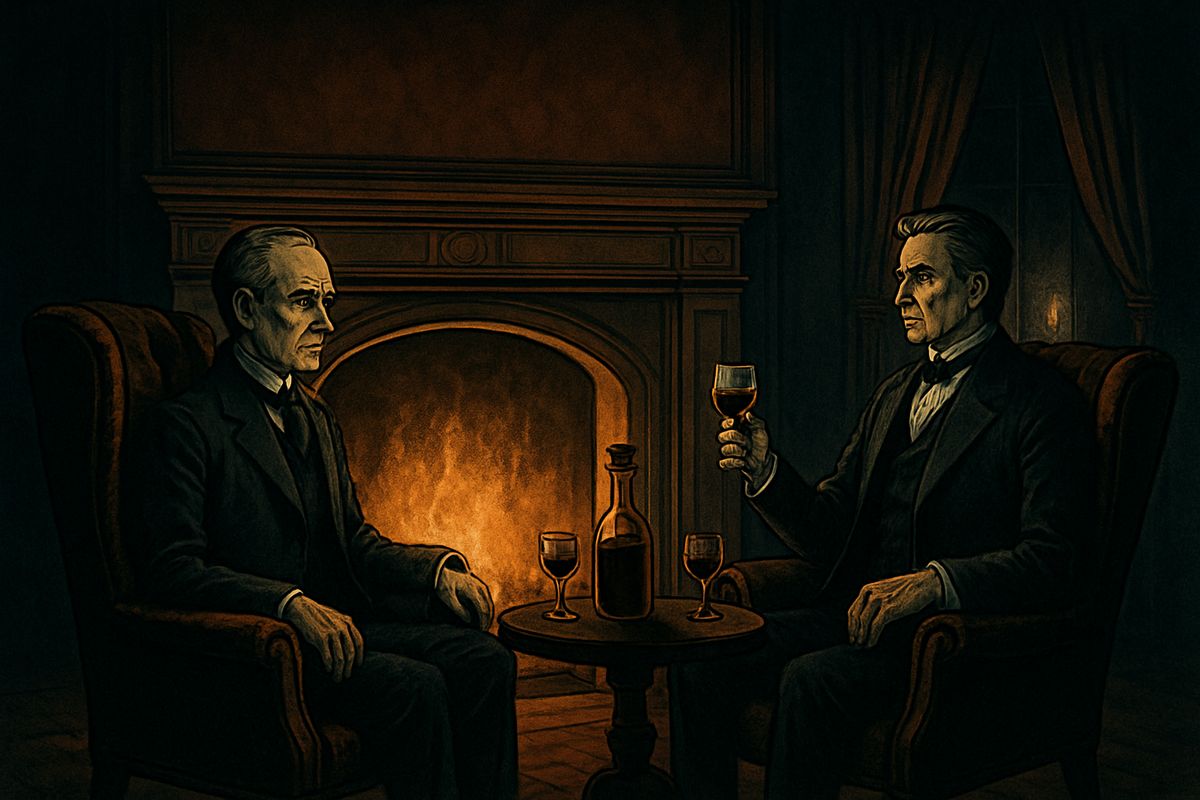
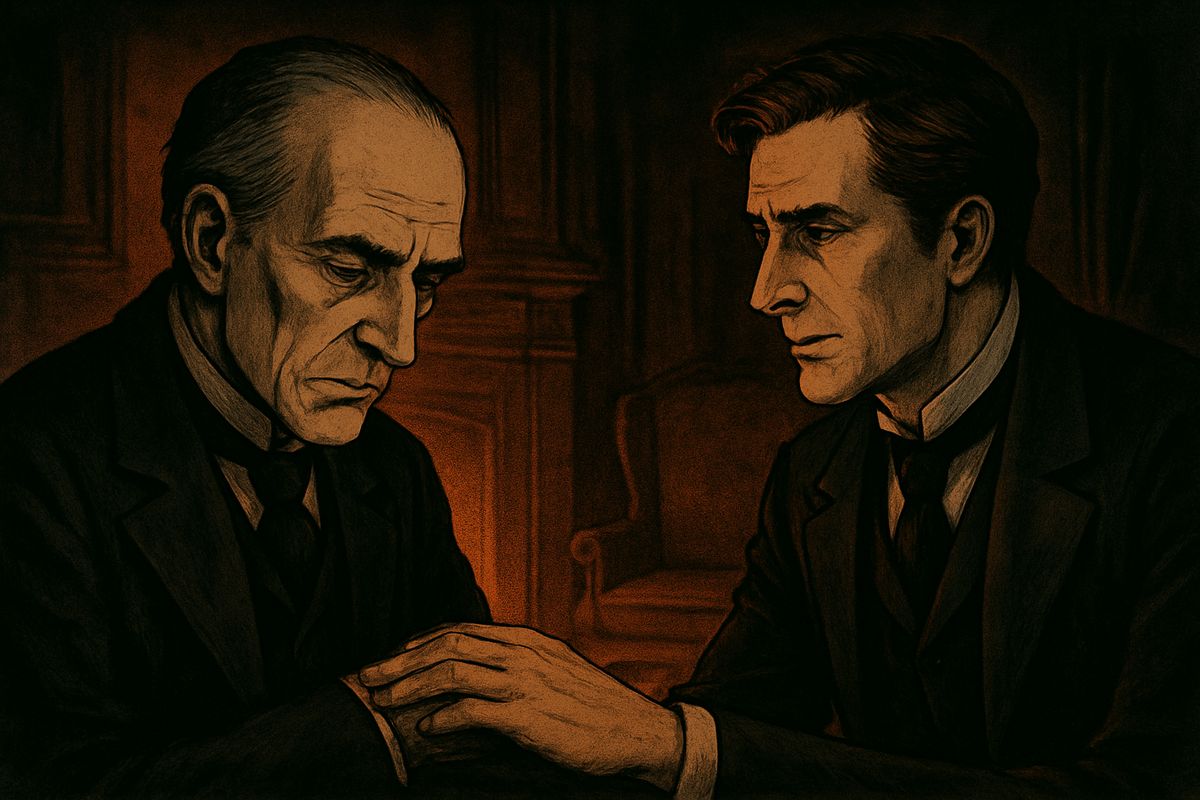
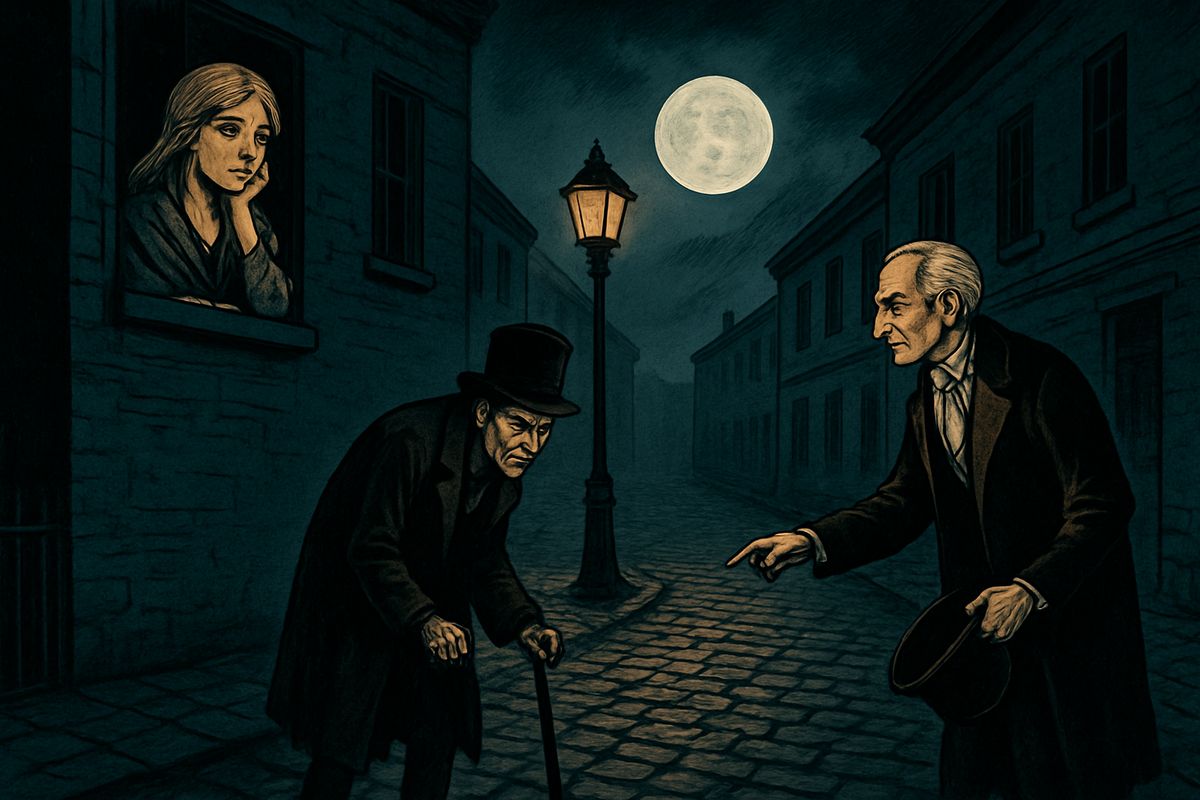
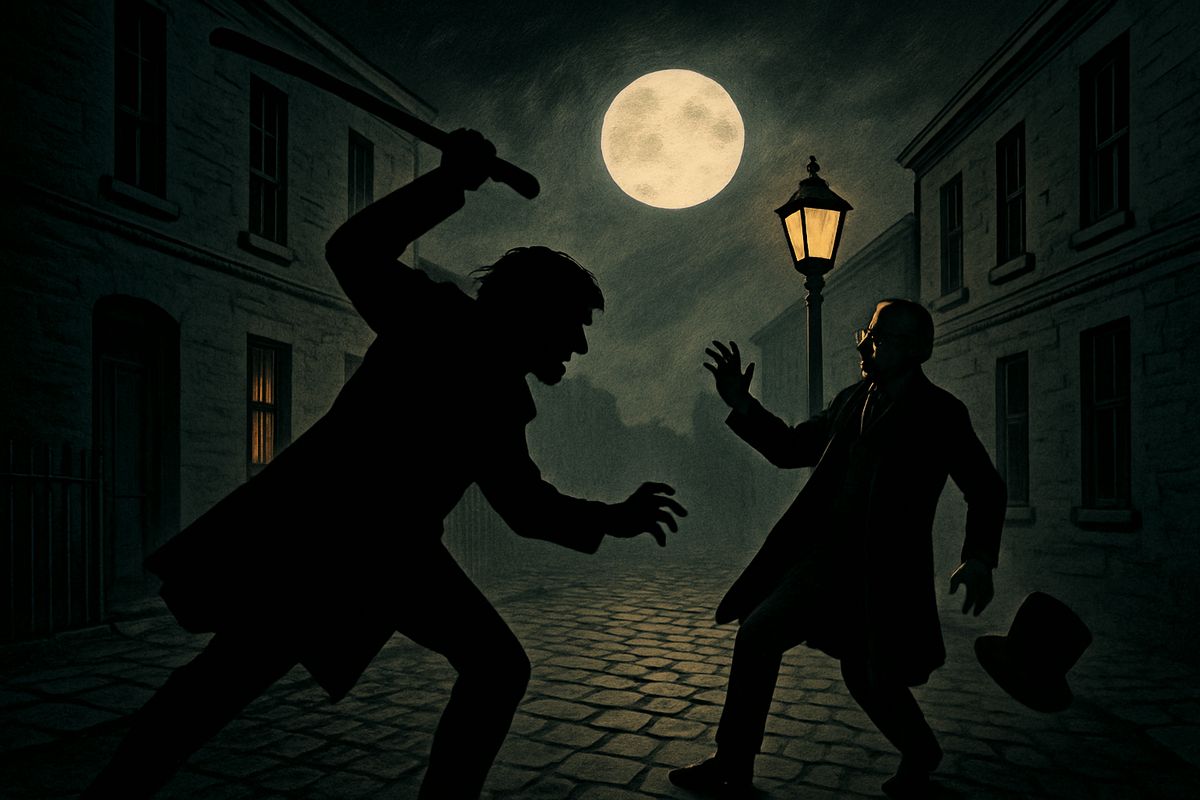
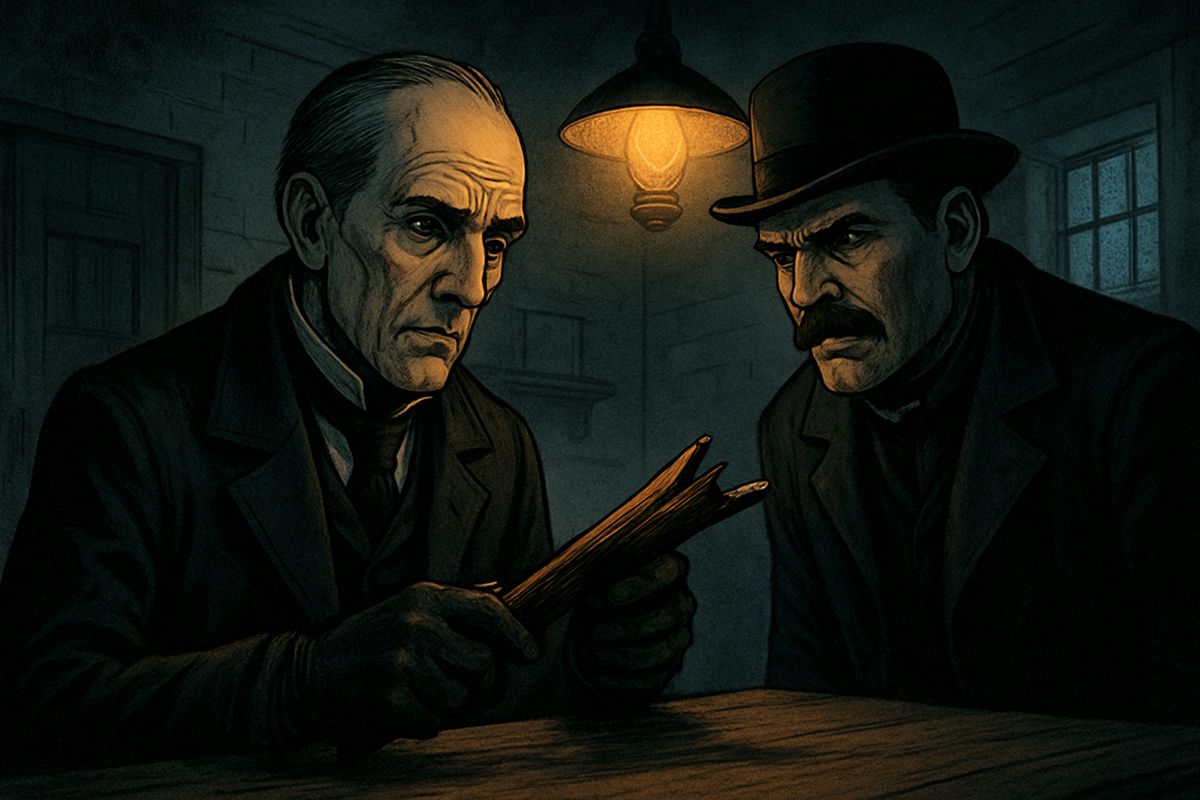
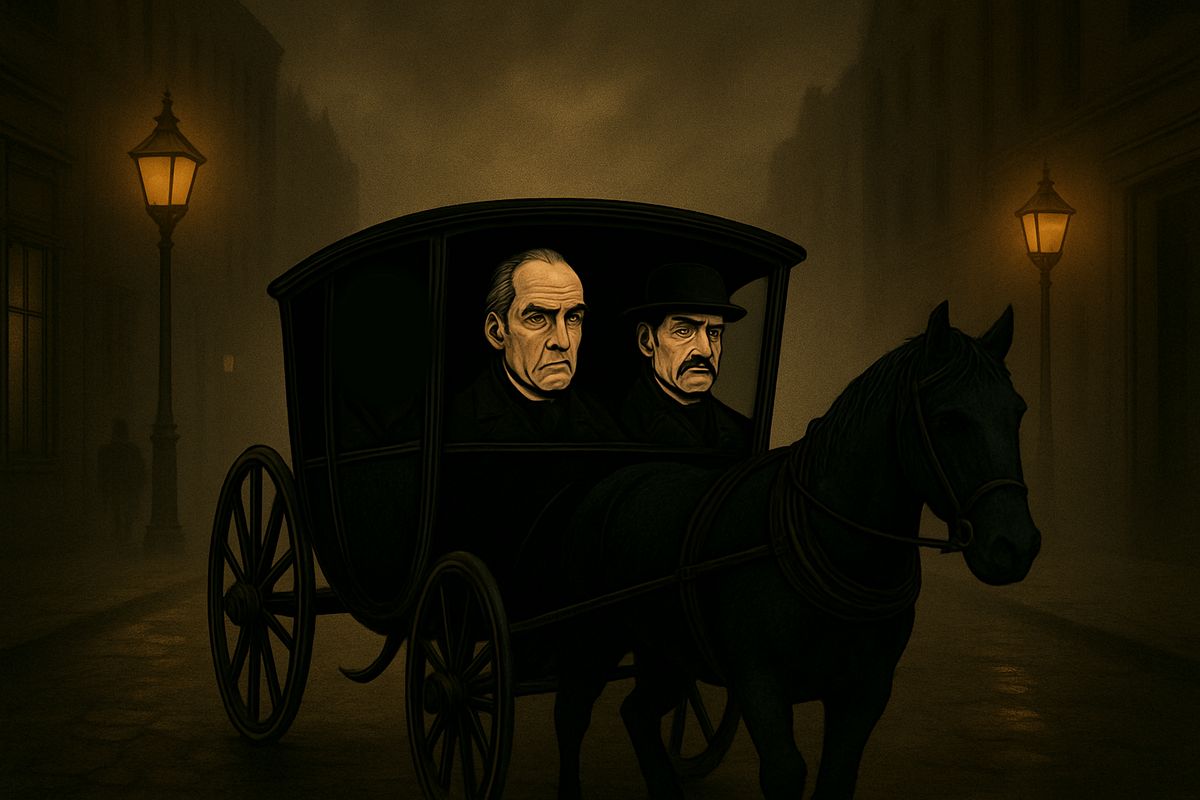
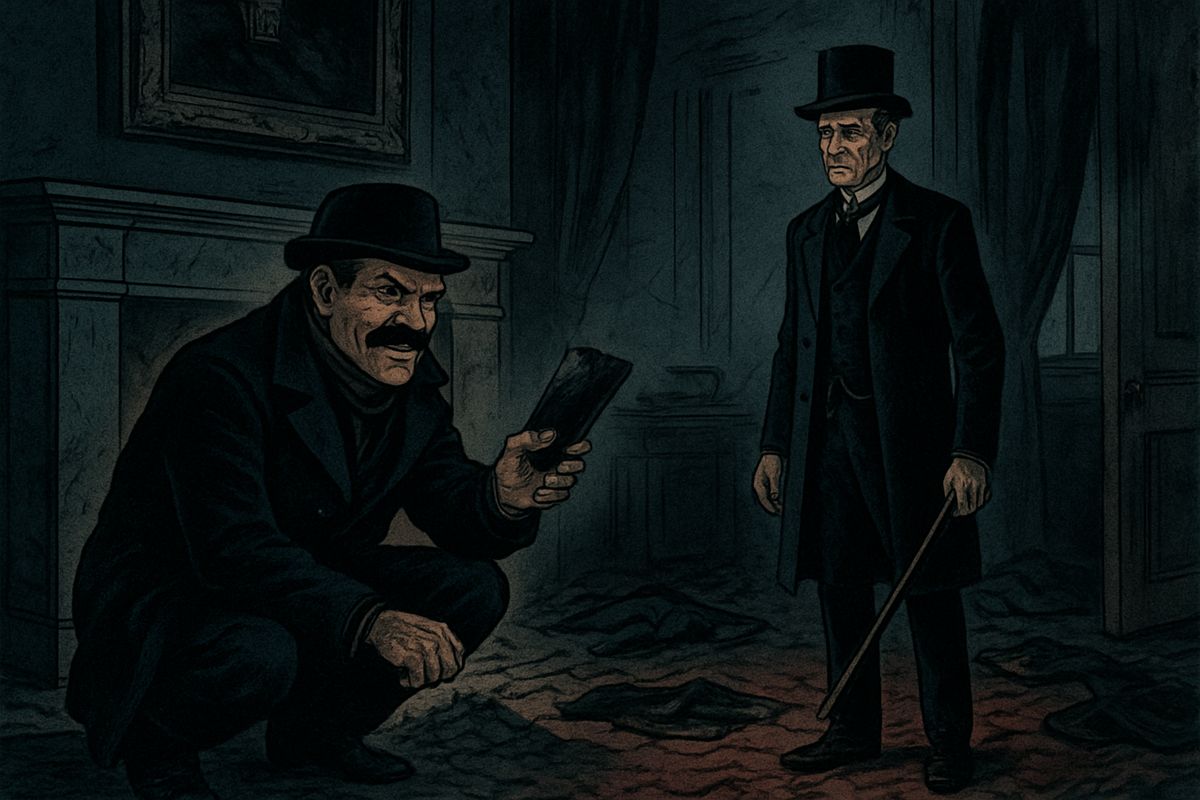
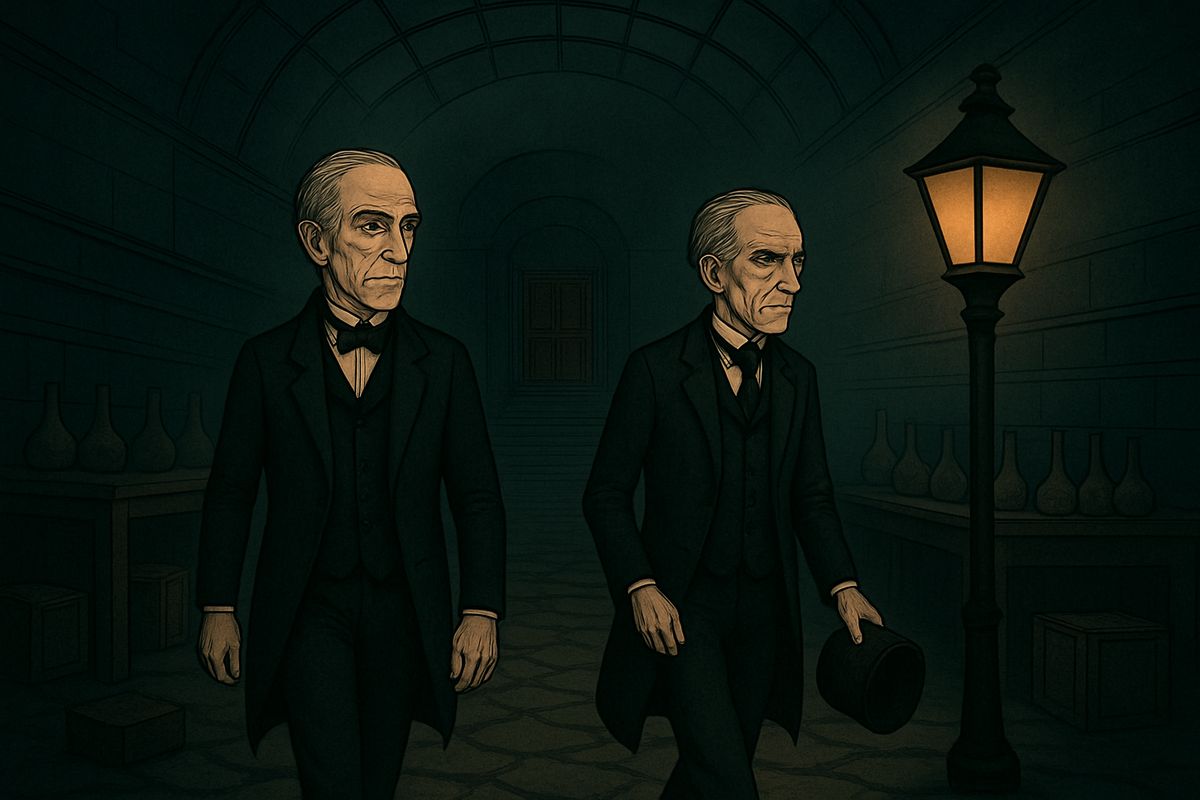
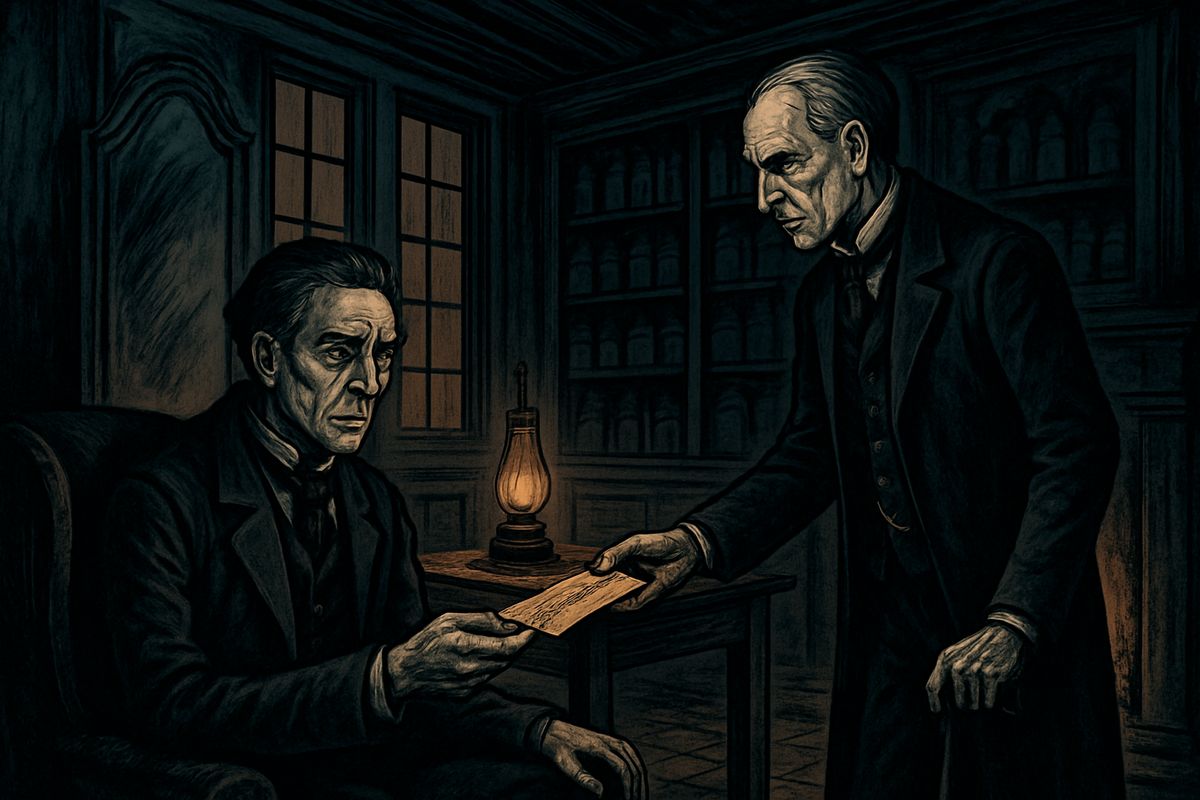
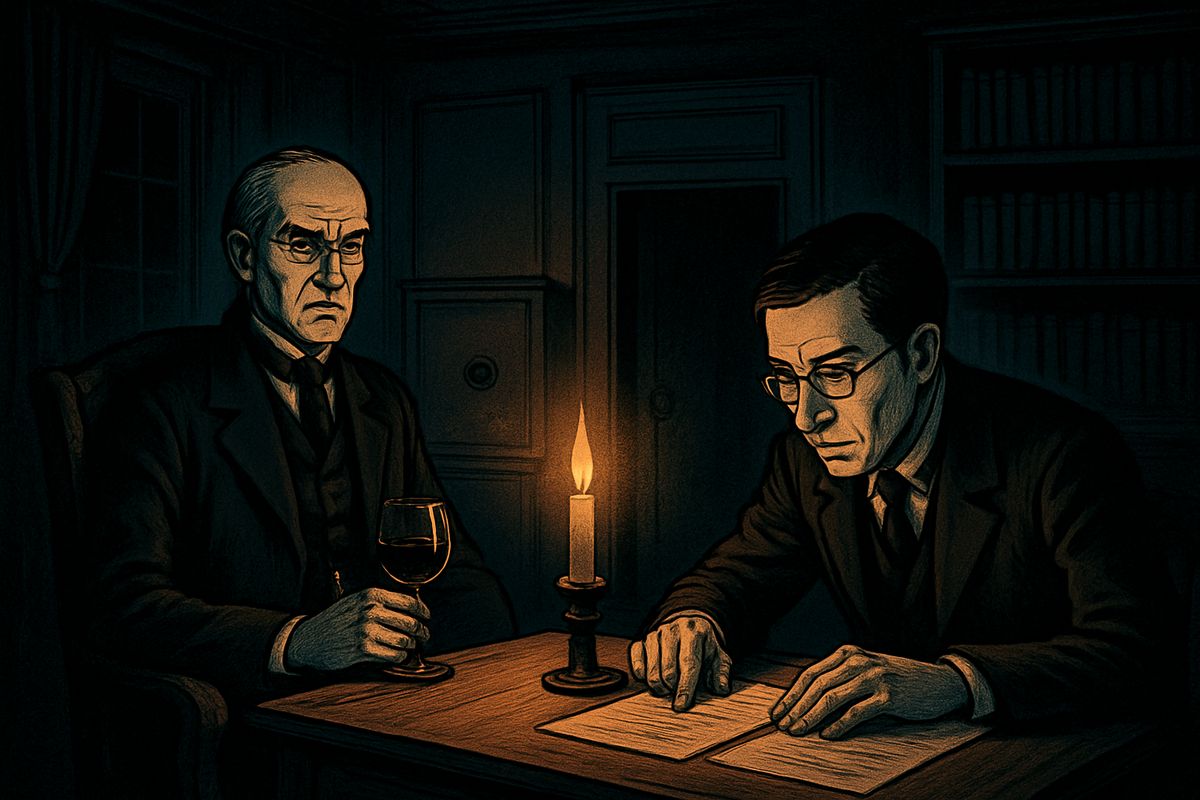
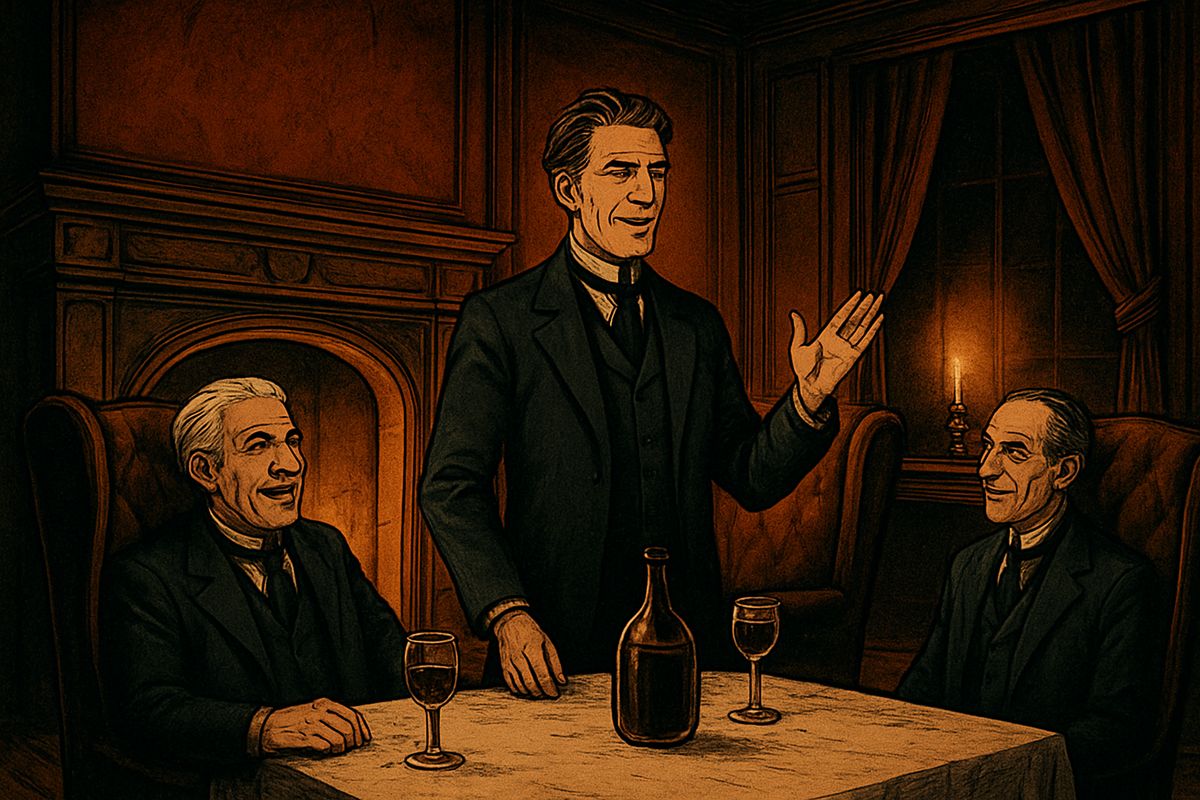
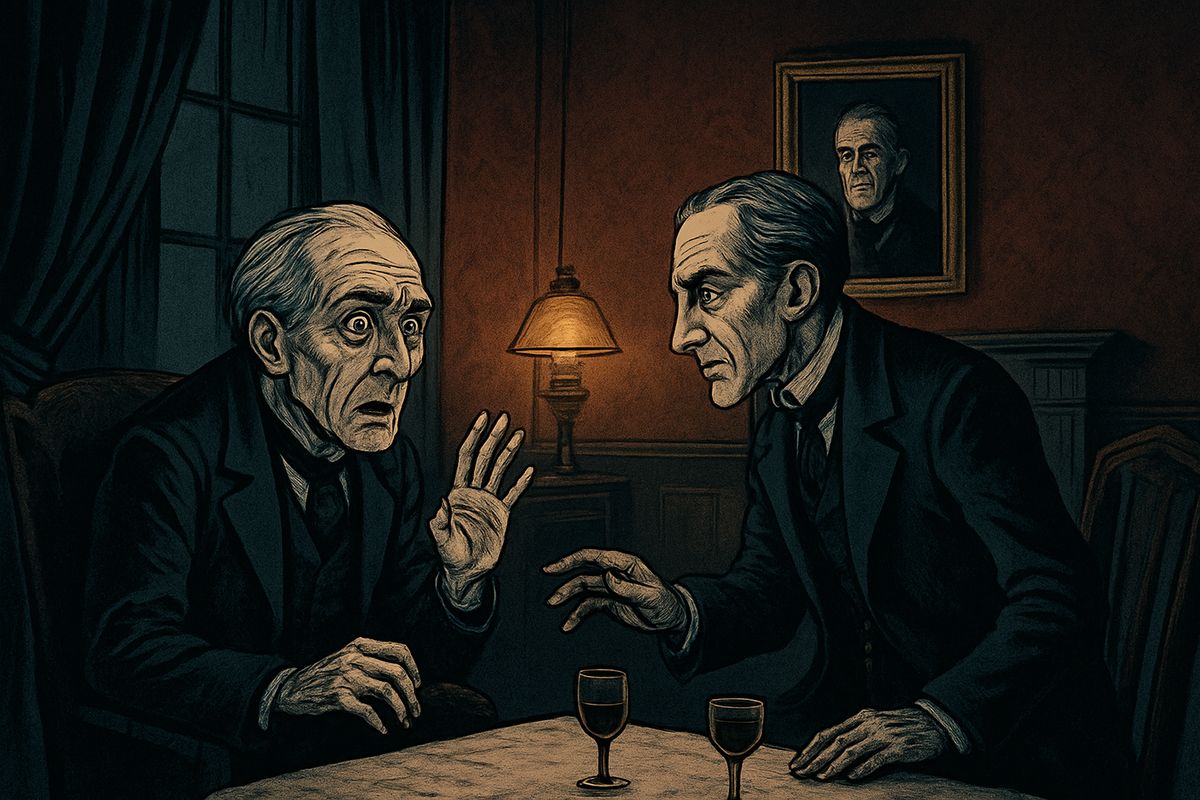
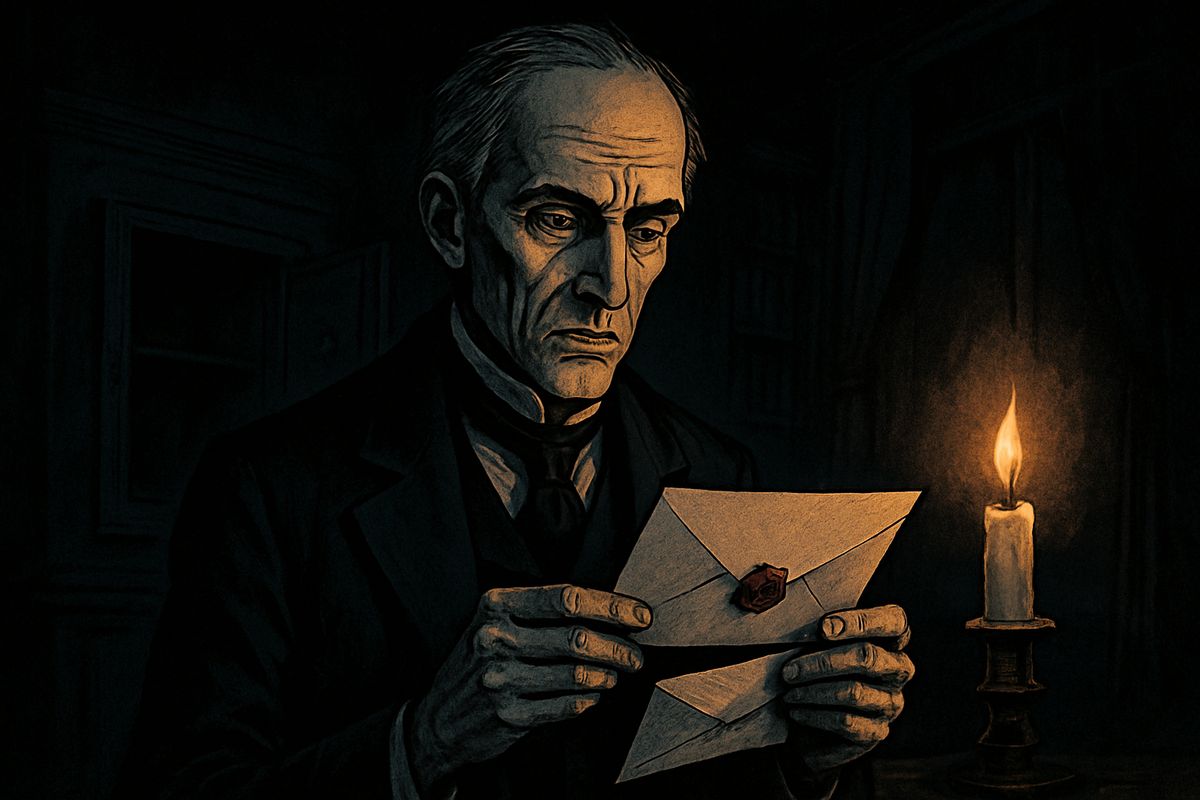
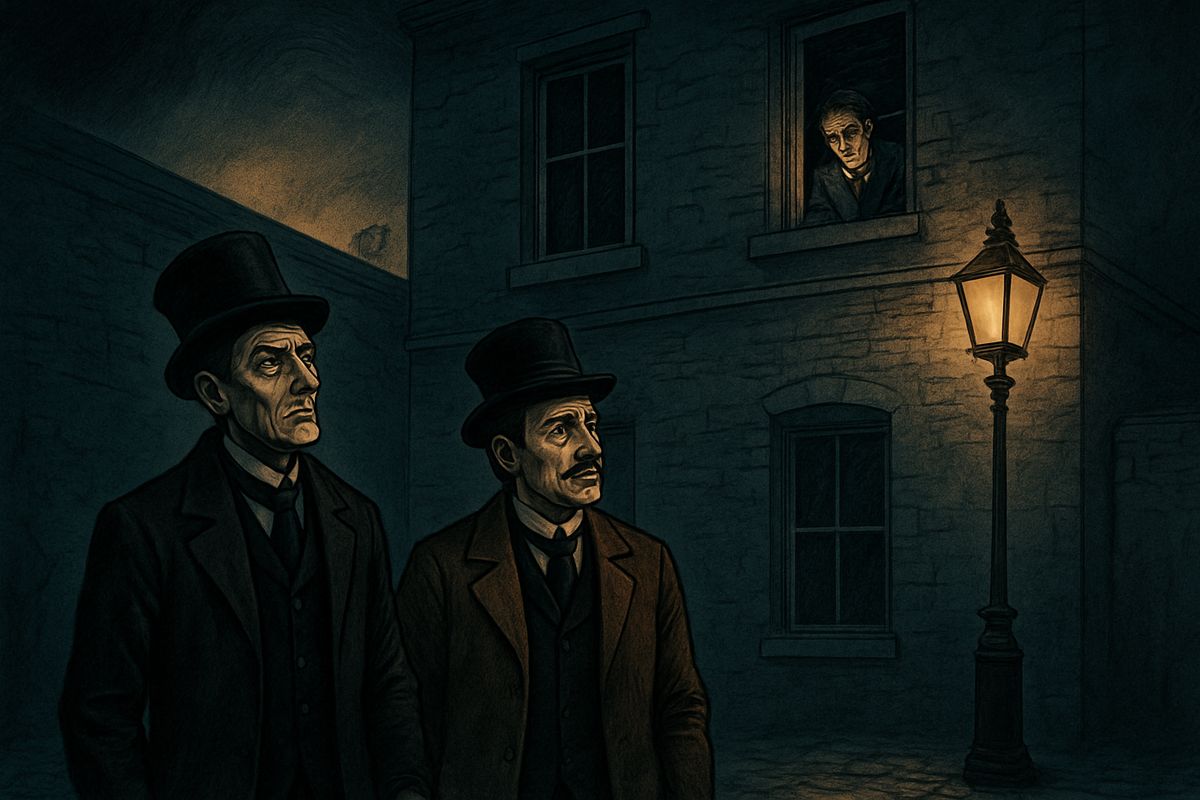
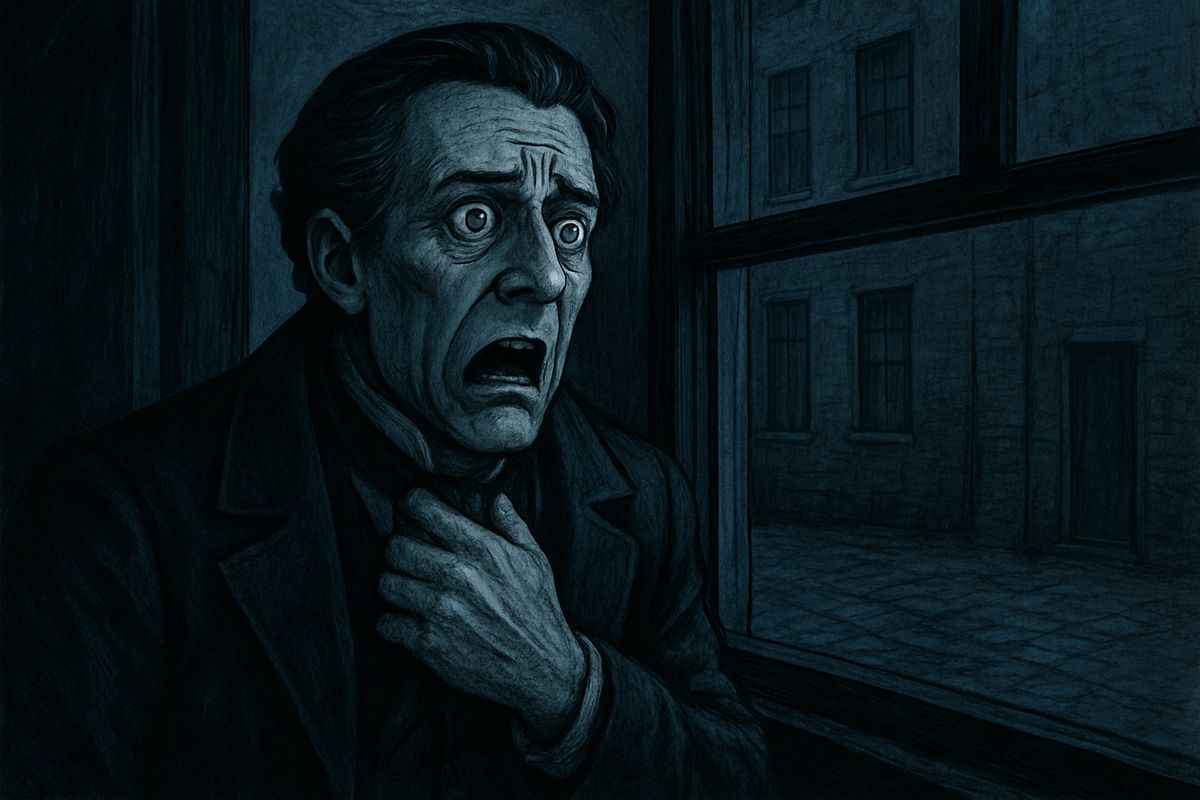
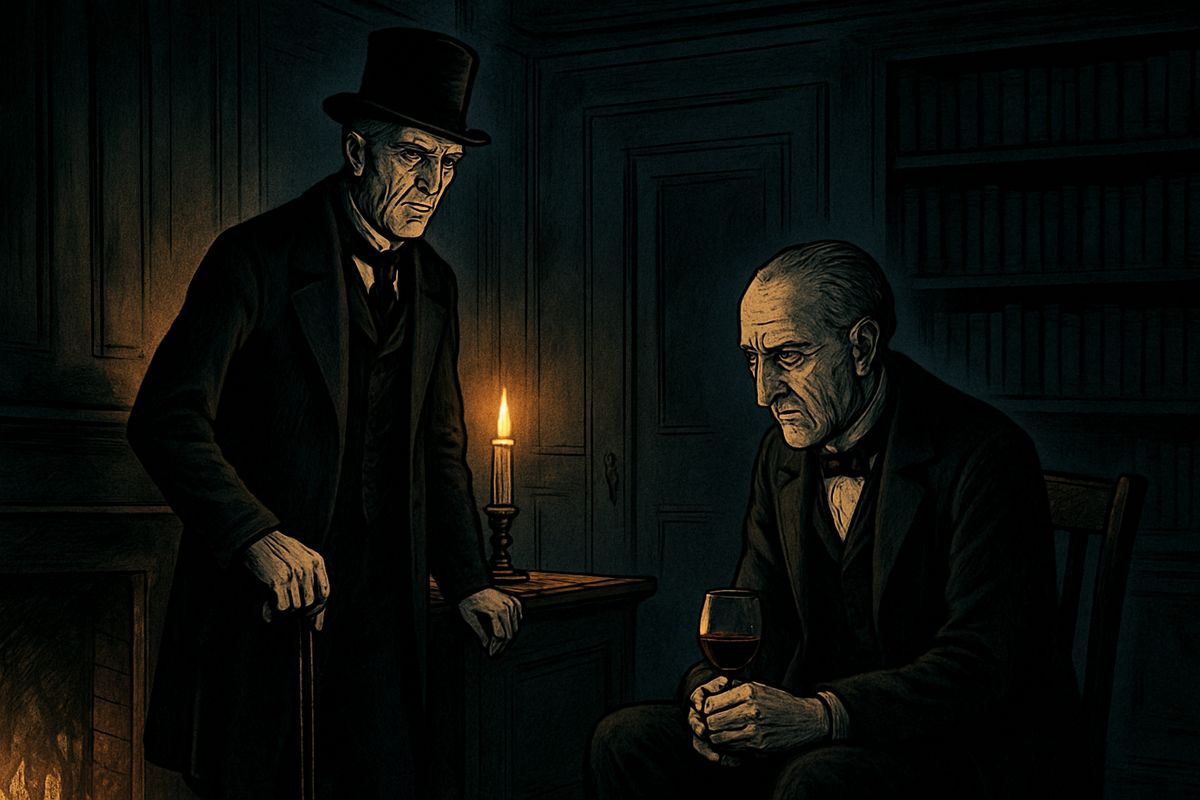
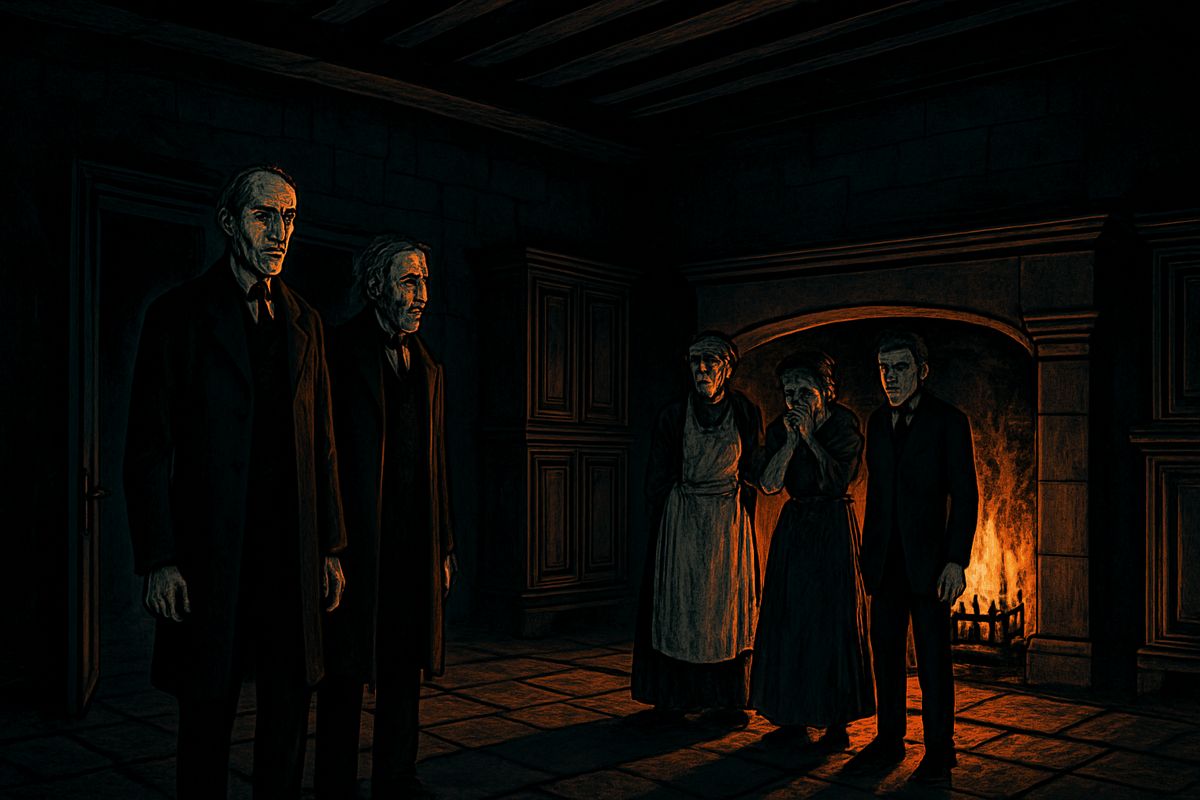
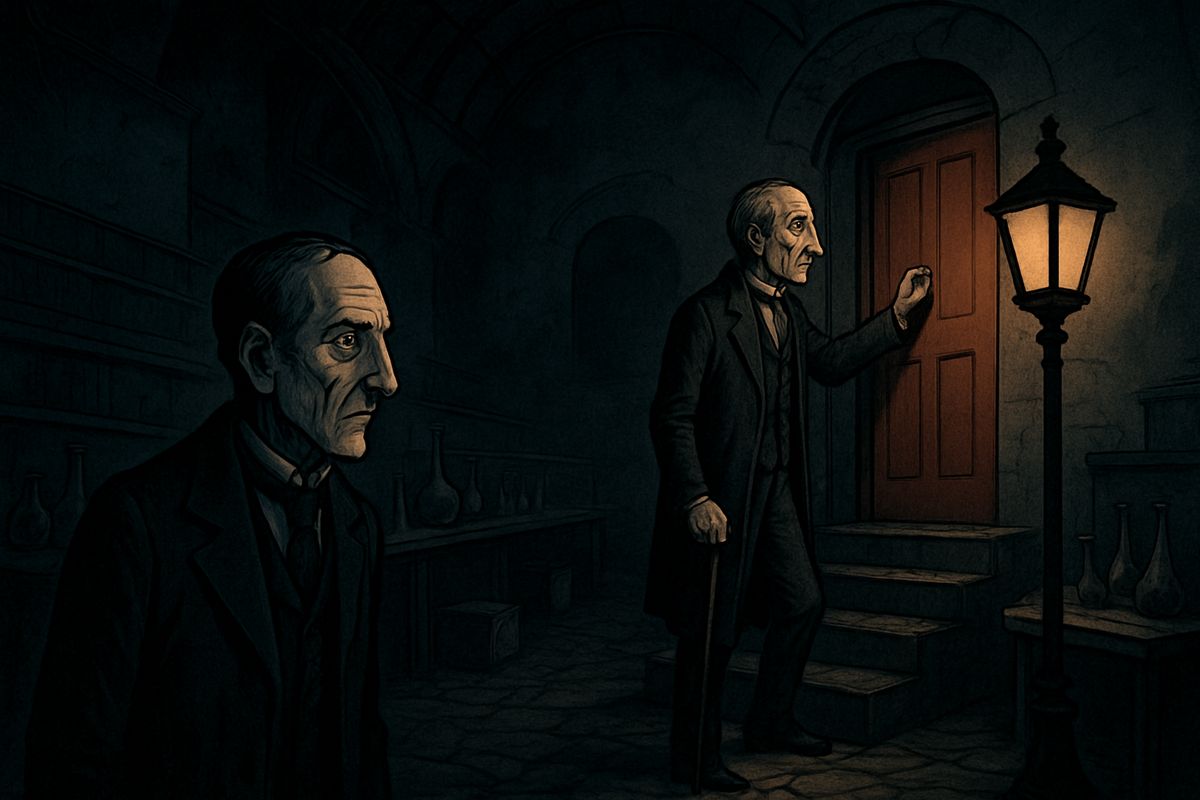
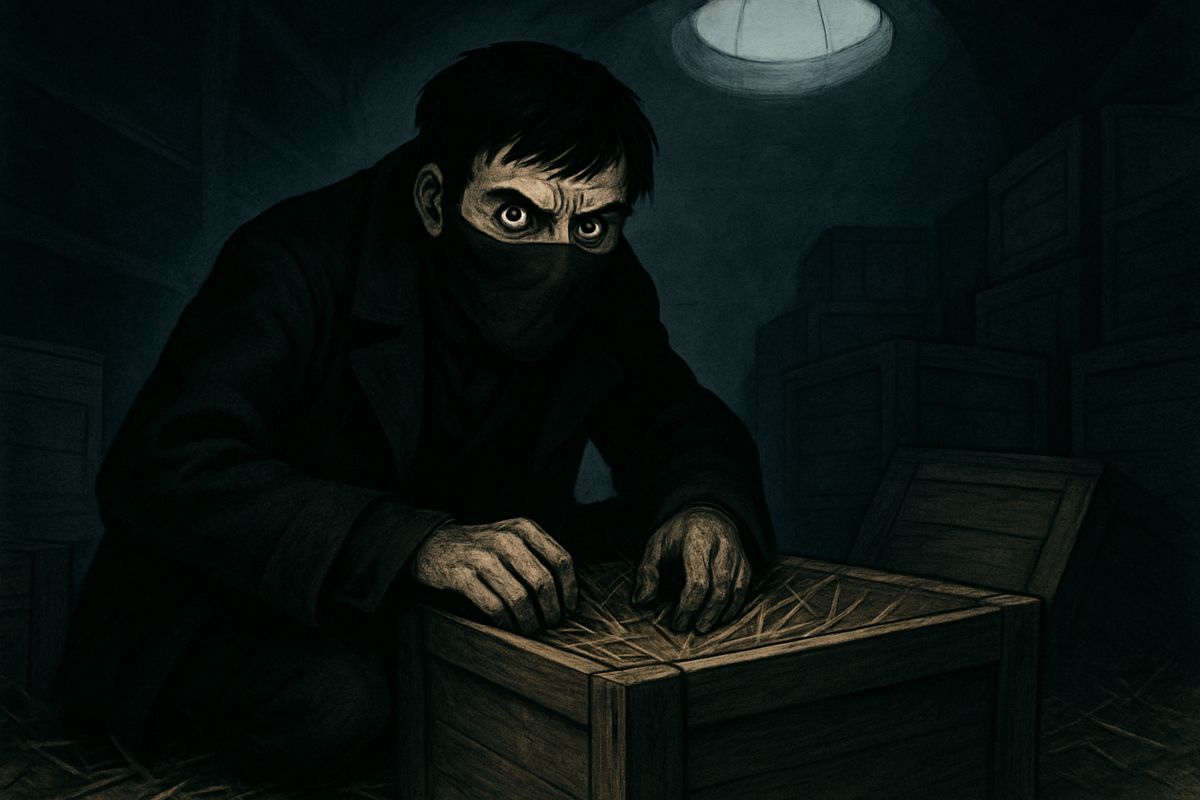
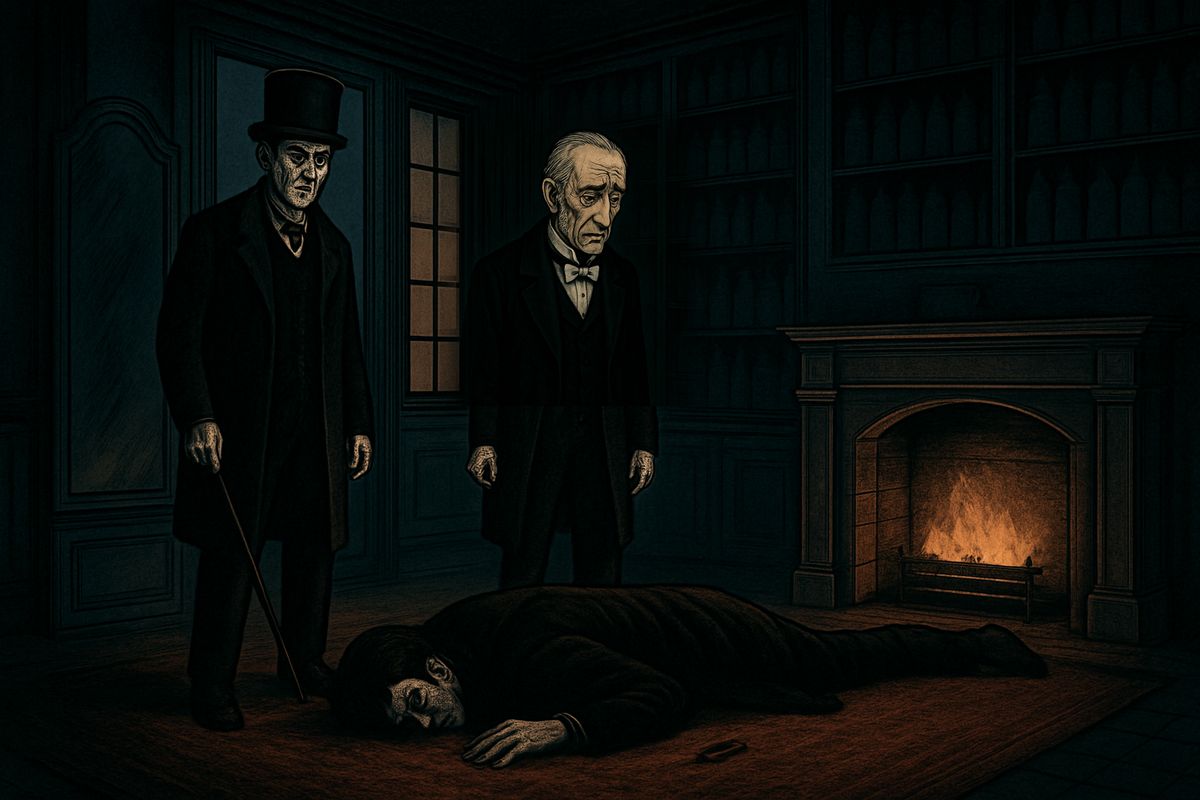
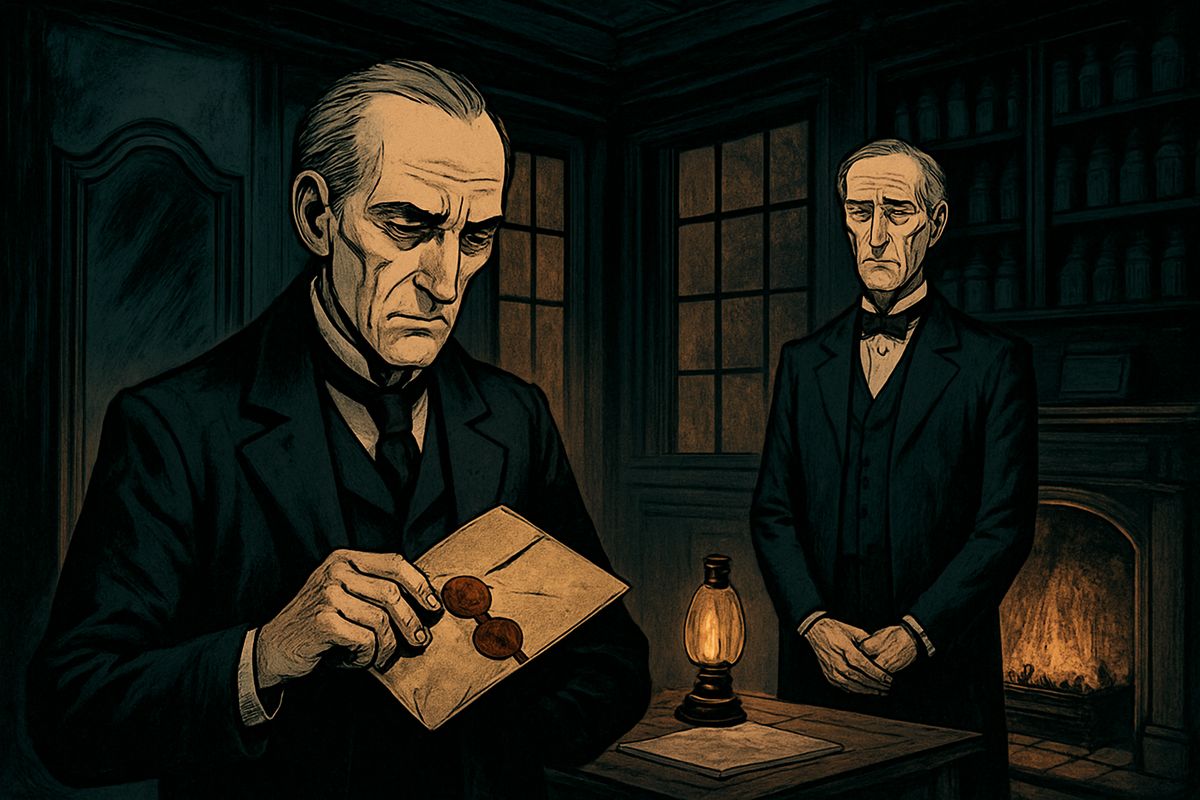
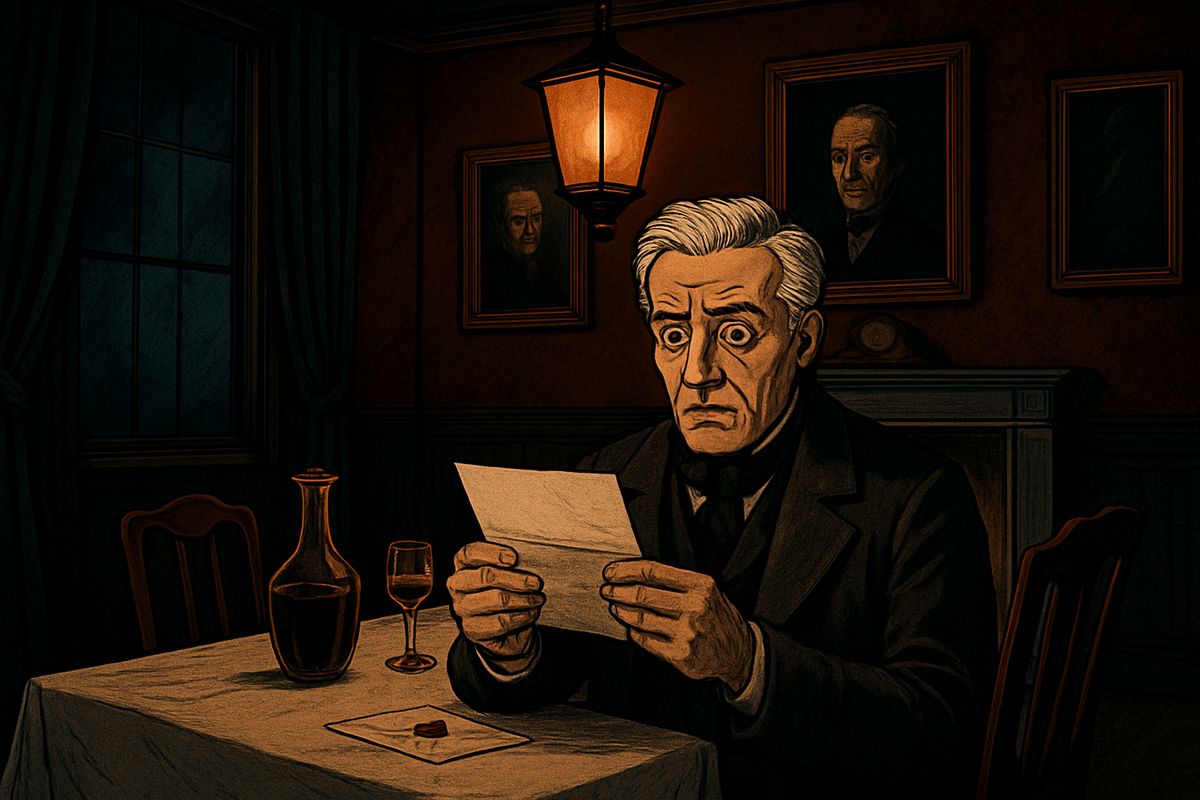
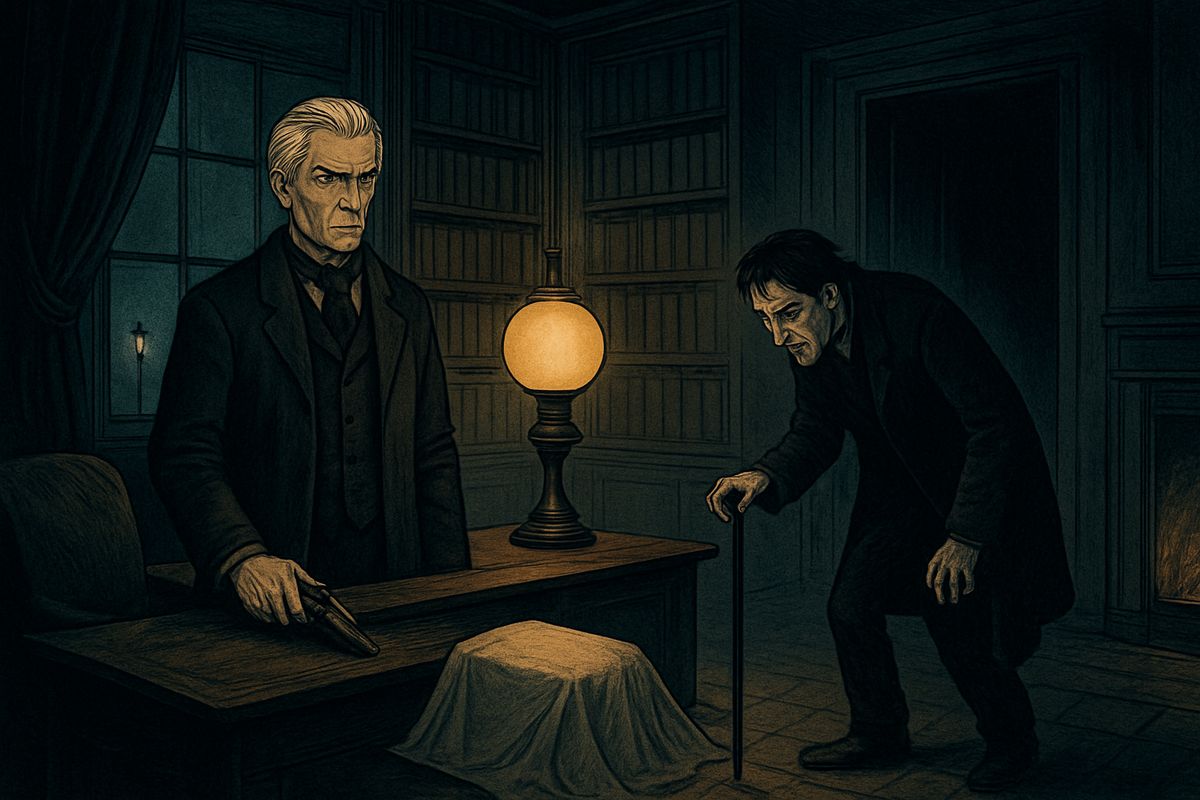
1Mr. Utterson the lawyer was a dry, unsmiling man, strict with himself yet slow to judge others, and his Sunday walks with his cousin Richard Enfield, a lively man about town, were the jewel of his week. One Sunday, in a cheerful little by-street, Enfield lifted his cane at a grim, windowless building. "Did you ever remark that door?"2Enfield told of coming home at three on a black winter morning through empty, lamp-lit streets. A little man stumping along ran into a girl dashing round a corner, and then came the horrible part: he trampled calmly over her and walked on, leaving her screaming on the ground. "It wasn't like a man," said Enfield; "it was like some damned Juggernaut."3Enfield collared the man and brought him back to the girl's furious family and the doctor, who turned white with loathing at the sight of him. Threatened with scandal, the man agreed to pay a hundred pounds, unlocked that very door with a key and came back with gold and a cheque signed with a famous, respectable name. At the bank next morning, the cheque proved genuine.4Walking on, Utterson asked the man's name. "Hyde," said Enfield. He could not describe him: something detestable, a feeling of deformity no one could point to. Utterson, grave and quiet, admitted he already knew who had signed the cheque. Ashamed of his long tongue, Enfield proposed they never speak of it again. "With all my heart," said the lawyer, and they shook hands.5That night Mr. Utterson took Dr. Jekyll's will from his safe and read it by candlelight. Everything was to go to 'Edward Hyde', even if Jekyll simply had a 'disappearance'. Now the name had the face of a fiend. 'I thought it was madness,' he said, 'and now I begin to fear it is disgrace.'6He went through the fog to Cavendish Square to see his old friend Dr. Lanyon. Lanyon had fallen out with Jekyll over science more than ten years before. 'Such unscientific balderdash,' he snorted, going purple in the face. But he had never heard of Hyde.7Utterson lay awake all night. In his dreams a figure trampled a child in the lamplit streets, then stood by Jekyll's bed and called him to rise and obey. The figure never had a face. Utterson had to see it, so he began to watch the door at every hour. 'If he be Mr. Hyde,' he thought, 'I shall be Mr. Seek.'8At last, on a frosty, silent night, a small man came straight to the door with a key. 'Mr. Hyde, I think?' Hyde turned defiantly, let the lawyer see his face and gave an address in Soho. But when Utterson named Jekyll, Hyde gave a savage, snarling laugh, unlocked the door and was gone.9Shaken, Utterson knocked at Jekyll's grand house round the corner. Poole the butler said his master was out, but Mr. Hyde had a key: 'We have all orders to obey him.' Walking home, Utterson feared blackmail over some old sin of Jekyll's, and that Hyde, knowing of the will, might grow impatient to inherit.10A fortnight later, Jekyll gave one of his pleasant dinners, and Utterson stayed on by the fire after the other guests had gone. When the lawyer raised the will, Jekyll laughed it off and mocked that 'hide-bound pedant' Lanyon. But at Hyde's name his handsome face went pale to the lips. "The moment I choose," he insisted, "I can be rid of Mr Hyde."11Jekyll begged his friend to let the matter sleep. Then, as Utterson rose to go, he laid a hand upon his arm: if he were ever taken away, would Utterson bear with Hyde and get him his rights? "I only ask for justice." The lawyer could never like the man, but he heaved a sigh and said, "I promise."12Nearly a year later, one cloudless October night, a maid sat dreaming at her window above a moonlit lane near the river. Below, a courteous white-haired gentleman bowed to ask a small man his way, and with a start she recognised the small man as Mr. Hyde, who had once visited her master.13Hyde answered never a word, trifling with his heavy cane in ill-contained impatience. Then all at once he broke out in a great flame of anger and, with ape-like fury, clubbed the old man to the earth and trampled him. At the horror of those sights and sounds, the maid fainted.14Hyde had fled; on his victim lay only a sealed letter addressed to Mr. Utterson. At the station next morning the lawyer nodded grimly: “I am sorry to say that this is Sir Danvers Carew.” Then he was shown the splintered half of the cane, and knew it at once for a gift he had once given Henry Jekyll.15“If you will come with me in my cab,” said Utterson, “I think I can take you to his house.” With Inspector Newcomen of Scotland Yard beside him, he crawled through the season's first fog, chocolate-brown and ever shifting, into the squalid streets of Soho, which seemed a district of some city in a nightmare.16Hyde's rooms were rich and tasteful but hurriedly ransacked, and Hyde was gone. The other half of the stick lay behind the door; from the ashes the inspector drew a burned cheque book. “I have him in my hand,” he declared, yet as all London cried out, no one could even describe the fugitive beyond a haunting sense of deformity.17Late that afternoon, Poole led Mr. Utterson across the yard that had once been a garden, and into the building at the bottom of it. For the first time the lawyer crossed the old dissecting theatre, once crowded with eager students and now gaunt and silent, full of apparatus and packing straw, towards the red door where Dr. Jekyll waited.18Jekyll sat close to the fire, looking deathly sick. "I swear to God I will never set eyes on him again," he cried, and handed over a letter in an odd, upright hand signed "Edward Hyde," saying it had been delivered by hand. Yet on his way out Utterson learned from Poole that no letter had come to the house that day.19That evening, over a very old wine by his own hearth, Utterson showed the letter to his head clerk, Mr. Guest, a keen student of handwriting. Just then a dinner invitation came from Jekyll. Guest laid the two sheets side by side: the same hand, only differently sloped. Alone that night, Utterson locked the note in his safe. "Henry Jekyll forge for a murderer!" His blood ran cold.20Thousands of pounds were offered for Hyde, and tales of his cruel, vile past came out, yet he had vanished as if he had never existed. Freed of him, Jekyll left his seclusion, did good among his friends, and for two months was at peace. On the 8th of January he dined Utterson and Lanyon like the old inseparable trio.21Days later Jekyll's door was shut again, and Poole turned Utterson away time after time. So the lawyer went to Lanyon, and found death written on his face. At Jekyll's name the old doctor raised a trembling hand: "I am quite done with that person; I regard him as dead."22Jekyll wrote back that he had brought on himself a punishment and a danger he could not name. Within a fortnight Lanyon was dead. After the funeral Utterson broke his friend's seal by candlelight and found a second envelope: "not to be opened till the death or disappearance of Dr. Henry Jekyll." Loyal to the dead, he locked it unread in his safe.23On a Sunday walk, Enfield admitted he had since learned the door was a back way to Dr. Jekyll's, so the two friends stepped into the cool, dim court behind it. At a half-open window sat Jekyll, sad as a prisoner. "I am very low, Utterson," he said. He dared not come out, but smiled gladly when they offered to talk from below.24Hardly had Jekyll spoken when the smile was struck from his face, replaced by such abject terror and despair that it froze the blood of the two men below; the window was thrust down at once. Without a word they left the court and the by-street, both pale, horror in their eyes. "God forgive us, God forgive us," said Utterson.25On a wild March evening, Poole, Dr Jekyll's butler, appeared at Mr Utterson's fireside. He left his wine untouched and would not meet the lawyer's eyes. His master had been shut up in the cabinet for a week, and he could bear it no more. "I think there's been foul play," he said hoarsely.26Utterson took his hat and followed him through streets swept bare by the wind, under a pale moon lying on her back. At Jekyll's house the door opened only on the chain. Inside, the servants stood huddled around a high-built fire like a flock of sheep, and a housemaid whimpered. "They're all afraid," said Poole.27Poole led him across the yard and through the dim theatre, then knocked on the red baize door of the cabinet. "Tell him I cannot see anyone," whined a voice, and it was not Jekyll's. For a week, Poole said, notes had sent him to every chemist in London for a pure drug, and each sample was sent back: "For God's sake, find me some of the old."28Worse, Poole had once surprised something digging among the crates: a small, masked, doubled-up creature that cried out like a rat and fled upstairs. His master was a tall man, and this was more like a dwarf. Both men believed it was Hyde, and that Jekyll had been murdered. Utterson resolved to break in, with Poole taking the axe and Utterson the kitchen poker.29They waited in the dark theatre and listened to a light, swinging step pacing the cabinet floor. "Utterson, for God's sake, have mercy!" cried the voice. It was Hyde's. On the fifth blow of the axe the red baize door fell in. In the quiet lamplight, by a singing kettle, Hyde lay dead in clothes far too large for him, a crushed phial in his hand.30They searched the theatre, the closets and the cobwebbed cellar, but found no trace of Jekyll, dead or alive. In the cabinet lay a pious book scrawled with blasphemies, and a tall mirror showed only their own pale faces. An envelope held a new will naming Utterson, a note from Jekyll dated that very day, and a sealed confession, which the lawyer took home to read.31On the ninth of January, Dr Lanyon received a registered letter from Henry Jekyll, his old school friend. "My life, my honour, my reason, are all at your mercy," it begged. Lanyon was to have Jekyll's cabinet forced open, take out one drawer, bring it home, and at midnight give it to a messenger.32Lanyon fetched the drawer and found powders, a phial of blood-red liquid and a notebook of dates marked "double" and "total failure!!!" Sure his friend was mad, he sent his servants to bed and loaded a revolver. At midnight a small man in huge, rich clothes crept in, and something about him turned Lanyon's blood cold.33The visitor mixed the red tincture with a powder. It fizzed, smoked, turned dark purple, then a watery green. Then he offered Lanyon a choice: let him go and know nothing, or stay and see something to shake his whole science. "I have gone too far," said Lanyon, "to pause before I see the end."34He drank it in one gulp, reeled, and seemed to swell as his features melted. There, pale and half fainting, stood Henry Jekyll. "O God!" Lanyon screamed, over and over. What Jekyll told him in the next hour he could never write down. Sleepless and full of horror, Lanyon felt sure the shock would kill him.35Henry Jekyll was rich, clever and admired, yet he hid certain undignified pleasures behind a grave face. He came to believe that every man is truly two, and at last compounded a drug to split his natures apart. Late one accursed night, in his cabinet, he drank it off.36After racking pangs, he felt younger, lighter and tenfold more wicked. Creeping to his bedroom, he met Edward Hyde in the glass -- smaller, slighter, pure evil -- and felt only a leap of welcome. Soon Hyde had a house in Soho and an heir's place in Jekyll's will, and his pleasures turned monstrous; one night he trampled a child.37Two months before the Carew murder, Jekyll went to bed as himself and woke in the yellow London morning to find, lying on the sheet, a lean, corded, hairy hand. It was the hand of Edward Hyde. He had changed without the drug.38Terrified, Jekyll swore off Hyde and lived strictly for two months. But the longing grew, and he drank again. "My devil had been long caged; he came out roaring." When the gentle Sir Danvers Carew stopped him in a moonlit lane, Hyde struck him down in a transport of glee.39Jekyll ground the laboratory key under his heel and did good for months. Then one fine January day, sitting smugly on a bench in Regent's Park, he felt a deadly shudder -- his clothes hung on shrunken limbs. Now a hunted murderer, Hyde wrote in Jekyll's own hand, begging Lanyon to fetch the drugs.40Soon Hyde came even in sleep, and only the drug held Jekyll's face. Then the salt ran out; new batches failed, for the first had held some unknown impurity. With the last powder, Jekyll wrote his confession as Hyde closed in. "Here then, as I lay down the pen, I bring the life of that unhappy Henry Jekyll to an end."
Adapted from The Strange Case of Dr Jekyll and Mr Hyde by Robert Louis Stevenson, public domain. Pictures are AI illustrations drawn for this edition.
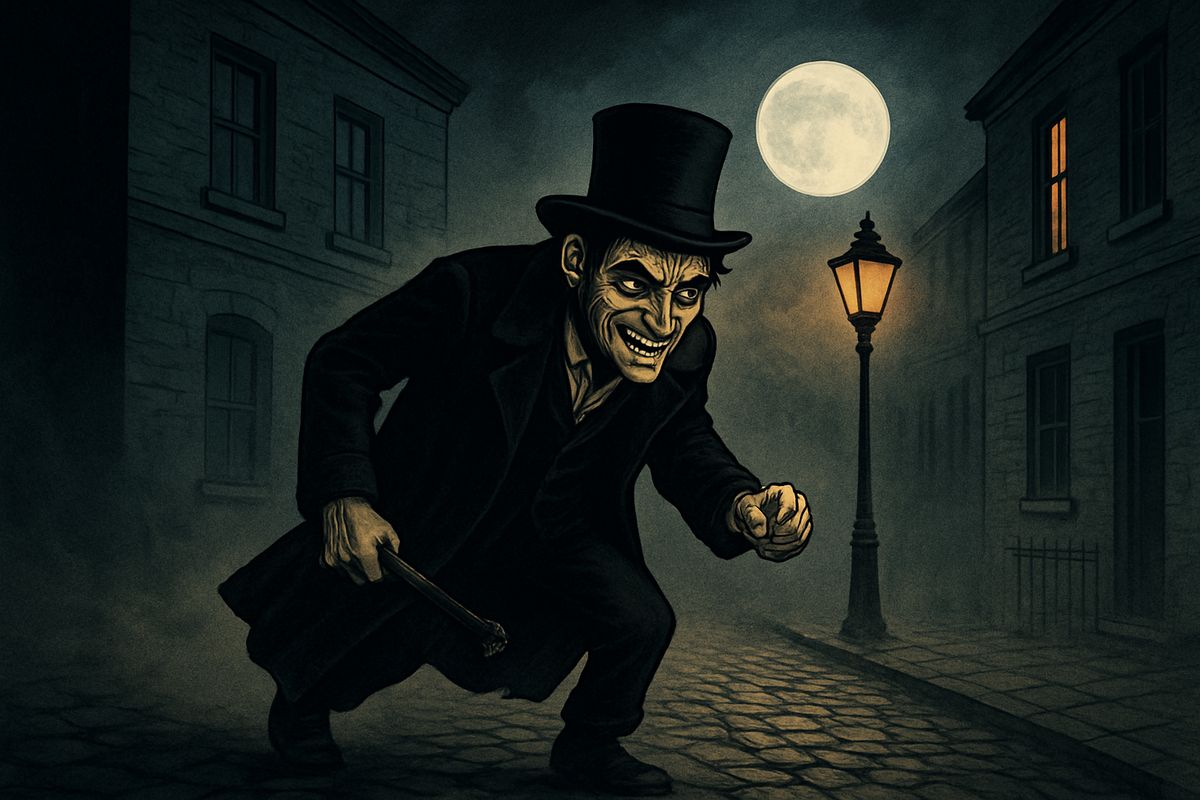
Add Stories to your Home Screen: tap
then Add to Home Screen.