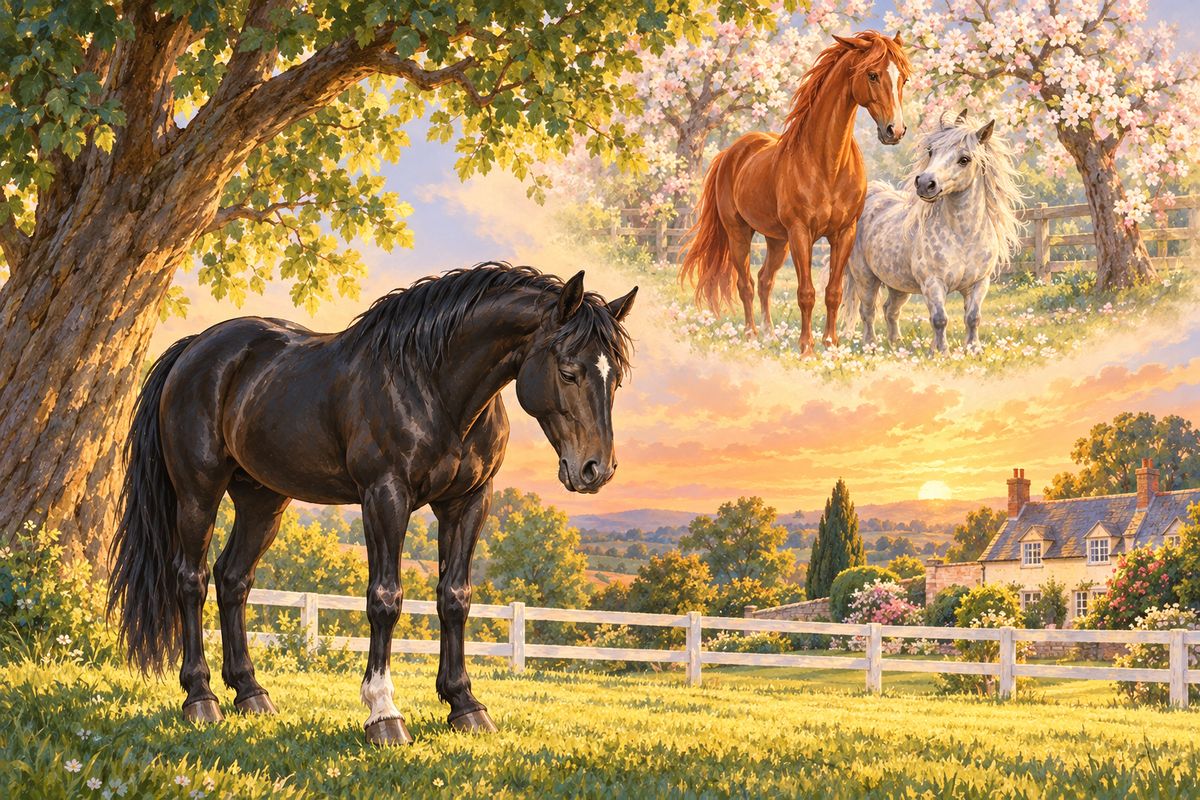
A picture-story retelling, after Anna Sewell (1877)
A gentle but honest story about how horses were treated. It includes a hunting accident, a stable fire, a drunken groom's fatal fall, and the deaths of a cab horse and a cabman. These are shown at a distance or just before or after, never in distressing detail.
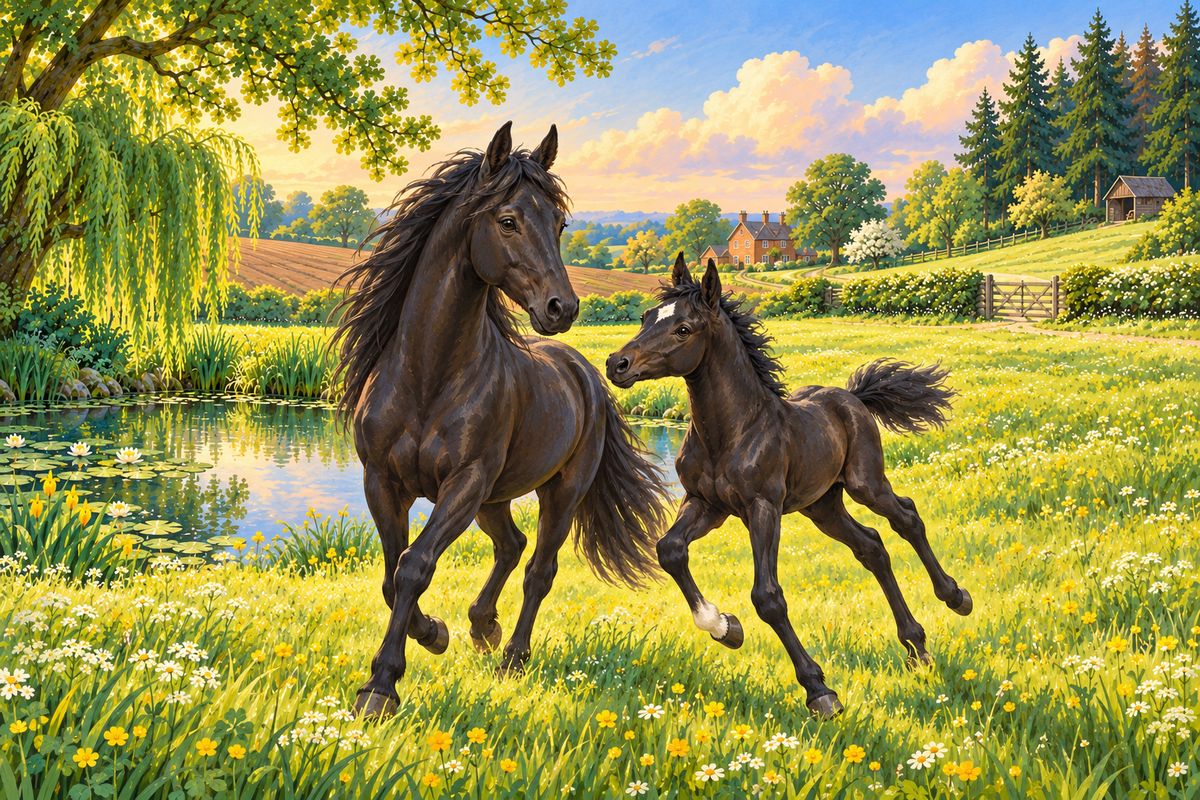
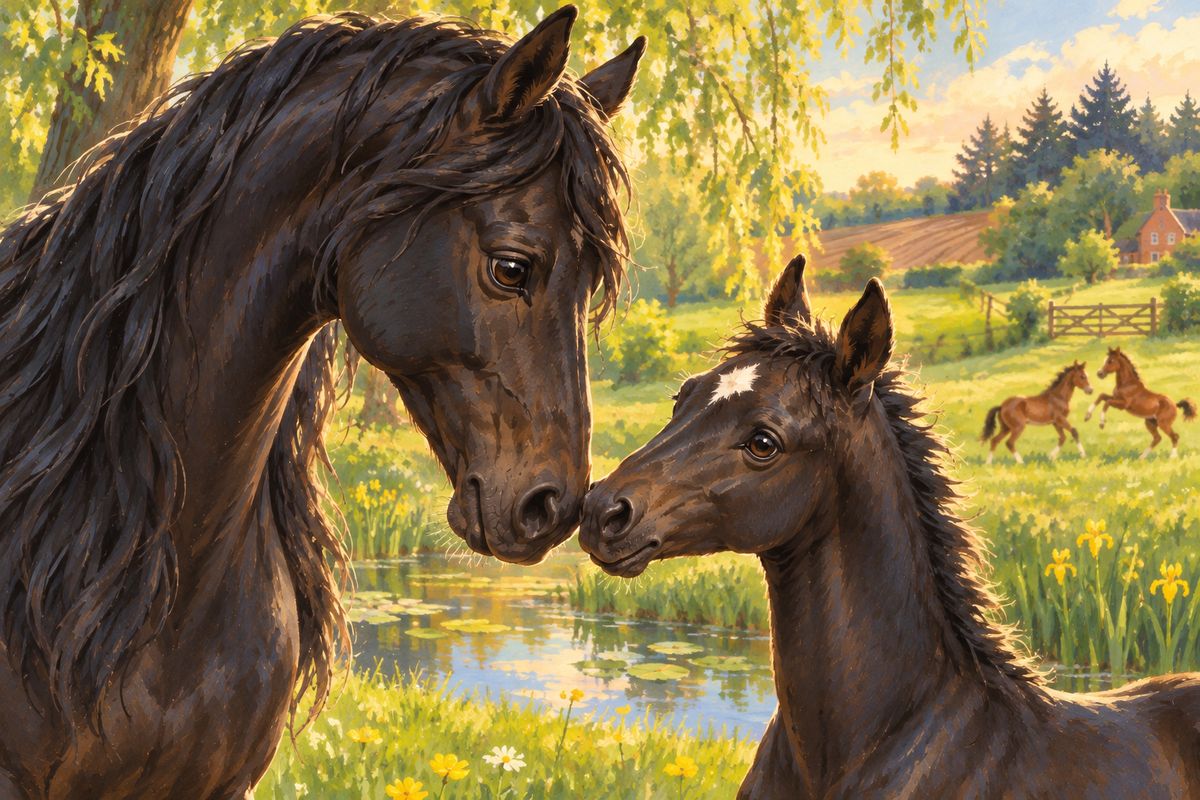
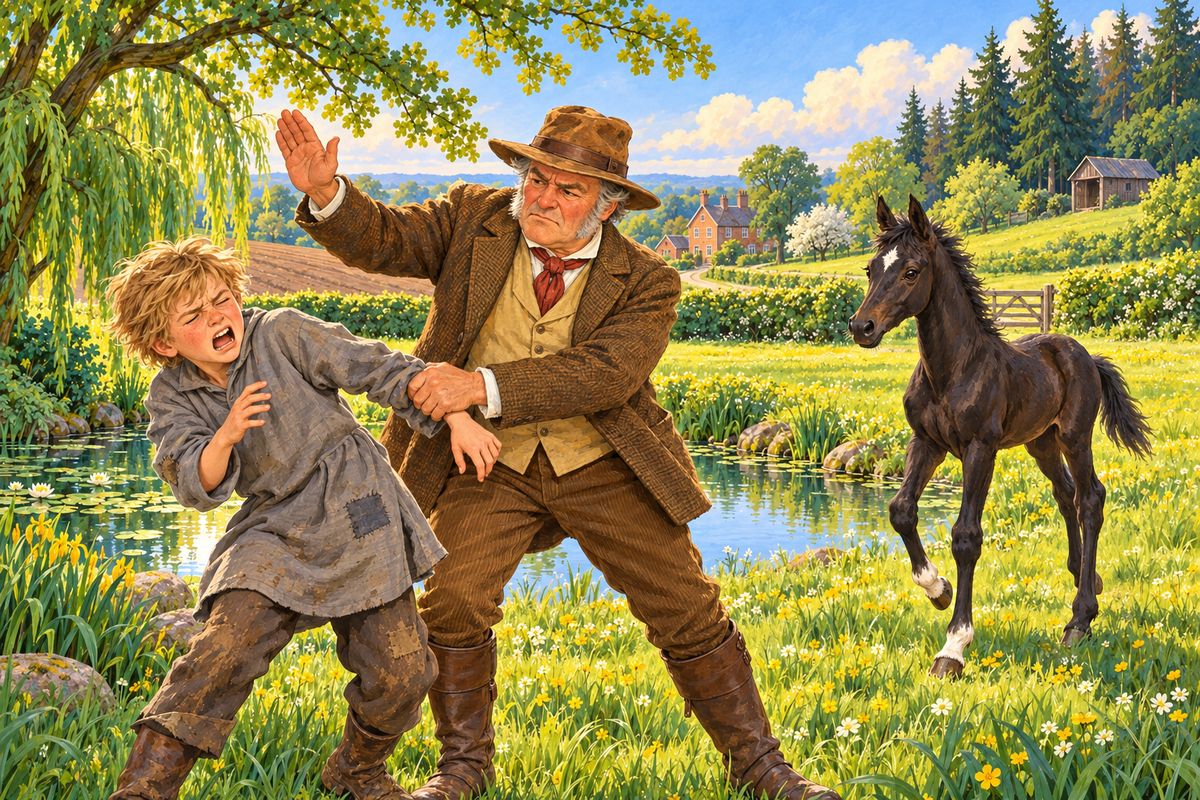
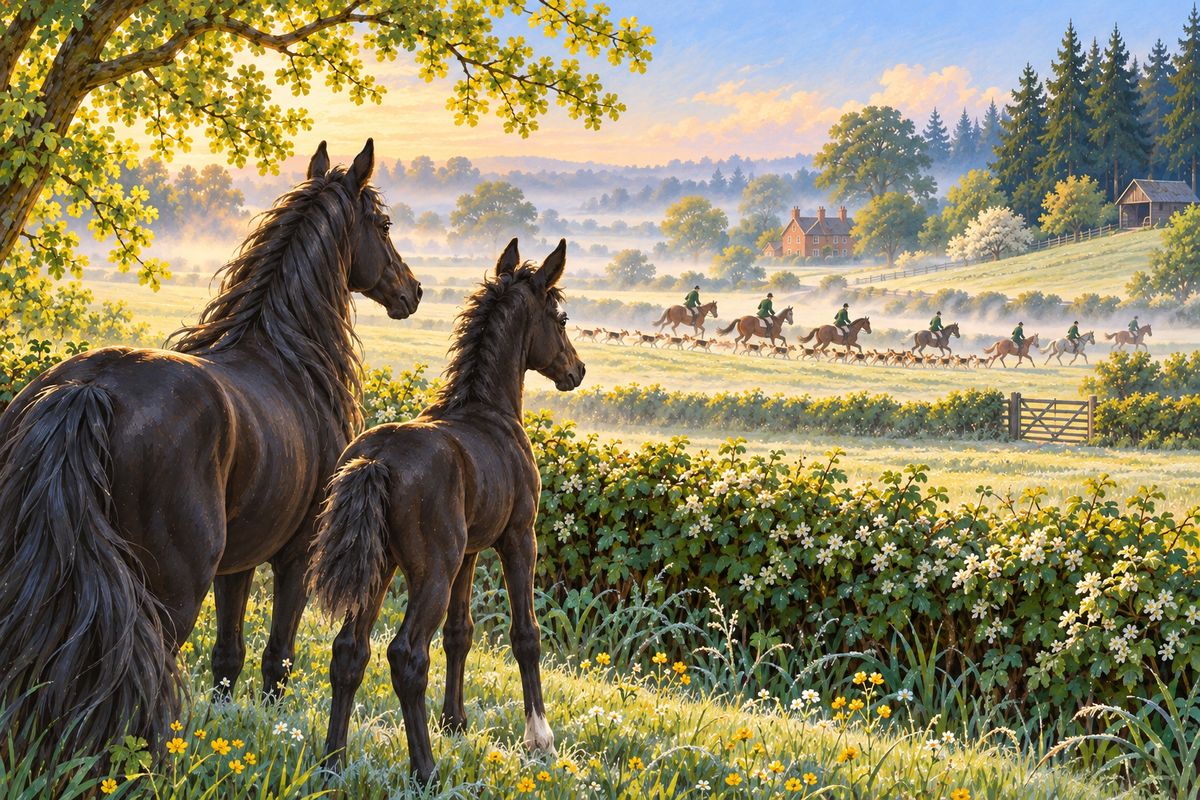
1The first place I can remember was a large, pleasant meadow with a clear pond, shady trees and a running brook at the bottom. In the daytime I ran beside my mother, Duchess, and at night I lay down close by her. Our master called me Darkie, for I was a dull black.2Six older cart-colts shared the meadow, and our galloping games often turned to biting and kicking. One day my mother called me aside. “You have been well-bred and well-born,” she said. “I hope you will grow up gentle and good, and never bite or kick even in play.” I have never forgotten her advice.3Our master was a kind man who brought me bread and my mother carrots, and old Daniel the groom was just as gentle. But when Dick the plowboy threw stones to make us gallop, the master leaped the hedge and boxed his ear. “Bad boy! to chase the colts,” he said, and sent him away for good.4Early one misty spring morning, before I was two, we heard hounds and ran to the top of the meadow to watch. Huntsmen in green coats galloped behind the dogs across the young wheat. A hare wild with fright raced for the woods, but the dogs caught her by the fence; we heard one shriek, and that was the end of her.5Then I saw a sad sight by the brook: two fine horses were down, and one rider lay quite still. It was young George Gordon, the squire's only son, and his neck was broken. My mother would not blame him. “I never yet could make out why men are so fond of this sport,” she said quietly.6I saw Rob Roy lying with a broken leg; a gun was fetched, there was a loud bang, and the black horse moved no more. Not many days after, the church bell tolled as black coaches carried young Gordon to the churchyard. All that sorrow had begun with one little hare.7By the time I was four, I had grown handsome, with a bright black coat, one white foot and a white star. Squire Gordon came to look me over, feeling my legs and watching me trot. "When he has been well broken in he will do very well," he said, and my master, Farmer Grey, decided to break me in himself.8The next day my training began. With oats, pats and great patience, my master coaxed the hated cold steel bit into my mouth and the saddle onto my back. Then one morning he rode me round the meadow on the soft grass; it felt queer, but I was proud to carry him. Later, at the forge, I stood quietly on three legs while the smith nailed on my iron shoes.9Next came collar, blinkers and the hated crupper, then two weeks in a farmer's meadow beside the railway. When the first train rushed past in a roar of smoke and clatter, I bolted to the far side of the field, snorting with fear. But the cows hardly lifted their heads, and soon I cared no more about trains than they did.10Soon my master often drove me in double harness beside my mother, Duchess, who taught me to go steadily. She told me there were good men, cruel men and careless men, and that a horse never knew who might buy him. "But still I say, do your best wherever it is," she told me, "and keep up your good name."11Early in May, when my coat shone like a rook's wing, a man came from Squire Gordon's to fetch me. "Good-by, Darkie; be a good horse, and always do your best," said my master. I could not say good-by, so I put my nose into his hand, and then I left my first home.12At Birtwick Park I was put into a large loose box, clean, sweet and airy. Next door a fat grey pony said, "My name is Merrylegs. I am very handsome." Beyond him a tall chestnut mare, Ginger, glared at me with her ears laid back, for I had taken her box. Later, Merrylegs explained that Ginger bit because no one had ever been kind to her.13John Manly fitted my bridle and saddle with care and rode me over the common in a splendid gallop; neither a basket cart nor a gunshot frightened me. Next day the Squire rode me home to the hall, where Mrs Gordon admired my sweet face. "What do you say to calling him Black Beauty?" she asked, and so it was.14Overhearing John and James, I learned that Rob Roy, killed at the hunt, had been my own brother; now I understood my mother's grief. Yet Birtwick was a happy home. On fine summer Sundays we horses were turned out in the old orchard to gallop, roll and nibble sweet grass, then talk together under the great chestnut tree.15One day in the shade, Ginger told me her story. She had been taken from her mother as soon as she was weaned, stoned by passing boys and forced into a halter, then broken in by Samson, Mr Ryder's hard son. When his whip and spurs grew cruel, she fought until she threw him, then stood alone all day in the hot, bare field.16Ginger told me that at sunset old Mr Ryder came quietly with a sieve of oats, calling, 'Come along, lassie,' and his kind voice took away her fear. He sponged her sore sides himself and told his son, 'A bad-tempered man will never make a good-tempered horse.' After that, steady Job finished her training.17Ginger told me that she was sold to a fashionable London gentleman and driven with a tight check-rein and a sharp bit until her mouth bled, and at last she kicked herself free of the harness. She passed through Tattersall's and several dealers and masters before she came to Birtwick. There I watched John's 'Birtwick balls' (patience, gentleness, firmness and common sense) slowly make her gentle.18In the orchard Merrylegs boasted to me that he had pitched the vicar's boys off when their hazel switches got too hard, yet he would never kick: 'Good places make good horses.' Old Sir Oliver showed me his stump of a tail. It had been cut off for fashion when he was young, so he could never whisk away the flies again.19One morning by the park gates, I saw Sawyer the builder wrench and lash his little bay pony for turning toward us. My master rode me straight up to him. 'Is that pony made of flesh and blood?' he demanded, and he told Sawyer that such brutal passion hurt his own character as much as it hurt his horse.20One windy autumn day my master drove to town on business in the light dog-cart, with John beside him and me between the shafts. At the toll-bar by the low wooden bridge, the gatekeeper looked at the swollen river and shook his head. "It's rising fast, sir. I fear it'll be a bad night."21My master's business kept us late, and by the time we turned for home the gale was howling through the wood. "It would be rather awkward if one of these branches came down upon us," said John. The words were scarcely out of his mouth when a great oak cracked, tore up by its roots, and crashed across the road just ahead of me.22We went six miles round and reached the bridge almost in the dark. The moment my hoofs touched it I stopped dead, and not even the whip would move me. John was trying to lead me on when the toll-keeper on the far side ran out waving a torch. "Stop! The bridge is broken in the middle, and part of it is carried away!"23On the quiet road home I heard my master and John agree that if I had gone on, we would all have drowned. At the hall the mistress ran out to meet us, crying, "Are you really safe, my dear?" That night John gave me a warm bran mash, crushed beans with my oats, and a thick bed of straw, and I was glad of it, for I was tired.24One December morning I heard my master read John a letter: Sir Clifford Williams wanted a trusty young groom, and John praised James so warmly that the place was his. For weeks James drove Ginger and me everywhere, even over the crowded, narrow bridge by the railway station, until his hand was light and sure.25Soon after, James drove my master and mistress on a long journey to visit friends, and at sunset we stopped at a big inn, where a quick little old hostler rubbed us horses down. Later a young man, Dick Towler, lounged in and climbed up to the hay loft with his pipe still in his mouth.26In the night I woke to thick, choking smoke and a crackling roar overhead. We horses stood frozen with fear and would not follow the frightened hostler. Then came James, quiet and cheery: "Come, Beauty, on with your bridle, my boy." He tied his scarf lightly over my eyes and led me out.27Out in the yard I gave a shrill whinny as James darted back inside, and Ginger later told me that hearing me gave her the courage to come. While the master shouted James's name, James came out of the smoke leading her, coughing too hard to speak, just as the fire-engine thundered in. Everyone later blamed Dick Towler's pipe.28Back home, I met little Joe Green, fourteen and a half, who came to learn the work. I heard that John, who had once been helped by kind masters with his orphaned sister Nelly, gladly took him on. James taught Joe on Merrylegs before leaving for Clifford Hall. "You have been my best friend except my mother," he told John.29A few nights after James had gone, the stable bell rang loud in the dark. "Ride for your life—that is, for your mistress' life," said the squire. Through the park, the village and the toll-gate John galloped me, and I needed no whip or spur. On we went under a frosty moon, through a dark wood, eight miles to the town.30The church clock struck three as we drew up at Dr White's door. The doctor's own horses were worn out, so he took me instead. He was heavier than John and not so good a rider, but I did my very best and carried him home in time. The mistress was saved.31Joe Green led me in, dripping and steaming like a pot on the fire. Young Joe did the best he knew: he rubbed my legs, but he left off the warm cloth and gave me a pailful of icy water. Soon I shook and turned deadly cold, aching all over, until John came home and covered me with warm cloths.32I fell very ill with inflammation of the lungs, and Mr Bond even bled me. John nursed me night and day. One night, by lantern light, I heard Thomas beg him to speak kindly to Joe. "Only ignorance! It is the worst thing in the world, next to wickedness," John said, but he promised a good word for the boy.33Weeks later, when I was well, I heard how Joe had found a drunken carter flogging two horses whose cart was stuck in the mud. The carter would not stop, so Joe galloped off to fetch Mr Clay, the brick-maker. Joe gave his evidence so clearly before the squire that the carter was sent for trial. John laughed that Joe had grown an inch taller that week.34After three happy years, sad news came to us: the mistress was ill and must go to a warm country at once. Miss Jessie and Flora came to say good-by and hugged Merrylegs like an old friend. I learned he was going to the vicar, with Joe to care for him, on condition he was never sold. Ginger and I were sold to the Earl of W——.35On the last sad day, Ginger and I brought the carriage to the hall door for the final time. I had heard that John turned down other good places, hoping to train young horses. Master came down the steps carrying the mistress in his arms and set her gently in the carriage while the house servants stood round crying. "Drive on, John."36At the station I heard the mistress say softly, "Good-by, John. God bless you." Poor Joe stood close to our heads to hide his tears as the train glided away in clouds of white smoke. "We shall never see her again," said John, and drove us slowly home. But it was not our home now.37John Manly rode me and Ginger fifteen miles to Earlshall Park. I heard him tell York, the Earl's coachman, that I had a perfect temper, but that the chestnut mare might give 'tit for tat' if ill-used, and that neither of us had worn a check-rein. 'My lady will have style,' York answered. John gave each of us a last sad pat and was gone.38Each afternoon the proud Countess came rustling down the steps. 'York, you must put those horses' heads higher; they are not fit to be seen.' Hole by hole our bearing reins were shortened, and up steep hills I had to pull with my head strapped high, the strain falling on my back and legs. I began to dread my harness.39One day she demanded that our heads go up at once. York strapped my head painfully tight, but when he unhooked Ginger's rein she reared, plunged and kicked, then fell over the carriage pole, striking me hard above the hock. York sat on her head until she was cut free.40Alone in my box, York let my head down and found my swollen leg. 'Confound these check-reins!' he muttered, but only in private. I learned that Lord W—— blamed him. Ginger was never harnessed again and went to a younger son for hunting, and I was sent back out to the carriage.41My new partner, Max, had always worn the tight rein. He told me a dealer once explained why: London buyers liked heads held high, and 'the horses soon wear up' and they bought another pair, which was good for trade. For four long months I foamed at the mouth, struggled to breathe and came home worn and low, with no friend to help me.42In spring Lady Anne chose me for her riding horse and called me Black Auster. One day she rode nervous Lizzie instead, while her cousin Blantyre rode me. At the doctor's gate, a frisky colt bumped Lizzie and a whip cracked. She kicked and bolted, and I, tied to the gate, neighed again and again for help.43Blantyre galloped me after them, and a road-mender pointed to the common. Lizzie had fallen at a new dike, but I cleared it in one great leap. Lady Anne lay white and still. A turf-cutter rode me to fetch the doctor and the carriage, and two days later Blantyre came to say she was out of danger: 'She ought never to ride any other horse.'44Reuben Smith was gentle, clever and the best man with horses at Earlshall, but he had a weakness for drink. After we took Colonel Blantyre to the station, he lingered at the White Lion with old friends. When the hostler pointed out a loose nail in my shoe, Smith waved him off. 'That will be all right till we get home.'45Long after nine, Smith galloped me out of town into the dark, slashing with his whip. My loose shoe flew off, and beyond the turnpike lay new, sharp stones. My bare hoof split, and I fell hard on both knees, throwing Smith. When the moon rose, he lay still, and I stood listening, remembering summer nights lying beside my mother in the meadow.46Near midnight I heard a familiar step and neighed; Ginger answered. Robert and Ned had come in the dog-cart because, as I learned, Susan was frightened. They found Reuben dead. With no one to hold her, Ginger stood still as stone while they lifted him into the cart, though she was usually so impatient. Then Robert bound my foot and led me slowly home, more than three miles.47The farrier's long, painful treatment healed my knees, but they stayed scarred forever. I heard that the inquest found Smith had been drunk, and I was cleared of all blame. Poor Susan kept crying, "It was all that cursed drink!" I learned that, with no home or family, she and her six little children had to leave the pretty cottage under the oaks for the gloomy workhouse.48I was turned out alone to rest until Ginger joined me, ruined, I learned, by Lord George's hard riding in a steeplechase. "You by a drunkard, and I by a fool," she said. We stood under the lime tree until the earl decided my knees meant I must go. Robert led me away, with Ginger calling along the hedge, and I went by train to a livery stable in Bath.49As a job horse, I was hired out to every kind of careless driver, the tight-rein men and the loose-rein men alike. One chattering driver let me pick up a sharp stone, then whipped me for 'shamming' lame, until a farmer on a brown cob stopped and prised it out. "It is a wonder he did not fall down," the farmer said.50Town drivers who drove a horse like a steam-engine wore me down, and at a blind corner a reckless gig drove its shaft into the chest of my partner Rory; I later heard he was sold for coal-carting. Then Mr Barry of Bath bought me, and I grew thin, because each morning his groom Filcher's boy carried off my oats in a covered basket. Finally the police caught the boy.51Mr Barry's next groom, the vain Alfred Smirk, left my stall so foul that my feet caught thrush, and I was sold at a horse fair. Broken-down horses stood in the background there, and gentlemen turned away from my scarred knees. Then a small grey-eyed man who smelled of fresh hay stroked my face. "Well, old chap, I think we should suit each other."52He paid twenty-four pounds ten and rode me to London, where gas lamps were already lit along mile after mile of streets. In a narrow side street he whistled, and his wife Polly ran out with Harry and Dolly to welcome us. "Is he gentle, father?" "As gentle as your own kitten," he said, and Dolly's little hand patted me all over.53In Jerry Barker's little yard, Polly brought me a slice of apple and Dolly a piece of bread, while old white Captain, once a cavalry horse, looked on from his stall. Jerry gave me the benefit of the doubt over my broken knees. "We'll call him Jack, after the old one," he said.54Jerry harnessed me with no check-rein and no curb, only a plain ring snaffle, and drove me to the big cab stand by the old church. The cabmen passed remarks until broad, gray-coated Governor Grant looked me over. "He's the right sort for you, Jerry," he grunted, and my character was settled on the stand.55Jerry kept his Sundays for rest, and on those quiet days old Captain told me his history. As a young dappled iron-gray, he had gone to the Crimean War with a kind young cavalry officer. He told me how he was hoisted in straps over the water onto a great ship and spent the voyage shut in a close, rolling stall without seeing the sky.56Captain told me of the last charge across a valley toward the enemy's cannon, when a ball struck his young master, who sank backward from the saddle as the rushing ranks swept Captain away. He never saw him again. When I said people called war a fine thing, the old horse answered, "I should think they never saw it."57Jerry would not race for careless fares, but when a young man, hurt by a fall, begged to catch the twelve o'clock Dover train, Jerry cried to me, "Spin along, Jack!" I wove past omnibuses and carts over London Bridge, and we reached the station at eight minutes to twelve. Jerry refused the extra half-crown, since the young man's gladness was pay enough.58Jerry turned down Mr Briggs's Sunday fares to keep his six-day license, and so we lost our best customer, but I heard Polly tell him, "Do your best, and leave the rest." Weeks later Mrs Briggs came back. Then one Sunday Polly begged Jerry to drive poor Dinah Brown, whose mother lay dying ten miles away.59Jerry borrowed the butcher's light trap, and I carried Dinah and her baby into the May countryside. While her family sat with their sick mother, I was turned loose in their meadow, where I rolled, grazed and galloped like a young colt. Jerry gathered flowers and hawthorn by the brook, and back home Dolly jumped for joy at the posy.60That hard, wet winter, I often watched little Dolly dash across the busy street with hot soup for her father. One day a gentleman hailed our cab just as Jerry began eating. 'No, no, finish your soup, my friend,' said Mr Wright, and waited. I came to know him as a man who stood up for ill-used horses wherever he saw them.61Not every cabman owned his horse, as I learned on the rank. Seedy Sam, who hired his from Skinner, cried out that he worked sixteen hours a day and never had a Sunday off. A few days later I heard that he had died of fever. 'I never had a Sunday's rest' were his last words.62Waiting outside a park one day, I saw a worn-out chestnut mare reach for a wisp of my hay. 'Black Beauty, is that you?' It was Ginger, sold lower and lower until she pulled a cheap cab with no Sunday rest. I touched my nose to hers. 'You are the only friend I ever had,' she said.63Soon afterwards a cart rolled past our cab stand carrying a dead chestnut horse with a long, thin neck and a white streak down its face. I believed it was Ginger, and I hoped it was, for then her troubles were over.64Jerry would not hire out his cab for the election, and he kept Dolly home after rough boys spattered her over party colours. On election day a lost country mother came by with a sick little boy. Jerry and I took them to the hospital for nothing: 'I'd be ashamed of myself to let a woman and a sick child run a risk like that.'65Later a drunken drayman lashed his horses into a gallop and smashed into Jerry's cab. My companion Captain was dragged down and badly hurt. Rather than sell his old friend into misery, Jerry chose a merciful end, and soon Captain was gone. In his place came Hotspur, a young brown horse who, I learned, had been ruined for a lord's stable by a cruel curb.66Hotspur soon settled in, gentle with an easy bit. On New Year's Eve Jerry waited with me in driving sleet until past one in the morning. Home at last, coughing and barely able to speak, he still rubbed me down and fetched me an extra bundle of straw before going in.67Jerry fell dangerously ill, and I learned that Governor Grant worked Hotspur to help the family. Jerry recovered but had to give up cab work; Polly's old mistress offered them a cottage and a coachman's place in the country, so we horses were sold. 'Poor old Jack! dear old Jack!' said Polly, kissing my neck, while Dolly cried and Harry stroked me in silence.68I was sold to a baker, whose hurrying foreman overloaded me, and his carter, Jakes, kept my check-rein tight. On a steep hill, as the whip came down, a kind lady persuaded Jakes to take the rein quite off. 'He cannot use all his power with his head held back,' she said. Given my head, I threw my weight into the collar and pulled the load steadily up.69A dark stable nearly ruined my eyes, and I was sold to Nicholas Skinner, whose cab-horses had no Sunday rest and whose drivers carried cruel whips. One hot day at the station a young girl named Grace saw how worn I was. 'Papa, papa, do take a second cab,' she begged, but her father ordered her in, and box after box was piled on.70With no food or rest since morning, I struggled as far as Ludgate Hill, and then my feet slipped and I fell heavily on my side. Strangers loosened my harness, threw cold water over my head and gave me cordial, until at last I staggered up. A farrier said only overwork was to blame, so Skinner fed me for ten days and sent me to the sale.71At the horse fair, where I stood among lame and broken-down horses, Farmer Thoroughgood and his grandson Willie stopped. 'Could not you buy him and make him young again as you did with Ladybird?' Willie begged. The farmer paid five pounds for me, and all winter I, Willie's 'Old Crony', rested in a quiet meadow, until by spring my legs were strong again.72That summer the three Blomefield sisters took me on trial. Next morning their young groom, cleaning my face, found my white star, my white foot and the little patch of white hair on my back that John called 'Beauty's three-penny bit'. It was Joe Green, now a grown man. 'It must be Black Beauty! Why, Beauty! Beauty! do you know me?'73The ladies kept me and gave me back my old name, Black Beauty, and Joe was the kindest of grooms. They promised I would never be sold. My troubles were over, and I was at home; and often, before I was quite awake, I fancied myself back in the orchard at Birtwick, under the apple-trees with my old friends.
Adapted from Black Beauty by Anna Sewell, public domain. Pictures are AI illustrations drawn for this edition.
Add Stories to your Home Screen: tap
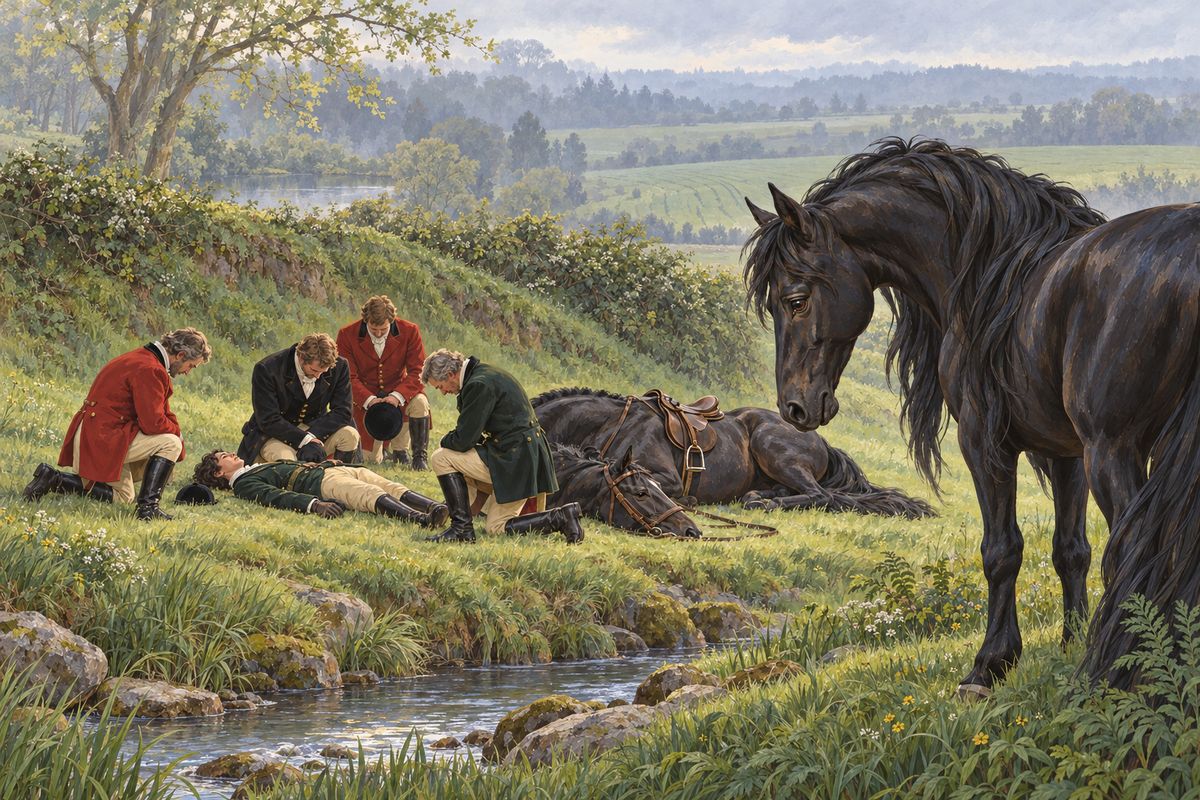
then Add to Home Screen.